Mil GM-1 / Mi-1 / Mi-3 / PZL Swidnik SM-1 / SM-2

Mikhail Mil was a contemporary of Nikolai Kamov at the TsAGI (Central Aero and Hydrodynamic Institute) during the 1930s, was given charge of his own design bureau in 1947 and became responsible for the first Soviet helicopter to go into quantity production. The GM-1 / Mi-1.

Mil GM-1 / Mi-1 / Mi-3 Article

Designed to meet a requirement for a three seat communications machine which was issued in late 1947 and originally designated GM-1 (Gelikopter Mil, or Mil helicopter), the Mi-1 first of three prototypes was completed and flown in September 1948 piloted by M.K. Baikalov (ex-Bratukhin).
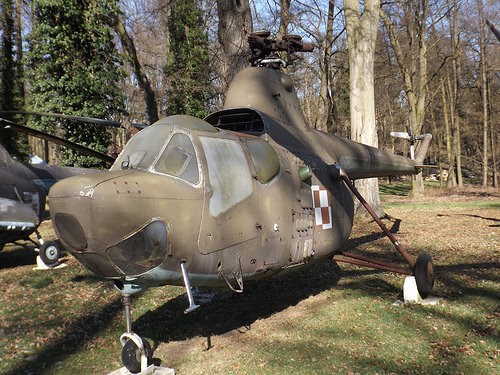
1105 PZL-Swidnik SM-1 Sz 01105

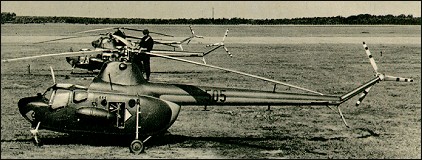
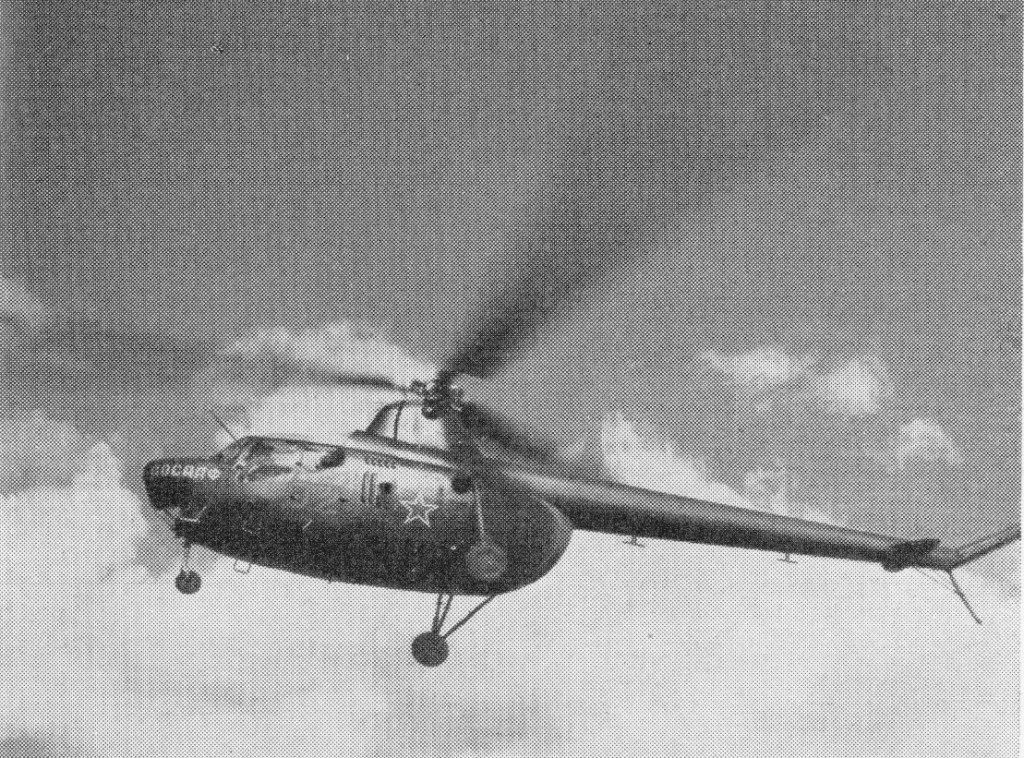
The Mi-1 was a compact machine with a fully-enclosed metal-skinned fuselage. Fuselage light alloy, except for welded steel tube basis of mid-section housing engine with crankshaft horizontal and cooling fan, driving through angle box to transmission with centrifugal clutch and rotor brake. Four-seat cabin with left/right hinged doors. Fuel in welded aluminium tank 240 lit behind engine and, from about 40th production, provision for external supplementary tank of 160 lit on left side. Monocoque tail boom and pylon for tail rotor with three wooden blades. A 2.5m shaft runs from the gearbox to the tail rotor. Fixed nosewheel-type landing gear with brakes, plus long rear skid to protect tail rotor. Three-blade main rotor, blades based on A-15 and related autogyros, mixed steel/ply/fabric NACA-230 profile, fully articulated hub with friction dampers, normal speed 232 rpm. The powerplant was an Ivcheriko AI 26V radial engine driving a three bladed rotor and producing 575 hp at takeoff. Like Soviet equipment during World War II, the Mi-1 is designed to operate at very low temperatures and has anti-freeze sprays for not only the rotors but also the windscreen.

Both the first two GM-1 were lost, the second killing Baikalov after a weld failure in the tail-rotor bearing. Project taken over by Mark Gallai and V.V.Vinitskii, followed in summer 1949 by NII testing by G.A.Tinyakov and S.G.Brovtsyev. The Mi-1 reached a height of 6800m and speed of 190.5km/h. Yak-100 delayed so production was authorized as Mi-1 and delivery of the production models began in 1951. The Mi-1 made its public debut when eight took part at the Tushino Air Display in 1951, by which time it was already in production and service with the Soviet armed forces. The four seat Mi 1 was ordered into production in September 1949. NATO code name ‘Hare’.

Subsequent production of the Mi-1, both in the Soviet Union and in Poland, has been extensive. Polish production began with the standard Mi-1 late in 1955, this being built at the WSK works at Swidnik under the designation SM-1 with a licence-built version of the AI-26V engine.

Once military requirements had been met by a production run of several hundred, the Mi-1 was also widely adopted for a great variety of civil tasks, such as air ambulance duties, fish-spotting or whaling, ice patrol in polar regions, highway patrol and for carrying mail.
Mi-1

From about the 40th, the Mi-1M was produced with a 0.32m adjustable stabilizer (tailplane).

From 1957 new blades with extruded steel-tube spar. By this time the basic model was the Mi-1T, which carries only 2 passengers plus radio and fluid de-icing, the 1950 Mi-1MU which is a dual-control trainer and the 1956 Mi-1NKh (Narodnoye Khozyaistvo), a utility model for such duties as freight and mail carriage, ambulance and agricultural operations. In an agricultural role it can be fitted with spraying bars and two 250-litre tanks, carrying 400kg at the sides of the fuselage.

In 1961, the Mi-1 Moskvich passenger version was developed for Aeroflot, with an all-metal rotor of almost untapered plan, hydraulic controls, better cabin soundproofing and night flying or all-weather instrumentation. The name was dropped and the improvements were mostly standardized.

Mil produced an ambulance version, the patients carried on stretchers in streamlined pods on either side of the fuselage. Pipes connected the pods to the fuselage to allow the temperature to be controlled.

The final production run was the Mi-1T, a three-seater with different operational equipment.

In 1956, a prototype (identified in the West as Mi-3) was also evaluated. This had a four-blade rotor, wider cabin, and various other external modifications, such as two lateral stretcher panniers, but it did not enter production.

Several of the Mi-1’s supplied to foreign air forces were Polish-built, and subsequent versions included the SM-1W (pilot and 3 passengers), SM-1WS (2-stretcher ambulance), SM-1WZ (agricultural) and SM-1WSZ (dual-control trainer). Production of the Mi-1/SM-1 is thought to have been phased out around 1963 in favour of the later turbine-powered developments.
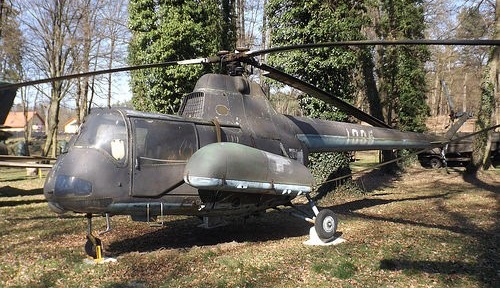
1005 PZL-Swidnik SM-2 S2-01005

The PZL Swidnik SM-2, Polish development of the basic design was flown late in 1959. This has a longer nose, enlarging the cabin to accommodate 4 passengers in addition to the pilot. In the ambulance role, the SM-2 can take a third stretcher inside the cabin in addition to the two carried on external panniers. Production of the SM-2 was initiated in 1961 to fulfil both military and civil orders.
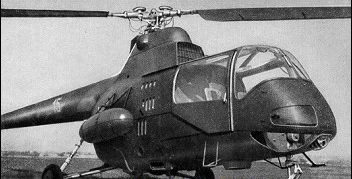
PZL Swidnik SM-2

Other variants include the Mi-1MRK reconnaissance and fire adjusting helicopter of 1960, Mi-1MG (Mi-1G) helicopter with float-type gear, SM-1/300 experimental helicopter with additional wing of 1971, and Mi-1M experimental helicopter with additional servo-tab of 1959.

The first armed Mi-1MU helicopter had TRS-132 rocket pods in 1958, and 4 Falanga anti-tank guided missiles in 1961.
In addition to those built for the Soviet armed forces, military Mi-1’s have also been supplied to the DOSAAF and the air forces of Albania, Afghanistan, Cuba, Czechoslovakia, Finland, Iraq, Poland, Syria, the United Arab Republic and the Yemen. A wide range of duties has included those of observation, liaison, rescue, ambulance and training.

Production of the Mi-1 ended in 1961 in the Soviet Union and in 1965 in Poland.

Developed from the Mi-1, the Mi-3 has a four blade main rotor and other modifications.
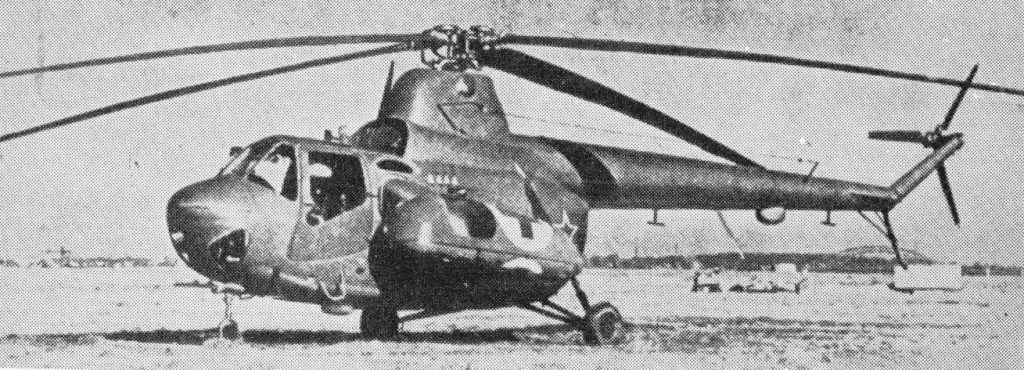
Mi-3

Gallery

Mi-1
Engine: 1 x Rybinsk AI-26V piston, 432kW
Main rotor diameter: 14.35m
Length without rotors: 12.05m
Height: 3.28m
Max take-off weight: 2550kg
Empty weight: 1900kg
Max speed: 190km/h
Cruising speed: 140km/h
Service ceiling: 4000m
Hovering ceiling: 2000m
Range: 360km
Payload: 500kg
Crew: 1
Passengers: 2

Mil Mi 1
Engine: Ivchenko AL-25 V, 424 hp
Length: 39.698 ft / 12.1 m
Height: 10.827 ft / 3.3 m
Rotor diameter: 46.916 ft / 14.3 m
Max take off weight: 5622.8 lb / 2550.0 kg
Weight empty: 3880.8 lb / 1760.0 kg
Max. speed: 111 kts / 205 km/h
Cruising speed: 76 kts / 140 km/h
Initial climb rate: 1377.95 ft/min / 7.00 m/s
Service ceiling: 18045 ft / 5500 m
Range: 319 nm / 590 km
Crew: 1+2

Mi-1NKh
Utility freight / ambulance / mail / agricultural version
Engine: Ivchenko Al-26V, 575 hp
Main rotor diameter: 46 ft 11 in / 14.30 m
Length overall: 43 ft 6 in / 13.26 m
Fuselage length: 39 ft 4.75 in / 12.01 m
Empty weight: 3964 lb / 1798 kg
MTOW: 4960 lb / 2250 kg
Mas speed SL: 102 kt / 118 mph / 190 kph
Econ cruise: 76 kt / 87 mph / 140 kph
Service ceiling: 9850 ft / 3000 m
Range max fuel: 205 nm / 236 mi / 380 km
Range 330 lb / 150 kg payload: 188 nm / 217 mi / 350 km
Crew: 1
Passengers: 5
External hopper capacity: 770 lb / 400 kg

Mi-1T
Seats: 3

Mi-1U
Dual control

Mi-1 Moskvich
Aeroflot version
Hydraulic controls

SM-1W
Crew: 1
Passengers: 3

SM-1WS
Ambulance version

SM-1WZ
Agricultural version

SM-1WSZ
Dual control trainer

PZL Swidnik SM-2
Engine: 1 x Lit-3, 425kW
Main rotor diameter: 14.3m
Length: 17.0m
Height: 3.1m
Max take-off weight: 2550kg
Empty weight: 1934kg
Max speed: 170km/h
Cruising speed: 130km/h
Ceiling: 3700m
Range with max fuel: 550km

Mi-1
PZL Swidnik SM-2

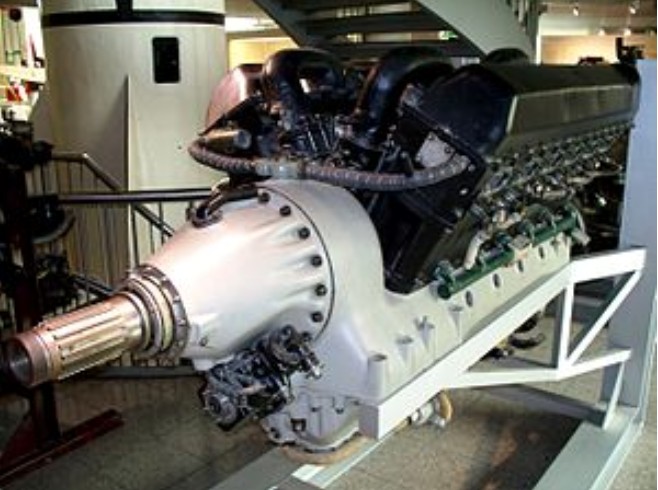
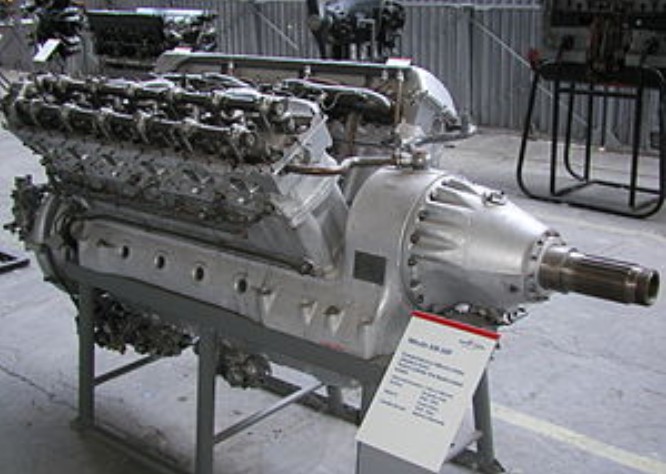
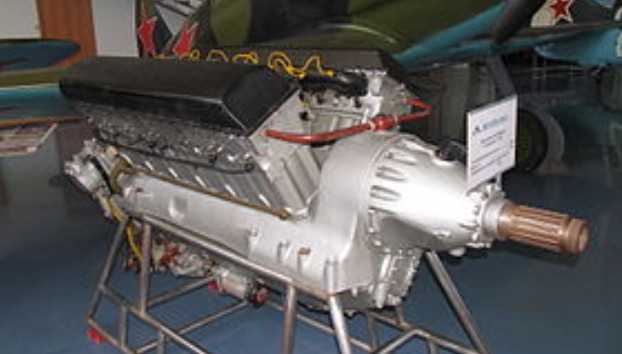
Mikulin AM-42

The Mikulin AM-42 was a liquid-cooled V-12 aircraft engine designed by Alexander Mikulin.

First run in November 1942, approximately 10,232 were built.

Representing a high-output version of the AM-38F, the AM-42 was used in the Ilyushin Il-1 fighter, and the Il-8 and Il-10 ground attack aircraft.

AM-42
Type: 12-cylinder 60° Vee aircraft piston engine
Bore: 160 mm (6.30 in)
Stroke: 190 mm (7.48 in)
Displacement: 46.66 L (2,847 in³)
Dry weight: 996 kg (2,195 lb)
Cooling system: Liquid-cooled
Power output: 1,490 kW (2,000 hp) at 2,500 rpm
Specific power: 31.9 kW/L (0.70 hp/in³)
Compression ratio: 5.5:1
Power-to-weight ratio: 1.50 kW/kg (0.91 hp/lb)

Mikulin AM-38

Mikulin AM-38F

The Mikulin AM-38 was a Soviet liquid-cooled V-12 aircraft engine first run in 1941. It was a further development of the Mikulin AM-35 design. The AM-38 was used on the Il-2 Shturmovik and Il-10 ground attack aircraft. The engine may also have been installed in MiG-3 aircraft, as a field modification, to improve the speed and performance

Approximately 36,163 were built.

Variants:
AM-38F
Low-altitude version with greater takeoff power and a 10 minute forsazh (war emergency power) mode.

Applications:
Ilyushin Il-2
Ilyushin Il-10

Specifications:
AM-38F
Type: 12-cylinder 60 deg Vee aircraft piston engine
Bore: 160mm (6.30 in)
Stroke: 190mm/196.7mm (7.48 in/7.744 in)
Displacement: 46.66 L (2,847 cu.in)
Dry weight: 880 kg (1,940 lb)
Supercharger: Single speed centrifugal
Cooling system: Liquid-cooled
Power output: 1,270 kW (1,700 hp) at 2,350 rpm
Specific power: 27.2 kW/L (0.60 hp/in³)
Compression ratio: 6.0:1
Power-to-weight ratio: 1.53 kW/kg (0.93 hp/lb)

Mikulin AM-37

Design work on a development of the liquid-cooled, V12 AM-35 with boosted supercharging and an intercooler positioned behind the supercharger began on the factory’s initiative in December 1939. A batch of ten prototypes was completed in 1940 and bench-testing began on 5 January 1941. It passed its State acceptance trials the following April and was approved for production. It was tested in a variety of aircraft, but proved to be unreliable and prone to overheating. Factory No. 24 in Moscow built only twenty-nine AM-37s, as the new engine was designated, in 1941 before the German advance forced the factory to evacuate in October. Mikulin had been unable to resolve the issues with the AM-37 in the meantime and production was not resumed.

Variants:

AM-37A
Planned version to be tested in February 1940, but no information if it was tested or it was even completed. 1,600 hp (1,200 kW) and a weight of 850 kg (1,870 lb).

AM-37TK
TK for toorbokompressor. Planned version with a turbocharger.

AM-37P
P for Pushechnyy or cannon. A 1940 project for a model with an autocannon mounted in the space between the cylinders, firing through a hollow reduction-gear shaft.

Am-37u/v or AM-37UV
UV for udlinyonniy val or lengthened shaft. An engine with a lengthened shaft and remote gearing for use in the Gudkov G-1 fighter that carried the engine behind the pilot. Ordered developed in 1940 and design work started in 1941, but it was not completed.

Applications:
Mikoyan-Gurevich MiG-1
Mikoyan-Gurevich MiG-3
Mikoyan-Gurevich DIS
Polikarpov TIS
Tupolev Tu-2
Yermolaev Yer-2

Specifications:
Type: supercharged, liquid-cooled, V12 engine
Bore: 160 mm (6.3 in)
Stroke: 190 mm (7.5 in)
Displacement: 46.66 l (2 in)
Dry weight: 885 kg (1,951 lb)
Designer: Alexander Mikulin
Supercharger: single-speed geared centrifugal supercharger
Cooling system: liquid-cooled
Power output: 1,500 hp (1,119 kW)
Compression ratio: 7.0:1
Power-to-weight ratio: 0.77 hp/lb (1.26 kW/kg)

Mikulin AM-35

The Mikulin AM-35 was a liquid-cooled V-12 piston aircraft engine. Derived from the AM-34FRN, the AM-35 first ran in October 1939, entered production in 1940 and was used on the MiG-1 and MiG-3 World War II fighters as well as the Petlyakov Pe-8 heavy bomber. The engine was very similar to the AM-38F of the Ilyushin Il-2, and built in the same plant (Kuybyshev, in late 1941). It was for this fact that Mikulin was forced to focus production on the AM-38F, thus discontinuing construction of the AM-35.

Applications:
Ilyushin Il-2
MiG-1
MiG-3
Petlyakov Pe-8

Specifications:
AM-35A
Type: Piston V12 engine with 60 deg angle
Bore: 160mm (6.3 in)
Stroke: 190mm/196.7mm (7.48 in/7.744 in)
Displacement: 46.66 L (2,847 cu.in)
Length: 2,402 mm (94.5 in)
Width: 866 mm (34.1 in)
Height: 1,089 mm (42.9 in)
Dry weight: 830 kg (1,830 lb)
Supercharger: Two-speed centrifugal type supercharger M-100 with aftercooler
Cooling system: Liquid-cooled
Power output: 993 kW (1,350 hp) at 2,050 rpm
Specific power: 21.6 kW/L (0.47 hp/cu.in)
Compression ratio: 7.0:1
Specific fuel consumption: 0.46 kg/km (1.64 lb/mile) calculated, 0.38 kg/km (1.35 lb/mile) observed.
Power-to-weight ratio: 1.21 kW/kg (0.74 hp/lb)

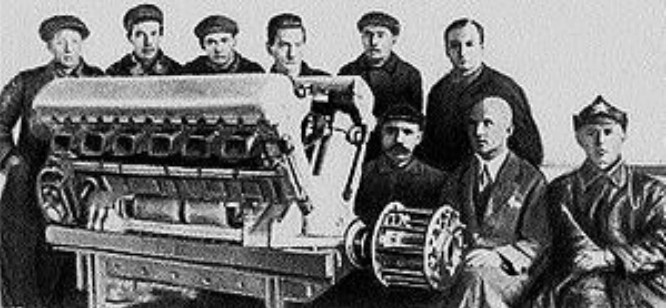
Mikulin M-34 / AM-34

Mikulin M-34

The M-34 began development in 1928 as a replacement for the Mikulin M-17, a license-built copy of the BMW VI. It had similar dimensions and attachment points, but was otherwise an entirely new design. It was a direct-drive, block-type engine with the cylinder block connected by long internal studs with centrally-coupled connecting rods. The development process was prolonged with the engineering drawings not completed until April 1931. The Soviet Union’s first indigenous, mass-produced, liquid-cooled, aircraft engine, the first engine was delivered to TsIAM (Tsentralniy Institut Aviatsionnogo Motorostroeniya, Russian: Центральный Институт Авиационного Моторостроения) on 21 September 1931 for bench testing with imported carburetors and magnetos. It began State testing in November 1931, but failed. It was submitted again a year later with Soviet-designed K-34 carburetors, but was again rejected. It was resubmitted in January 1933, but again failed. It was flight-tested in a Tupolev TB-3 in October 1933.

Despite these failures it began production in 1932 at Factory No. 24 in Moscow and 64 engines had been delivered by the end of the year. 790 were built the following year and it was exhibited in Paris as an achievement of the Soviet aviation industry. The M-34 was redesignated with Alexsander Mikulin’s initials as the AM-34 on 9 August 1936 in honor of his achievement.

The M-34 was used in an unusual system, first tried by Imperial Germany in 1918 with a Zeppelin-Staaken R.VI, that used an external supercharger to supply pressurized air to the aircraft’s M-34FRN engines. The first installation, designated ATsN-1 (Agregat tsentral’novo nadduva – central boosting unit), used an auxiliary M-34 fitted inside the fuselage to drive a central supercharger with ducts leading to the engines in the wings. This was flight-tested in a Tupolev TB-3 in 1935. It was adapted for use in a Petlyakov Pe-8 bomber prototype with a smaller Klimov M-100 engine substituted for the M-34 as the ATsN-2. It was flight-tested during 1938–39, but was not approved for production. The same idea was revived in 1943 by Nazi Germany with the Henschel Hs 130E bomber prototype series, with the Höhen-Zentrale Anlage unit.

The AM-34FRN and subsequent models used articulated connecting rods which increased the stroke to 196.7 mm (7.74 in) and increased the displacement to 46.66 L (2,847 cu.in). Combined with a number of other changes power significantly increased in most models to 1,200 horsepower (890 kW).

Development of a version for motor torpedo boats began in 1932 as the GM-34, but it did not pass its State tests until December 1934, although it was put into production that same year. It was given a reversing gear, a free-wheel sleeve and its cooling and exhaust systems were modified. Production continued through 1943 with the GM-34s adapting features from the aviation models. With the exception of the GAM-34BP and the original GM-34 all maritime engines used a benzene-alcohol fuel mixture.

A version of the GM-34 was adapted for use in heavy tanks in 1939 as the GAM-34BT, although only small numbers were built. It was mounted in the prototypes of the T-100 and SMK heavy tanks and the SU-100y self-propelled gun, none of which were put into production. The cooling system was modified with an external fan and it was given new gearing. An electric starter was used rather than the original pneumatic one. It was rated at 850 hp (630 kW).

Produced between 1934–43, 10,538 were built.

Aviation Variants:
M-34
First production version. Direct drive. Early engines used imported Zenith 90R carburetors, although later ones used indigenous K-34 carburetors. In production until the end of 1939. Rated at 800 hp (600 kW) with a weight of 680 kg (1,500 lb).

Coupled M-34
Two engines driving one propeller, project for the Kalinin K-7, no production.

M-34F
small batch built in 1933 with a rating at 830 hp (620 kW).

M-34R
R for Reduktor or reduction gear. Rated at 800 hp (600 kW) with a weight of 670 kg (1,480 lb). Passed its State trials in May 1933 and in production from the end of that year to the end of 1939.

M-34RD
D for Dal’niy or long-range. Ten engines built with special attention to quality, smaller tolerances and K-34RD carburetors to equip the Tupolev ANT-25 record-breaking aircraft. RPMs were boosted to give a power of 830 hp. Later fifty more were built to power Tupolev TB-3 bombers converted to VIP transports.

M-34N
N for Nagnetatel’ or supercharged. Development began in 1931 of this direct-drive model, but the first two-stage supercharger design proved to be quite unreliable. A single-speed replacement was developed at TsIAM and tested in November 1933 and production began in September 1934. The centrifugal type supercharger was designed as a removable module and could be installed on other versions of the M-34. Rated at 820 hp (610 kW). A PTK steam-powered supercharger was developed and tested from 1938 to 1940, but was not accepted for production.

M-34RN
This geared model used the same geared centrifugal supercharger (GCS) as the M-34N and had the same rating. It failed State testing in September 1934 when the pistons burned through.

M-34NA
A version of the M-34N with minor changes to some components to extend service life. It had the same power as the original model.

M-34RA
A version of the M-34R with the same changes and power as the M-34NA.

M-34RNA
A version of the M-34RN with all the changes introduced on the NA and RA models. Same power as before, but weighed 748 kg (1,649 lb). Flight-tested on a TB-3 in May 1935 and production began at the end of the year.

M-34NB
The NA fitted with a strengthened crankcase, a lightened crankshaft with a modified nose and a refined supercharger. The power remained the same, but the weight dropped to 638 kg (1,407 lb). A TK-1 turbocharger was tested with the prototype on a Polikarpov R-Z in 1936.

M-34RNB
A geared equivalent of the NB model with a lightened reduction gear. The power remained the same, but the weight dropped to 725 kg (1,598 lb). In production from October 1935 until the end of 1939.

M-34P
P for Pushechniy or cannon. A version of the M-34RN adapted to mount an autocannon in the V between the cylinder banks that fired through a hollow gear shaft. The specification was issued in August 1934.

M-34NV
NV for Neposredstvenniy Vprysk or fuel-injected. It passed its bench tests in 1935 and was flight-tested in 1937, but was not accepted for production. Rated at 985 hp (735 kW).

M-34RNV
Geared version similar to the NV.

AM-34RNV-TK
Prototype built in 1938, similar to the RNV with the addition of a TK-1 turbocharger. Rated at 850 hp (630 kW) and an estimated weight of 810 kg (1,790 lb).

AM-34RS
Prototype built in 1938 with mixed cooling; air-cooled sleeves and ethylene glycol-cooled cylinder heads. Rated at 1,200 hp (890 kW).

AM-34NF
Prototype with a geared centrifugal supercharger and a TK-1 supercharger. Flight-tested in a TB-3. Compression ratio of 6.6:1 and rated at 985 hp (735 kW).

M-34N2B
A prototype with a supercharger, two turbochargers and four K-4 carburetors. Rated at 1,030 hp (770 kW).

AM-34FRN
F for Forsirovanniy or boosted. Development began in 1934, but development was not completed until 1938. The crankshaft, crank case, gearing and the side joints of the connecting rods were reinforced. The lubrication system was modified, the supercharger improved and a new gas-distribution system was fitted. The carburetors were moved to behind the supercharger. Rated at 1,200 hp (890 kW) and the weight dropped to 690 kg (1,520 lb). It was exhibited in the 1937 Paris Air Show.

AM-34FRNA
First main production version of the FRN model. Equipped with four carburetors.

AM-34FRNB
Next production model of the FRN. Equipped with six carburetors. A small batch was adapted for the ATsN-2 system with pressurized air provided by an external supercharger and flight-tested in a Pe-8 in 1938–39.

AM-34FRNV
The last main production variant of the AM-34. Built during 1938–39. The crankcase was modified and bronze bushings were used for the main supports. It had a longer crankshaft nose, four K-4 carburetors, and a modified lubrication system. The valve castings were made of magnesium alloy. The power remained the same, but the weight increased to 763.5 kg (1,683 lb). Variants with fuel injection and two TK-1 turbochargers were tested, but not put into production.

AM-34RB
Superchargers were removed from AM-34RNB engines during 1938–39 to create this model.

Aviation Applications:
Beriev MBR-2
Bolkhovitinov DB-A
Kalinin K-7
Petlyakov Pe-8
Polikarpov I-17
Tupolev ANT-20
Tupolev TB-3
Tupolev TB-4

Specifications:
AM-34R
Type: 12-cylinder 60 deg Vee aircraft engine
Bore: 160 mm (6.30 in)
Stroke: 190 mm (7.48 in) (196.7 mm (7.74 in) in the FRN series)
Displacement: 45.82 L (2,796 cu.in) (46.66 L (2,847 cu.in) in the FRN series)
Dry weight: 680 kg (1,500 lb)
Fuel system: Carburetor
Cooling system: water-cooled
Power output: 800 hp (600 kW)
Specific power: 13.42 kW/L (0.30 hp/cu.in)
Compression ratio: 6.0:1
Power-to-weight ratio: 0.92 kW/kg (0.56 hp/lb)

Mikoyan-Gurevich MiG-17 / I-330 / Aero Vodochody S.104 / WSK-PZL-Mielec LIM-5 / LIM-6 / Shenyang J-5

Mig-17PM

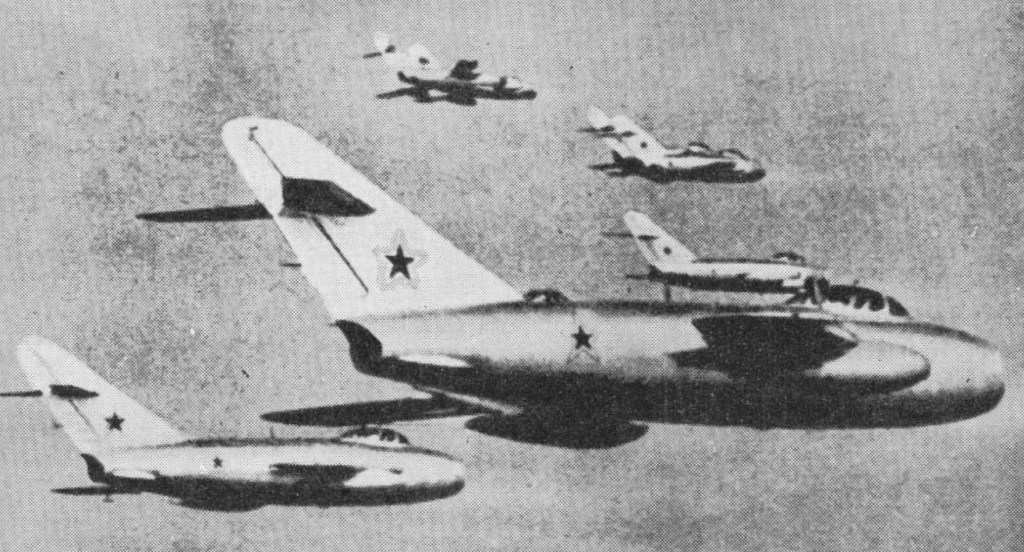
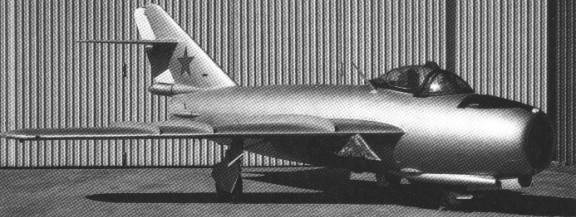
Early in 1949, in parallel with work on the SD (MiG-l5bis), the MiG OKB launched a more thoroughgoing redesign of the basic MiG-15 as the SI, alias 1-330. The SI was intended to afford improved transonic behaviour, achieved by mating the existing fuselage (forward of the rear frame of the engine plenum chamber) with a lengthened rear fuselage and an entirely new wing possessing better compressibility charac¬teristics, having leading-edge sweep of 45 deg inboard and 42 deg outboard. A mark of identification was the MiG-17’s three boundary layer fences on each wing.

The Klimov VK-l engine of the SD was retained, together with the armament of one 37-mm and two 23-mm cannon. The first prototype, officially flown on 13 January 1950, allegedly attained M 1.03, but crashed in March 1950. Following the loss of the first prototype, a second and further improved prototype took over, the test programme being completed on 20 June 1951 and series production being ordered as the MiG-17. Production began with a day fighter model (NATO `Fresco-A’), which retained the VK-1 engine.

Mikoyan-Gurevich MiG-17 Article

The MiG 17 was preferred to the Yak 50 and entered service with the Soviet air force in its Fresco A form during 1952. Its power¬plant was a Klimov VK 1 turbojet producing 2700 kg (5950 lb) of thrust, the same as in the MiG 15 bis, and the armament was similar: one 37 mm (1.46 in) N 37 cannon and a pair of 23 mm (0.90 in) NR 23s, aimed with the aid of a simple gyro gunsight. Air to surface armament could also be carried in the form of four UV 8 57 pods each containing eight 5.5 cm (2.16 in) S 5 rockets, two 21 cm (8.26 in) rockets, two 250 kg (551 1b) bombs or 240 litre (53 Imp gal) drop tanks. The use of steel underwing beams allowed two rocket pods or bombs to be carried inboard, with drop tanks on the outboard pylons.

Fresco B was the MiG-17P, flown as a prototype in 1951, fitted with an S band ‘Izumrud’ (Emerald) radar, known as Scan Fix in the West, with the main dish mounted on the intake splitter and the rang¬ing element housed above in the lip discardingd the 37-mm cannon in favour of a third 23-mm weapon. The fuselage was lengthened by 127 mm (5 in) and the cockpit glazing was modified to cater for additional displays. In the event, production of the MiG-17P was to be limited pending availability of the afterburning VK-1F engine.

Experimental versions included the SN, a ground attack model of the VK-1-engined fighter, which, flown in November 1953, featured lateral air intakes and twin 23-mm nose-mounted cannon which could be hydraulically elevated or depressed (± 40 deg). Another, the SP-2 flown in 1951, was a limited all-weather version with a higher-powered Korshun (Kite) search radar and a twin 23-mm cannon armament. During the course of 1953, production of the MiG-17 gave place to the improved MiG-17F.

Availability of an afterburning version of the Klimov engine, the VK-1F offering 7,452 lb st (3 380 kgp) for three minutes, resulted in the SF, which, flown in 1951, was cleared for series production as the MiG-17F Fresco C (Forsirovannyi, or, literally, “boosted”) in April 1953. Apart from a cut-back rear fuselage exposing the variable nozzle, the MiG-17F featured shorter and deeper air brakes; those on the new variants were larger than their predecessors, mounted in a different position on the fuselage and operated by external jacks.

Large-scale production of the MiG-17F was paralleled by production of the similarly-powered MiG-17PF limited all-¬weather fighter with a trio of 23-mm cannon and (from the 26th aircraft) the improved RP-5 Izumrud radar in a bullet' radome at the centre of the nose air intake and in an extension on the upper lip of the intake. Subsequently, this S-band radar was superseded by an E/F-band version ofScan Fix’, which still gave neither a large antenna nor a wide angle of scan.

In 1953, gun armament was deleted from a MiG-I7PF and provision made for a quartet of K-S (ARS-212) beam-riding missiles mounted on underwing pylons, this version entering production in 1955 as the MiG-I7PFU (Usovershenstvovanny, or, literally, “improved”).

The MiG 17PF Fresco D entered service in 1955 and was fitted with progressively improved versions of Izurnrud/Scan Fix, operating in X band as well as the original S band, and in the MiG-17PFU Fresco E variant the gun armament was replaced by four beam riding AA 1 Alkali air to air mis¬siles carried on underwing pylons projecting forward of the leading edge. Some MiG-17s were fitted out for reconnaissance, with cameras in the forward fuselage and only two guns, and the type has increasingly been used for ground attack as it was replaced in the interception role.

The MiG-17PM (Nato Farmer D) being an all weather fighter carrying only air-to-air missles as armament.

Production of the MiG-17F and MiG-17PFU continued in the Soviet Union until 1958, and licence manufac¬ture of the MiG-17F was initiated in 1957 in Poland as the LIM-5P (licencyjny mysliwiec, or “licensed fighter”), remaining in production until 1960. The MiG-17F was in service with that country’s Soviet-dominated air force in the late 1950s. The lead company, WSK-PZL-Mielec, also carried out design work on various modified versions, some greatly altered. Production continued until 1961. Dedicated reconnaissance and ground attack variants evolved designated LIM-5R and LIM-6.

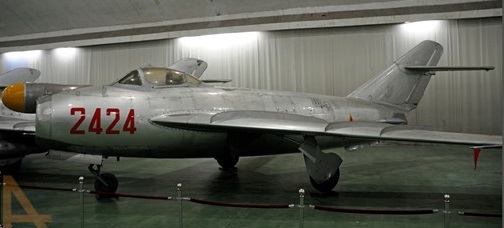
Polish production of the MiG-17PF (LIM-5M) being initiated in 1959 and continuing until 1961. Dedicated reconnaissance and ground attack variants evolved in Poland were designated LIM-5R and LIM-6. Licence production was also undertaken of the MiG-17F (as the Jian5) and MiG-17PF (Jian-5A) by Shenyang in China commencing late 1956, and a uniquely Chinese tandem two-seat advanced training version was developed as the JT-5.

MiG-17 was license built China and known as Type-56, Dong Feng 101 and later is was dubbed J5 in Peoples Republic of China Air Force service. The first J5 prototype carried ‘Zhong-0101’.

J5 prototype
J5

Some Polish LIM 5P’s were modified to LIM 5M standard by fitting additional fuel tanks and a twin wheel main undercarriage with low pressure tyres which retracted into a larger wing centre section built of rein-forced plastics. A relatively small number were converted, but many others were upgraded to LIM 6 standard by introducing a braking parachute, rocket assisted takeoff units and additional stores pylons. The LIM-6, together with the LIM 6bis having modified ordnance racks and the reconnaissance LIM 6R, remained in Polish service until replaced by the Su 20 Fitter C.

LIM-5

The earlier model had been constructed as the Czech S.104.

1721 Mikoyan-Gurevich Lim-5 R 1C-17-21

Licence production was undertaken of the MiG-17F (as the Jian-5) and MiG-17PF (Jian-5A) in China commencing late 1956, and a uniquely Chinese tandem two-seat advanced training version was developed as the JT-5.

A total of 11,015 was built (including licence production). The last one was built in 1958 but the type was exported more widely than any other Soviet military aircraft. The Fresco was withdrawn from Soviet air force service in the late 1960s but soldiers on in many parts of the world, typical ground-¬attack weapons comprising 250 kg (551 1b) bombs, UV 16 57 rocket pods and S 24 rockets.

Gallery

Mikoyan-Gurevich MiG-17
Engine: 1 x Klimov VK-1 turbojet, 5,952 lbs thrust
Wing Span: 31 ft 7 in
Length: 36 ft 5 in
Height: 12 ft 6 in
Light weight: 8,646 lb
Loaded weight: 11,803 lb
Ceiling: 52,366 ft
Speed: 696 mph
Range: 1,290 miles (ferry)
Crew: 1
Armament: 2 x 23mm cannon, 1 x 37 mm cannon, 4 x 57mm rocket pods

MiG-17
Engine: 1 x VK-1F(N) turbo-jet
Wingspan: 9.6 m / 31 ft 6 in
Length: 11.4 m / 37 ft 5 in
Height: 3.8 m / 12 ft 6 in
Wing area: 22.6 sq.m / 243.26 sq ft
Max take-off weight: 5200 kg / 11464 lb
Max. speed: 1114 km/h / 692 mph
Ceiling: 15000 m / 49200 ft
Range: 2000 km / 1243 miles
Crew: 1
Armament: 1 x 37mm machine-guns, 2 x 23mm machine-guns, bombs or missiles

MiG-17
Engine: 1 x Klimov VK-1 turbojet, 5952 lb (later models) VK-1F, 4732 lb / afterburner-7452 lb)
Max speed, 692 mph (1114 km/h) at 6,560 ft (2 000 m)
Initial climb, 9,252 ft/min (47 m/sec)
Range (with max external fuel), 1,336 mls (2150 km)
Empty weight, 8,373 lb (3798 kg)
Loaded weight (clean), 11,468 lb (5202 kg)
Span, 31 ft 7 1/8 in (9,63m)
Length, 36ft l1 1/3 in (1l,26m)
Height, l2 ft5 5/8 in (3,80 m)
Wing area, 243.26 sq ft (22,60 sq.m)

MIG-17F ‘Fresco-C’
Type: single-seat fighter
Powerplant: one 3400-kg (7,495-lb) afterburning thrust Klimov VK-JF turbojet
Maximum speed 1145 km/h (711 mph) at 3000m (9,845 ft)
Initial climb rate 3900 m (12,795 ft) per minute
Service ceiling 16600 m (54,460 ft)
Range (with max external fuel): 1470 km (913 sm)
Empty weight: 4100 kg (9,040 lb)
Maximum take-off weight: 6700 kg (14,770 lb)
Wingspan 9.63 m (31 ft 7 in)
Length 11.09 m (36 ft 4½ in)
Height 3.35 m (11 ft)
Wing area 22.60 sq.m (243.3 sq ft)
Armament: three 23-mm NR-23 cannon, plus four AA-1 ‘Alkali’ missiles or up to 500 kg (1, 102 lb) of external stores.

MiG-17P
Engine: 1 x Klimov VK-1 turbojet, 5952 lb (later models) VK-1F, 4732 lb / afterburner-7452 lb)
Wing span: 31 ft (9.45 m)
Length: 36 ft 3 in (11.05 m)
Height 11 ft (3.35 m)
Empty wt: 9040 lb
MAUW: 14,770 lb

MiG-17PF
Wing span: 31 ft (9.45 m)
Length: 36 ft 3 in (11.05 m)
Height 11 ft (3.35 m)
Empty wt: 9040 lb
MAUW: 14,770 lb

MiG-17PM
Wing span: 31 ft (9.45 m)
Length: 36 ft 3 in (11.05 m)
Height 11 ft (3.35 m)
Empty wt: 9040 lb
MAUW: 14,770 lb
Armament: 4 x AA-1 missiles.

LIM-5P
Engine: Kumov VK1A turbojet
Seats: 1

Mikoyan/Gurevich MiG-17

Mikoyan-Gurevich MiG-13 / I-250

In February 1944, the MiG OKB initiated the design of a mixed-power single-seat fighter with the Izdeliye designation N. Conceived to use the so-called “accelerator”, or VRDK (Vozdushno-reaktivny dvigatyel kompressorny, or Air-reaction engine compressor), which had been developed at the TsIAM under the leadership of K V Kholshchevnikov, the N preliminary design was finished on 28 March 1944. Drawings were completed by 30 November 1944, by which time the official designation I-250 had been applied to the project, and three months later, on 26 February 1945, the first of two prototypes, the N-1, left the factory.

Primary power was provided by a Klimov M-107A (VK-107A) 12-cylinder Vee-type engine rated at 1650hp for take-off and armament was three 20mm G-20 cannon, one between the engine cylinder banks and the others flanking the engine. The VRDK consisted of an engine-driven compressor which fed compressed air via a water radiator to a mixing chamber in which fuel was introduced under pressure, the mixture being ignited in a double-walled combustion chamber and then ejected through a variable orifice. This provided 300kg of thrust for up to 10 minutes, boosting speed by 100km/h.

The first flight took place on 3 March 1945, and the VRDK was fired for the first time during the third test flight. N-1 crashed during mid-May when the permissible load factor was exceeded and the horizontal tail collapsed at low altitude, but a second prototype, the N-2, was rolled out on 26 May 1945. This lacked armament and the vertical tail was enlarged to rectify some longitudinal instability, but this prototype, too, was destroyed in an accident. In July 1945, the OKB received instructions to supervise the construction of 10 I-250 aircraft to participate in the Air Parade that was planned for 7 November 1945, barely four months later.
Nine I-250s were ready on time, but inclement weather resulted in cancellation of the Parade. These aircraft, together with a further seven, were subsequently delivered to the Navy as MiG-13s, equipping an evaluation unit based at Skultye airfield, near Riga. Several of the pre-series MiG-13s were experimentally fitted with sabre-shaped propeller blades, and official NII VVS trials were conducted between 9 October 1947 and 8 April 1948. Production of the I-250 / MiG-13 had totalled 16 pre-series aircraft, and although the fighter was essentially successful, it had been overtaken by pure jet fighters and surviving examples were retired by the Navy in May 1948.

N-1
Engine: 1 x Klimov M-107A (VK-107A) 12-cylinder, 1650hp & 1 x VRDK, 300kg thrust
Max. speed: 825 km/h / 513 mph
Ceiling: 11960 m / 39250 ft
Range: 1380 km / 858 miles
Armament: 3 x 20mm G-20 cannon

N-2
Engine: 1 x Klimov M-107A (VK-107A) 12-cylinder, 1650hp & 1 x VRDK, 300kg thrust
Max take-off weight: 3931 kg / 8666 lb
Empty weight: 3028 kg / 6676 lb
Wingspan: 9.50 m / 31 ft 2 in
Length: 8.18 m / 26 ft 10 in
Wing area: 15.00 sq.m / 161.46 sq ft

Mikoyan/Gurevich MiG-13 (I-250)

Mikoyan-Gurevich MiG-8 Utka

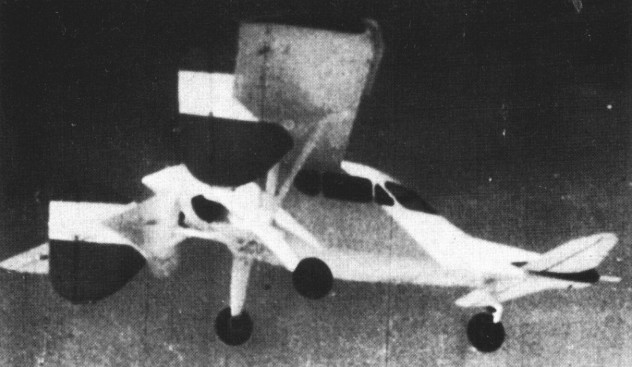
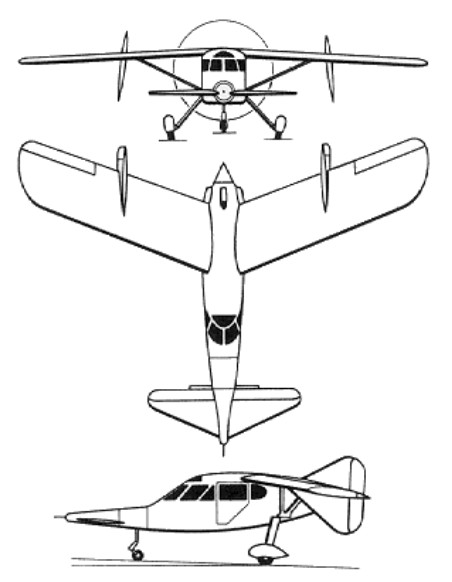
Although usually attributed to the Mikoya Gurevich design bureau and certainly assign the designation MiG-8, the Utka (Duck) three seat tail-first monoplane was apparently designed by students of the Zhukovskii Academy under the supervision of Prof G A Tokaev as a research project and built at the MiG bureau’s experimental factory.

A light high-wing canard monoplane with pusher propeller, built of wood with fabric cover, the Utka was completed and flown in 1945, intended primarily to study low-speed control problems associated with wing sweepback at low speed. The wings were swept 20 deg, carried splayed vertical surfaces at mid-span and featured leading-edge slats which occupied approximately one-third span outboard. Elevators were carried by the canard surface. The aircraft was flown in two variants, differed by location of the rudders.

Test pilots A.I.Zhukov and A.N.Grinchik flew it in the end of 1945. Apparently it performed well without any modifications.

Engine: five cylinder M-l1FM air-cooled radial, 150 hp / 81kW
Wing span: 3l ft 2in (9,50 m)
Length: 23 ft 3.5 in (7,10 m)
Wing area: 170.07sq ft (15.8 sq.m).
Max take-off weight: 1150 kg / 2535 lb
Empty weight: 640 kg / 1411 lb
Maximum speed: 127 mph (205 km/h)
Maximum endurance: 5.0 hours
Crew: 1
Passengers: 2

Mikoyan-Gurevich I-231

A third I-230 airframe was completed early in 1943 with an 1800hp Mikulin AM-39 12-cylinder Vee-type engine and the Izdeliye designation 2D. Apart from the tailplane which was set 20cm lower, this aircraft was basically similar to the first I-230 and retained the same armament of twin synchronised cannon. Assigned the official designation of I-231, the prototype was written off in a landing accident shortly after the completion of factory testing and further development was discontinued.

Engine: 1800hp Mikulin AM-39
Max take-off weight: 3287 kg / 7247 lb
Empty weight: 2583 kg / 5695 lb
Max. speed: 707 km/h / 439 mph
Range: 1350 km / 839 miles