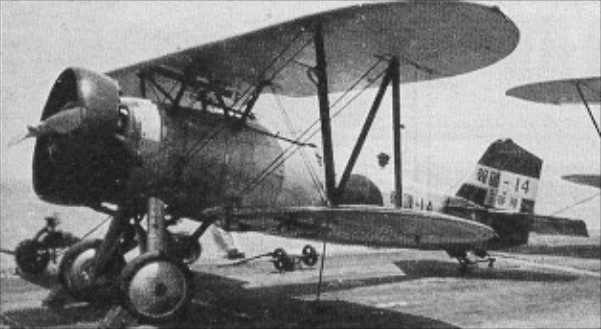
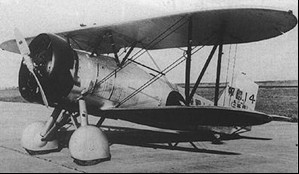
After importation in 1928 of a Boeing 69-B (F2B-1) by the Imperial Navy, and, in the following year, the fourth Boeing 100 (essentially similar to the F4B-l), the two aircraft were shown to industry as examples of the then-current US shipboard fighter technology. Nakajima, which had previous¬ly built the Gloster Gambet (A1N1-2) for the Imperial Navy, initiated development of a carrier fighter based broadly on the Boeing designs as a private venture. Responsibility for the fighter was assigned to Takao Yoshida and two prototypes powered by the Jupiter VI engine were completed in December 1929 and the NY prototype first flew in 1930.
It was an unequal-span single-seat fighter of biplane configuration, with divided fixed landing gear which had spatted wheel fairings discarded in later production aircraft. The A2N1 and A2N2 had lower wing dihedral only, whereas the A2N3 had dihedral on both wings. The twin-gun armament was installed in blast troughs on the lower sides of the fuselage in the A2N1, while later versions had them installed in the forward decking.
Type 90 type 2 Carrier Fighter
Evaluated by the Navy in the following year, these prototypes were rejected as they were considered to offer an insufficient improvement over the A1N1. Some redesign was undertaken by Jingo Kurihara, and, with a 580 hp Kotobuki 2 engine, a further prototype was completed in May 1931, the type being adopted by the Navy in April 1932 as the A2N1 (Type 90). With a fabric-covered metal fuselage and a similarly skinned wing of mixed construction, the A2N1 carried an armament of two 7,7-mm machine guns. The principal production version was the A2N2 (Type 90-II) with re¬arranged fuel tankage and armament, the A2N3 (Type 90-III) differing in having five degree of dihedral on the upper wing main panels. Series production was undertaken from 1932 until 1936 by both the parent company and Sasebo.
Production totalled 106, built between 1930 and 1935, and later 66 examples of the A3N1 two-seat training variant appeared, most being conversions of the single-seater. A2Ns from the carrier Kaga (2nd Carrier Division) flew on operations in the Shanghai area during the 1937 Sino-Japanese Incident.
A2N1 Engine: Nakajima Kotobuki 2, 580 hp / 433kW Span: 30 ft 8.9 in (9,37 m). Length: 20 ft 3.4 in (6,18 m). Height: 9 ft 11 in (3,02 m). Wing area: 212.49 sq ft (19,74 sq.m). Empty weight: 2,304 lb (1 045 kg) Loaded weight: 3,417 lb (1 550 kg). Max speed: 182 mph (293 kph) at 9,845 ft (3000 m) Endurance: 3 hrs. Time to 9,845ft (3000m): 5.75 min. Ceiling: 9000 m / 29550 ft Range: 500 km / 311 miles Armament: two 7,7-mm mg. Crew: 1
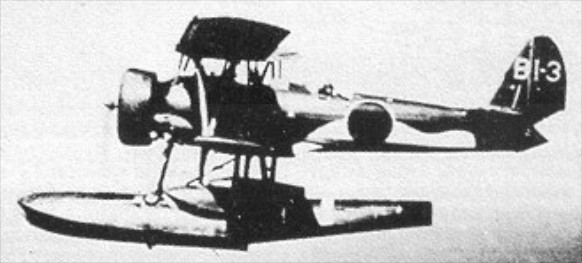
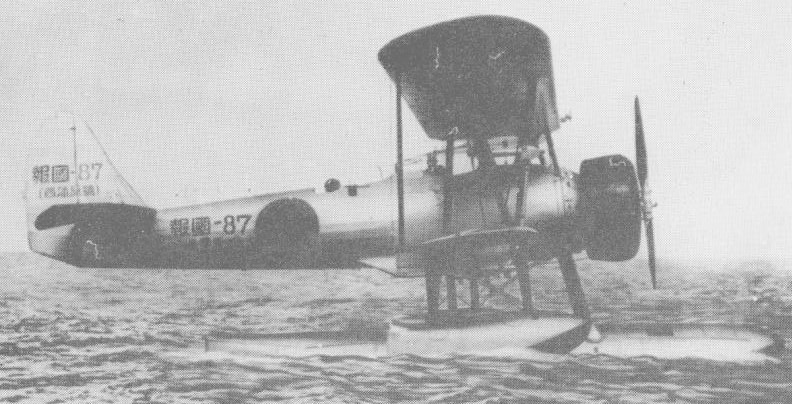
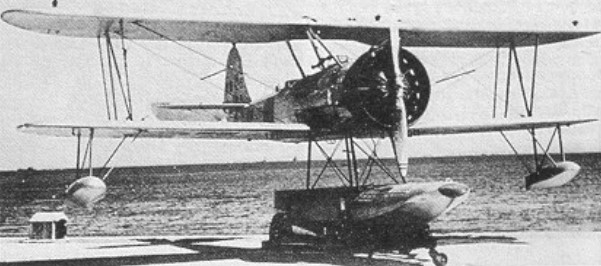
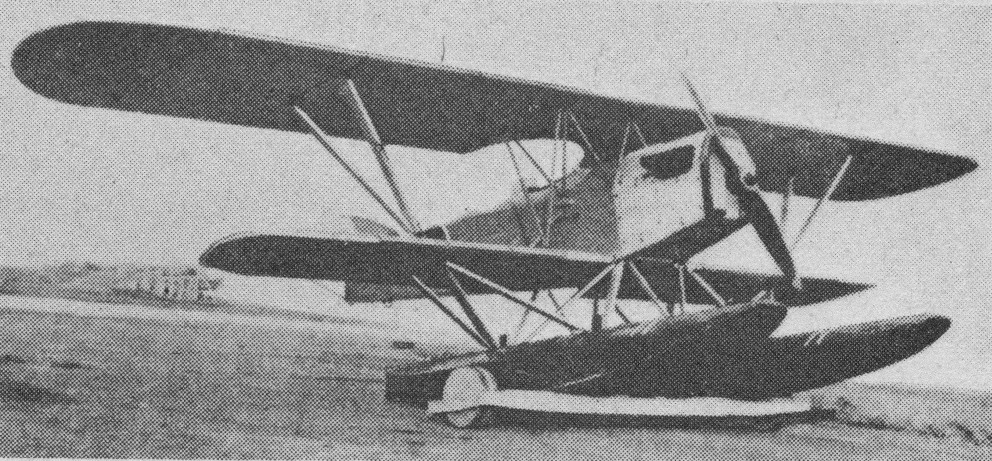
Designed to replace the company’s E4N2 in Navy service, Nakajima’s MS submission was basically an updated version of the E4N2. Of similar biplane configuration, with a central float and underwing stabilising floats, it was powered by a 433kW Kotobuki 2 KAI 1 radial engine, and differed from its predecessor primarily by having revised wings and tail unit.
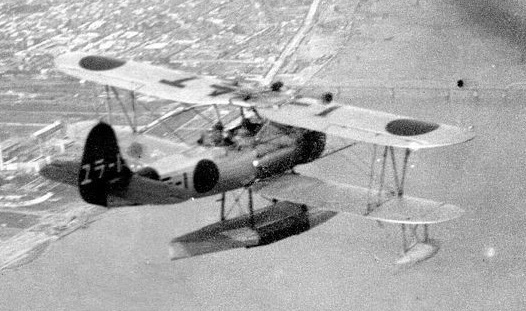
Seven prototypes were tested from March 1934 and, following evaluation against competing aircraft from Aichi and Kawanishi, the MS was ordered into production in October 1935 as the Navy Type 95 Reconnaissance Seaplane Model 1 (Nakajima E8N1).
An E8N2 with improved equipment and a more powerful engine was introduced before production ended in 1940, when a combined total of 755 had been built by Nakajima (707) and Kawanishi (48).
Used successfully, during the Sino-Japanese War in roles which included artillery spotting and dive-bombing as well as reconnaissance, some were still operating from navy vessels at the beginning of the Pacific war, gaining the Allied codename ‘Dave’. They were soon diverted to second line duties such as communications, liaison and training.
E8N1 Engine: Nakajima Kotobuki II-Kai, 580 hp Wingspan: 33 ft 0.75 in Max speed: 183 mph
E8N2 Engine: 1 x Nakajima “Kotobuki-2” KAI 2 Wingspan: 10.98 m / 36 ft 0 in Length: 8.81 m / 28 ft 11 in Height: 3.84 m / 12 ft 7 in Wing area: 26.5 sq.m / 285.24 sq ft Max take-off weight: 1900 kg / 4189 lb Empty weight: 1320 kg / 2910 lb Max. speed: 300 km/h / 186 mph Ceiling: 7270 m / 23850 ft Range: 900 km / 559 miles Armament: 2 x 7.7mm machine-guns, 2 x 30-kg bombs Crew: 2
A Japanese army requirement of March 1927 for a new single-seat fighter successor for the Ko-4 (Nieuport-Delage NiD 29) was contested by Nakajima, Kawasaki and Mitsubishi. All the designs were parasol-wing monoplanes developed in Japan by teams wholly or partly led by Europeans, in the case of Nakajima the French engineers Mary and Robin from Dewoitine leading designers Shigejiro Owada and Tei Koyama. Structural failure of the Mitsubishi prototype led to severe testing of the survivors, which were then also eliminated.
The Nakajima: prototype, company designation NC, had a slim tapering monocoque fuselage, an uncowled Jupiter VI nine-cylinder radial engine, and elaborate strut bracing connecting wings, fuselage and the wide-track landing gear. Two prototypes were completed in May and June 1928 respectively, but structural testing led to rejection by the Army. The contest was, in the event, cancelled but Nakajima persevered with the design as a company-funded venture and built six more prototypes armed with two 7,7-mm machine guns be¬tween 1929 and 1931.
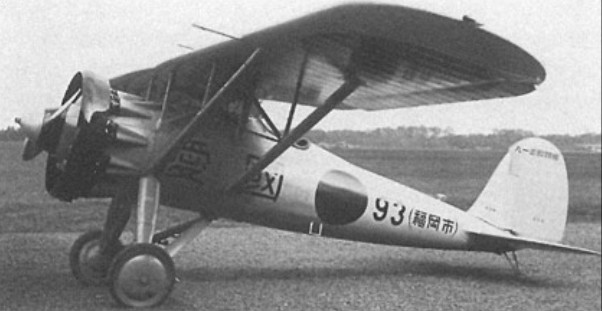
The final two of these prototypes were, in fact, of an essentially new design, retaining no more than the rear fuselage of the preceding prototypes. These were to serve as a basis for the series Type 91 fighter. The last of the series being tested extensively by the Japanese army and accepted for production as the Army Type 91 Fighter Model 1.
Type NC No.7
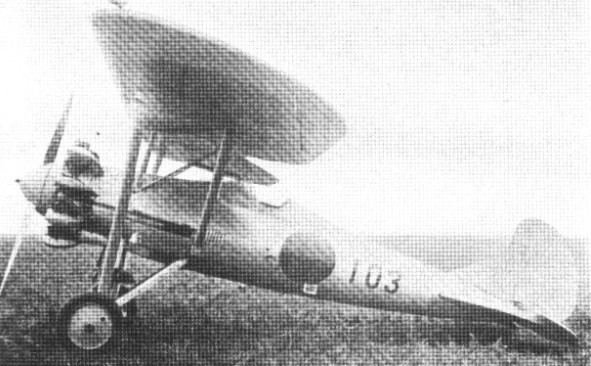
Retaining the company appellation NC, the sixth prototype so designated was of fundamentally different design and powered by a supercharged 520 hp Bristol Jupiter VII radial. New wings of smaller area incorporated an internal (jettisonable) fuel tank to port replacing the podded tank of preceding prototypes. The engine was enclosed by a Townend ring, the diameter of the forward fuselage was increased, both fore and aft main bracing struts were attached to the fuselage, the tail surfaces were redesigned, the cross-axle gave place to one of split type and the guns were repositioned.
This was ordered into production by the Army as the Type 91, deliveries commencing late 1931, but service introduction being delayed by C of G and directional stability problems. A total of 320 fighters of this type was built by the parent company (and approximately 100 more by Tachikawa), the initial version subsequently becoming the Type 91-1 with the appearance of a version powered by a Jupiter derivative, the Nakajima Kotobuki 2 of 580 hp. A prototype of this variant, the Type 91-2, was completed in July 1934, this being followed by 22 series aircraft, production terminating in September 1934 with the 450th aircraft.
Introduced from 1932 onwards, the Type 91s were deployed in action with the four squadrons of the 11th Air Battalion operating with the army Kanto Command in Manchuria against the Chinese. In. 1933 the Type 91 was the principal army fighter and constituted the standard equipment for the newly formed air wings (or Hiko Rentai). The Type 91 remained in service until succeeded by the Kawasaki Type 95 in 1936-37.
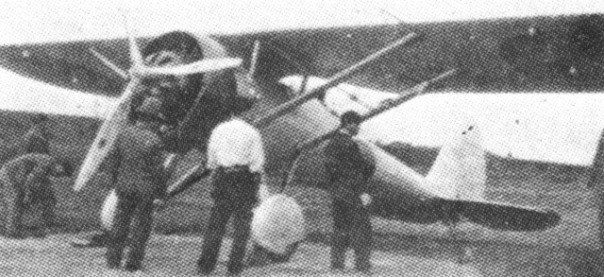
A Type 91 was converted for carrier operations and with spatted wheel fairings was submitted for the navy 7-Shi experimental fighter competition, but was rejected. The only other modification from standard army configuration was the use of a three-bladed propeller.
One experimental example was fitted with a Kotobuki 5 engine.
Type 91-1 Engine: Bristol Jupiter VII, 520 hp. Max speed: 186 mph (300 km/h). Endurance: 2 hrs. Time to 9,845ft (3000m): 40 min. Empty weight: 2,370 lb (1 075 kg). Loaded weight: 3,373 lb (1 530 kg). Span: 36 ft 1 in (11.00 m). Length: 23 ft 9.75 in (7.26 m). Height: 9 ft 1.8 in (2,79 m). Wing area: 215.28 sq ft (20,00 sq.m).
Type 91-2 Engine: Nakajima Kotobuki 2, 580 hp / 433kW Wingspan: 11 m / 36 ft 1 in Length: 7.3 m / 23 ft 11 in Height: 3 m / 9 ft 10 in Wing area: 20 sq.m / 215.28 sq ft Max take-off weight: 1500 kg / 3307 lb Empty weight: 1075 kg / 2370 lb Max. speed: 300 km/h / 186 mph Ceiling: 9000 m / 29550 ft Range: 500 km / 311 miles Armament: 2 x 7.7mm machine-guns Crew: 1
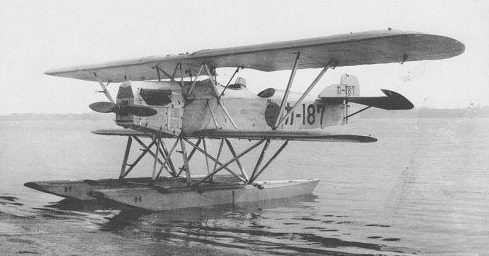
Nakajima’s first attempt to satisfy the Navy requirement was the E4N1 biplane. This aircraft had a welded chromium molybdenum steel tube structure with fabric covering at the rear and aluminium sheet covering at the front. It was a standard biplane, with fabric covered wings with a wooden structure. The E4N1 was a twin float aircraft, but the two floats were very similar to the Vought design. Bombs were carried on the underside of the fuselage. It was powered by a 420-520hp Nakajima Jupiter VI radial engine, and reached 130mph.
The first prototype Type 90-2 Reconnaissance Seaplane, or E4N1, equal-span biplane reconnaissance aircraft first flew in 1930, company designation NZ. Intended for navy service as the Nakajima E4N1, it had twin floats and an uncowled Kotobuki radial engine.
Two prototypes of the E4N1 were built. They were given the official designation Navy Type 90-2-1 Reconnaissance Seaplane – Aichi had already had a reconnaissance seaplane accepted in 1930, and that became the Type 90-1. The E4N1 was tested by the Japanese Navy early in 1931, but the design was rejected because it wasn’t very manoeuvrable.
A stronger version was produced and in December 1941 was accepted as the Type 90-2-2 Reconnaissance Seaplane, E4N2. It could also be used with wheels, when it became the Type 90-2-3 E4N3.
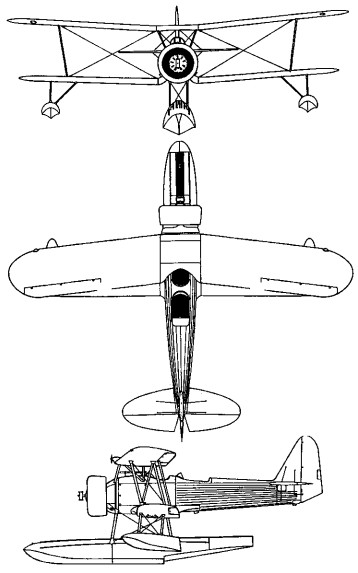
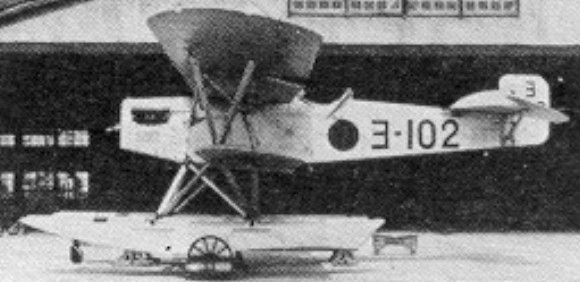
The NJ or Navy Type 90-2-2 or E4N2, Reconnaissance Floatplane was a complete redesign, with a single main float and twin wingtip stabilising floats and introduced a cowled engine. It closely resembles the US Vought O3U-1 Corsair biplane and, like it, was intended for shipboard use and catapult launching. This time the fuselage structure was a mix of wood and metal. Once again the forward fuselage was metal covered but the rest of the fuselage and the wings were fabric covered. The wings had a wooden structure and were rearward folding.
The E4N2 was much more manoeuvrable than the E4N1. The first prototype was tested late in 1930, suggesting that it was already under development before the E4N1 had been rejected.
Powered by a 336kW Nakajima Kotobuki radial engine, the Type 90-2-2 had a maximum speed of 222km/h and 85 went into service with the Japanese navy as the E4N2 between 1931 and 1933, a version with fixed wheel landing gear going into service as the E4N2-C; 67 of the latter were completed.
E4N2
Nakajima produced eighty E4N2s between 1931 and 1936 and Kawanishi produced another 67 aircraft between 1932 and 1934.
Nakajima also produced five of the E4N2-C carrier variant. This had wheels and carrier arrestor gear. They underwent service trials but weren’t accepted.
In total 153 were built.
In 1933 nine of the E4N2-C landplanes were converted as night mail carriers designated P-1 Mail, for use between the main islands of Japan. A single-seater with the pilot accommodated in an enclosed cockpit.
The E4N2 was the Japanese Navy’s main ship-borne reconnaissance aircraft from 1932 until it was replaced by the Nakajima Type 95 Reconnaissance Seaplane (E8N) in the mid 1930s. It was used on battleships and cruisers and was a popular aircraft with a good combination of manoeuvrability and strength. It saw combat during the Shanghai Incident
In January 1933 Nakajima won a contract for eight mailplanes from Nihon Koku Yuso to fly a new night mail service. Their design, the Nakajima P-1, was based on that of the Nakajima E4N3 (Navy Type 90-2-3), a reconnaissance seaplane. The P-1 was a single seat, landplane biplane of mixed wood and metal structure with fabric covering.
It had two spar, single bay wings with N-form interplane struts between the spars aided by wire-bracing. The central upper wing was joined to the fuselage with outward-leaning cabane struts, inverted Vs to the forward spar and single struts to the rear. The lower wing, slightly shorter in span, was joined directly to the lowest fuselage longerons.
The P-1 was powered by a nose-mounted 420–450 hp (310–340 kW) Nakajima Jupiter VI nine cylinder radial engine though some were later re-engined with the 585 hp (436 kW) Nakajima Kotobuki 2-kai-1, a related nine cylinder radial which had powered the Nakajima E4N3. Both had narrow-chord Townend cowlings. Its cockpit, initially open but enclosed on later aircraft with glazing running aft into a turtle back fairing, placed the pilot well behind the wings. Night flight safety was increased by two landing lights under mid-span and parachute flares. It also had a radio receiver and a radio beacon.
The fuselage was circular immediately behind the large radial engine but became more flat-sided rearwards. The tail was conventional with the tailplane mounted on top of the fuselage carrying elevators with rounded tips and cut-outs for rudder movement. The vertical tail was also rounded, with a full rudder that reached down to the keel.
The P-1 had fixed landing gear with wheels on divided axles, their centres hinged on a short, under-fuselage V-strut pylon. Splayed landing struts and rearward drag struts were mounted on the lower fuselage longerons. The wheels were largely enclosed under narrow helmet fairings.
The first of Nihon Koku Yuso’s eight aircraft was completed in May 1933. The standard night mail route connected Tokyo, Osaka and Fukuoka and began operations in August 1933. Though this service was successful in the sense of increasing mail volume it showed that these night flights were stressful for a single pilot in a single-engined aircraft, especially in bad weather. As a result, the P-1s were gradually retired over two pioneering years, replaced by larger, twin-engined aircraft with a larger crew.
A ninth, specially built, P-1 was used by the Ministry of Communications.
E4N1 / Navy Type 90-2-1 / NZ two prototypes twin-float seaplane Engine: Nakajima Jupiter VI, 420-520hp Speed: 130mph
E4N2 / Type 90-2-2 / NJ Engine: 1 x Nakajima “Kotobuki”, 433 kW (580 hp) Wingspan: 10.98 m (36 ft 0 in) Wing area: 29.7 m² (319 ft²) Length: 8.87 m (29 ft 1¼ in) Height: 3.97 m (13 ft 0 in) Empty weight: 1,252 kg (2,760 lb) Loaded weight: 1,800 kg (3,968 lb) Max speed: 222 km/h / 138 mph Cruise speed: 148 km/h (80 kn, 92 mph) Range: 1,019 km (550 nmi, 633 mi) Climb Rate: 10 min 34 sec to 9,843ft Service ceiling: 5,740 m (18,830 ft) Crew: 2 Armament: 1 × fixed 7.7 mm machine gun & 1 × flexible 7.7 mm machine gun Bombload: 2 × 30 kg (66 lb) bombs single-float seaplane 85 built
E4N2-C / Navy Type 90-2-3 / NJ landplane arresting gear and fixed-undercarriage 67 built
E4N3 / Navy Type 90-2-3 / NJ Reconnaissance Seaplane
P-1 Mail 9 converted from E4N2-C airframes Powerplant: 1 × Nakajima Jupiter VI Propeller: Hamilton Standard fixed pitch metal Wingspan: 10.97 m (36 ft 0 in) Wing area: 32.57 m2 (350.6 sq ft) Airfoil: N-22 upper wing, Clark Y lower Length: 7.66 m (25 ft 2 in) Height: 3.70 m (12 ft 2 in) Empty weight: 1,225 kg (2,701 lb) Gross weight: 1,992 kg (4,392 lb) Maximum speed: 243 km/h (151 mph, 131 kn) Cruise speed: 194 km/h (121 mph, 105 kn) Range: 1,000 km (620 mi, 540 nmi) Time to 3,000 m (9,800 ft): 9 m 27 s Crew: one
Giyu-11 One of the two E4N1 seaplanes converted with a cabin for use by Tokyo Koku Yuso Kaisha between Haneda airport, Shimizu and Shimoda.
Built between 1927 and 1929, this two-seat twin-float sesquiplane was powered by a 224kW Hispano-Suiza engine and could attain a maximum speed of 166km/h. It was intended for shipboard reconnaissance and served with the Japanese navy as the Type 15 Reconnaissance Floatplane (Nakajima E2N1 and E2N2).
A total of 80 was built, many being relegated to training or sold to civil users during the 1930s.
Two machines were bought at the outset for civil fishery patrol duties. Converted by Itoh as the Itoh Emi 53, the Navy Type 15 conversions were completed in 1938, intended for use in fishery spotting.
E2N1 Engine: 1 x Hispano-Suiza, 224kW Max. speed: 166 km/h / 103 mph Crew: 2
To meet a 7-Shi (1932) requirement for an advanced single-seat shipboard fighter with which the Imperial Navy hoped to replace the A2N1 that had just been adopted, Nakajima was instructed in April 1932 to develop a suitable aircraft in competition with Mitsubishi. Whereas the latter elected to adopt a cantilever low-wing monoplane configuration (1MF10), Nakajima chose to base its contender on the Army’s Type 91 parasol monoplane then entering service. A single prototype of a navalised Type 91 was completed in the autumn of 1932, this differing from the Army fighter essentially in having a 560 hp Nakajima Kotobuki 5 engine driving a three-bladed propeller, wheel spats and an arrester hook. Armament remained the standard two 7,7-mm guns. The 7-Shi fighter was considered to offer an insufficient advance to warrant further development.
Engine: Nakajima Kotobuki 5, 560 hp Max speed: 184 mph (296 km/h). Empty weight: 2,425 lb (1100 kg) Loaded weight: 3,527 lb (1 600 kg). Span: 36 ft 1 in (11,00 m) Length: 23 ft 7.5 in (7,20 m). Height: 10 ft 6 in (3,20 m) Wing area: 215.28 sq ft (20,00 sq.m).
In 1917, Chikuhei Nakajima set up the “Airplane Institute” at Ojima Town in Gunma Prefecture. In 1918 they built their first airplane; the “Nakajima Type 1” with a U.S.A. made engine.
In 1917, Chikuhei Nakajima (33 years old at that time), who retired as Engineering Captain of the Navy, contemplating developing a public aircraft industry, set up the “Airplane Institute” at Ojima Town close to Ota Town in Gunma Prefecture (currently Ota City). The building was a simply remodeled sericultural hut along the Tone River. In the beginning, there were only nine members, but in the following year they built their first airplane; the first “Nakajima Type 1” with a U.S.A. made engine. But the first Type 1 sadly crashed after take off. The second Type 1 also failed, and the third one finally did take off, but hit a ditch upon landing and also crashed. In that age, it was said that there was a pasquinade in Ota Town, “Too much paper money, too high a price for rice. Everything goes up, except Nakajima planes”.
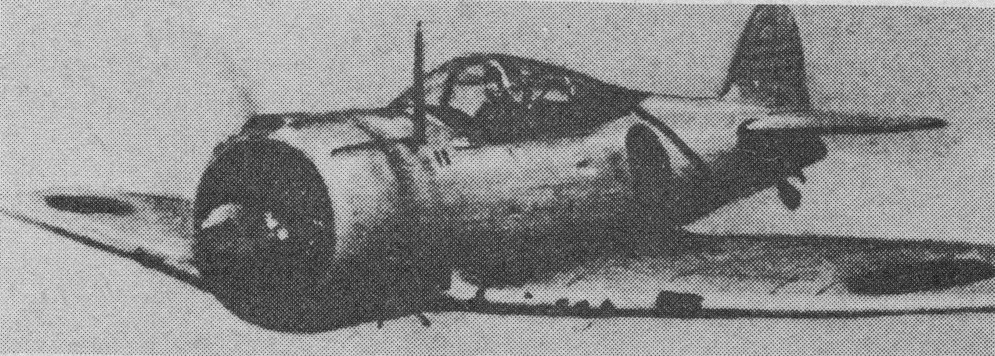
Confusion over pre-war Japanese fighters was so complex many fictional or misidentified types received code names.
After the Pearl Harbor attack military intelligence gathered every piece of downed Japanese aircraft they could find. From that operation they came up with this aircraft. They found a manufacturing plate with the words Nogoya Sento, they thought that was a manufacturer, it was a plant location. From the wings and tail group, it looks like they found parts of an Aichi type 99 Val.
Given the allied code name ‘BEN’ after one of the 5th Air Force Intelligence officers, the code was dropped in less than a year.
It was 1943 before the war department figured out there was no such a plane.