Nels J. Nelson, a 22-year-old Swedish immigrant working as an automobile mechanic in his shop on Elm Street in New Britain, began building and flying his own aircraft. On May 1, 1911, young Nelson made his first flight from the new field in Plainville, now known as Robertson Airport and the oldest in Connecticut.
That summer he flew some 40 miles to the ball field that also served as an airfield in Saybrook. Located at the end of Dudley and Coulter Streets, the area remained open fields until housing was built there in the 1940s. After arriving, he tested his biplane but it did not rise more than a few feet from the ground.
That evening a crowd of about 2,000 people gathered to see his flying machine and to watch the Saybrook and Deep River baseball game. When the time came, he took his machine to one end of the field, got good speed on the ground and, it was reported, “glided upward like a bird.”
He skillfully circled around while ascending to the magnificent height of two or three hundred feet. While circling, the engine’s radiator cap flew back and broke the wooden propeller. With the loss of thrust the aircraft came down rapidly and struck a fence as it landed. He was in the air for about five minutes.
Nelson continued to fly and build airplanes but, unable to get government contracts, ultimately lost out to other manufacturers. He died at his home in Yonkers, New York, in 1964.
The H-44 was designed by Ted Nelson in the period following the Second World War and a specially designed motor glider was created by Hawley Bowlus to utilize the engine, the Bowlus/Nelson Dragonfly.
The Nelson H-44 is a single ignition, four-cylinder, horizontally opposed, direct drive, two-stroke aircraft engine. The engine was not certified. Under the CAR 5 regulations then in place in the USA for gliders, a certified auxiliary power glider could be flown with a non-certified engine and propeller. The engine is instead described on the Dragonfly type certificate. The four-cylinder engine runs on a 12:1 mixture of 80 octane gasoline and SAE 30 oil. It is equipped with a single Carter WA1 carburetor and a recoil starter.
Employed in the Dragonfly the H-44 proved underpowered, which lead to the design of the H-49 version. The engine family was not a success and few were produced.
Variants: H-44 Original design with a 2.25 in (57 mm) bore and 2.75 in (70 mm) stroke, producing 25 hp (19 kW) at 3900 rpm.
H-49 Upgraded design with E-225 cylinders giving a 2.375 in (60 mm) bore and 2.75 in (70 mm) stroke, producing 28 hp (21 kW) at 4000 rpm.
Applications: Bowlus/Nelson Dragonfly
Specifications: H-44 Type: Four-cylinder, two-stroke, single-ignition aircraft engine Bore: 2.25 in (57 mm) Stroke: 2.75 in (70 mm) Displacement: 44 cubic inches Dry weight: 40 lb (18 kg) Designer: Ted Nelson Fuel system: Carter WA1 carburetor Fuel type: 80 octane gasoline Oil system: premixed oil in fuel, SAE 30 oil mixed at 12:1 fuel to oil Cooling system: air
The Nelson H-63, known in the US military designation system as the YO-65, is an American dual ignition, four-cylinder, horizontally opposed, two-stroke aircraft engine that was developed by the Nelson Engine Company for use in helicopters and light aircraft.
The H-63 was designed in the late 1950s specifically to power the sort of very light single-man helicopters that the US Army was investigating at the time. Application for certification was made on 15 March 1958 and the engine was certified under the CAR 13 standard on 8 February 1960.
Engines were produced for Nelson by the Franklin Engine Company of Syracuse, New York under a production certificate. Originally the type certificate was held by the Nelson Specialty Corporation of San Leandro, California, but it was transferred to Nelson Aircraft of Irwin, Pennsylvania on 15 July 1966. Ownership of the type certificate was transferred to the present owner, Charles R. Rhoades of Naples, Florida, on 14 February 1996.
The four-cylinder engine runs on a 16:1 mixture of 80/87 avgas and SAE 30 outboard motor oil. It is equipped with a single Nelson E-500 carburetor.
Variants: H-63C Vertically mounted version for use in helicopters, producing 43 hp (32 kW) at 4000 rpm.
H-63CP Horizontally mounted version for use in light aircraft, producing 48 hp (36 kW) at 4400 rpm for take-off.
Applications: H-63C Hiller YROE
H-63CP Lobet/Shafor Ganagobie
Specifications: H-63C Type: Four-cylinder, two-stroke, dual ignition, vertically mounted helicopter engine Bore: 2.6875 in (68 mm) Stroke: 2.75 in (70 mm) Displacement: 63 cubic inches Dry weight: 76 lb (34 kg) including the cooling fan, cooling shroud and clutch Fuel system: Nelson E-500 carburetor Fuel type: 80/87 avgas Oil system: premixed oil in fuel, SAE 30 outboard motor oil mixed at 16:1 fuel to oil Cooling system: fan forced air Reduction gear: none Power output: 43 hp (32 kW) at 4000 rpm Compression ratio: 8:1
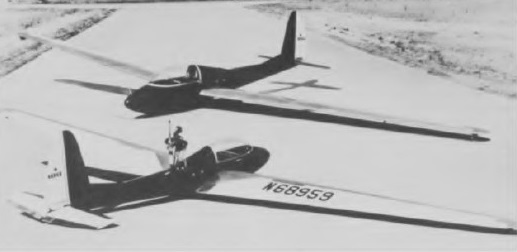
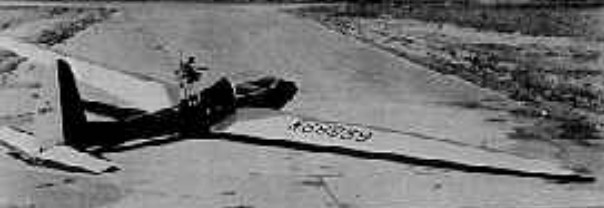
Designed by Harry Perl & Ted Nelson, Nelson developed the Hummingbird in 1953 after discontinuing the Dragonfly. It is a two-place tandem self-launching sailplane. The fixed gear is two wheels in tandem, the front one steerable with rudder pedals. It features an all-moving horizontal tail with anti-balance tab, spoilers and dive brakes, and styrofoam-filled leading edges. The original version, of which two were built, was almost all wood; later models were metal.
Built by the Nelson Aircraft Corporation of Irwin, Pennsylvania, which firm also makes the 45hp Nelson H-63CP four-cylinder horizontally-opposed two-stroke engine that powers it. This is mounted aft of the cockpit and drives a two-blade fixed-pitch pusher propeller; it retracts forward into the fuselage behind the one-piece tear drop cockpit canopy when not in use.
Three or four were built, including N68581, N68959. Two belong to the National Soaring Museum, and one belongs to the Smithsonian Air & Space Museum, Washington.
PG-185B Engine: 40 kW/ 40 bhp. Nelson H-59 Span: 54 ft 0 in / 16.46m Length: 22 ft 0 in Wing area: 185.0 sqft / 17.18sq.m Aspect ratio: 15.76 Airfoil: Go 549 (root), Go 676 (tip) Empty Weight: 363kg / 800lb Gross Weight: 544kg / 1200 lb Max speed: 120 mph Cruising speed: 90mph Stall: 39 mph MinSink: 25 at 89 kph / 48 kt / 55 mph L/DMax: 0.91 m/s / 3.0 fps / 1.78kt Seats: 2
William Nelsch of St Louis MO., USA, built an experiment in roadable airplanes. A single place cabin, high-wing monoplane, featuring folding wings, and caged motor for ground operation.
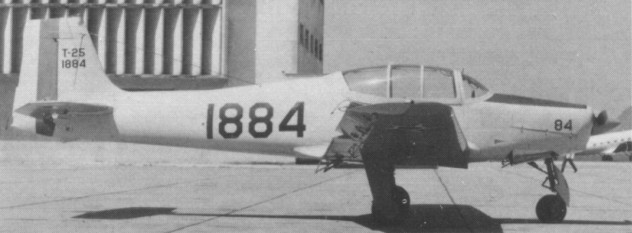
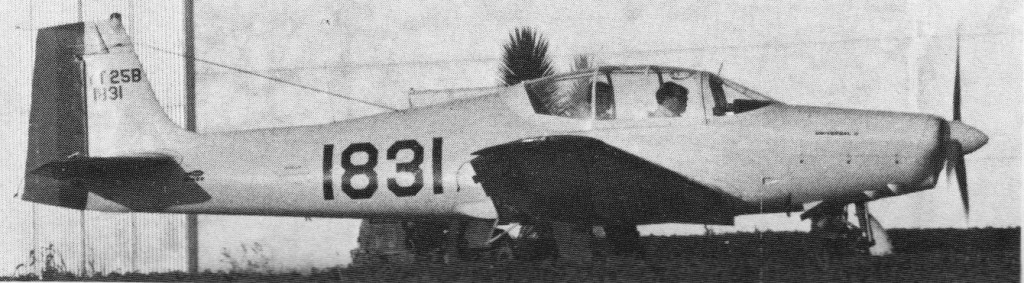
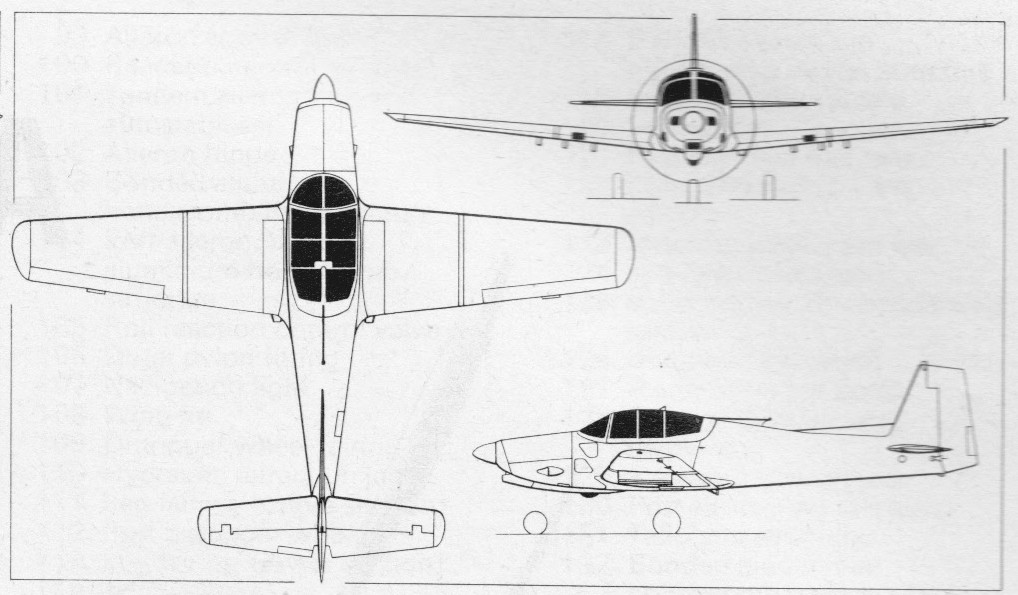
Designed to replace Fokker S-11 and Harvards with the Brazilian Air Force. The Universal is designated T-25 in Brazilian service and operates as a 2/3 seat basic trainer. About 140 were delivered plus 10 to the Chilian Air Force. An armed version with underwing pylons is designated AT-25.
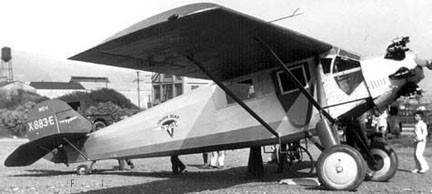
Designed by Richard Korman, the three-place cabin Neilsen Steel Aircraft Co NC-1 Golden Bear, or Coach, was a fabric-covered Ryan B-3 type. Subsequent models were planned to be metal-clad.
Priced at $7,500 in 1928, it was destroyed by an angry crowd at a “thrill show” at Oakland Speedway in Aug 1939 after its performance failed to meet their expectations.
A second one, with 300hp Wright J-6, was reportedly under construction at the time, but its history is unknown.
Engine: 130hp Comet Wingspan: 37’6″ Length: 29’0″ or 28’6″ Useful load: 800 lb Max speed: 130 mph Cruise speed: 110 mph Stall: 40 mph Range: 800 mi Seats: 3
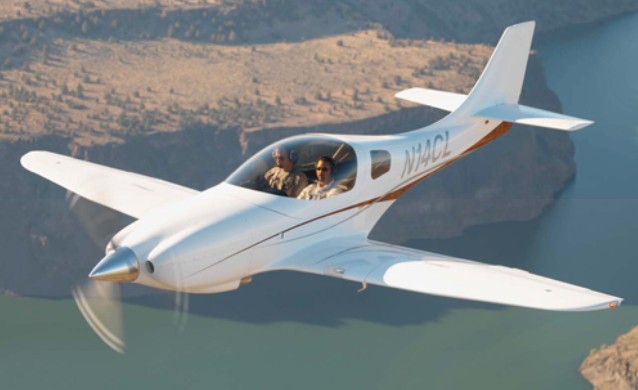
In 1982 Martin Hollmann held one of his aircraft design classes in Santa Monica, CA. Six people attended including Lance Neibuaer. He asked Martin if there was a future in bringing to market a new, two place sport aircraft. Martin of course said “yes.” Two years later, Lance sent Martin a request to perform a stress analysis on his two place design and a check for $200. Richard Trickel offered to build the moulds for Lance’s aircraft at no cost. Richard had formed a composite fabrication company called High Tech Composites in Oxnard, CA. Lance moved to Santa Paula, CA based on Martin’s recommendations and rented a shop space that had been occupied by Jim Kern of Task Research. The new aircraft was powered by a Continental O-200 and Lance called his aircraft the Lancair 200. It had a cruise speed of 200 mph. Although the prototype was made of urethane and hot wire cut styrofoam and covered with wet layed up fiberglass, the production Lancair 200 kit parts were made of temperature cured, prepreg fiberglass and graphite parts. They were lighter and stronger than the epoxy, wet layed up, fiberglass parts used on most kits at that time.
Lance Neibauer sold his family home to pursue his dream of producing the perfect kit. At the time, only the prototype had flown but its performance on an O 235 engine was good. The Lancair 200 is a sleek two-place retractable with maximum level flight speed of 213 mph and 625 pound useful load, and 193 mph cruise. Comprising 27 premoulded, oven cured components, it can be put together in around 600 hours.
Lancair 235 ZK-PDS
The structural integrity of the Lancair wing is said to be +9G and 4.5G ultimate at maximum all up weight (MAUW). This is achieved with an airframe in excess of 25 per cent lighter than similar aircraft built using different construction methods.
At Oshkosh 87 Lancair unveiled its new 320 model, powered by a 150 hp Lycoming O-320. This increased the cruise to 230 mph from the 235 models 210 mph. Kit prices in 1987 were $16,900 for the 235, and $18,500 for the 320.
When the NEICO “fast build kit” became available early 1990, popularity resulted in a one year waiting list. Two years in the development, the kit provides all major sub assemblies including the fuselage ex factory with a resultant saving of up to 700 hours by the builder.
In twelve years 400 kits had been sold using 108-180 hp.
Lancair 360
Two models were available in 1990; the 118hp version with a fixed pitch propeller returns a 180 knot cruise on 75 per cent power while the Lancair 320, sporting a 160 hp Lycoming and constant speed unit, has a 210 knot cruise. The kit price was $18,950 (1987), and $23,200-28,900 in 1998. A kit was also available in carbon for $34,400 in 1998. The 320 is approved for aerobatics. The 320 replaced the 235.
The Lancair 360 has optional wingtip extensions that take the wing from its usual 7.2 m out to 8.3 m. The empty aircraft weighs in at 543 kg and is powered by a Lycoming IO-360-B1F engine behind an MTV-12-B/175-59d three-bladed propeller.
The Australasian market is provided for by licence built 235 and 320 kits manu¬factured by Avtex at Ballina on the NSW coast. The Australian company takes prospective builders step by step through the construction manual. Deposits for twenty eight Lancairs were held by the NSW company in 1990 which has the capacity to turn out one kit every ten days. Standard kits can be constructed in around 800 900 hours while the “fast build” comes together in as little as 200 300 hours.
Aviation Composite Technology / ACT in the Philippines was formed in 1990 to develop the Apache I military trainer from the Lancair 320. 1988 saw the first flight of a Lancair 320 assembled in the Philippines by Aviation Composite Technology (ACT) in a venture with Aerotech S.A. of Switzerland.
In 1991 in the Philippines, Pacific Aeronautical, the new name of ACT relocated to Cebu City started producing airframes for Lancair 320 and Lancair IV, the new higher-powered, four-seat version.