1910 Monoplane

Present but not flown at the Los Angeles Aviation Meet at Dominguez in January 1910, its actual identity is not determinable at this time.
1910 Monoplane
Present but not flown at the Los Angeles Aviation Meet at Dominguez in January 1910, its actual identity is not determinable at this time.
Mohawk Biplane
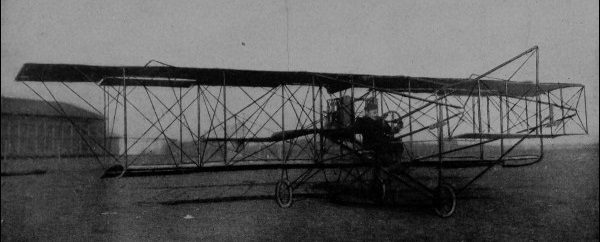
Marcel Penot in the Mohawk Biplane Mineola to Hicksville, L. I.
26 miles cross-country in 30 minutes (50 hp. Harriman Engine)
The Mohawk biplane employs a powerful Harriman four Cylinder water cooled engine
Marcel Penot the French aviator announced that he would start from the Guttenberg race track at about 9 am Monday morning Jan. 2, and attempt to make a Landing in Manhattan somewhere in the Vicinity of Columbus Cycle. Penot will drive a Mohawk by plane which has been used successfully by George Byrnes and himself. The Mohawk biplane employs a powerful Harriman four Cylinder water cooled engine made especially for Penot it closely resembles the Farman biplane. Penot is 82 years old and has been in America several years. He was born at Rheims France and previous to coming to America was employed in the famous wine cellars there.
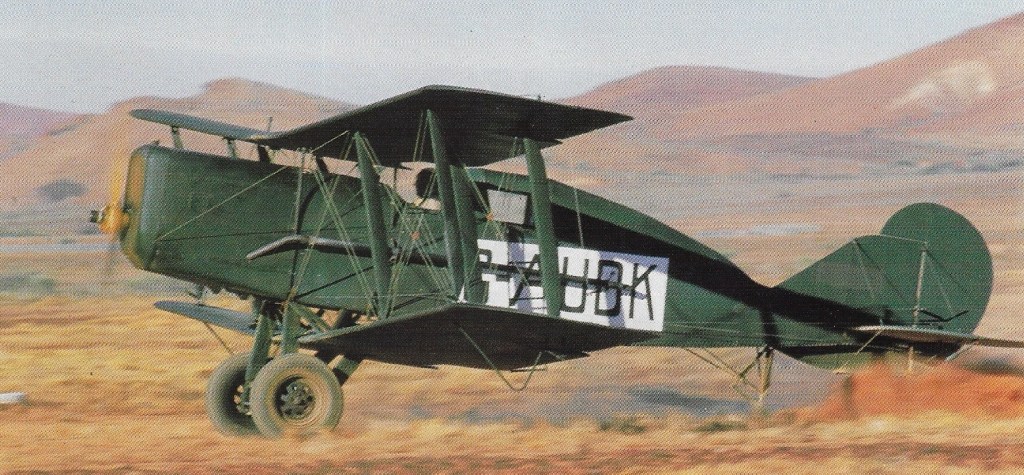
Three Bristol Tourer replicas were built in Australia. A static display replica was built over 18 months during 1980-1981 as a project by the Civil Aviation Historical Society (WA Division) by Ansett WA carpenter Frank Matthews, under supervision of Ansett engineer Billy Tilly, with help of Frank Colquhoun, a former West Australian Airways mechanic/engineer. It was built for display at the Ansett terminal at Perth Airport (now Terminal 3) and was unveiled in the terminal on 5 December 1981, painted to represet G-AUDK. The Ansett terminal was expanded in the mid-1980s, so in 1986 this replica was donated to the RAAF Association Aviation Heritage Museum at Bull Creek, WA, where it is displayed with part of the fuselage and wing unskinned to reveal the structure.
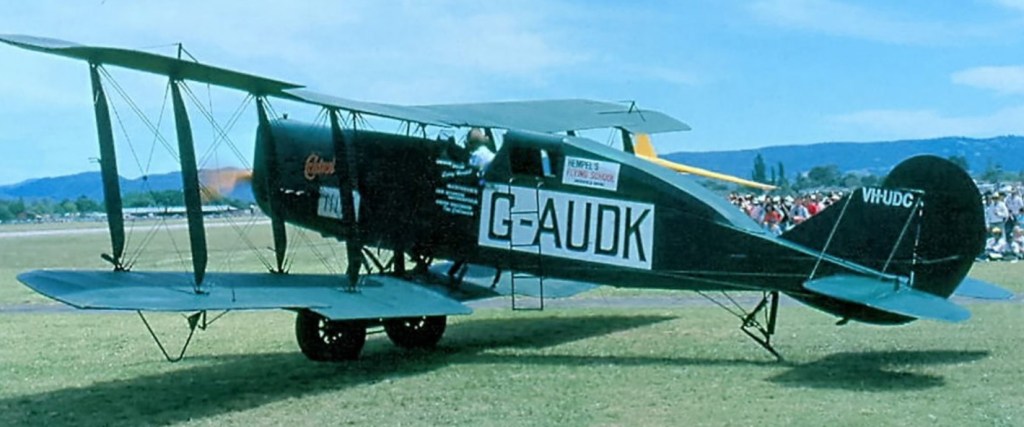
In 1984-1985 an Australian company called A Thousand Skies Ltd had two airworthy Bristol Tourer replicas built in Brisbane, QLD by Air Charter Pty Ltd for a television mini-series “A Thousand Skies”, a story on the life of Sir Charles Kingsford Smith. They were registered as Air Charter Bristol F.2b Tourers, VH-UDC (c/n QA-32-1, painted as G-AUDK) and VH-UDR (c/n QA-32-2, painted as G-AUDJ). These aircraft were powered by 172 kw (230 hp) Continental IO-520 six-cylinder engines, the fuselages being of steel tube construction and the wings of wood, with fabric covering overall. These aircraft were later seen at a number of aviation events but suffered their share of problems.
On 1 June 1992 VH-UDC (painted as G-AUDK) was on a 70-year commemorative flight by owner/pilot Barry Hempel when it suffered engine trouble and was damaged in a forced landing on North West Coastal Highway, 100 km (62 miles) north of Geraldton, WA. The aircraft was restored by Mid West Aero Club and the Shire of Greenough donated it to the Western Australian Museum at Geraldton, where it is now displayed suspended from the ceiling. This is a fitting location, given that the first scheduled air service in Australia by Bristol Tourers of West Australian Airways began at Geraldton Airport on 5 December 1921.
The second aircraft VH-UDR (painted as G-AUDJ) was registered in March 1985 and was withdrawn from service in March 1986. It was converted to a Bristol Fighter F.2b configuration, painted in military markings to represent C-4623, and was placed on display at the Army Aviation Museum at Oakey, QLD.
Flying Hangar Door

The 1983 “Flying Hangar Door” was home-designed and home-made by a very quiet and talented NASA engineer from Dryden Flight Research Center and weighed as much as a Vespa moped. The all-wing airframe was made of corrugated paper and the wheels were from child’s bicycles (plastic rims). It was powered by a lawnmower engine.
Despite its seemingly bulky shape, the “Flying Hangar Door” was an “excellent flyer”. It is possible that the aircraft never received a proper designation or even a registration.
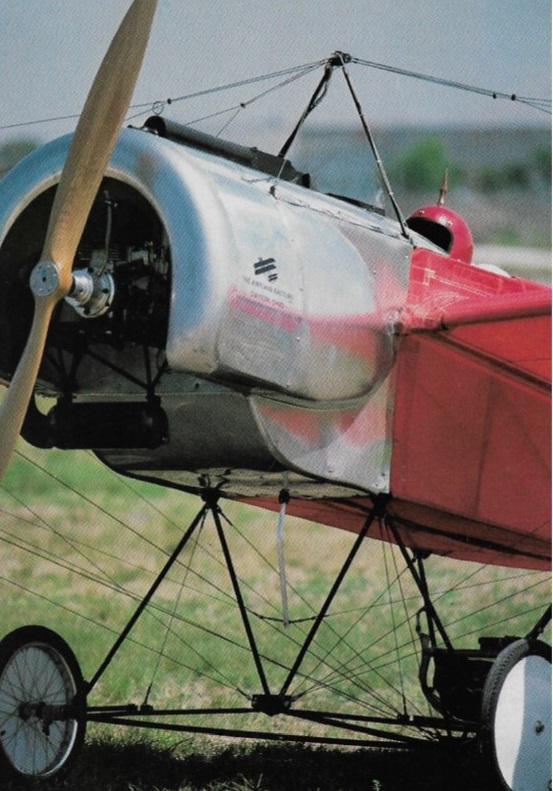
Circa 1982-4 ultralight replica of the Fokker E.III
Aya-7 – unknown manufacturer

Built in Russia, the Aya-7 is a single-seat, high wing monoplane. 30 hp pusher engine. Tricycle landing gear. Length 12’, wing span 17’, wing area 63.6 sq/ft. Empty weight 173 lbs and gross weight 360 lbs. Top speed 69 mph and stall speed 44 mph. Rate of climb 600 fpm. Wing and tail made from wood and fabric. Tail is metal.
Atgimimas – unknown manufacturer
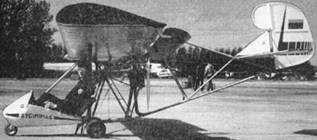
The Lithuania Atgimimas single-seat, high wing monoplane. 22hp pusher engine. Tricycle landing gear. Length 16.6’, wing span 27’, wing area 116.6 sq/ft. Empty weight 215 lbs and gross weight of 415 lbs. Top speed 72 mph and stall speed 28 mph. Fuselage is tubing while wing is wood and composite. Tail is tubing and fabric.
Antoshka – unknown manufacturer

The Russian Antoshka single-seat biplane. 40 hp pusher engine. Tricycle landing gear. Length 16.2’, wing span 31.2’, wing area 111 sq/ft. Empty weight 297 lbs. Gross weight 475 lbs. Top speed 62 mph, stall speed 37 mph. Wing is metal and fabric with tubing and fabric tail. Fuselage metal.
Curtiss-Wright, the very first licencee of the Wankel RC engine, developed the RC2-90-Y2 Wankel RC aircraft engine, which displaces 90 cu.in twice per shaft revolution, and develops 310 bhp at 6000 rpm.
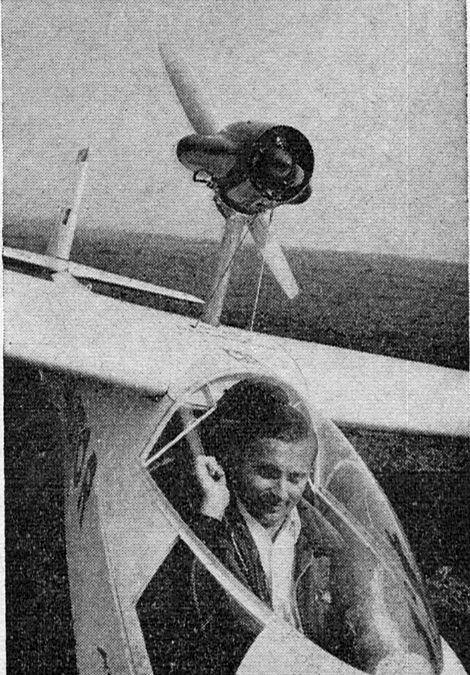
Circa 1967 Fichtel & Sachs AG developed the Wankel KM 48 into an auxiliary power unit for sailplanes.
The 10 bhp engine uses normal grade petrol with 2% by volume of added lubricating oil.
The first installation was in a Ka8 single seat sailplane. The Wankel KMA8 is mounted on a single upward projecting tube above the aircraft C of G. A 31.5in diameter Hoffman pusher propellor is mounted directly on to the output shaft. Engine cooling and appearance are enhanced by a polyester resin glassfibre cowling. The engine, cowling and 1.1 Imp.Gal of fuel weight 38.6 lb.
The test programme showed at a steady 5000 rpm and a forward speed of 40.5 mph, the Ka8 was climbed at up to 140 fpm at around 6500 ft. Maximum level speed was 59 mph.
Fichtel & Sachs believe that 800-1000 between overhauls could be expected.
Displacement: 160 cc
Output: 10 bhp at 5,000 rpm
Engine weight: 18.74 lb
 All Aero