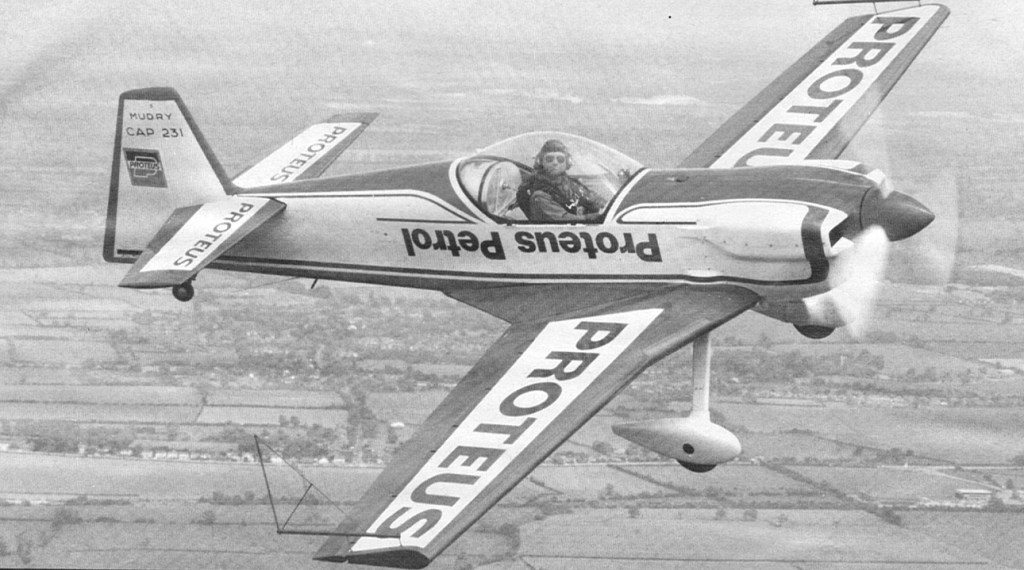
The CAP 231 differs from the CAP21/230 by its new wing leading edge fillets where the wing joins the fuselage.
The CAP 231 is stressed to +/- 10g and has a Vne of 250 mph.
The 231 has taken part in the 1990 WAC at Yverden, Switzerland.
The CAP 231 differs from the CAP21/230 by its new wing leading edge fillets where the wing joins the fuselage.
The CAP 231 is stressed to +/- 10g and has a Vne of 250 mph.
The 231 has taken part in the 1990 WAC at Yverden, Switzerland.
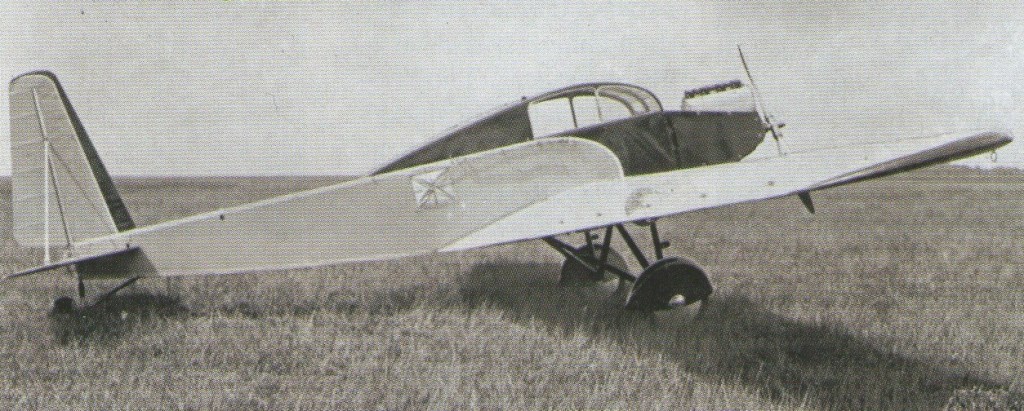
This cabin monoplane, possibly a homebuilt job, looks like it was scaled up from a flying model. It is all straight lines and simplicity, but its fixed taildragger undercarriage has a tailwheel, and spats cover the mainwheels, The tall narrow-chord fin and rudder is strut-braced, and the aerofoil-shaped cockpit cover sits atop a squaresection fuselage. The upright four-cylinder inline air-cooled piston engine in the nose drives an adjustable-pitch two bladed metal propeller. Although the aircraft is finished in a two-tone scheme it carries no markings to reveal either maker or registration, apart from an indecipherable emblem in a square on the fuselage side, in line with the wing trailing edge, and another small and even more indistinct logo on the rudder. The flat grassland offers no clues at all as to whereabouts, and it is even difficult to date the picture, which is just as likely to have been taken in the 1930s as the 1950s.
AEROPLANE NOVEMBER 2006
Unidentified Quadruplane

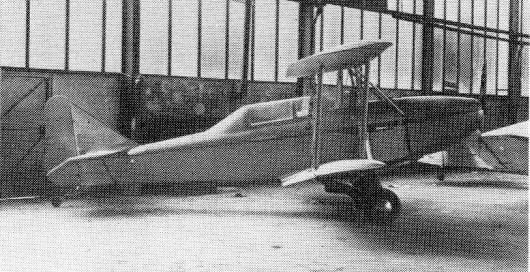
1966 Formula 1 Racer Pusher Type Experimental
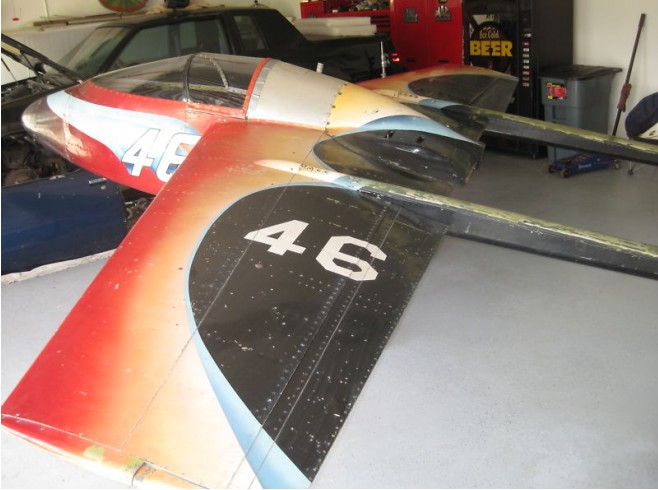
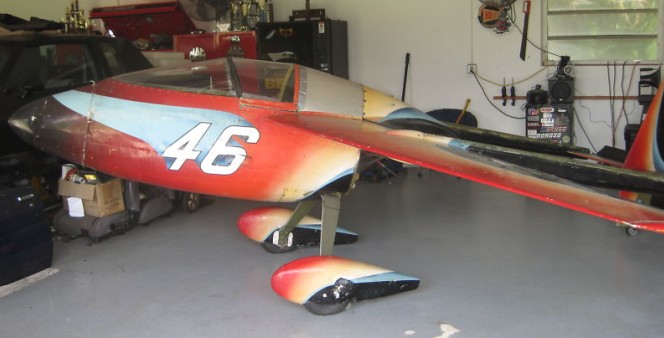
This is a 1966 formula 1 racer pusher type experimental, the aircraft is a stressed skin design with cantilever wing construction and twin booms to accomodate pusher engine and conventional landing gear. The entire airframe components, internal structure, and all skin surfaces are made from 2024-T3 alclad aluminum, wingspars are of 2024 -T3 aluminum web with extruded spar cap top to bottom.The cockpit area is formed of half hard aluminum.The canopy is formed of plexiglass, all fittings are welded chromoly, all flight controls are cable operated except ailerons these are push type controlled.Engine is a O-200 or C-85.
It was built for the Goodyear races, by three engineers who passed away together in an airline accident and the aircraft was never finished or flown.
Henry Guantt later purchased this aircraft from a Mr. Watts in 1973.
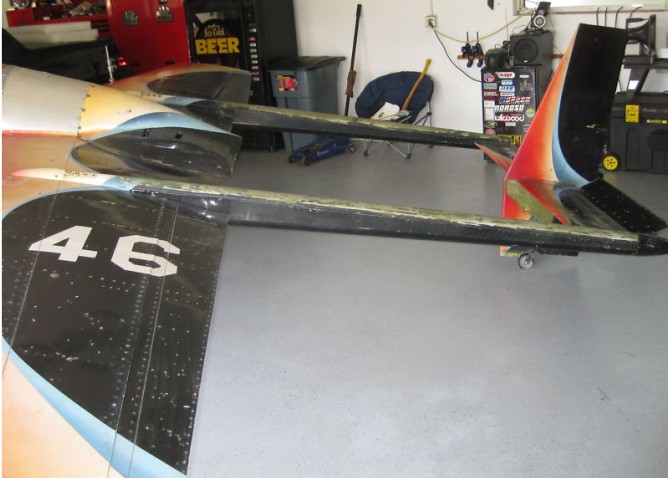
This aircraft was then aquired by a father and son team around 2006 for the purpose of fixing and flying the aircraft but that never came to be because the father passed and they never got to finish this project. Around 2012 the craft was again on the market, hoping someone could dedicate the time to it and fly it. This included all of its documentation and specs and all of the parts to complete it except the engine but including the pusher type propeller.
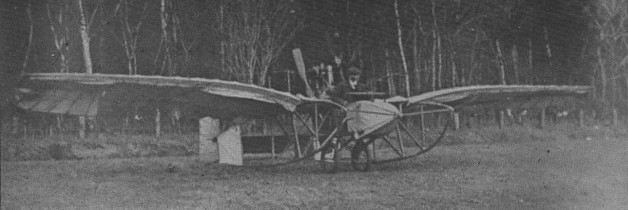
The machine is a monoplane with arched wings. Its cloth-capped pilot is seated in a faired central nacelle, immediately in front of a large vertical piston engine, possibly with four cylinders, driving a two-bladed wooden pusher propeller. The nacelle is supported on a twin-wheel undercarriage, and a few feet out on either side are open frames extending rearwards to carry the tall surfaces. The rear ends of these frames are covered in to serve as fins There appears to be a monoplane tailplane, possibly with an elevator, plus twin rudders behind the tailplane. The wings appear to be double-surfaced only along their leading edges, back to the front spar, and single surfaced aft of the front spar, and their fabric covering is clearly poorly applied, as it may be seen hanging down beneath the inboard leading edges. Inset ailerons are fitted at the wingtips. It is extremely difficult to date it any more precisely than 1909-13.
Aeroplane Monthly August 2006
Farman seaplane circa 1908

Morane-Saulnier Type H13 replica
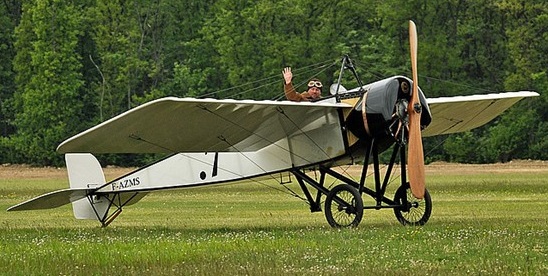
La Ferte-Alais, France, May 18, 2013
F-AZMS (cn SAMS 22.01) M
Built in 1913 in San Francisco CA., powered by a Hall-Scott “80” engine, the aircraft was flown at Grand Junction CO on 23 September 1913 by William Blakeley.
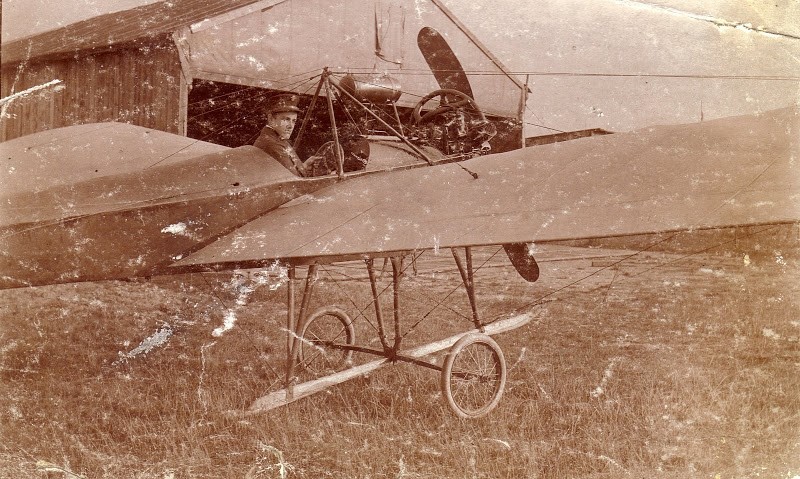
Cologne Eindecker of 1911
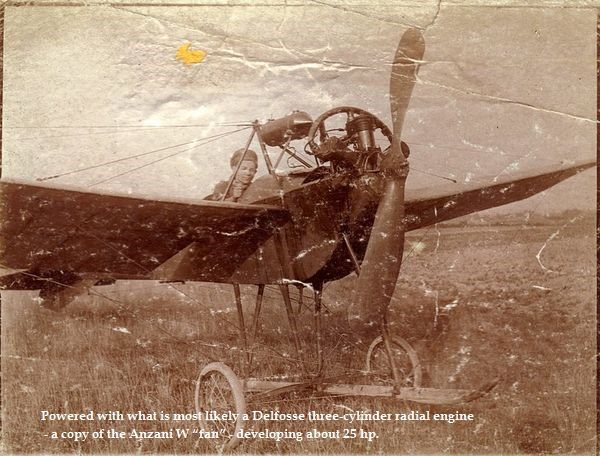
An unidentified Eindecker of 1911 at Cologne. Probably photographed at the Butzweiler farm airfield, what is almost certainly a machine by Jean Hugot or Bruno Werntgen, to name but two possibles among a small group of very early Kölner aviators. Powered with what is most likely a Delfosse three-cylinder radial engine – a copy of the Anzani W “fan” – developing about 25 hp.
 All Aero