A powered version of the Waco CG-4 Glider with two Franklin 6AC-298-N3 engines.
Piston
North Star Aerial Service Loomis Special
The 1926 Loomis Special was a redesign by C G Taylor of another plane for barnstormer Jack Loomis (Taylor’s flight instructor). With a steel tube fuselage, Clark-Y wing, and two place cabin under a monoplane wing. Registered N2594 c/n 2, powered by a 120hp Anzani, it crashed in August 1927, and rebuilt as a four place open cockpit with a 135hp Hallett and reregistered N2954.
Engne: 120hp Anzani
Wingspan: 40’0″
Length: 24′
North Star Aerial Service JN-4D
Pre-1928 a three-place JN-4D was rebuilt as 285=3035 c/n 1.
Northstar Viking
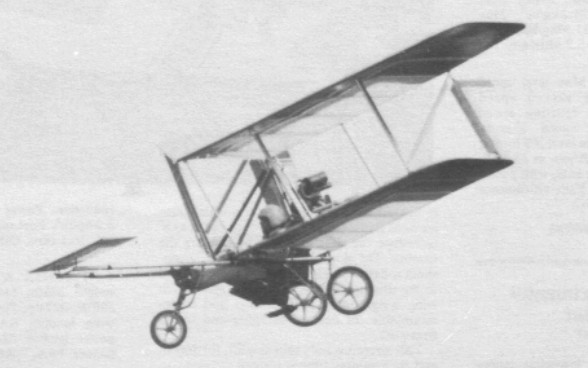
Single seat single engined biplane with two-axis control. Wings have swept back leading and trailing edges, and constant chord; no tail, canard wing. Pitch control by fully flying canard; yaw control by tip rudders between wings; no separate roll control; control inputs through stick for pitch and pedals for yaw. Wings braced by struts and transverse X cables; wing profile; double surface. Undercarriage has three wheels in tricycle formation; glass fibre suspension on main wheels. Push-right go left nosewheel steering independent from yaw control. Brake on nosewheel. Aluminium tube framework, without pod. Engine mounted between wings driving pusher propeller.
Shown at Sun ‘n’ Fun in March 1983 at Lakeland, Florida, the Viking is a variation on the famous Easy Riser theme.Whereas UFM of Kentucky has fitted the Easy Riser with a conventional tail giving rise to the Aeroplane (a 1983 model), Northstar had preferred a canard of variable incidence, thus acting as an elevator, for its Viking.
Designed for cross countries, it gives its pilot comfort and a large speed range. Its Kawasaki TA440 is equipped with an electric start, making it necessary to have a 12 V battery on board. The fuel tank is moulded into the seat back, whose structure is of glass fibre, and other nice touches include a twin blade ground adjustable variable-pitch propeller and a rudder bar which is adjustable according to the height of the pilot. Northstar supplies its Viking in kit form requiring 75 100 h for assembly at an introductory price (March 1983) of $5395. The kit does not require any special tools, assembly being largely with pop rivets.
Engine: Kawasaki TA440, 38.5hp at 6000rpm
Propeller 60 in / 1.52 m ground adjustable) inch
Micro V belt reduction, ratio 2.25/1
Max static thrust 235 lb, 107 kg
Power per unit area 0.22 hp/sq.ft, 2.4 hp/sq.m
Fuel capacity 5.0 US gal, 4.2 Imp gal, 18.9 litre
Wing span 32.0 ft, 9.75 m
Total area of main wings 170 sq.ft, 15.8 sq.m
Nosewheel diameter overall 16 inch, 41 cm
Main wheels diameter overall 20 inch, 51 cm
Empty weight 244 lb, 11.1kg
Max take off weight 502 lb, 228 kg
Payload 258 lb, 117 kg
Max wing loading 2.95 lb/sq.ft, 14.4 kg/sq.m
Max power loading 13.0 lb/hp, 5.9kg/hp
Load factors +5.0, 3.0 design
Max level speed 54 mph, 87 kph
Never exceed speed 55 mph, 88 kph
Max cruising speed 45 mph, 72 kph
Stalling speed 23 mph, 37 kph
Max climb rate at sea level 800 ft/min, 4.1 m/s
Best glide ratio with power off 7/1
Northrop/Northrup Special

The Northrop Special was built by Russ Northrop in 1952. Powered by an 85hp Continental C-85, he inverted gull-wing midget racer was competed into 1955, then was sold as N33N.
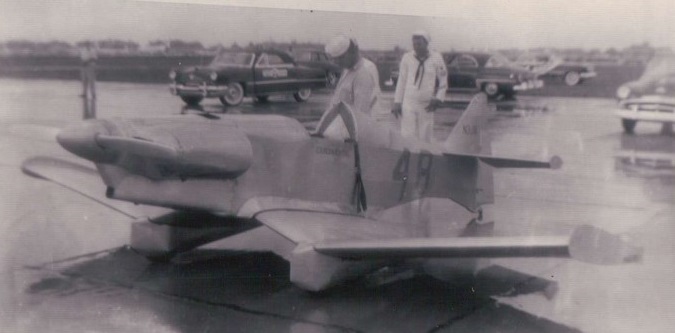
It is sometimes credited to Northrop Aviation, but there was no connection, and the spelling of Russell’s name is seen both ways.
Northrop-Grumman Firebird / Scaled Composites Firebird Model 355
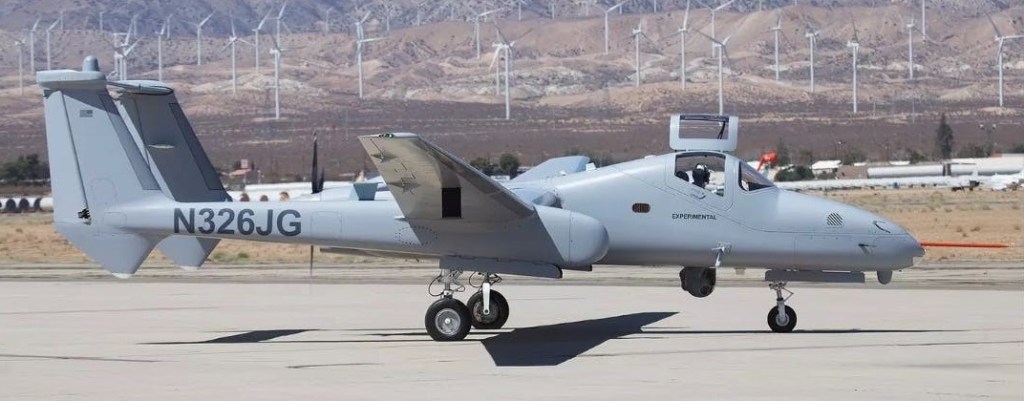
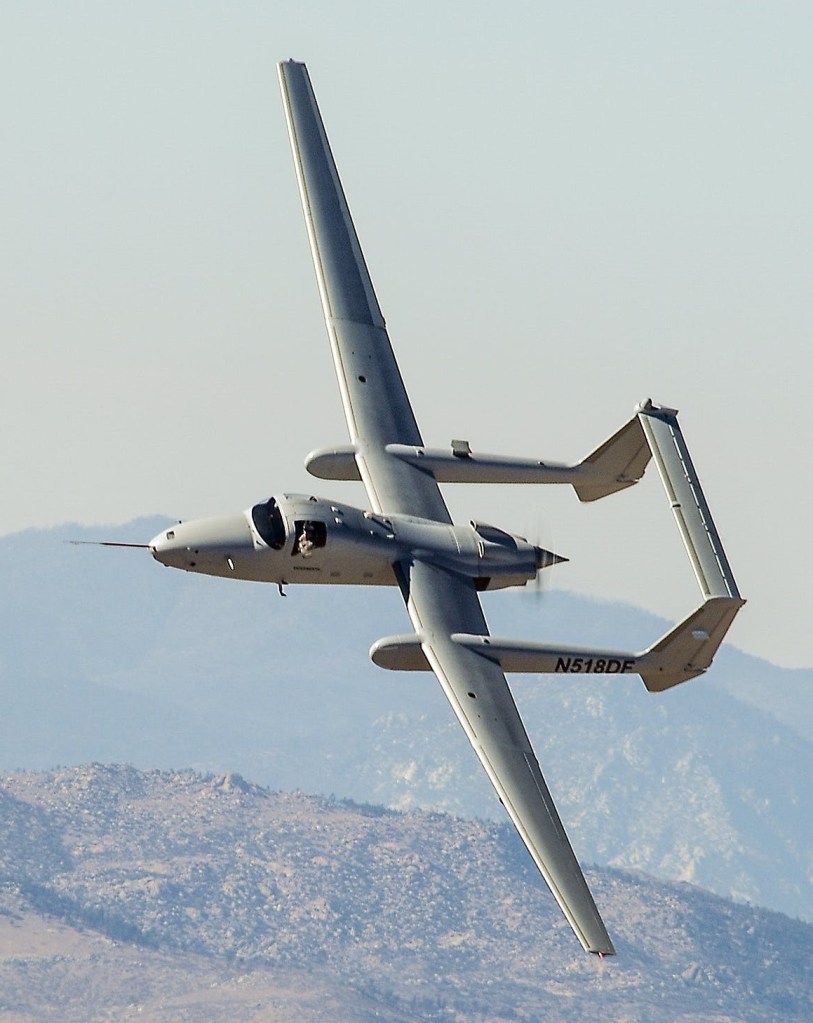
The Firebird concept actually dates the back to the latter half of the 2000s, with Scaled Composites, Northrop Grumman’s storied subsidiary, eventually building a technology demonstrator. That highly experimental aircraft was a forerunner to the current Northrop Grumman designed Firebird, which is a clean-sheet, production-ready aircraft. Scaled Composites’ Firebird demonstrator first flew in 2010 and proved that an optionally manned, highly flexible surveillance aircraft could not only work, but it could compete for missions with both unmanned and manned platforms at the same time.
Firebird in manned configuration. It can be flown by one or two pilots and uses open architecture Garmin 3000 avionics.
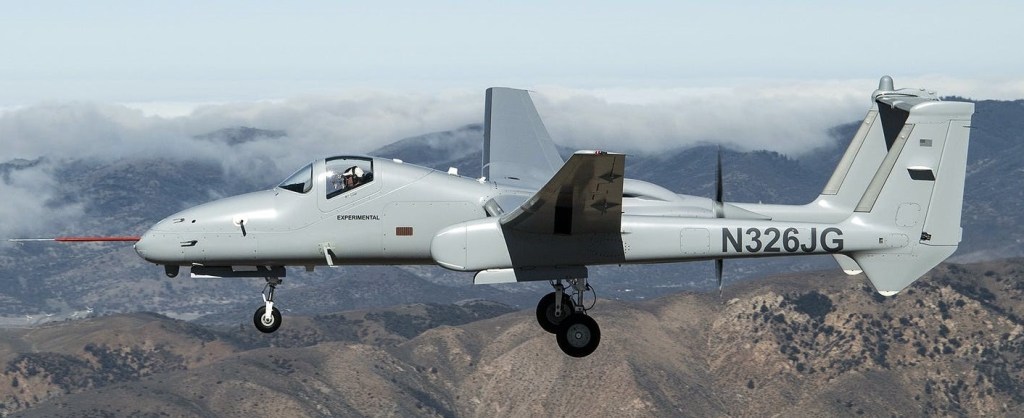
Firebird is that it can self-deploy anywhere in the world with a pilot at its controls and even work out of small, rough airfields. Once forward deployed, it can then be converted into unmanned configuration and fly missions lasting over 30 hours. It single six-cylinder Lycoming TEO-540 engine runs on avgas.
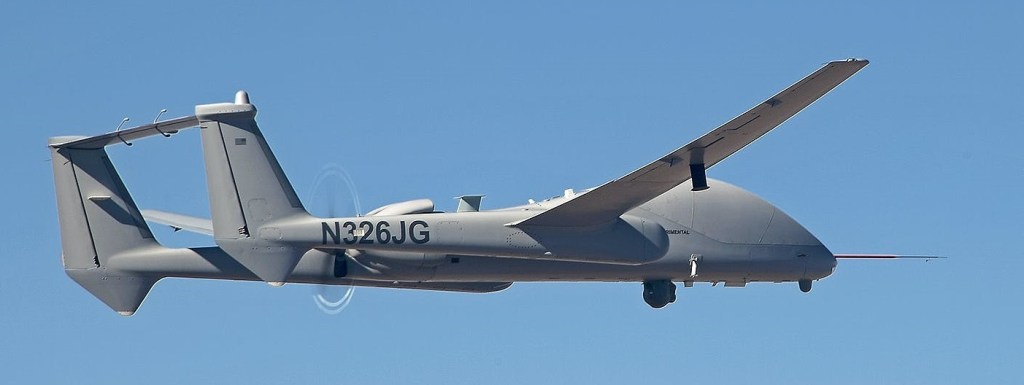
Being able to tailor payloads to the operating environment and mission, some operations and operating areas benefit from or even necessitate a human in the cockpit, while others largely benefit from long-duration missions run from a ground station. Being able to provide both in one airframe is revolutionary, at least in terms of a purpose-built aircraft being sold and sustained by an American aerospace-defense prime contractor.
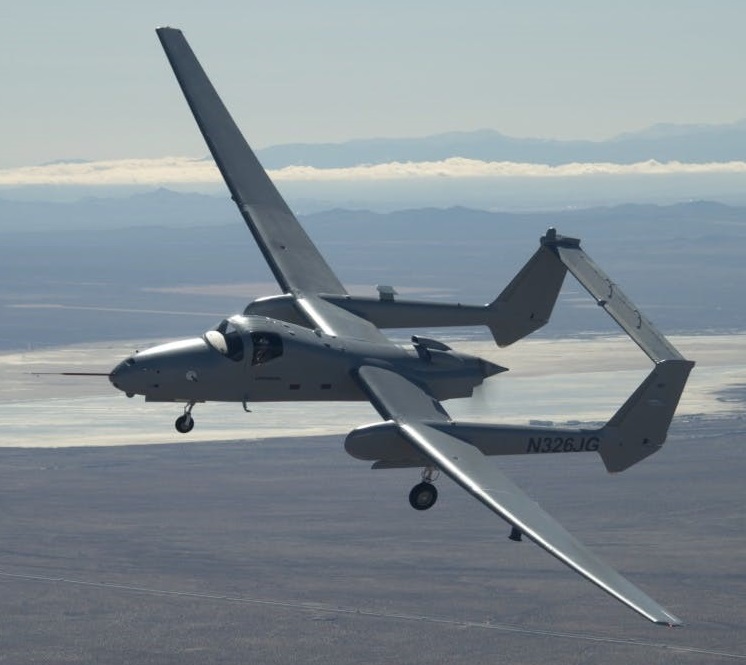
The Firebird can be easily broken down and flown on a transport. Its modular carbon fiber design made this nearly a default capability.
Firebird was into the back half of its flight test program circa 2019.
Northrop N-23 Pioneer / C-125 Raider
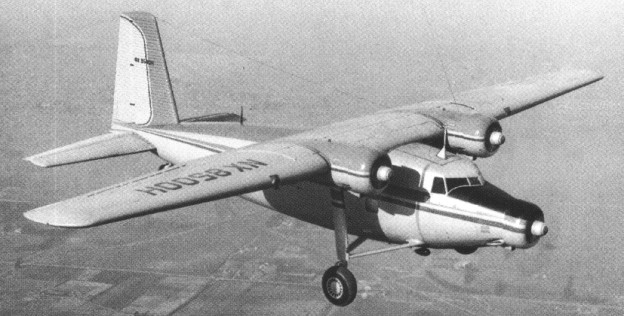
Northrop’s postwar model was intended for the less developed parts of the world where airline operations frequently involved short, unprepared runways. The Pioneer was a 36-passenger (or a combination of fewer passengers but more cargo) design with three 800hp (600kW) Wright R-957 C7BA Cyclone engines and a fixed, conventional landing gear. The prototype made its first flight from Hawthorne, California, on December 21, 1946.
Full-span flaps and retractable ailerons, which had been successfully tested on the P-61 Black Widow, enabled the Pioneer to takeoff at its maximum weight of 25,000lb (11,340kg) in less than 400ft (120m) and to land in 600ft (180m). Dual main landing gear wheels could be installed for operation from soft fields. The cruising speed was only 150mph (240km/h), but that was considered sufficient for the short stages on which the Pioneer would operate. After about a year of test flying, the Pioneer was lost when a make-shift dorsal fin failed during yaw tests. By that time, the Pioneer could not compete with the inexpensive military-surplus transports, even with its outstanding short-field performance. Although the Pioneer program was terminated, the basic design evolved into the larger Northrop C-125 Raider for the USAF. 23 were built with 894kW Wright R-1820-99 engines: 13 as C-125A assault transports and ten as C-125B Arctic rescue aircraft.
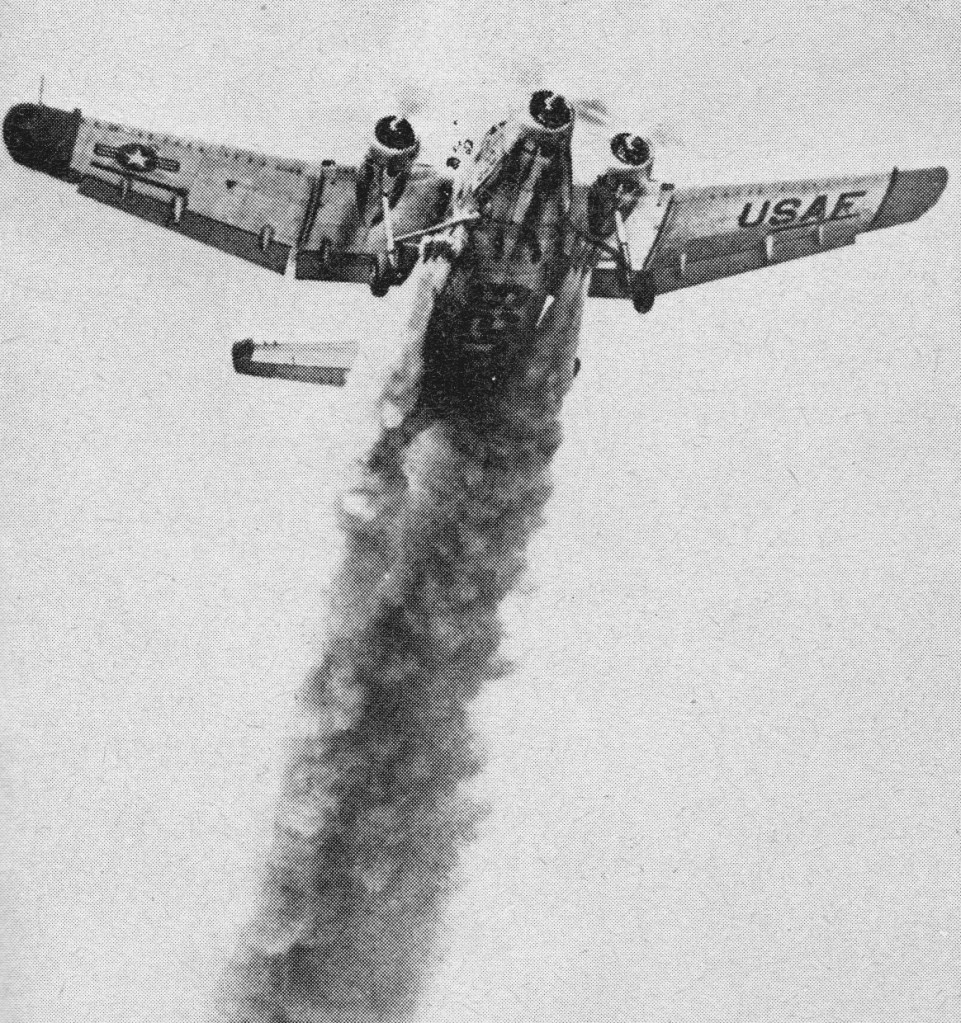
N-23 Pioneer
Engines: three 800hp (600kW) Wright R-957 C7BA Cyclone
Maximum take-off weight: 25,000lb (11,340kg)
TO dist: 400ft (120m)
Landing dist: 600ft (180m)
Cruising speed: 150mph (240km/h)
Capacity: 36-passenger
C-125A Raider
Engines: 3 x 894kW Wright R-1820-99 engines
C-125B Raider
Engines: 3 x 894kW Wright R-1820-99 engines
Northrop N-2B / XP-56
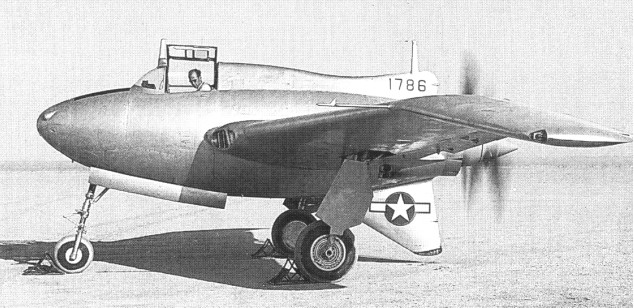
Northrop Aircraft Inc was invited to submit proposals for a new pursuit aircraft (in the R 40C informal Army competition), allotted the designation XP 56, for a single engined pusher. An informal competition initiated late in 1939, the winning contractors being Vultee (XP-54), Curtiss (XP-55) and Northrop (XP-56).
Northrop began to scheme the N 2B in August 1941. A wing very similar to the N-1M, though thinner, was selected for the fighter. On each trailing edge was a single, large elevon, combining the, functions of elevator and aileron. Above each tip was a hinged spoiler for creating drag for yaw control. The fuselage was just a minimal nacelle, with a ventral fin to keep the propeller from hitting the ground.
Armament was to comprise two M 2 20mm cannon and four 0.5in Brownings, grouped in the nose, although this was never fitted. Tricycle landing gear was inevitable, the mainwheels being housed in. the lee of the large ducts that served the engine. Power was provided by a 2,000hp Pratt & Whitney R-2800-29 Double Wasp 18-cylinder radial engine buried in the rear fuselage and driving contra-rotating pusher propellers. The canopy hinged to the right, and for emergency escape the pilot was to jettison not only the canopy but also the propeller, Pratt & Whitney designing a jettison system with explosive cord surrounding the gearbox. The propeller eventually used was a Curtiss, Electric contraprop, with two three blade units. The primary structure was entirely magnesium, welded by the company’s patented Heliarc process (which sur¬rounded the are with inert helium) perfected during construction of this aircraft.
As far as possible it was based on the experience gained with the N-1M. It even retained the down sloping wing tips, though the angle was not acute and the control system was of the latest type with bellows¬ opening split “trim rudders” (i.e., ailerons) used as single surfaces for lateral control and opened into upper and lower spoilers for making properly banked turns. The actuation of these surfaces was novel. Air was rammed in through a forward facing intake on each tip, taken through a duct and diverted by valves to pressurise the bellows when required. In straight and level flight the duct was open at both ends, creating little drag.
At first Northrop tried to stay as close as possible to the pure all wing concept, and planned for the pilot to lie prone, but when the Army began to talk about a prototype contract they made it clear they wanted a regular body with a conventional cockpit. Eventually they purchased two prototypes, ordered on 26 September 1940 and 13 February 1942 respectively, each having quite a fat body of symmetrical streamline form containing a 2,400 h.p. Pratt & Whitney R 2800 Double Wasp engine. Cooling the engine was, as in the N 1M, a major problem. Air was rammed in through large wing root intakes, ducted sharply in to the engine bay and allowed to escape past the baffled cylinders and out via the ejector assisted exhaust ducts. Cooling airflow was assisted by a high speed fan geared up from the engine, but to perfect the installation would have been a very large task. The unpressurised cockpit was immediately ahead of the engine, and the nose was planned for an eventual armament of two 20mm and four 0.50in guns. Elevators were fitted inboard of the tip droops, there was a large delta fin above and below the rear fuselage and the main wheels of the tricycle landing gear were housed in bays immediately behind the cooling ducts.
According to Northrop two prototypes were ordered on September 26, 1940, at a price of $411,000; other observers insist the second was not signed for until February 13, 1942. The first XP 56 was delayed by the decision of Pratt & Whitney to drop the X 1800. The R 2800 Double Wasp was already giving 2,000 h.p. while the, X 1800 did not look like maturing until after the war. The decision, was taken on, July 21, 1941, and Pratt & Whitney had to make a Double Wasp with concentric drive shafts and the jettison device (the R 2800 29), while Northrop had to rearrange, the, engine bay and central wing structure to pick up the big 18 cylinder radial and supply it with air, the latter augmented by a fan and discharged via gills ahead of the spinner. Another change was to alter the anhedral of the outer wing as a result of N-1M testing. Eventually the XP 56 emerged in March 1943. In April test pilot John Myers began taxiing tests and found directional stability unsatisfactory. Especially as speed was increased, the XP 56 by now for some – reason dubbed “The Black Bullet” tended to swerve violently, skidding the, tyres and rocking laterally. At least part of the trouble was due to the; brakes, and a new hydraulic brake system, was fitted to give smoother differential action.
After further cooling and system difficulties, the XP 56 first flew on September 30, 1943. It had been expected that the ventral fin added, to the contraprop side area would prove adequate for weathercock stability, but it was clear that directional stability was almost non existent. A larger upper fin was quickly added over the original, and from then on the handling seemed to be satisfactory. No photographs are known of the modified aircraft. In any case, USAAF 41 786 was soon written off. According to one set of writers it suffered a burst mainwheel tyre. According to another it suffered nose-wheel shimmy, leading to failure of the nose leg. For whichever reason, the aircraft somersaulted and was demolished. Myers broke his back, though his head was saved by the fact he habitually wore his polo helmet.
When the second aircraft, 42 38353, emerged the upper fin was even larger than on the modified No.1 aircraft. A further modification was that the, wingtips now carried bellows-type split ailerons for lateral and yaw control, replacing the upper and lower surface spoilers. Each tip was formed by a large venturi duct which normally sucked the split surfaces closed. For yaw control the surfaces were blown open by a bellows to which ram air from the tip duct was admitted via a diverter valve.
The second Bullet was flown by Harry Crosby from Hawthorne, on March 23, 1944. Though flight characteristics were better than for the first aircraft the engine did not deliver full power, the nosewheel would not lift off until an airspeed of 160 m.p.h. had been reached, and the flight was terminated after 7½ min. On the second flight, with gear retracted, the trim was normal but speeds were below prediction. So concerned were, Northrop at the failure to reach design speeds (the objective was 465 mph at 25,000ft), that they booked a place in the queue for the giant open jet wind tunnel of the NACA at Molfett Field. Meanwhile, testing continued, but on the tenth flight the pilot logged so many shortcomings that it was decided to discontinue further flying.
By this time the XP 56 had been outclassed by such conventional fighters as the P 51, and overtaken by the jet engine. In 1979 No 2 was still intact, held by the Smithsonian.
XP-56
Max take-off weight: 5148 kg / 11349 lb
Empty weight: 3946 kg / 8699 lb
Wingspan: 12.98 m / 42 ft 7 in
Length: 8.38 m / 27 ft 6 in
Height: 2.94 m / 9 ft 8 in
Wing area: 28.52 sq.m / 306.99 sq ft
Max. speed: 671 km/h / 417 mph
Range: 1062 km / 660 miles
Crew: 1

Northrop XB-35

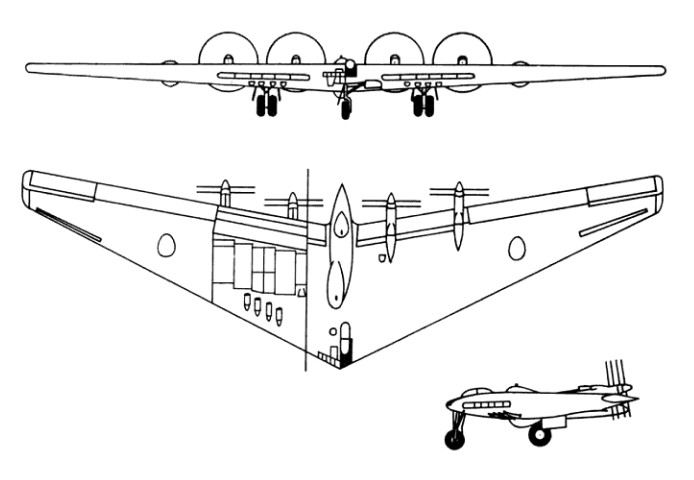
In 1941 Northrop developed a flying wing design to compete with the Consolidated Model 37. Conceptually more advanced than the B-36, the Northrop XB-35 was a low-drag flying wing with four piston engines in the wings driving contra-rotating pusher propeller units. The type was ordered in prototype form as the XB-35 in November 1941. Powered by four 2237kW Pratt & Whitney R-4360 Wasp Major piston engines driving eight-bladed counter-rotating pusher propellers behind the trailing edges of the 172-ft (52.43m) span wing they could carry a maximum bombload of 56,000 lb (25,402 kg), or a 20,000-lb (9072-kg) bombload over a radius of only 2500 miles (4023 km). The XB-35 was faster than the XB-36 (especially at lower altitude), possessed a usefully higher service ceiling, and was also considerably more agile than the XB-36.
There had been problems with the prototype, but these were concerned with factors such as the propeller gears stripped, blade pitch reversed in flight, propellers ‘ran away’, uncontrollable fires started, rather than the structure and flight characteristics of the basic airframe.
The first of 15 YB-35 aircraft ordered in early 1943, flew on 25 June 1946, followed by the second in the following year. With the B-36 slated for production, it was then decided to use the design for the evaluation of jet power in a strategic bomber the production contract was cancelled.
The second and third YB-35 pre-production prototypes were converted into YB-35B aircraft: their four 3250-hp (242 3-kW) Pratt & Whitney R4360 piston engines were replaced by eight 4000-lb (1814-kg) thrust Allison J35-A-5 turbojets, a quartet of the jets being grouped in each trailing edge and aspirated through the same arrangement of leading-edge inlets used to supply carburation and cooling air for the piston engines of the original aircraft.
The YB-35B was redesignated YB-49 while it was being rebuilt, and the first aeroplane flew in October 1947.
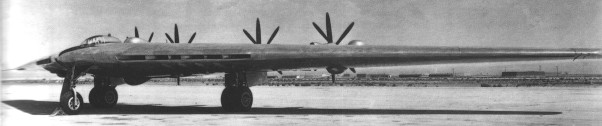
Engines: 4 x Pratt & Whitney R-4360 Wasp Major, 2624kW / 3250 hp
Max take-off weight: 76340 kg / 168302 lb
Wingspan: 52.4 m / 171 ft 11 in
Length: 16.2 m / 53 ft 2 in
Wing area: 372 sq.m / 4004.17 sq ft
Max. speed: 605 km/h / 376 mph
Range: 4023 km / 2500 miles
Bombload: 20,000 lb / 9072 kg
Crew: 9
Northrop P-61 Black Widow

The Northrop P-61 Black Widow began in August 1940, at the height of the Blitz on London. During this time, the US air officer in London, Lt. Gen. Delos C. Emmons, underwent a briefing on British progress on radar. British scientists and engineers were at that time working on the early versions of AI (Airborne Interception) radar sets which could be carried aboard airplanes, enabling them to detect and intercept other airplanes in flight without having to rely on ground installations.
Northrop P-61 Black Widow Article
At the same time, the British Purchasing Commission that was shopping for aircraft in the USA announced that they urgently required a night fighter that would be capable of stopping the German bombers that were attacking London by night. Such a fighter would have to be able to stay on station above London all night, which meant at least an 8-hour loiter time. In addition, the night fighter needed to have sufficient combat altitude in order to take on the bombers when they showed up.
When General Emmons returned to the USA, he reported that the British had an urgent need for night fighter aircraft, and that American industry might be able to supply that need. A preliminary specification was drawn up by the Emmons Board and was passed on to Air Technical Service Command at Wright Field in late 1940. Because of the heavy weight of the early AI radar and because of the high loiter time required, a twin-engined aircraft was envisaged.
Northrop Chief of Research Vladimir H. Pavlecka happened to be at Wright Field at that time on an unrelated project, and was told of the Army’s need for night-fighters. However, he was told nothing about radar, only that there was a way to “see and distinguish other airplanes”. He returned to Northrop the next day. On October 22, Jack Northrop met with Pavlecka and was given the USAAC’s specification. At this time, no other company was known to be working on night fighters, although at about this time Douglas was starting work on their XA-26A night fighter and the AAC were considering the A-20B as an interim night fighter.
Northrop’s proposal was a twin-engined monoplane powered by a pair of Pratt & Whitney R-2800 Double Wasp air-cooled radial engines mounted in low-slung nacelles underneath the wings. The nacelles tapered back into twin tail booms which were connected to each other by a large horizontal stabilizer and elevator. The long fuselage housed a crew of three. The crew consisted of a pilot, a gunner for the nose turret, and a radar operator/rear turret gunner. Each turret housed four 0.50-inch machine guns. A tricycle landing gear was fitted. Estimated weights were 16,245 pounds empty, 22,654 pounds gross. Height was 13 feet 2 inches, length was 45 feet 6 inches, and wingspan was 66 feet. These dimensions and weights were more typical of a bomber than a fighter.
On November 14, Northrop presented this revised design to the USAAC. An additional gunner’s station was fitted. Nose and tail turrets of the original version were replaced by twin 0.50-in machine guns in the belly, and four 0.50-in machine guns in a dorsal turret. The crew was now up to four-a pilot, a radar operator, and two gunners. The airborne intercept radio was moved to the nose.
The design was revised still further on November 22. The belly turret was deleted, and the crew was changed back to three-pilot, gunner, and radar operator. The pilot sat up front, and the gunner sat immediately behind and above the pilot. The gunner was to operate the turret via remote control, using a special sight attached to a swiveling chair. A “stepped-up” canopy was used to provide a clear field of view for the gunner. The rear fuselage with its clear tail cone provided the radar operator with an excellent rearward view which enabled him to act as a tail gunner if the plane happened to be attacked from astern. Optionally, the dorsal turret guns could be “locked” into the forward-pointing position, so that they could be fired by the pilot. The belly guns were deleted, and four 20-mm cannon were to be fitted in the wings. This design was formalized into Northrop Specification 8A (or NS-8A), dated December 5, 1940.
Incorporated into the night fighter design was the Zap wing and Zap flap, named after Edward Zap, a Northrop engineer. These were attempts to increase the maximum lift coefficient and to decrease the landing speed by the use of improved lateral control and lifting devices
NS-8A was submitted to Wright Field. The Army was generally pleased with the design, but they suggested some changes. A letter of quotation prepared by Northrop for two experimental prototypes was presented to Materiel Command on December 17, 1940. Northrop signed the formal contract on January 11, 1941. A contract was let on January 30, 1941 for two prototypes and two wind-tunnel models. On March 10, 1941, a contract was issued for 13 YP-61 service test aircraft, plus one engineless static test airframe.
The mockup was ready for inspection in April of 1941. At that time, it was decided to move the four 20-mm cannon from the outboard portion of the wings to the belly. This was done to improve the ease of maintenance and to make the airflow over the wing smoother. The internal fuel capacity was increased from 540 gallons in two tanks to 646 gallons in four self-sealed tanks built into the wings.
In the meantime, development of the A/I radar had proceeded at a rapid pace. Radar development in the United States had been placed under the control of the National Defense Research Committee. The NDRC’s Microwave Committee in turn had established the Radiation Laboratory at the Massachusetts Institute of Technology. The Radiation Laboratory was to handle the development of the XP-61’s airborne interception (AI) radar. The designation of the radar was AI-10. The AI-10 radar was given the military designation SCR-520, where SCR stood for “Signal Corp Radio” (some references have this as standing for “Searchlight Control Radar”). The Western Electric corporation was assigned the responsibility of refining the design and undertaking the mass production of the radar.
In October 1941, a pedestal-type mount for the turret guns was substituted for the General Electric ring-type mount.
A letter of intent was initiated on December 24, 1941, which called for 100 P-61 production aircraft and spares. Fifty more were ordered on January 17, 1942. The order was increased to 410 aircraft on February 12, 1942, fifty of which were to be diverted to the RAF under Lend-Lease. The RAF order was eventually cancelled.
The XP-61 flew at Northrop Field for the first time on May 26, 1942, piloted by contract test pilot Vance Breese. It was powered by a pair of Pratt & Whitney R-2800-10 radials of 2000 hp each. In keeping with its nocturnal role, it was finished in black overall, befitting its popular name that was taken from the poisonous North American spider. Wingspan was 66 feet, length was 48 feet 10 inches, and height was 14 feet 2 inches. Weights were 19,245 pounds empty, 25,150 pounds gross, and 28,870 pounds maximum. The aircraft was equipped with only a mockup of the top turret, as General Electric had not yet been able to deliver the real thing because of the higher priority of other projects.
The XP-61 had a maximum speed of 370 mph at 29,900 feet, and an altitude of 20,000 feet could be attained in 9 minutes. Service ceiling was 33,100 feet, and maximum range was 1450 miles.
In mid-June 1942, a new horizontal tail was designed to complement the full-span flaps. Eventually, the Zap flaps were completely eliminated because of their high cost and complexity of manufacture, and spoilers were added to supplement the conventional ailerons. The spoilers were located in the rear one-third of the wing, and were one of the most successful innovations introduced during the entire Black Widow program. Operating in conjunction with the conventional ailerons, the spoilers provided the desired rolling moment at speeds even below the stalling speed. Although the spoilers were fully capable of providing all necessary lateral control on their own, the ailerons were nevertheless still left on the airplane if only to provide “warm fuzzies” to pilots who were used to conventional ailerons.
On May 25, 1942, an agreement was reached between Northrop and the USAAC to produce 1200 P-61s at a government facility in Denver, Colorado. By the end of July, that order had been cut down to 207 aircraft and it was decided that the Northrop facilities at Hawthorne were to be used after all.
The thirteen YP-61s were delivered during August and September of 1943. In order to reduce vibrations from firing the 0.50-inch turret machine guns, some YP-61s were fitted with only two turret guns. The assignments of the YP-61s were varied. Some stayed at Northrop for flight testing and factory training of maintenance personnel. Some went to Wright Field in Ohio for service testing. Others went to Florida where they underwent operational suitability testing.
The YP-61s initially did not have any airborne interception radar fitted, but the SCR-520, a preproduction version of the SCR-720 which was to go into the production P-61A, was installed.
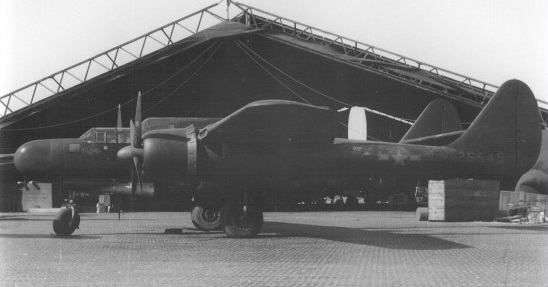
It made its operational debut in the South Pacific in the summer of 1944 and was the standard USAAF night fighter at the end of the war. Unlike other USAAF fighters such as the P-47 Thunderbolt or P-51 Mustang, the Black Widow did not chalk up a particularly impressive number of kills, because by the time of its entry into service, the Allies had already established almost overwhelming air superiority over virtually all fronts, and enemy aircraft were rather few and far between, especially at night.
The F-15A two-seat strategic reconnaissance variant first flew in 1946.
A total of 706 aircraft were built.
P-61A
Engines: 2 x Pratt & Whitney R-2800-10, 2000 hp
Wingspan: 66 ft / 20.12 m
Length: 48 ft 11 in / 14.92 m
Height: 14 ft 8 in / 4.49 m
Empty weight: 24,000 lb / 10,886 kg
Max loaded weight: 32,400 lb / 14,696 kg
Max speed: 366 mph / 590 kph
ROC: 2200 fpm / 670 m/min
Service ceiling: 33,000 ft / 10,060 m
Range max fuel: 500 mi
Armament: 4 x 20mm M-2 cannon (belly), plus in first 37 A: 4 x 0.5in dorsal
P-61B
Engines: 2 x Pratt & Whitney R-2800-65 Double Wasp, 1491kW / 2219 hp
Wingspan: 20.12 m / 66 ft 0 in
Length: 15.11 m / 49 ft 7 in
Height: 4.47 m / 14 ft 8 in
Wing area: 61.53 sq.m / 662.30 sq ft
Max take-off weight: 16420 kg / 36200 lb
Empty weight: 10637 kg / 23451 lb
Max. speed: 589 km/h / 366 mph
ROC: 2200 fpm / 670 m/min
Ceiling: 10090 m / 33100 ft
Range: 2173 km / 1350 miles
Range max fuel: 2800 mi / 4500 km
Bombload: 6400 lb
Armament: 4 x 20mm M-2 cannon (belly), plus in last 250 B: 4 x 0.5in dorsal
Crew: 3
P-61C
Engines: 2 x Pratt & Whitney R-2800-73, 2800 hp
Wingspan: 66 ft / 20.12 m
Length: 49 ft 7 in / 15.1 m
Height: 14 ft 8 in / 4.49 m
Empty weight: 24,000 lb / 10,886 kg
Max loaded weight: 40,300 lb / 18,280 kg
Max speed: 430 mph / 692 kph
ROC: 3000 fpm / 914 m/min
Service ceiling: 41,000 ft / 12,560 m
Range max fuel: 2800 mi / 4500 km
Bombload: 6400 lb
Armament: 4 x 20mm M-2 cannon (belly), 4 x 0.5in dorsal
F-15
2 seat strategic reconnaissance
Engines: 2 x Pratt & Whitney R-2800-73, 2800 hp
Wingspan: 66 ft / 20.12 m
Length: 50 ft 3 in / 15.3 m
Height: 14 ft 8 in / 4.49 m
Empty weight: 22,000 lb / 9979 kg
Max loaded weight: 28,000 lb / 12,700 kg
Max speed: 440 mph / 708 kph
ROC: 3000 fpm / 914 m/min
Service ceiling: 41,000 ft / 12,560 m
Range max fuel: 4000 mi / 6440 km
Armament: none


