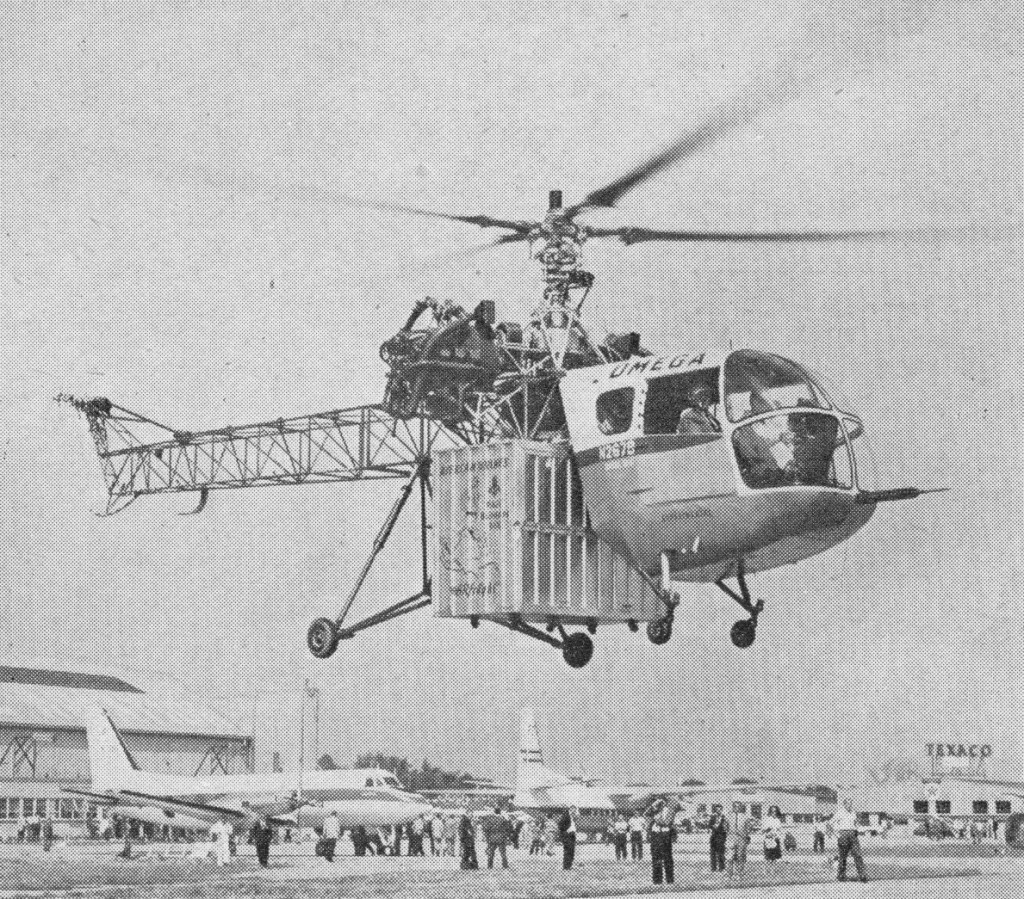
The Omega BS-12 four-seat, twin-engined helicopter flew in 1956, and was succeeded by the BS-12D with more powerful engines and the 1963 BS-12D3S supercharged version.
Developed from an original Canadian design with two Franklin engines, the BS-12 could carry a 1500 lb load.
Production was to have started in 1964, when all development was suspended after completion of four prototypes.
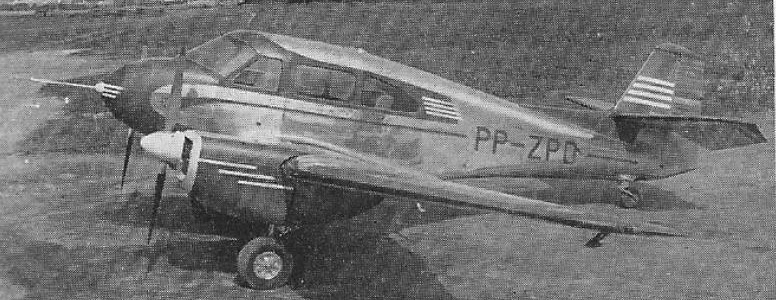
Designed to operate from small airfields, the Casmuniz 52 sive-seat cabin monoplane is the first all-metal twin designed in Brazil.
The prototype was designed and completed in 1952 by Cassio Minuz S.A. of Sao Paulo, and eighty per cent of the skin is made of uniformed or single-curvature aluminium sheet panels to facilitate replacement in any locality of limited resources. It was first flown in April 1952.
Oficina de Manutenco e Recuperaceo de Avioes Ltda, the Brazilian maintenance and overhaul facility based at Sao Paulo, acquired manufacturing rights to the Casmuniz 52 and sole prototype in 1955. OMAREAL took over the flight testing of the sole prototype, but no production ensued.
Engine: 2 x Continental E185, 185 hp Max speed: 200 mph Cruise: 165 mph Range: 700 mi Seats: 4-5
The Old Rhinebeck Aerodrome has a reproduction 1910 Hanriot constructed by Cole Palen, Mike Lockhart, and Andy Keefe with the aid of drawings published in Flight during the winter of 1974 in Florida. It had originally been powered by a 1910, two-cycle, water-cooled Elbridge Featherweight engine, but it had later been retrofitted with a more capable, water-cooled, 50-hp Franklin after it had sustained connecting rod damage. Because of its lower weight, it often resulted in a nose-high pitch which had to be elevator-counteracted during flight, although its increased horsepower produced more sprightly performance than the original engined-version had offered.
The aircraft, initially demonstrating stability problems, was subsequently modified and first performed in the 1976 Hammondsport Air Show. Demonstrating its handling characteristics much further afield, it partook, along with the Curtiss Model D and the Sopwith Camel, of the 2003 Australian International Air Show in Geelong, flying circuits round Avalon Airport 11,000-foot runway.
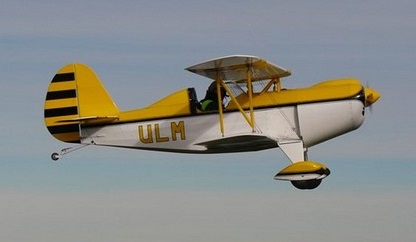
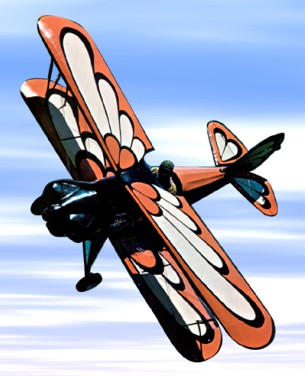
The Baby Great Lakes (one place) and Buddy Great Lakes (two place) aircraft are well proven designs which are easy to construct and fly, provide classic good looks, and are aerobatic. Construction is of wood and steel tubing and plans are well presented for the first time builder.
Aircraft Spruce & Specialty Company acquired all rights to these designs in May 1996 and now offers packs, plans, raw materials kits, and pre-fabricated kits for these aircraft.
My Dad was great friends with Walt Redfern. We owned one of the Great Lakes that he built (red and white). I even got sick in it while doing loops over Henley. Tim Heale
Engine: Lycoming O-235, 108 hp HP range: 85-125 Height: 6.25 ft Length: 14.67 ft Wing span: 18 ft Wing area: 98 sq.ft Weight empty: 550 lbs Gross: 1000 lbs Fuel cap: 14 USG Speed max: 135 mph Cruise: 135 mph Range: 250 sm Stall: 55 mph ROC: 1600 fpm Take-off dist: 400 ft Landing dist: 400 ft Service ceiling: 14,000 ft Seats: 2 Landing gear: tail wheel
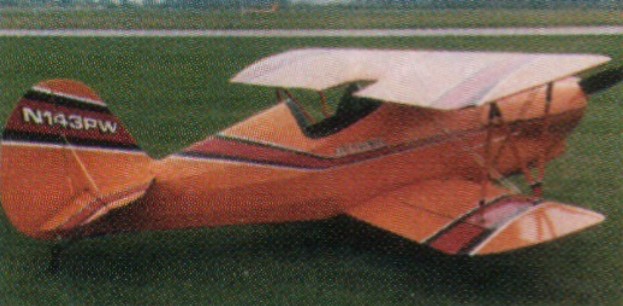
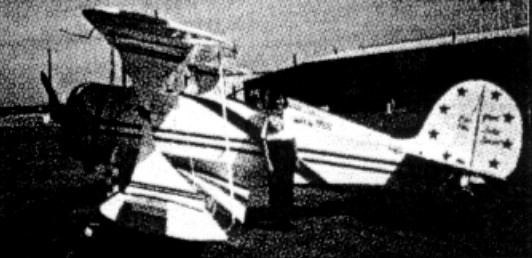
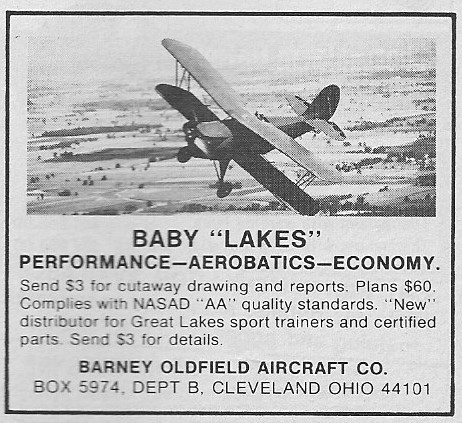
Harvey R. Swack had encountered a fellow named Barney Oldfield no relation to the auto racer who had designed a small, single seat sport biplane for homebuilders. Swack went into business with Oldfield, selling plans of the 2T 1 under the name “Baby Great Lakes” which he was entitled to do, as owner of the name, although the little homebuilt bore only a distant, imitative relationship to the original. When Champ¬lin bought Great Lakes Aircraft Company from Swack, Swack changed the name of the homebuilt design to “Barney Oldfield Special,” though it is still informally known as the “Baby Lakes.”
Dec 1973
Feb 1974
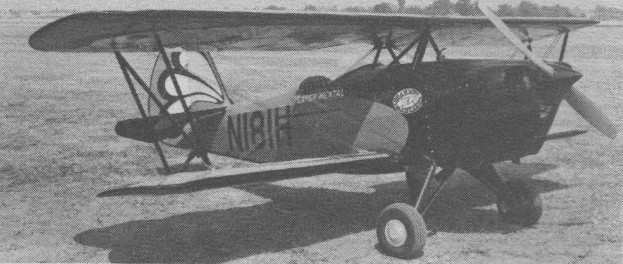
Barney Oldfield’s Baby Great Lakes flys much like its big brother, the Great Lakes Sport Trainer. The Baby “Lakes” was designed to get the same sort of flying ease and performance at lower cost. It uses a steel-tube fuselage, wood wings and fabric cover, and offers unusually lively aerobatic performance when powered by an 85-hp Continental engine. The Baby Lakes can also be fitted with 50- to 100-hp Continentals or the 108- and 125-hp Lycomings. (When fitted with the 108- and 125-hp engines, the airplane is called the Super Baby Lakes.) Its makers say it will out fly aircraft of twice the horsepower, and it is the least expensive, high-performance biplane available to the homebuilder.
Baby Lakes
The Baby Great Lakes (one place) and Buddy Great Lakes (two place) aircraft are well proven designs which are easy to construct and fly, provide classic good looks, and are aerobatic. Construction is of wood and steel tubing and plans are well presented for the first time builder. Aircraft Spruce & Specialty Company acquired all rights to these designs in May 1996 and offers packs, plans, raw materials kits, and pre-fabricated kits for these fine aircraft. The Baby Great Lakes Main Tank Standard holds 10 gallons. The Baby Great Lakes Tank Stretch is 3″ longer and holds 11 gallons.
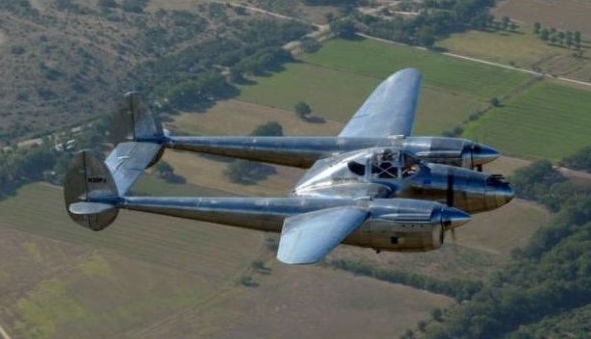
Jim O’Hara, a retired college professor, learned to fly in 1988. Six years later, he began construction of a two-thirds-scale P-38. Using information he obtained from various sources about the P-38, Jim drew up a set of plans in CAD and began building the plane with only his wife Mitzi aiding him in the construction of the aircraft.
He first flew his plane in July 2008, and at 81 years old in November 2009, he and his wife made its maiden cross-country trip.
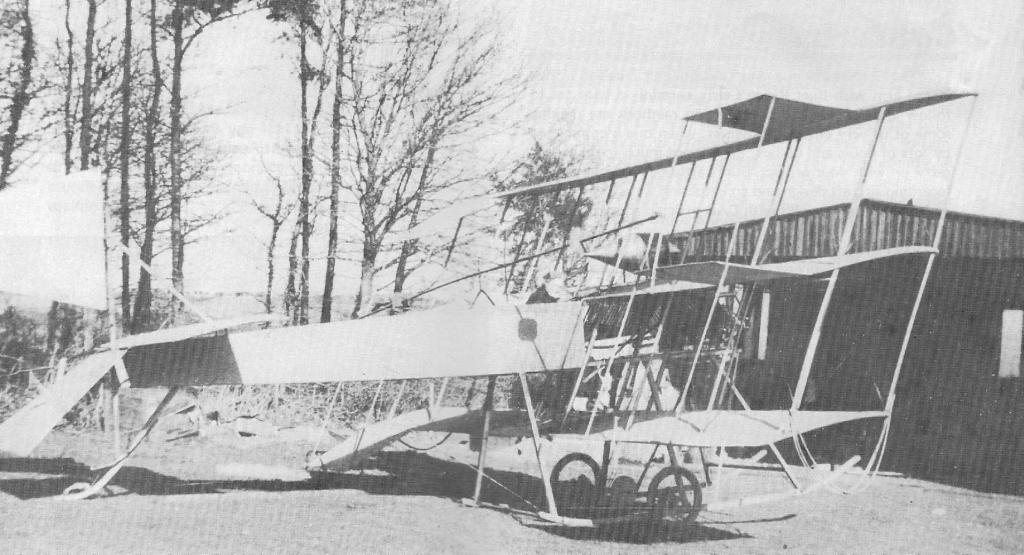
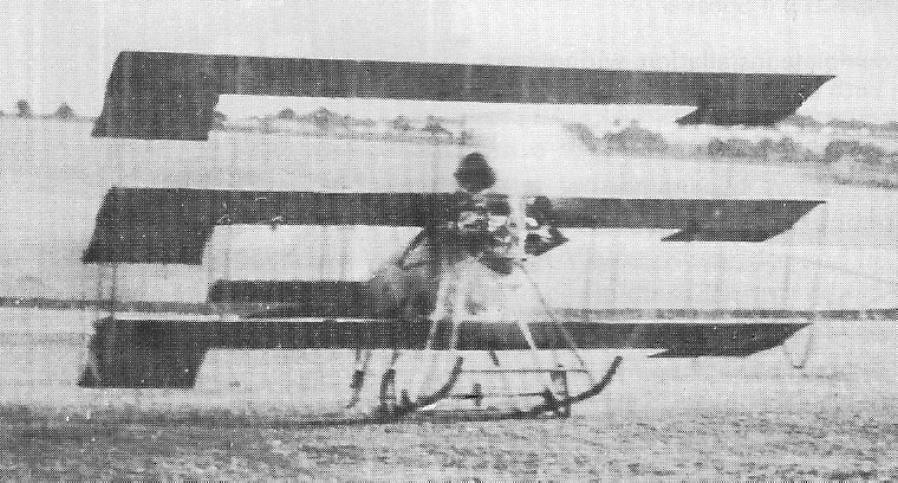
The second machine of Bertram Ogilvie wa a larger triplane about 12 feet high at the upper mainplane. The success of this aircraft is reputed to have been no better than that of the first. But Bertram Ogilvie, and Arthur Pickard-Hawkins, his employer, who’s help and encouragement had been instrumental in construction of these first two machines, set about building a third, still with the intention of testing Ogilvies ‘briai child’ the aileron.
Prior to construction of his first aircraft, Ogilvie built a small wing of about 4 foot span, mounting it behind a motor vehicle, and had observed its reaction when, with the aid of cords, the ailerons were activated.
By all accounts, the third aircraft proved successful, and Lord Kitchener who witnessed flights at ‘Grafton’, the Pickard-Hawkins’ property at Maraenui near Napier, was so impressed that he undertook to arrange publicity for Ogilvie and his aircraft should he take it to England.
On arrival in the UK Ogilvie and Pickard-Hawkins assembled the aircraft at Aldershot. With top military personnel present in preparation for Oglvie’s display, difficulty was experienced in coaxing the engine into life and, in the ensuing confusion the throttle was left open. When the motor finally fired the aircraft careered across the airfield and was wrecked.
Arthur Pickard-Hawkins returned to New Zealand but Bertram Oglvie remained in the UK and became and aircraft designer with Handley Page Ltd.