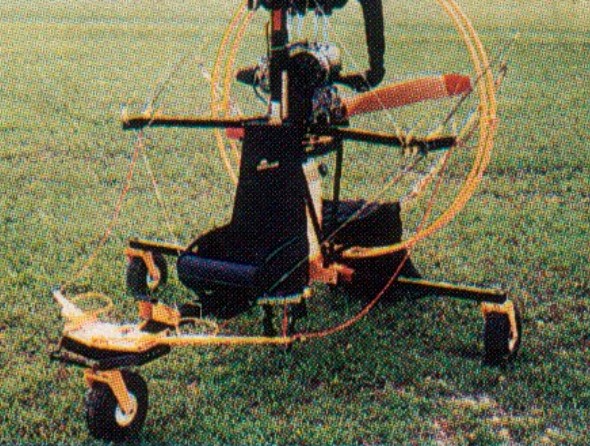
ParaPlane Corp WD-1 Wind Dancer

Manufactured in the USA and supplied as a completely assembled trike style powered parachute. The rectangular ram air parachute has a zero porosity silicon coating. Electric start was included, and powder coating optional.

Engine: Rotax 447, 42 hp
Height: 5.5 ft
Length: 6.5 ft
Wing span: 31.5 ft
Wing area: 370 sq.ft
Empty weight: 180 lb
Gross weight: 519 lb
Fuel capacity: 4 USG
Speed max: 26 mph
Cruise: 26 mph
Range: 26 sm
Rate of climb: 550 fpm
Service ceiling: 7,500 ft
Takeoff dist: 150 ft
Landing dist: 100 ft
Landing gear: nose wheel
Seats: 1

ParaPlane Corp PSE / PSE-1 / PSE-2 Osprey

The PSE-1 was designed by Dan Thompson and was only sold to the military.

Scott Kelly (ParaPlane Corporation 1983-1994) designed the PSE-2 for ParaPlane Cooperation and put it into production.

PSE-SF was the Special Forces version of the PSE-2 and 12 were delivered for Operation Desert Storm.

PSE-WD was a highly modified version of the PSE-2 that was made exclusively for Disney World.

The PSE-2 (named Osprey) was advertised circa 1998 as manufactured in the USA and supplied as a completely assembled trike style powered parachute. The rectangular ram air parachute has a zero porosity silicon coating. Electric start was included, and powder coating optional.

Engine: Rotax 503, 46 hp
Height: 6.5 ft
Length: 6.5 ft
Wing span: 30.6 ft
Wing area: 370 sq.ft
Empty weight: 235 lb
Gross weight: 554 lb
Fuel capacity: 4.9 USG
Cruise: 28 mph
Range: 25 sm
Rate of climb: 650 fpm
Service ceiling: 7,500 ft
Takeoff dist: 150 ft
Landing dist: 100 ft
Seats: 1
Landing gear: nose wheel

ParaPlane Corp Paraplane

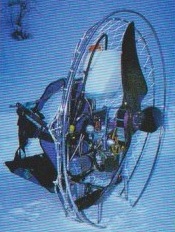
Single seat twin engined motorised parachute with constant chord. Control inputs through pedals for yaw. Pilot suspended below wing in trike unit. Undercarriage has three wheels in tricycle formation. Nosewheel steering. No brakes. Aluminium tube trike unit, without pod. Engines mounted below wing driving pusher propellers.
The ParaPlane, which is listed as an ultralight in the USA, is in fact a motorised parachute. Shown at Sun ‘n’ Fun in March 1983 at Lakeland, Florida, this amazing flying machine only flew once due to difficult weather conditions.

Designed by Steve Snyder, the ParaPlane uses as its ‘wing’ a 28.5 ft (8.69 m) parachute of constant chord giving 375 sq.ft (34.8 sq.m) of lifting surface. For pilots heavier than 185 lb (84kg), it can also be equipped with a 36.0ft ‘wing’ of 450sq.ft (10.97 m, 41.8 sq.m). The contraption is flown like a non powered parachute wing, its pilot steering via lines attached to foot pedals to give directional control. The rear wheels of the trike unit are free to castor and are unbraked, the structure being made of alumi-nium tubes with a hammock seat and shoulder harness. Behind the seat, the engine mount carries the two Solo 210cc 15hp engines driving two twin blade contra rotating prop¬ellers.

Weighing 79 lb (36 kg) empty, the trike unit is foldable down to 50 x 14 x 20 inch (127 x 35 x 51 cm). The aircraft is used like an ascending parachute and it collapses behind the trike unit when it lands. Take off is made at 25 mph (40 kph), which is also the landing speed. ParaPlane Corporation does not quote a stalling speed, though a figure of 8 10mph (13 16kph) is mentioned.

Price: from $3750 in 1983.

During the 1983 Oshkosh ParaPlane rook over 1000 orders for the craft.

Engine: 2 x Solo 215 (2 x 215cc) 33hp
Empty wt: 163 lbs
Wing span: 30’6”
Wing area: 400 sq.ft
Fuel cap; 4.5 USG
Construction: Aluminium, Nylon
Max wt: 360 lbs
Max speed: 26 mph
Climb rate: 250 fpm
Design limit: +9g
Glide ratio: 3-1
Wing loading: 0.9 lbs/sq.ft
Power loading: 11.0 lbs/hp

Engine: 2 x Solo 335, 15 hp each
Propeller diameter 50 inch, 1.27 m
Belt reduction
Power per unit area 0.08 hp/sq.ft, 0.86 hp/ sq.m
Fuel capacity 4.5 US gal, 3.8 Imp gal, 17.0 litre
Length overall 5.7ft, 1.73m
Height overall 5.6ft, 1.70m
Wing span 28.5ft, 8.69 m
Constant chord 13.0 ft, 3.96 m
Total wing area 375 sq.ft, 34.8 sq.m
Empty weight 140 lb, 64 kg
Max take off weight 355 lb, 161 kg
Payload 215 lb, 98 kg
Max wing loading 0.95 lb/sq.ft, 4.6 kg/sq.m
Max pow¬er loading 11.8 lb/hp, 5.4 kg/hp
Max level speed 30 mph, 48 kph
Never exceed speed 30 mph, 48 kph
Max cruising speed 30 mph, 48 kph
Economic cruising speed 25 mph, 40 kph
Best glide ratio with power off 3/1
Range at average cruising speed 41 mile, 66 km

Paramount Cabinaire

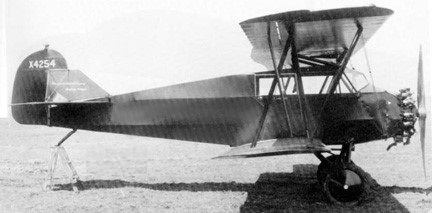
Paramount Cabinaire 110 Prototype NX4254

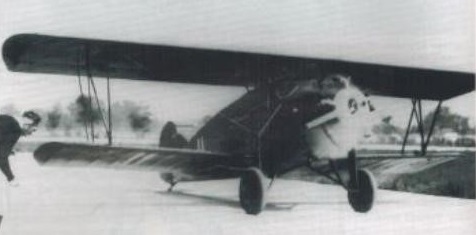
Following the failure of Walter J. Carr’s first aircraft company, the CSC Aircraft Company, Carr worked as a tester for the new Warner Scarab radial engines. Carr flew with Scarabs on a Travel Air 2000, and later cannibalized the test aircraft to produce the first Cabinaire aircraft design.

The prototype Cabinaire was formed around a welded steel tube Travel Air 2000 fuselage modified for an enclosed cabin. A new center section of wing was added and Travel air wings were reinstalled onto the center sections. The biplane aircraft featured a radial engine, and conventional landing gear. The upper wing was mounted several inches above the enclosed cabin. The entire plane was fabric covered with wooden wing spars and ribs. The upscale cabin used two individual upholstered wicker seats in the front and a wicker bench seat for passengers. The interior used velor finishing, nickel plating, mohair rugs, mahogany panels and roll-down windows. It first flew in 1928.

Designed by Walter Carr, the 1929 Cabinaire 110 (ATC 2-164, 2-165) was a four place cabin biplane. The prototype, NX4254 c/n 2, used many Travel Air parts; cabane-mounted upper wing. c/n 1 is generally assumed to have been rebuilt from a Travel Air.

Prototype #2 was made from parts of the first. Each production model differed slightly from each other with choices of engines, and landing gear and aileron improvements.

The Cabinaire was introduced at the 1929 National Aircraft Show.

Only eight were completed before production ceased.

In 1929, Viola Gentry and Jack Ashcroft attempted an endurance record for flight with aerial refueling in a modified Cabinaire SN#5 named ‘The Answer’. The name was chosen in response to the Army aircraft that had completed previous endurance records, the ‘Question Mark’. The aircraft had a 55-gallon cabin tank, and 21 gallon wing tanks installed for the attempt. The Answer crew was unable to refuel after the first ten hours of flight due to fog and crashed 28 June 1929, killing Ashcroft. Carr had been the original choice of co-pilot, but had to pass on the opportunity when struck with pneumonia.

In 1930, a Cabinaire was entered in the 4814 mile long Ford National Reliability Air Tour, placing 15th out of 18. The same aircraft has been restored and was still flown in 2011.

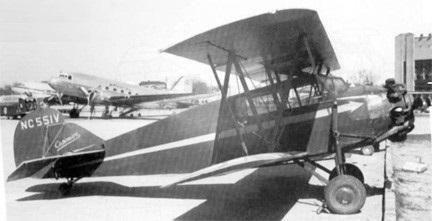
Selling for $6,750 seven were built in total; NC17M, NC387, NC587, NC551V, NC7930/7931. NC587 c/n 6 was repowered with a 150hp Hisso in 1936. (2-164) and (2-165) were 4p and 3p approvals respectively.

Cabinaire 110 NC587 Courtesy Barry Link

Cabinaire 110 NC587 was owned by Universal Engineering of Frankenmuth MI. and the founder of Universal, W.R. Fisher flew the plane for business. It was wrecked and then stored away at the family farm, probably in the early 30’s.

Cabinaire 165 NC17M c/n 7 on 11 September 1930

The 1930 Cabinaire 165 (ATC 265) sold for $7,500, and $5,750 in 1931. One was built, NC17M c/n 7, modified from a Cabinaire 110.

Paramount Cabinaire 165 NC17M

NC17M it caught fire during restoration in the ’60s and it was finally restored in the ’90s. Greg Herrick purchased it in 1997, and while flying it from FL to MN, an engine failure stopped the trip near Zebulon GA. The Cabinaire was once again being restored by Nathan Rounds in Zebulon in 2000.

Paramount Cabinaire A-70 NC551V

One Cabinaire 110, NC551V c/n 9 was modified to a Cabinaire A-70 in 1930 (ATC 2-233) with a 165hp Continental A-70.

Paramount Cabinaire A-70 NC551V

Gallery

Cabinaire 110
SN#1-6
Engine: Warner Scarab, 110hp (82 kW)
Span (upper): 34’8″
Span (lower): 29’0″
Length: 23’9″
Useful load: 908 lb
Max speed: 103 mph
Cruise speed: 90 mph
Stall: 38 mph
Range: 465 mi
Ceiling: 12,000′
Seats: 4

Cabinaire 165
SN#7
Engine: Wright J-6, 165hp (123 kW) / Wright R-540, 175 hp (130 kW)
Upper wingspan: 33 ft 2 in (10.11 m)
Lower wingspan: 29 ft (8.8 m)
Wing area: 309 sq ft (28.7 m2)
Length: 24’7″ (7.49 m)
Height: 9 ft (2.7 m)
Empty weight: 1,620 lb (735 kg)
Gross weight: 2,630 lb (1,193 kg)
Fuel capacity: 50 U.S. gallons (190 L; 42 imp gal)
Useful load: 1054 lb
Maximum speed: 100 kn (120 mph, 190 km/h)
Cruise speed: 90 kn (103 mph, 166 km/h)
Stall speed: 35 kn (40 mph, 64 km/h)
Range: 350 nmi (400 mi, 640 km)
Service ceiling: 12,000 ft (3,700 m)
Rate of climb: 800 ft/min (4.1 m/s)
Seats: 4

Cabinaire A-70
Originally, SN#3 flown as an aerial survey aircraft, it was rebuilt to meet ATC requirements, with a new engine, becoming SN#9.
Engine: 165hp Continental A-70.

Paramotor Performance M3

The Paramotor chassis design was a variation of Marbella’s PAP.
Circa 1998 the range was imported into the UK by Trekking.

M3
Empty weight: 21.5 kg
Engine: Solo, 16 hp
Reduction: 1:2.2
Prop diameter: 100 cm
Fuel capacity: 8 lt
Price (1998): 33 000 SEK

M3 ES
Empty weight: 23.5 kg
Engine: Solo, 16 hp
Reduction: 1:2.2
Prop diameter: 100 cm
Fuel capacity: 8 lt
Price (1998): 38 000 SEK

Paramentier Wee Mite

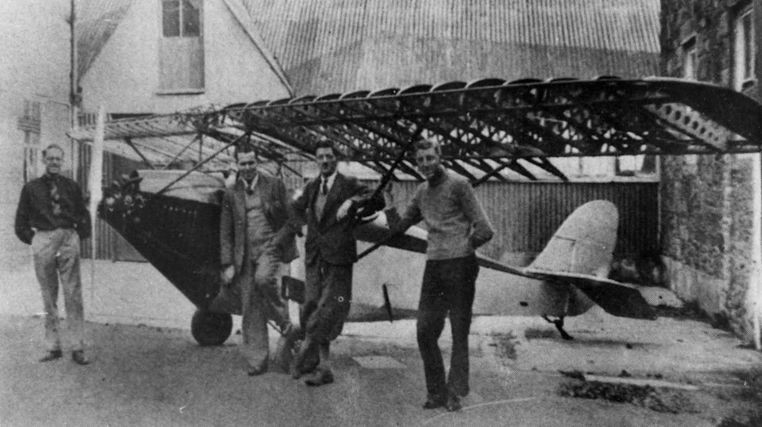
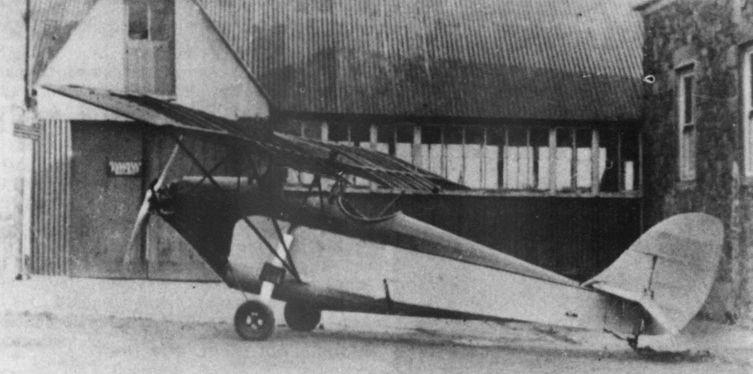
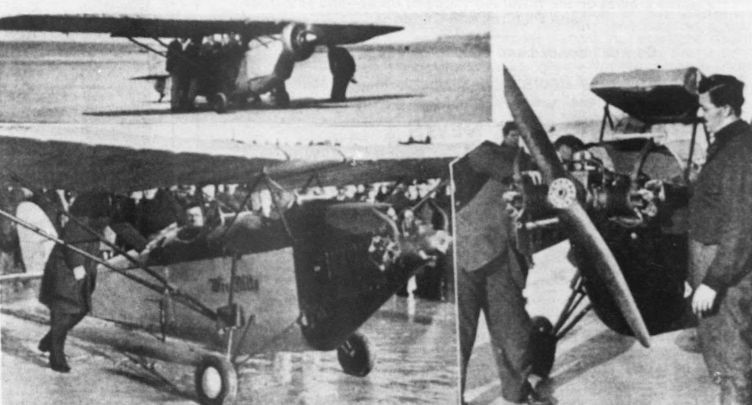
The Wee Mite was a parasol monoplane with a welded steel frame with wooden wings and a fixed landing gear with a tailwheel. Designed by Cecil Noel and built by him and Harold James Le Parmentier it was initial powered by a 30 hp (22 kW) ABC Scorpion engine.

A second-hand ABC Scorpion engine of 30-40 hp coming on the local market made the proposition feasible, and the necessary planning and designing began. Even with his past experience as a pilot-instructor, Mr Noel found that the limitations of the island with regard to take-off and landing made the theoretical side of the business a tricky undertaking, and it was nearly six months before the plans and blueprints were completed.

Early in the summer of 1932 the practical work was commenced, and in this the designer was joined by a small band of enthusiasts. The first job of the work was the creation of the propellor. This was of mahogany, two-bladed, 3ft 4 in pitch, and was manufactured entirely in Guernsey. When fitted to the engine it was tested out on the sandy foreshore mounted on a Ford chassis.

A high wing, semi-cantilever monoplane, V-strutted, a split ‘Oleo’ undercarriage was fitted and open cockpits.

The engine was put aside until the following winter while the fusealge was built to receive it. The engine in position and early one summer morning, Guernsey’s air pioneers smuggled the aircraft through the sleeping streets to the sandy stretch of Vazon Bay.

Here it was put through her speed, control and acceleration tests. As was to be expected, adjustments were necessary, but these were so slight that they served rather to flatter the skill of the designers and builders and the exactitude of their labours.

The calulation of the centre of gravity was found to be slightly at fault, having been estimated at from 1½ to 2 inches too far forward, necessitating an alteration of the wing position. This satisfactorily adjusted, the Wee Mite with Mr W C Noel at the controls essayed her first flight. First flown at Vazon Bay, Guernsey on 10 April 1933. Still slightly out of trim though she proved, her initial flutter of a few hundred yards was successful.

To improve her the engine was geared and she was fitted with a four-bladed metal prop of 6ft pitch, 5 ft 9 in in diameter. The metal prop burst and set up such a tremendous vibration that it crystallised the front part of the metal air-frame, practically ruining the front of the fuselage.

An A D Salmson of 40-50 hp, repairs having been completed, it was installed with a two-bladed wooden propellor and a lengthened fuselage by 18 in (46 cm). this proved ideal for vibration was noticeable less and with the experience gained further teat flights were successfully accomplished, until the ‘Wee Mite’ was ready to be re-christened the ‘We Can,’ to the confusion of all the local doubters.

It was successfully flown around Guernsey in a 50 minute flight on 15 September 1933.

It was registered as G-ACRL to Parmentier on 21 April 1934.

The aircraft crashed on 21 January 1935. Le Parmentier, at the controls, found himself unable to keep it aloft in inclement weather. Gusts of wind were buffeting the beach as he took off, one of which caught the underside of the aircraft and turned it upside down while in flight.

Fortunately, Wee Mite wasn’t very high when at the time, but its aerodynamic properties were completely thrown out and it fell to earth. The propeller and wings were destroyed and, although the engine remained intact, it was beyond practical or economical repair. Its registration was cancelled in spring of 1935.

It was dismantled and stored in March 1936.

In her occupation diaries, Ruth Ozanne recounts how, in March 1941, the owner of a garage in St Peter Port found what was apparently the remains of the plane stowed in the loft.

The Bailiff had no choice but to report the discovery to the German forces, who ordered its destruction so it couldn’t be used either against their own men or to escape the island. A post on the Priaulx Library website recounts the same story.

However, the online history of the Guernsey Aero Club tells a different tale. The club had been established by Wee Mite’s designer, Cecil Noel, and in 1935 it bought an Avro 594 Avian IV, which was damaged in a gale. What was left of it was stowed in the loft of a St Peter Port garage and, when discovered during the occupation, shipped off to Germany.

Powerplant: 1 × British Salmson AD.9, 40 hp (30 kW)
Wingspan: 31 ft 0 in (9.45 m)
Wing area: 148 sq ft
Chord: 5 ft
Length: 20 ft 0 in (6.10 m)
Height: 6ft 1½ in
Empty weight: 650 lb (295 kg)
Gross weight: 970 lb (440 kg)
Wing loading: 6.55 per sq ft
Maximum speed: 92 mph (148 km/h, 80 kn)
Cruise speed: 75 mph (121 km/h, 65 kn)
Take-off speed: 38-40 mph
Landing speed: 30-35 mph
Take-off distance: 100-120 yards
Landing distance, 100 yards
Ceiling: 8,000 ft
Tested height: 3,000 ft
Initial rate of climb: 450 ft per min
Crew: one
Capacity: one passenger