Parnall Plover

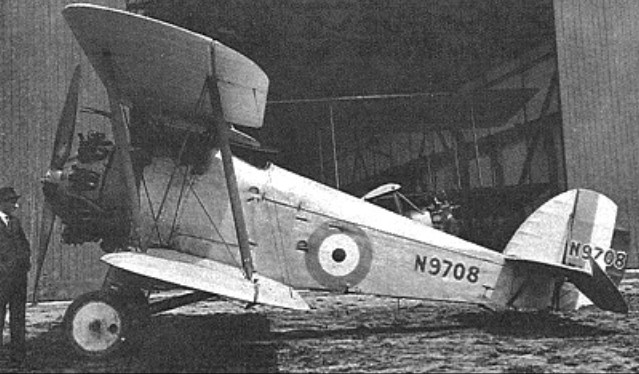
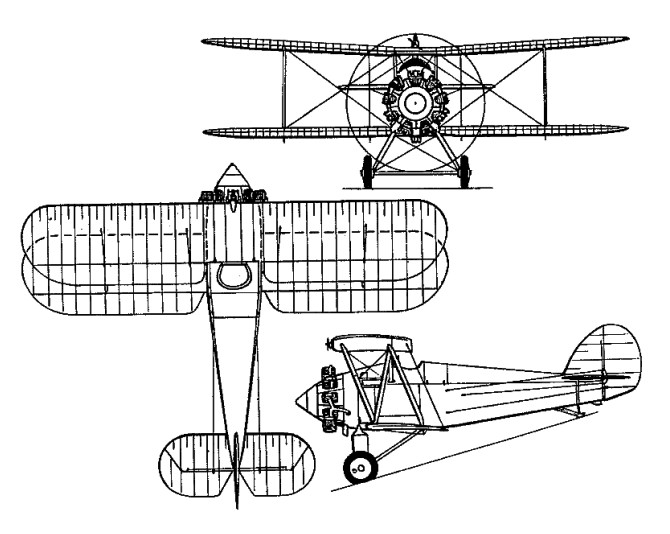
Designed by Harold Bolas to meet a specification (6/22) for a single-seat shipboard fighter to succeed the Gloster Mars X Nightjar, the Plover appeared in 1922, three prototypes were built.

Of wood and fabric construction, and designed around a 436 hp Bristol Jupiter IV nine-cylinder radial, the Plover could be fitted with either a normal wheel undercarriage or with twin floats from which wheels projected to provide amphibious capability.
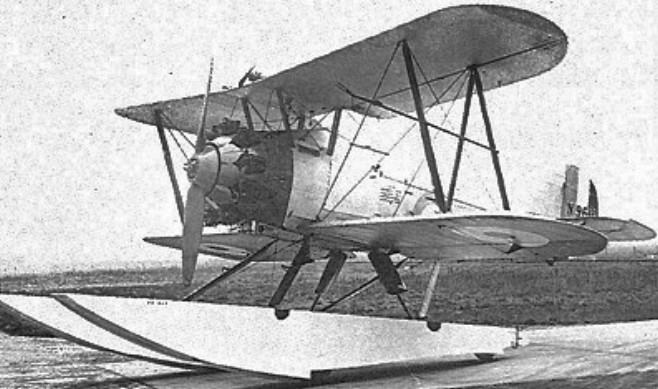
Armed with two synchronised 0.303-in (7,7- mm) guns, the Plover was ordered into small-scale production, ten were built of which at least six served briefly with Fleet Fighter Flights, before being superseded by the superior Fairey Flycatcher.

Engine: 436 hp Bristol Jupiter IV
Max take-off weight: 1354 kg / 2985 lb
Empty weight: 923 kg / 2035 lb
Wingspan: 8.84 m / 29 ft 0 in
Length: 7.00 m / 23 ft 12 in
Height: 3.65 m / 12 ft 0 in
Wing area: 28.43 sq.m / 306.02 sq ft
Max. speed: 228 km/h / 142 mph
Parnall Scout

Parnall and Sons of Bristol initiated work on the company’s first original aircraft, a single-seat anti-airship fighter to the designs of A Camden Pratt, in 1916. Intended to meet a requirement formulated by the Admiralty, this aircraft, unofficially known as the Zeppelin Chaser, was a large, two-bay staggered biplane of wooden construction. It was powered by a 260hp Sunbeam Maori 12-cylinder water-cooled engine and armed with a single 7.7mm gun offset to starboard and firing upward at an angle of 45 degrees. Two prototypes were ordered, but the first of these proved appreciably overweight. Although the Scout reportedly flew twice, it was considered to possess unacceptably low safety factors and was returned to the manufacturer, development being abandoned.

Engine: 260hp Sunbeam Maori
Wingspan: 13.41 m / 44 ft 0 in
Wing area: 47.94 sq.m / 516.02 sq ft
Max. speed: 182 km/h / 113 mph

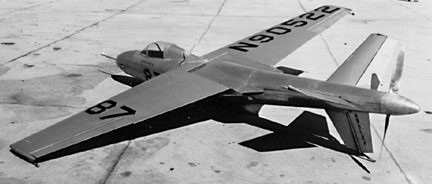
PAR / Parks Alumni Racer Special / Trefethan TRW Special

PAR Special

Designed by George Owl, the PAR Special N90522 of 1950 was a single place racer powered by an 85hp Continental C-85 pusher, with a variable-incidence wing.

The 1952 TRW Special midget racer N2948 was built partially from the PAR Special. Raced as a midget racer ‘Mixmaster’ with Y-tail and aft-mounted prop, after unsuccessful competitions, it was rebuilt in 1952 as Trefethan TRW Special, using the wings, aft fuselage and tail.

PAR Special
Engine: Continental C-85, 85hp
Span: 20’0″
Length: 20’0″

TRW Special
1952
Engine: 85hp Continental C-85
Seats: 1

Parks P-2 / Detroit-Parks P-2A / Ryan Speedster

P2-A

The 1929 Parks Aircraft P-2 (ATC 200) sold for $6,000. Six were built including NC902K and NC965K.

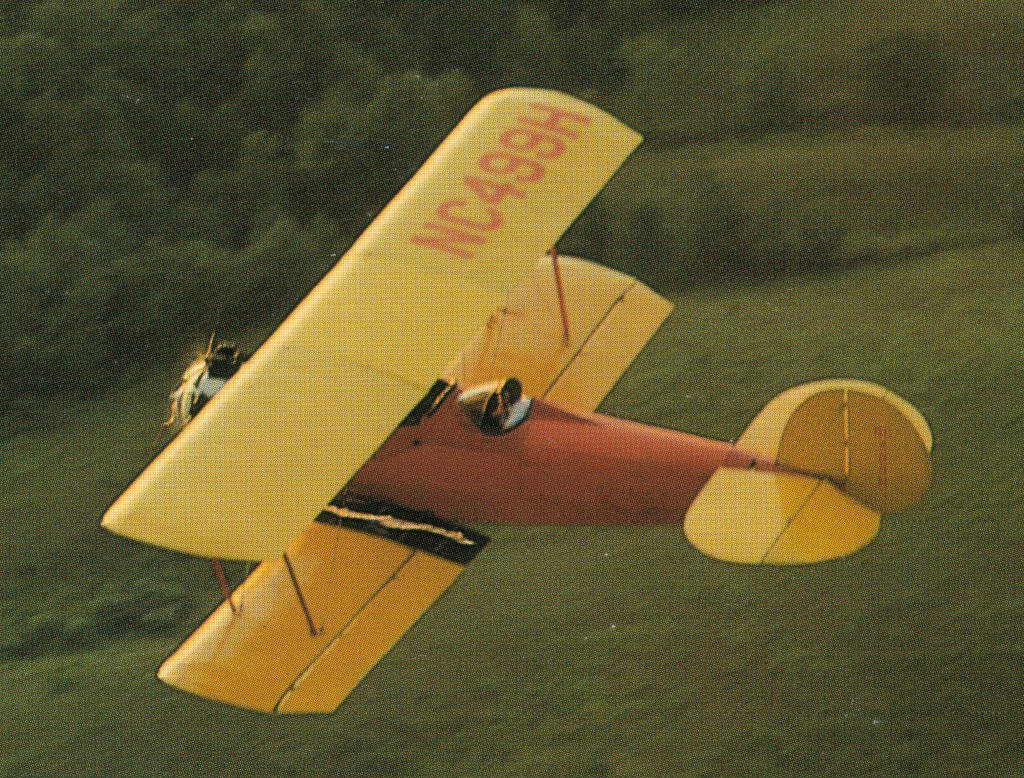
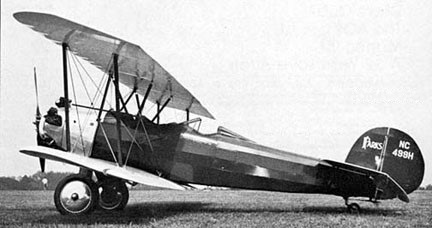
Some were repowered as P-2A. The 1929 P-2A (ATC 276) powered by a 165hp Wright J-6 sold for $6,350. Eleven were built: [NC480M, NC499H, NC502N, NC902K, NC965K, NC8487, NC8490-8492, and NC967K-968K.

Parks P-2A NC499H

The P-2A was marketed as the Detroit-Parks P-2A after merger with Detroit Corp and, later, as the Ryan Speedster.

The P-2 was also available with a 130hp Comet. (ATC 2-99) superseded by (ATC 200), including NC8487.

Gallery

P2
Engine: 150hp Axelson-Floco
Wingspan: 30’0″
Length: 22’10”
Useful load: 860 lb
Max speed: 115 mph
Cruise speed: 98 mph
Stall: 42 mph
Range: 490 mi
Seats: 3

P-2A
Engine: 165hp Wright J-6
Winspan: 30’0″
Length: 23’0″
Useful load: 897 lb
Max speed: 120 mph
Cruise speed: 100 mph
Stall: 45 mph
Range: 500 mi

Parks P-1 / Hammond P-1H

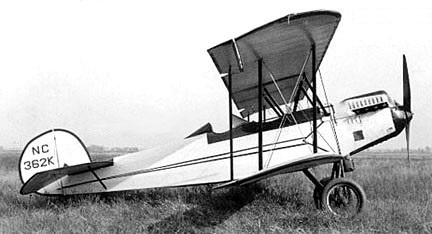
Parks P-1 NC362K

The 1929 P-1 (ATC 179) was a duplicate of the Fairchild KR-31, but with a chin radiator. They were built to replace Travel Airs used at the subsidiary Parks Air College. Selling for $3,165, forty-five were built.

The prototype, cn 10008 NX289W, was used to test the feasibility of a large, built-in “planechute” that could be released in emergencies to float the aircraft to the ground. In operation it had apparent success, but results of testing is unknown.

Parks P-1 NC376K

The 1929 P-1T (ATC 2-506) was fitted with a 115hp Milwaukee Tank.

Parks P-1T

The 1930 P-1X three place open cockpit biplane was fitted with a 90hp Curtiss OX-5, and registered as a Detroit P-1-X N289W c/n 19911.

The 1932 P-1H (ATC 2-428) with a 100hp Kinner K-5 became the Hammond 100. Following Ryan’s demise the Park name was revived for the P- 1H biplane built by Hammond.

P-1
Engine: 90hp Curtiss OX-5
Wingspan: 30’1″
Length: 24’1″
Useful load: 812 lb
Max speed: 100 mph
Cruise speed: 85 mph
Stall: 37 mph
Range: 340 mi
Seats: 2-3