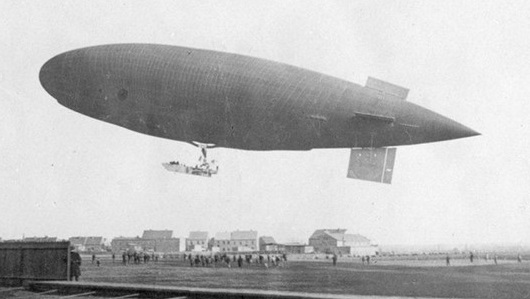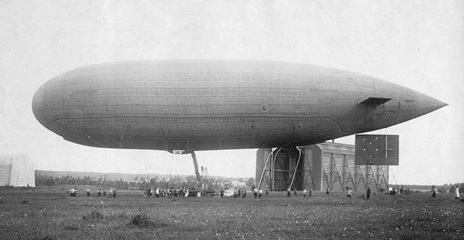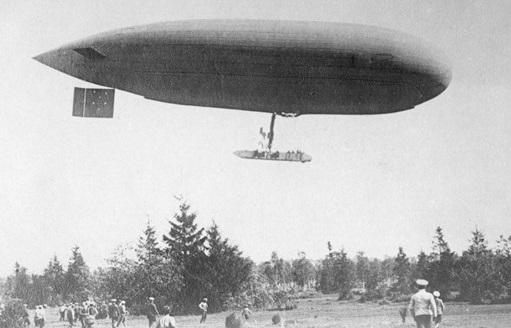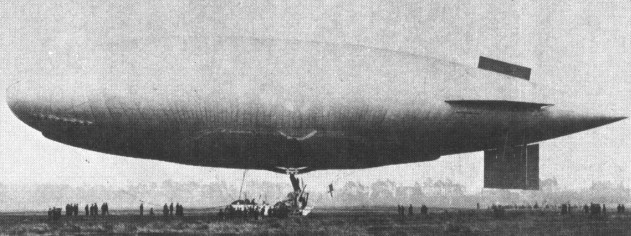
A new non-rigid airship made its first flight in Germany in May 1906: re¬latively small with a volume of only 2300 cu.m (81 224 cu ft), this airship was of technical interest in that the shape of the envelope was maintained by means of pressurized ballonets fore and aft. The craft was to the design of former army officer August von Parseval, later a professor at the Berlin Technical Academy, and improved models con¬tinued to be produced after their con¬struction was transferred from the Motorluftschiff Studiengesellschaft to the Luftfahrzeug Gesellschaft (LFG) organization in June 1913. In this same year an order was placed by the Brit¬ish government for a single example of the improved type, and Parseval PL 18 was delivered for use by the Royal Navy where it received the service designation Naval Airship No. 4 (NA4).
On 5 August 1914 this vessel, by a strange stroke of irony, was the first British aircraft to carry out an active war operation when, flying from its base at Kingsnorth, the first RNAS airship station, it was sent to patrol the Thames Estuary. It was used again on 10 August, this time in company with NA3, the only British airship of the period to be armed, another imported design, an Astra-Torres.
The degree to which Parseval de¬signs had advanced in a short time was evident from the fact that the NA4 was a revised type of vessel, which prob¬ably promoted the order for a further three before the war, to be built under licence by Vickers at Barrow-in¬-Furness. These were given the service designations NA5, NA6 and NA7 at the beginning of their career, which was entirely confined to use for the instruc¬tion of airship crews.
Meanwhile, the NA4 was still em¬ployed on sterner duties, and the first months of World War I found it in use as a submarine hunter, although its effect was entirely psychological, pro¬viding cover for the convoys ferrying troops of the British Expeditionary Force between Dover and Calais.
An order had been placed with the LFG organization for a further three airships of similar design which would have been the PL 19, PL 20 and PL 21 but the outbreak of war prevented their delivery. They would probably also have been used for training, a role to which the NA4 was finally relegated but it is interesting to note that at the time it was in service as a patrol vessel, the German navy had requisitioned the non-rigid PL 6009 August 1914 and also obtained PL 19 on loan on 19 September for sea patrol work over the Baltic from Kiel This was a duty to which they were well suited, being capable of carrying 590 kg (1,301 lb) of bombs and with a maximum flight time of 11 hours.
Type: patrol airship
Powerplant: two 134 2-kW(180-hp) Maybach six-cylinder water-cooled piston engines
Maximum speed 72 kim h (45 mph)
Service ceiling 4000 m (13123 ft)
Range 1000 km (621 miles)
Diameter 15.50 m (50 ft 10.2 in)
Length 94.00 m(308 ft 4.8 in)
Volume 10000 cu.m (353 147 cu ft)