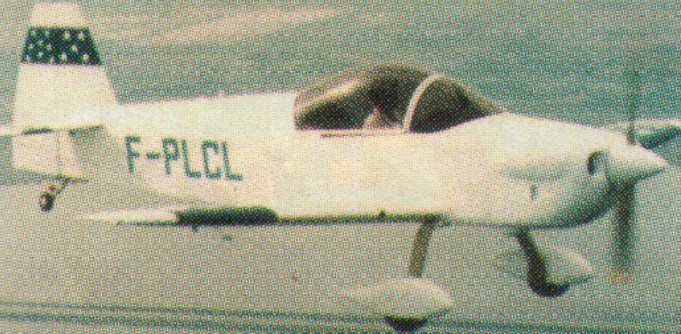
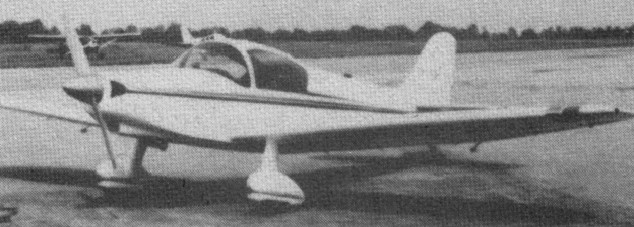
The C.P. 90 Pinocchio is a single seat, low wing aircraft designed by Claude Piel. Construction materials are wood & fabric, and the landing gear is a fixed tailwheel configuration.
Engine: 65 hp Span: 23.6 ft Length: 19.7 ft Height: 6.0 ft Area: 104 sq ft Empty Weight: 695 – 760 lbs Gross Weight: 1015 – 1105 lbs Fuel: 95 lbs U/C Track: 5.25 ft Dihedral: 5° 40′ Incidence: 3° Max Speed: 130 mph Cruise 75% 5,000 ft: 118 mph Cruise 65% 5,000 ft: 110 mph Range: 400 miles T/O Distance: 580 ft Landing Distance: 525 ft Stall Speed: 45 mph Approach Speed: 65 mph Vne: 200 mph Rate Of Climb: 785 fpm Complete set of plans 2009: US$225
Engine: 90 hp Span: 23.6 ft Length: 19.7 ft Height: 6.0 ft Area: 104 sq ft Empty Weight: 695 – 760 lbs Gross Weight: 1015 – 1105 lbs Fuel: 95 lbs U/C Track: 5.25 ft Dihedral: 5° 40′ Incidence: 3° Max Speed: 150 mph Cruise 75% 5,000 ft: 140 mph Cruise 65% 5,000 ft: 130 mph Range: 350 miles T/O Distance: 580 ft Landing Distance: 525 ft Stall Speed: 45 mph Approach Speed: 65 mph Vne: 200 mph Rate Of Climb: 1140 fpm Complete set of plans 2009: US$225
Engine: 115 hp Span: 23.6 ft Length: 19.7 ft Height: 6.0 ft Area: 104 sq ft Empty Weight: 695 – 760 lbs Gross Weight: 1015 – 1105 lbs Fuel: 95 lbs U/C Track: 5.25 ft Dihedral: 5° 40′ Incidence: 3° Max Speed: 160 mph Cruise 75% 5,000 ft: 152 mph Cruise 65% 5,000 ft: 143 mph Range: 380 miles T/O Distance: 580 ft Landing Distance: 525 ft Stall Speed: 45 mph Approach Speed: 65 mph Vne: 200 mph Rate Of Climb: 1220 fpm Complete set of plans 2009: US$225
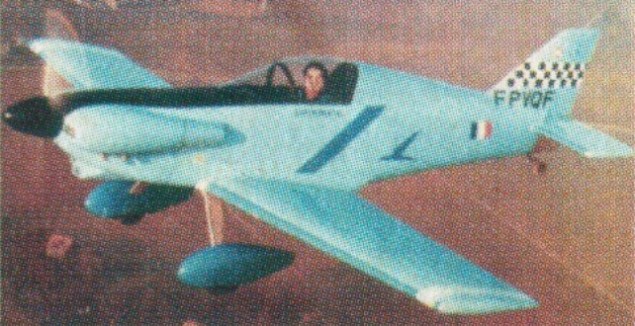
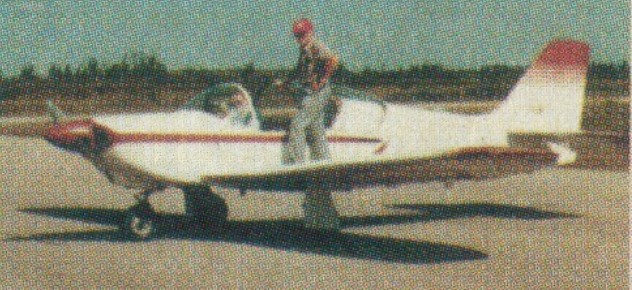
The Sapphire is a single-seat racing airplane of all-wood construction designed by Claude Piel. The airplane is stressed for the load factors of +12 and 19 C’s at the maximum takeoff weight of 770 pounds. The Saphhire can accommodate any engine from 50 to 100 hp. Its wing is fully cantilevered and tapered for minimum drag and has a tip-to-tip laminated box spar to avoid heavy root fittings and wing alignment problems. The fuselage consists of three bulkheads and is entirely plywood covered. The cockpit is roomy enough to accommodate a large pilot. The landing gear is a fixed tailwheel configuration.
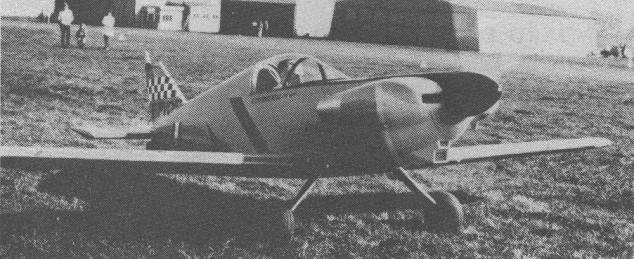
The Cougar is a single-place, high-speed aerobatic monoplane. It utilizes an all-wood design and a 90-hp engine.
In 1980 plans were available from E. Littner, Box 272, Saint Laurent, Quebec H4L 4V6, Canada.
Engine range: 65 to 100 hp Span: 19.7 ft Length: 17.3 ft Height: 5.6 ft Area: 66.7 sq ft Empty Weight: 575 lbs Fuel: 60 lbs Max Speed: 200 mph Cruise 75% 5,000 ft: 175 mph Cruise 65% 5,000 ft: 155 mph Stall Flaps Up: 60 mph Approach Speed: 80 mph Vne: 235 mph Rate Of Climb: 2350 ft/min T/O distance: 650 ft Landing Distance: 650 ft Range (65%): 280 miles Complete set of plans 2009: US$225
Zephyr Engine: Continental C-90, 90 hp HP range: 65-90 Height: 5.6 ft Length: 17.3 ft Wing span: 19.7 ft Wing area: 66.7 sq.ft Weight empty: 515 lb Gross: 840 lb Fuel cap: 10 USG Speed max: 200 mph Cruise: 155 mph Range: 280 sm Stall: 50 mph ROC: 2300 fpm Take-off dist: 600 ft Landing dist: 650 ft Service ceiling: 10,000 ft Seats: 1 Landing gear: tail wheel
Littner Zephyr Engine: Continental O-100, 100 hp HP range: 65-100 Height: 5.6 ft Length: 17.3 ft Wing span: 19.7 ft Wing area: 66.7 sq.ft Speed max: 200 mph Cruise: 155 mph Range: 280 sm Stall: 50 mph Weight empty: 515 lb Gross: 840 lb Fuel cap: 10 USG ROC: 2300 fpm Take-off dist: 650 ft Landing dist: 650 ft Service ceiling: 10,000 ft Seats: 1 Landing gear: tail wheel
Cougar Gross Wt. 770 lbs Empty Wt. 525 lb Fuel capacity 10 USG Wingspan 23’8” Length 20’l0” Top speed 190 mph Cruise 160 mph Stall 67 mph Climb rate 2300 fpm Takeoff run 600 ft Landing roll 600 ft Range 300 sm
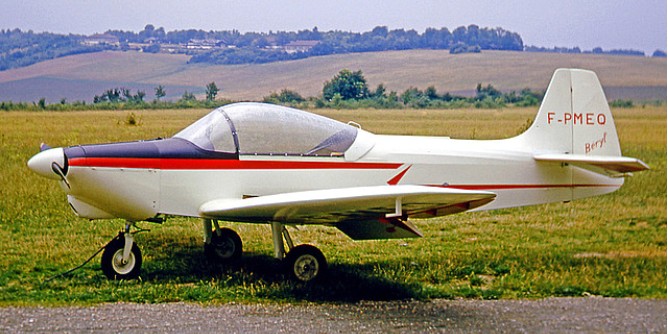
The Diamant is a three- or four-seat version of the Emeraude. This low-wing, high-performance monoplane is powered by a 100-hp Continental engine, It is also available in a four-place model propelled by a 150 Lycoming designated the Super Diamant. Both were created by designer Claude Piel.
The C.P. 60 Super Diamant is a two plus two (2 + 2) seat, low wing aircraft. A rear bench can be added to accommodate an adult (max. 170 lb) or 2 children.
Super Diamant
CP.605 Diamant three/fourseat cabin monoplane (first flown 1964 in CP.604 prototype form) and is certificated for commercial production Construction materials are wood & fabric, and the landing gear can be built in fixed tailwheel or retractable trigear configurations.
Diamant Engine: 100 hp Span: 30.5 ft Length: 21.8 ft Height: 5.8 ft Wing area:143.1 sq.ft Empty Weight: 995 lb Gross Weight: 1700 lb Fuel: 130 lb Undercarriage: Fixed Gear Dihedral: 5° 40′ Incidence: 4° 10′ Ultimate Load at 1610 lb: +6.6 / -2.64 G Ultimate Load at 1875 lb: +5.7 / -2.28 G Max Speed: 134 mph Cruise 75% 5,000 ft: 127 mph Cruise 65% 5,000 ft: 122 mph Range: 1200 miles T/O distance: 850 ft Stall Flaps Up: 56 mph Stall Flaps Down: 51 mph Approach Speed Flaps Down: 78 mph Max Speed Flaps Down: 87 mph Rate Of Climb: 500 fpm Vne: 175 mph Landing Distance: 720 ft Complete set of plans 2009: US$350
Super Diamant Engine: 150 hp Span: 30.5 ft Length: 21.8 ft Height: 5.8 ft Wing area:143.1 sq.ft Empty Weight: 1120 lb Gross Weight: 1875 lb Fuel: 250 lb Undercarriage: Fixed Gear Dihedral: 5° 40′ Incidence: 4° 10′ Ultimate Load at 1610 lb: +6.6 / -2.64 G Ultimate Load at 1875 lb: +5.7 / -2.28 G Max Speed: 160 mph Cruise 75% 5,000 ft: 154 mph Cruise 65% 5,000 ft: 143 mph Range: 1750 miles T/O distance: 600 ft Stall Flaps Up: 56 mph Stall Flaps Down: 51 mph Approach Speed Flaps Down: 80 mph Max Speed Flaps Down: 87 mph Rate Of Climb: 1000 fpm Vne: 175 mph Landing Distance: 800 ft Complete set of plans 2009: US$350
Super Diamant Engine: 160 hp Span: 30.5 ft Length: 21.8 ft Height: 5.8 ft Wing area:143.1 sq.ft Empty Weight: 1150 lb Gross Weight: 1875 lb Fuel: 250 lb Undercarriage: Retractable Tri Gear Dihedral: 5° 40′ Incidence: 4° 10′ Ultimate Load at 1610 lb: +6.6 / -2.64 G Ultimate Load at 1875 lb: +5.7 / -2.28 G Max Speed: 170 mph Cruise 75% 5,000 ft: 161 mph Cruise 65% 5,000 ft: 149 mph Range: 1850 miles T/O distance: 600 ft Stall Flaps Up: 56 mph Stall Flaps Down: 51 mph Approach Speed Flaps Down: 80 mph Max Speed Flaps Down: 87 mph Rate Of Climb: 1100 fpm Vne: 175 mph Landing Distance: 800 ft Complete set of plans 2009: US$350
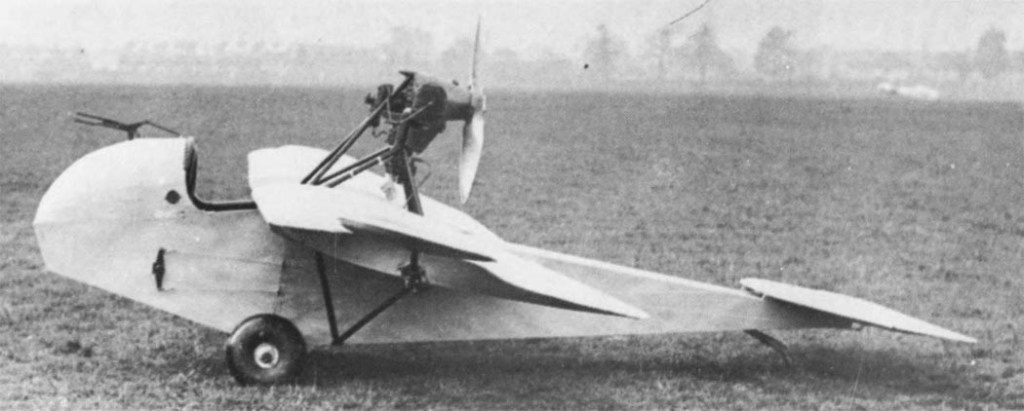
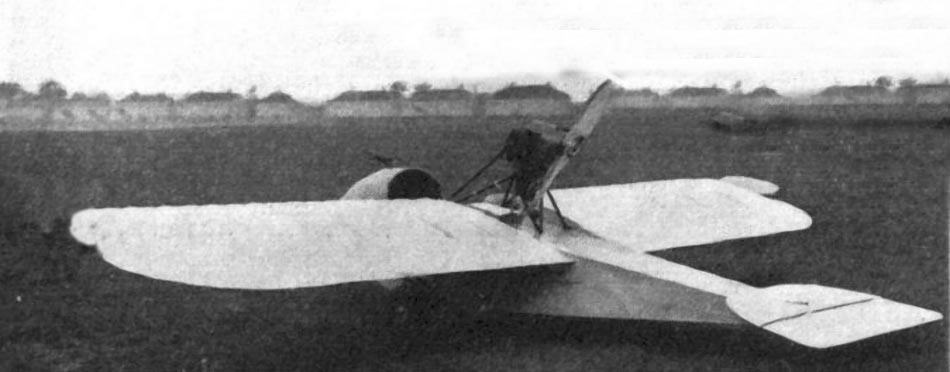
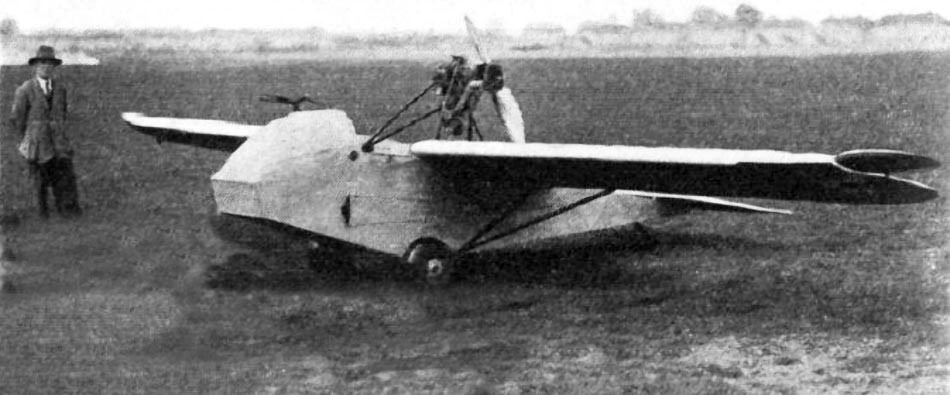
The Pickering-Pearson K.P.2 was designed by K.N.Pearson as a single-seat, mid wing monoplane. It was powered by a 40-horsepower Aeronca E.117 pusher engine. The KP.2 was a wooden monoplane with fixed landing gear.
It used no rudder, being equipped with Pearson rotary ailerons, one on each wingtip.
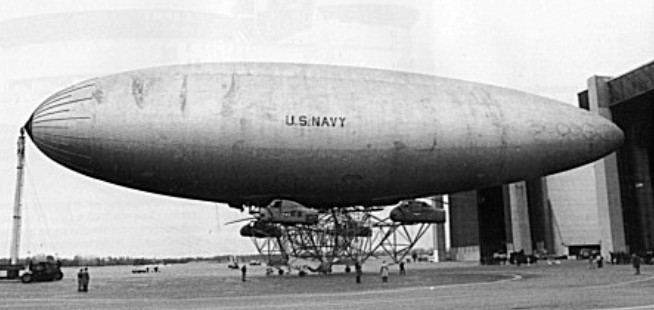
The Piasecki PA-97 Heli-Stat project began in the mid 1970s with a view to combining the lift capability of a lighter-than-air vehicle with the precise manoeuvrability of the helicopter, and following support from the US Forestry Service and the US Navy, construction of a prototype Heli-Stat began at Lakehurst, New Jersey, in 1979. The hybrid aircraft uses an airship-based envelope, attached via a skeletal structure to the front fuselage portions of four Sikorsky SH-34J helicopters, each powered by a standard Wright radial engine driving the conventional main rotor system and mounted at the four corners of the aircraft. The tail rotors are replaced by large diameter propellers to provide propulsion and full controllability.
At the beginning of 1984 it was expected that the Heli-Stat would fly in 1985, following a redesign of the structure which had failed under load tests. The following data is provisional
Richard Burke, 29.07.2008 I spent 7 years on this project starting first at the MAIN engineering facility drafting this monster along with 15 other people on Island Avenue in Philadelphia and later moved to Lakehurast during the structural pluck tests. I was there up until the ground manuvering tests where being performed. If you have any questions I can answer them I was over every single part of the airframe / Sh34J’s (Modified) and the aerostat (ZPG2 envelope). [The photo] was a roll out for a photo op dog and pony show note the lack of inverted v fins on the aerostat and the lack of pusher props on the helos also US Forrest Service was not painetd on the envelope yet . I am actually in this photo aft center stern of ship next to the guy with the bike, Joe O’Halleren It was truly a combination of four SH-34 helicopters and a ZP-3 patrol blimp. It had B-52 landing gear and P-51 reduction gear boxes driving H-3 tail rotors as pusher props.
Piasecki Heli-Stat Engines: 4 x Wright R-1820-84A, 1525shp Overall width: 60.05m Overall length: 74.07m Empty weight: 24895kg Gross weight: 50469kg Maximum speed: 132km/h Service ceiling: 3810m Range: 3307km Range with maximum payload: 80km
While the Army was pursuing the flying platforms, they were also investigating larger rotorcraft along similar lines, called the “flying jeeps”. Some sources imply that they were intended mostly for hovercraft operation, with an ability to fly over obstacles or impassable terrain when necessary, while other sources indicate they were regarded as helicopter-like utility vehicles that operated normally as flying machines. Whatever the case, the US Army Transportation Research Command began an investigation into the flying jeeps in 1956, leading to award of contracts for prototypes to Chrysler, Curtiss-Wright, and Piasecki in 1957.
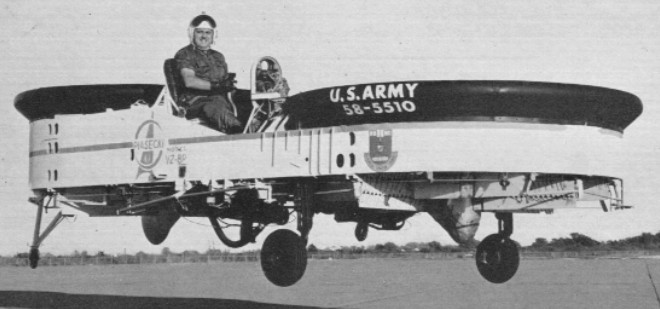
The first of the Piasecki flying jeep was the Piasecki “Model 59H AirGeep”, which was given the Army designation “VZ-8P”. The craft was built around two tandem 2.4 meter (8 foot) diameter, three-bladed, ducted rotors driven by two 135kW / 180 hp Lycoming piston engines. Both powerplants were connected to a single central gearbox so that both rotors would continue to turn even if one engine failed. The “Sky Car” had fairly conventional helicopter-type controls which provided directional stability through a series of hinged vanes mounted under each rotor duct. Forward motion was achieved by pitching the aircraft nose-down. The craft had fixed tricycle wheeled landing gear, and accommodated its single pilot and one passenger in seats sited between the two rotor ducts.
The AirGeep was 7.9 meters long and 2.7 meters wide (26 feet by 9 feet), with three-bladed rotors in ducts in the front and the back. The pilot and passenger sat between the ducts. The rotors spun in opposite directions to reduce torque effects.
The first of two Model 59 AirGeep (58 5510) examples ordered by the Army was first flown on 12 October 1958. Apparently it proved grossly underpowered, barely able to fly over a fence, and it was sent back to the shop, where the piston engines were replaced by a single 317 kW (425 HP) Turbomeca Artouste IIB turbine engine. The upgraded AirGeep flew on 28 June 1959. It weighed 1.1 tonnes (2,500 pounds) and could carry a payload of 550 kilograms (1,200 pounds), including the pilot.
Turned over to the Army shortly, the machine was subsequently given the designation VZ-8P (the “P” indicating Piasecki). Shortly after being accepted by the Army the VZ-8P was fitted with a single 315kW Turbomeca Artouste IIB turbine engine in place of its twin Lycoming pistons, and its first turbine-powered flight took place in June 1959.
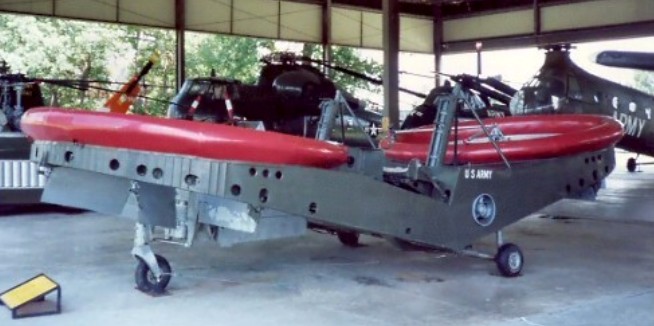
The AirGeep was put through trials for both the Army and the Navy over the next few years. The engine was upgraded again to a Garrett / Airesearch 331-6 engine, which had a higher power-to-weight ratio. For Navy trials, which began in June 1961, the rotorcraft was fitted with floats, and redesignated the “PA-59 SeaGeep”.
The second VZ-8P incorporated several significant design changes and was designated the Model 59H “Airgeep II” by Piasecki and the VZ-8P (B) by the Army. The Army Transportation Research Command issuing a contract for the “Model 59K”, which made its first non-tethered flight in the summer of 1962.
Piasecki PA-59K 58-5510
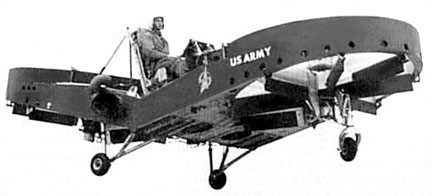
The AirGeep II was similar to the AirGeep, except that the aircraft was “bent” in the middle so that the rotors were tilted fore and aft, to improve forward flight characteristics. The AirGeep II used twin 298 kW (400 SHP) Turbomeca Artouste IIC turboshaft engines, once again linked so that if one failed the other would drive both rotors. One engine could also be coupled to the landing wheels to drive the machine on the ground.
Airgeep II 58-5511
The increased power allowed a maximum take-off weight of 2.2 tonnes (4,800 pounds). The pilot and observer had “zero-zero” ejection seats, allowing safe escape if the machine was on the ground and standing still, and there were seats for up to passengers.
Piasecki PA-59N 58-5510
During 1961 it was used for a series of trials by the U.S. Navy, operating from water and from the deck of a destroyer. For these, pontoons replaced the wheeled undercarriage and the VZ 8 became known as the PA-59N Seageep. Following completion of these trials, it was re engined with an AiResearch Model 331 6 turboshaft.
Piasecki VZ-8(P)
Neither version of the VZ-8P was dependent upon surface effect lift for flight and, though intended to operate within a few feet of the ground in order to make the best use of natural cover, both were quite capable of flying at altitudes of several thousand feet. Both versions were found to be stable and relatively capable craft.
The Airgeep was ultimately judged by the Army to be mechanically ill-suited to the rigors of field operations. The “flying jeep” concept was eventually abandoned in favor of the further development of conventional battlefield helicopters, and both VZ-8P examples were dropped from the Army’s inventory in the mid-1960s.