Piper J-2 Cub

The company was always sensitive to customer desires, and in 1936, Taylor introduced a refined Cub in order to incorporate design improvements as well as suggestions from the field. Walter Jamouneau was given the job of improving the E 2. He rounded off the wingtips and tail, widened the landing gear tread and moved the axles forward a few inches for better ground handling, improved the fuel system, redesigned the ailerons and got to put his initial into the new type designator, J 2. Aerodynamically, the plane remained virtually the same, but Jamouneau believes that directional and roll control were improved in the J 2. It retained the E 2’s tandem, two place seating but added sliding windows on the left and a clamshell arrangement on the right (the window folded up and the door down), actually a late model E 2 improvement that is still used on the Super Cub. The J 2’s engine remained the reliable A 40-3 or -4.

The sale price in 1936 was $1,470 and $1,270 in 1938. 550 were built by the end of 1936. ATC 2-533 was superseded by ATC 595.

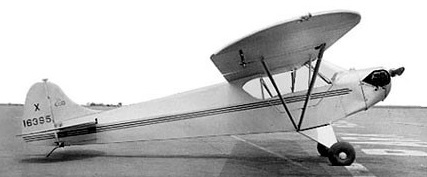
Taylor J-2

NX16395 J-2S was the prototype with EDO pontoons.

Taylor J-2S minus its floats NX16395

In early 1938, the Ilmavoimat / Maavoimat test team evaluated the Piper J-2. The J-2 had excellent STOL capability, able to take off in less than 300 feet by firewalling the throttle, lifting the tail immediately, pulling full flaps at 45 knots and levering the stick back into the pilots lap. The J-3 was near stallproof, with a stall speed of 34 knots, and short field approaches were easy with full flaps.

Although sales were initially slow, about 1,200 J-2s were produced before a fire in the Piper factory in March 1937. Only 658 Cubs were built that year; total more than 1,200 built by July 1937, at which time production was taken over by Piper Aircraft and the name changed. William Piper relocated his manufacturing operation and several hundred employees to Lock Haven, Pennsylvania, and the Piper Aircraft Corporation was born. By year’s end, it had built 687 Piper airplanes.

Production began in February 1936 and 1207 were built in total until production ended in 1938.

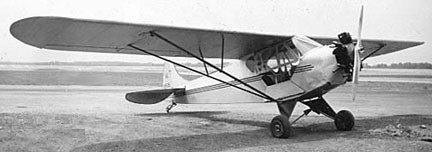
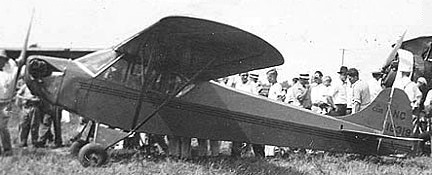
Piper J-2 NC19518 with LeBlond engine

Gallery

J-2 Cub
1936 (ATC 595, 2-533)
Engine: Continental A-40-3, 37 hp
Wingspan: 35 ft 3 in
Length: 22 ft 5 in
MTOW: 970 lb
Useful load: 407 lb
Max speed: 87 mph
Cruise: 70 mph
Stall: 30 mph
Range: 210 sm
Seats: 2

Pioneer International Aircraft Flightstar / Flight Designs 440ST

The machine has been developed by Flight Designs, an associate of Pioneer International Corporation and the firm which builds and sells the single seat Jetwing ATV, as well as conducting a research programme on a prototype single seat three axis machine designated 440ST However, at the start of 1983, Andrew N Bohjalian, group president, announced that production and sales of the FlightStar would be taken over by a new associate company called Pioneer International Aircraft. The Pioneer group is well known for its activities in aerospace industry, and includes the Pioneer Parachute Company, which is one of the world leaders in its field. So it is not surprising to find that the FlightStar has been designed from the start to accommodate an emergency 29.0 ft diameter (8.84 m) parachute, which is deployed ballistically and fitted behind the pilot at the rear of the frame.

Pioneer Flightstar / Flight Designs 440 Article

The aircraft is sold as a complete kit requiring 20 h for assembly and at a price of $7495 in 1983. Apart from the parachute, options offered are floats, skis, wheel fairings, electric starter for the Kawasaki TA440A engine, larger diameter wheels (16 and 20 inch, 41 and 51 cm), transport covers and an instrument panel.

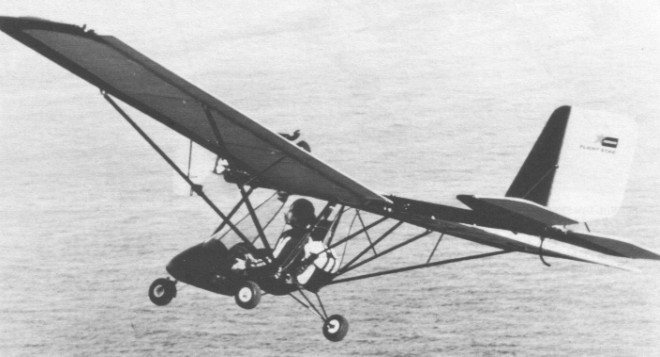
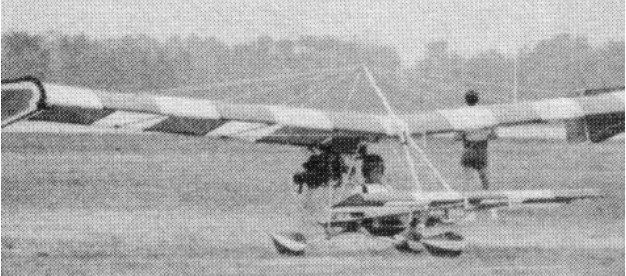
The Flight Designs 440 ST was a single seat single engined high wing monoplane with conventional three axis control. Wing has unswept leading edge, swept forward trailing edge and tapering chord; two fin tail. Pitch control by elevator on tail; yaw control by fin mounted rudders; roll control by spoilers; control inputs through stick for pitch/roll and pedals for yaw. Wing braced from above by kingpost and cables, from below by cables. Undercarriage has three wheels in tricycle formation. Aluminium tube framework, without pod. Engine mounted at wing height driving pusher propeller.

This single seat twin¬-boom, twin rudder aircraft exists only as a prototype in 1982, and was being used at Flight Designs to study the flight envelope of such machines.

Single seat single engined high wing mono¬plane with conventional three axis control. Wing has unswept leading edge, swept for¬ward trailing edge and tapering chord; conventional tail. Pitch control by elevator on tail; yaw control by fin mounted rudder; roll control by full span ailerons; control inputs through stick for pitch/roll and pedals for yaw. Wing braced from below by struts; wing profile; double surface. Undercarriage has three wheels in tricycle formation, with additional tailskid; bungee suspension on all wheels. Flush right go right nosewheel steering connected to yaw control. Aluminium tube framework, with optional pod. Engine mounted at wing height driving tractor propeller.

Shown at Oshkosh in August 1982, the prototype FlightStar made its first flights during that summer. It carried trapezoidal planform ailerons, whose chord tapered toward the wing tips and which covered a little less than the full span of each wing, but these have been replaced for the production machines by full span ailerons. In addition, the production FlightStar, on show at Sun ‘n’ Fun in Lakeland, Florida in March 1983, was fitted with a glass fibre pod with a windscreen mounted on top and going right up to the strut carrying the wing.

440 ST
Engine: Kawasaki TA440A, 38.5 hp at 6000 rpm
Power per unit area 0.26hp/sq.ft, 2.9hp/sq.m
Fuel capacity 5.0 US gal, 4.2 Imp gal, 18.9 litre
Length overall 18.8 ft, 5.69 m
Height overall 8.3ft, 2.51m
Wing span 34.0ft, 10.36m
Sweepback 0 deg
Total wing area 144 sq.ft, 13.4 sq.m
Wing aspect ratio 8.0/1
Empty weight 218 lb, 99kg
Max take off weight 529 lb, 240 kg
Payload 311 lb, 141 kg
Max wing loading 3.67 lb/sq.ft, 17.9 kg/sq.m
Max power loading 13.7 lb/hp, 6.2kg/hp
Load factors; +6.0, 4.0 ultimate
Max level speed 60 mph, 97 kph
Max cruising speed 50 mph, 80kph
Stalling speed 22mph, 35kph
Max climb rate at sea level 950ft/min, 4.8m/s
Take off distance 60ft, 18m
Landing dis¬tance 50ft, 15m
Range at average cruising speed 240 mile, 386 km

FlightStar
Engine: Kawasaki TA440A, 38.5hp at 6000rpm
Propeller diameter and pitch 58×27 inch, 1.47 x 0.68 m
Belt reduction, ratio 2.0/1
Max static thrust 270 lb, 122kg
Power per unit area 0.25hp/sq.ft, 2.9hp/sq.m
Fuel capacity 5.0 US gal, 4.2 Imp gal, 18.9 litre
Length overall 16.5 ft, 5.03 m
Height overall 7.5ft, 2.29m
Wing span 30.0ft, 9.14m
Chord at root 4.8ft, 1.46m
Chord at tip 4.5ft, 1.37m
Dihedral 2.5 deg
Sweepback 0 deg
Tailplane span 8.2 ft, 2.50 m
Fin height 4.0 ft, 1.22 m
Total wing area 144 sq.ft, 13.4 sq.m
Total aileron area 26.0 sq.ft, 2.41 sq.m
Fin area 5.0sq.ft, 0.46 sq.m
Rudder area 7.0 sq.ft, 0.65 sq.m
Tail¬plane area 10.0sq.ft, 0.93sq.m
Total elevator area 11.0sq.ft, 1.02 sq.m
Wing aspect ratio 6.3/1
Wheel track 5.1 ft, 1.55 m
Wheelbase 6.0 ft, 1.83 m
Nosewheel diameter overall 10 inch, 25 cm
Main wheels diameter overall 10 inch, 25 cm
Empty weight 247 lb, 112kg
Max take off weight 500 lb, 227kg
Payload 253 lb, 115kg
Max wing loading 3.47 lb/sq.ft, 16.9kg/sq.m
Max power loading 13.0 lb/hp, 5.9kg/hp
Load factors +6.0, 4.0 design; +7.8, ulti¬mate
Max level speed 64 mph, 103 kph
Never exceed speed 75 mph, 121 kph
Max cruising speed 55 mph, 88 kph
Economic cruising speed 50 mph, 80 kph
Stalling speed 25 mph, 40 kph
Max climb rate at sea level 850 ft/min, 4.3 m/s
Min sink rate 350 ft/min at 30 mph, 1.7 m/s at 48 kph
Best glide ratio with power off 7.1/1 at 35mph, 56 kph
Take off distance 100 ft, 30 m
Land¬ing distance 100ft, 30m
Service ceiling 10,000ft, 3050 m
Range at average cruising speed 50 mile, 80 km

Pini 1910 Monoplano/Biplano

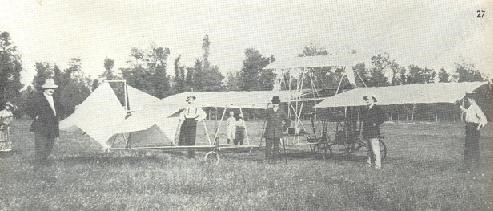
In 1908 Enrico Pini (born in Milan in January 1889), was in Paris during time when Wilbur Wright presented their airplanes. He became excited and remained influenced by aviation. He abandoned his normal activities and followed the American aviator, with such interest as to attract attention and sympathy of Wilbur Wright, who wanted to reward him by taking him as a passenger in a short flight. Then Pini decided to build himself an airplane, he designed one, a monoplane-biplane that best met his needs for aesthetics rather than technical ones.

In Milan, Enrico Pini had a brother, engineer Adolfo Pini, who was five years elder, he was an electrical engineer and occupied a responsible position at the Edison Electric Company. Bothe brothers started to build a full size machine according to Enricos drawing and with help of Adolfos fundings (this sum was to be used for the expenses of his marriage, which was therefore postponed), Adolfo even resigned from Edison`s company to dedicate himself fully to the project.

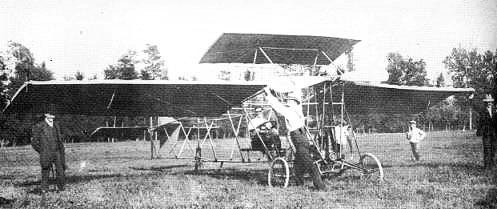
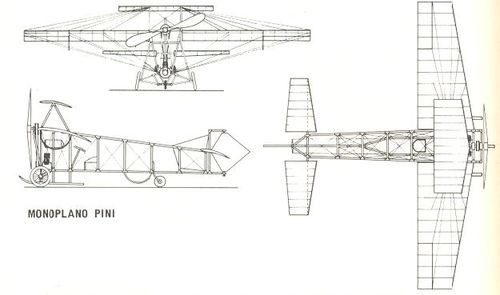
The brothers built the machine at the Bezzi`s factory, he was an industrialist, who owned an electric motor factory. Designed Enrico Pini, its planes were so arranged as to widely separate a large rectangular monoplane wing, then to add a small horizontal plane above the gap. All year 1909 was dedicated to the creation of the airplane, the assembly of which took place in the hangar of Societa Restelli, which built the Rebus engines, located in Piazza d’Armi nuova. In turn, the uncle and godfather of the two brothers Adollo, wanted to help them by providing them with the engine unit, a three-cylinder fan-type Anzani fan of about 25 HP, the kind used by Bleriot in his famous crossing of the Channel.

At the end of 1909, on 15th November, it was inaugurated in Milan the first exhibition of Italian Air Force “1a Esposizione Italiana d’Aviazione” organized by the Gazzetta dello Sport, at the vast halls of the Splendido Corso Hotel. The Pini brothers exhibited the model of their aircraft that was awarded by the jury with a bachelor’s bronze medal. In the spring of 1910 finally they began testing, pilot was Enrico, but at first the machine rarely reached the desired speed, it was only taxiing, the engine was underpowered. They made some improvement of undercarriage. With the daily trials and modifications aimed at improving the performance of complex propulsion and weight reduction, the device gradually lengthened its hops up to make small flight in height ranging between 50 and 80 cm from grass surface and a length variation from 200 to 500 meters.

Unfortunately the financial means of the two brothers were soon at the end, in view of their uncle would not hear of poor results to come to the aid; they tried to borrow, but even this was limited by the lack of trust that was fed to the success of the company (Bezzi was the same creditor to over six thousand liras) and therefore the tests had to be suspended and the two unfortunate inventors, despite all the sacrifices and renunciations that were subjected to succeed in their intent, reluctantly abandoned their aviation activities. The autumn saw the device removed and deposited in a cellar and was eventually sold as scrap.

A manufacturer from Milan, Ercole Marelli, which had seen the equipment of the Pini brothers had been appreciated, rather than the qualities of the aircraft itself, the brilliant and original construction, the engineer then offered a job in his company. Enrico Pini, after the bitter disappointment, continued in his business with bold new initiatives, and finally, helped by luck managed to form a solid financial position.

Pinaire Ultra-Aire

Side mounted joy stick, nosewheel steerable through joystick. Construction: Aluminium, Dacron

Engine: Cuyuna ULII-02 (429 cc) 33 hp
Static thrust: 250 lb
Wing span: 26 ft
Wing area: 130 sq.ft
Height: 6 ft 11 in
Length: 14 ft 2 in
Empty wt: 240 lb
Max wt: 550 lb
Fuel cap: 5 USG
Stall: 22 mph
Max speed: 63 mph
Vne: 75 mph
Climb rate: 600 fpm @ 35 mph
Design limit: +6, -4g
Glide ratio: 8-1
Wing loading: 4.23 lbs/sq.ft
Power loading: 15.71 lbs/hp

Pilgrim KR-135

Pilgrim KR-135 NC248V

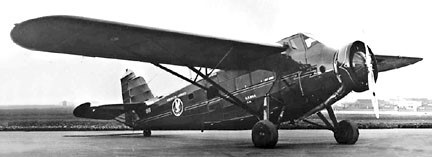
The 1931 Pilgrim KR-135 (ATC 415) was based on the Kreider-Reisner 21 series. Three were built; [NC248V, X311H, and NC963V. X311H was used as a test bed for Fairchild’s 100hp experimental Ranger 6-375 engine.

Engine: 125hp Fairchild (Ranger) 6-390
Wingspan: 27’0″
Length: 21’6″ Useful load: 590 lb
Max speed: 116 mph
Cruise: 93 mph
Stall: 51 mph
Range: 380 mi
Seats: 2

Pilgrim 100 / American Pilgrim / Y1C

Pilgrim 100-A

Designed by Virginius E. Clark, the 1931 100, 100-A or American Pilgrim was essentially a Fairchild product, descended from Fairchild 100.

The Pilgrim 100-A received ATC 443, 2-365.

Pilgrim 100-B

The 1932 100-B was powered by Wright R-1820 Cyclone B engines and received ATC 470. Ten were built, of which six went to American Airways, and four to the Army as Y1C-24.

Priced at $28,750, sixteen P&W Honet-engined Pilgrim 100As and six Wright Cyclone-engined 100B were built, all of which went to American Airlines, later passing to Alaskan Airways.

100 / 100-A / American Pilgrim
Engines: 575hp P&W Hornet B
Wing span: 57’0″
Length: 38’1″
Useful load: 3388 lb
Max speed: 136 mph
Cruise: 118 mph
Stall: 65 mph
Range: 400-500 mi
Seats: 10

100-B
Engines: 575hp Wright R-1820 Cyclone B
Length: 39’2″
Useful load: 3313 lb
Max speed: 135 mph
Cruise: 118 mph
Stall: 65 mph
Range: 510
Seats: 10