Prudden-San Diego-Whitehead Monoplane / Atlanta PW-1 / PW-2 / Prudden monoplane

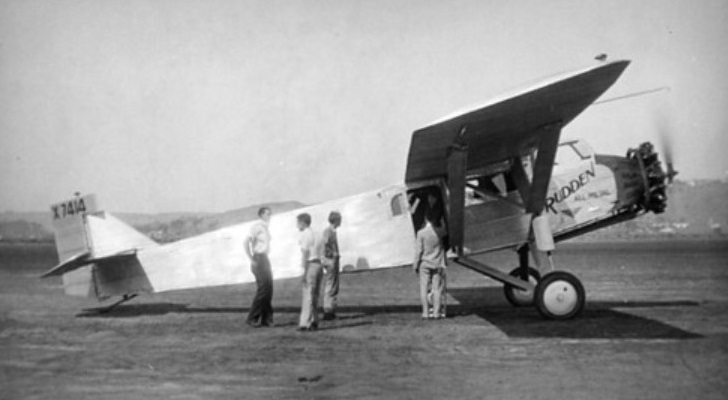
The Prudden-Whitehead monoplane (sometimes referred to as the Atlanta PW-1, PW-2 or the Prudden monoplane) is an American three-engined eight-seat commercial transport monoplane. Built by the Atlanta Aircraft Corporation and designed by George H. Prudden,

The Prudden-Whitehead monoplane is an all-metal low-wing cantilever monoplane with a monocoque fuselage and powered by three 240 hp (179 kW) Wright R-760 piston engines. It has a conventional fixed landing gear with a tailwheel. It has an enclosed passenger cabin for eight to ten passengers and a washroom and toilet.

Edward Whitehead was responsible for the sales of the aircraft. Only two of the trimotors were built.

The PW-1 variant, the first aircraft built was registered N366W.

The PW-2 variant, the second aircraft built was registered N280V.

PW-1 / PW-2
1930 (ATC 2-218)
Powerplant: 3 × Wright R-760, 240 hp (179 kW) / 220hp Wright J-6
Wingspan: 66 ft 6 in (20.27 m)
Wing area: 662.5 sq ft (61.6 sq.m)
Length: 44 ft 10 in (13.67 m)
Height: 14 ft 0.88 in (4.29 m)
Empty weight: 5,200 lb (2,359 kg)
Gross weight: 7,735 lb (3,509 kg)
Maximum speed: 145 mph (233 km/h, 126 kn)
Cruise speed: 124 mph (199 km/h, 108 kn)
Stall: 55 mph
Range: 620 mi (998 km, 540 nmi)
Endurance: 5 hours 0 minutes
Service ceiling: 15,000 ft (4,600 m)
Rate of climb: 1,220 ft/min (76.2 m/s)
Crew: 2
Capacity: 8 to 10 passengers

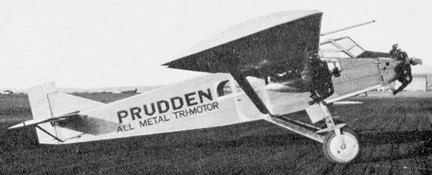
Prudden-San Diego TM-1 / XM-1 / SE-1

XM-1

The first development of the company was the project of a three-engine transport aircraft. The prototype aircraft, designated XM-1 and registration number X3321, flew for the first time in late 1927.

It was an all-metal high-wing aircraft equipped with three Ryan engines (a copy of the German Siemens-Halske Sh 12) with 125 hp. The passenger cabin was designed for six people, but after a slight transformation it was possible to accommodate seven using the co-pilot’s seat.

This aircraft, built from steel and duralumin, was advertised by the company as being resistant to fire and the whims of the weather and even to damage (crash-proof).

After several months of testing, the aircraft was converted into the TM-1 (changing the registration number to N5728). In this form, the plane took off in June 1928 powered by Siemens-Halske engines.

TM-1

The Super TM-1 had Ryan-Siemens wing engines and a Wright J-5c in the nose position.

Thanks to good publicity, even before the end of testing, a contract was awarded for the production of 16 such aircraft for Beacon Airways.

However, the company soon began to experience serious financial difficulties that prevented the implementation of these plans. The only copy of the aircraft made only a few advertising flights, and then, was converted into a single engine and sold to Mexico. The SE-1 designation showing the largest change to date, into a single-engine configuration.

SE-1

The type was developed into the Solar MS-1.

TM-1
Engines: 3 x Ryan, 125 h.p.
Wingspan: 17.37 m
Wing area: 47.00 sq,m
Length: 11.58 m
Height: 3.67 m
Weight empty: 1820 kg
Maximum speed: 175km / h
Cruising speed: 153km / h
Practical ceiling: 4572m
Crew: 2
Payload: 6 passengers

Prowler Aviation Jaguar

Development of Morse 364P.

Kits have been made available to construct the Jaguar tandem two-seat, 300mph (480kmh) low-wing monoplane, derived from the Prowler of 1985 designed by George Morse.

Engine: Rodeck V8, 350 hp
Height: 7.3 ft
Length: 21 ft
Wing span: 25.4 ft
Wing area: 104 sq.ft
Weight empty: 1560 lb
Gross: 2500 lb
Fuel cap: 72 USG
Speed max: 300 mph
Cruise: 250 mph
Range: 1200 sm
Stall: 65 mph
ROC: 2500 fpm
Take-off dist: 1100 ft
Landing dist: 1200 ft
Seats: 2
Landing gear: retractable tail wheel

Prowler Aviation Morse 364P Prowler

The 1985 Prowler Aviation Morse 364P Prowler was a two-place cabin low-wing monoplane powered by a modified Oldsmobile F-85 engine. The first, N611A, first flew on 17 March 1985.

George Morss asked Martin Hollman to perform the stress analysis on his Prowler. Several modifications such as wing to fuselage attachment were needed to make the aircraft safe.

Engine: 225hp Auto-Aviation modified Oldsmobile F-85
Wingspan: 25’0″
Length: 21’0″
Useful load: 788 lb
Max speed: 220 mph
Cruise: 170 mph
Stall: 55 mph
Range: 1200 mi
Seats: 2
Undercarriage: retractable

Protech PT2

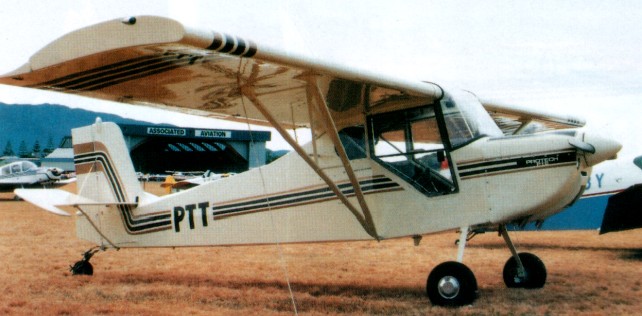
A high wing aircraft with all aluminium wings that can be easily and quickly folded rearwards, parallel with the steel tube, ceconite-covered fuselage. It has transparent doors which hinge upwards under the wings and can be opened in flight. The undercarriage is one-piece spring steel and either two or four 20 lt fuel tanks in the wing roots. Standard tires are 600×6, with optional 700×6.

The Protech PT2 Sassy origi¬nates from Houston, Texas circa 1988. Being a high wing side by side two seater of taildragger design, power comes from a 75hp Revmaster, providing a maximum speed of 140 mph. An interesting feature is the aircraft’s fold back wings to facilitate storage. The first was N211PT.

PT-2 Sassy
Engine: 75hp Revmaster
Wingspan: 31’9″
Length: 17’6″
Useful load: 604 lb
Max speed: 115 mph
Cruise: 105 mph
Stall: 29 mph
Range: 420 mi
Seats: 2

Engine: Continental O-200, 100 hp
Cruise: 85 kts
Stall: 38 kts
Landing dist: 100-200 m
Take off dist: 100-200 m
Seats: 2

PT-2C
Engine: 150hp Textron Lycoming O-320
Wingspan: 32’6″
Length: 22’0″
Useful load: 750 lb
Max speed: 130 mph
Cruise: 115 mph
Range: 300 mi
Seats: 2

Prospective Concepts Stingray

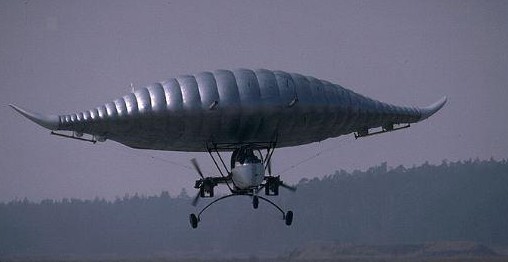
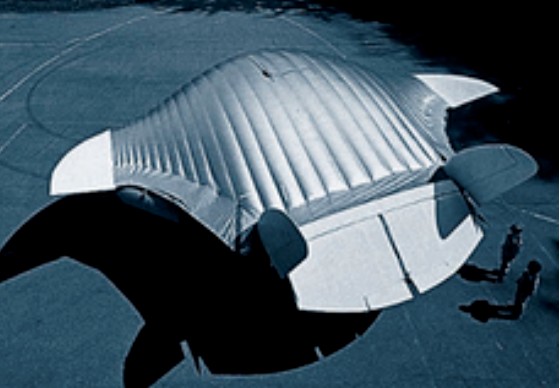
The media talked about a “flying stingray” when Prospective Concepts AG finally unveiled its secretive technology demonstrator in May 1998. Stingray is designed by this Swiss company, with a wing that derives its rigidity from compressed air. Later versions will be filled with helium. The second radical concept developed especially for the Stingray is a pneumatic catapult to be placed in the aicraft’s tail. The concept has been tested on the “Kangarou,” a light airplane with slow flight characteristics similar to the Stingray’s: a cylinder that extends to 5 meters catapults the craft right into the air and accelerates it from standstill to flying speed at 1.5 g.

According to the company, a significantly larger successor to the Stingray is also planned. It will derive 25 percent of its lift from helium in its wing and integrate propulsion and the gondola into the wing. Development of the Stingray was supported by the German pneumatic conglomerate Festo.

Stingray
Wingspan: 13 m
Length overall: 9.4 m
Wing surface: 70 sq.m
Volume: 68 cu.m
Max. speed: 130 km/h (85 mph)