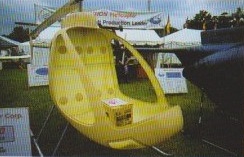
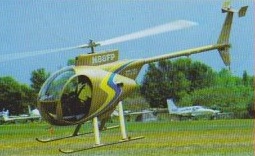
The two seat Voyager 500 was launched at the Sn ‘n Fun show in Florida in 1998. Still only in kit form, it featured a three cylinder two stroke engine.
Engine: US Airpower, 138 hp Rotor span: 6.80 m Blade area: 0.2 sq.m MAUW: 515 kg Empty weight: 276 kg Fuel capacity: 76 lt Max speed: 193 kph Cruise speed: 152 kph Minimum speed: 0 kph Climb rate: 6 m/s Seats: 2 Fuel consumption: 30 lt/hr Kit price (1998): $48,500
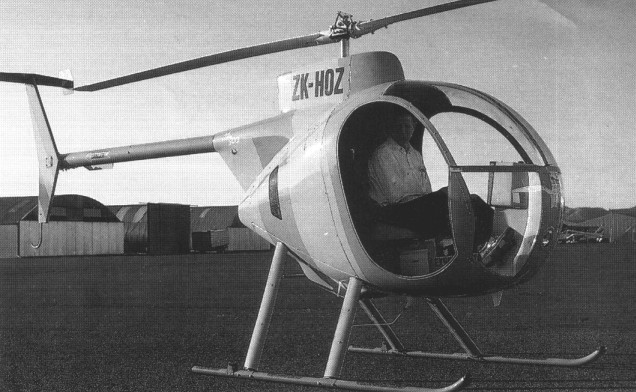
Designed by Augusto Cicare, the Mini 500 was developed by Dennis Fetters, and utilises a single, semi-rigid, teetering, underslung main rotor and free-teetering, rigid in-plane tail rotor, and first flew in 1992. A single seat fully enclosed helicopter. Steel tube frame covered with a composite body enclosure. Tail boom is aluminium.
By 1998 around 400 examples had been sold.
Engine: Rotax 582, 67 hp Rotor blades: Composite 19’2” Height: 8.3 ft Length: 22.6 ft Disk span: 19.2 ft Tail rotor: aluminium 3’10”. Fuel cap: 14.7 USG Weight empty: 485 lb Gross: 840 lb Speed max: 115 mph Cruise: 65-83 kt Range: 225 sm ROC: 1100 fpm Service ceiling: 10,000 ft Seats: 1 Landing gear: skids
Engine: Rotax 582, 64 hp Rotor span: 6.85 m Blade area: 0.2 sq.m MAUW: 350 kg Empty weight: 155 kg Fuel capacity: 57 lt Max speed: 155 kph Cruise speed: 100 kph Minimum speed: 0 kph Climb rate: 5.5 m/s Seats: 1 Kit price (1998): US$32,900
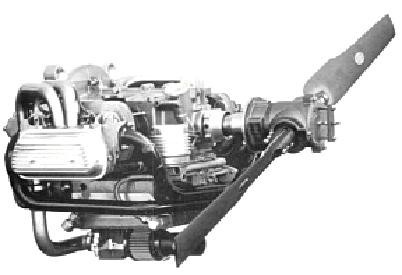
The Revmaster 2100D is a Volkswagen air-cooled engine modified for Homebuilt aircraft with dual magneto ignition. Designed by Joe Horvath the unit cost was US$1,095 in 1971
Two versions available were the R-2100 75 hp and the R-2100 turbo 80 HP. Originally, the R-2100 was equipped with POSA 28mm carburettors.
Specifications: R-2100D Bore: 92 mm Stroke: 78 mm Displacement: 2073cc Valvetrain: Single overhead exhaust valve, single side inlet valve per cylinder Fuel system: Single carburettor Cooling system: Air-cooled Tillotson Floatless Carburetor Power output: 65hp
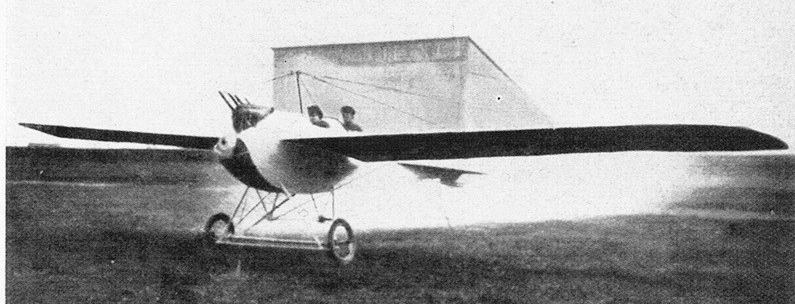
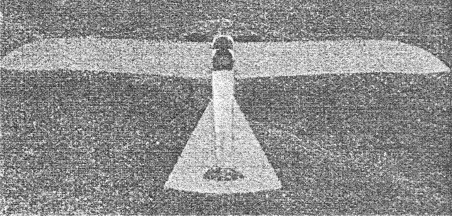
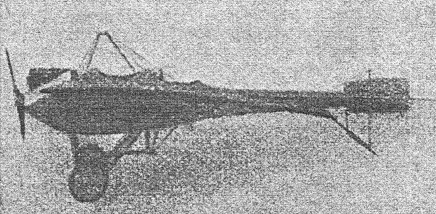
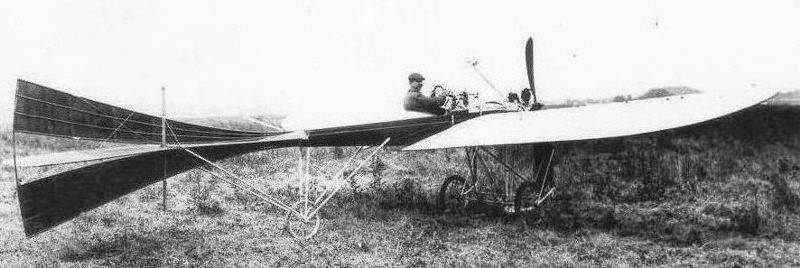
Requillard’s monoplane made its official appearance at Juvisy, France, in June 1910, flown by Marc Pourpe. The machine was very slender and streamlined, with long and triangular fixed tail surfaces, the rudder in two parts connected at the trailing edges to allow the elevator to move up and down between them. It was powered by a 50 hp Gnome. It was reported to have flipped onto its back on its first tests.
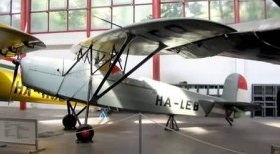
Training and liaison aircraft, Hungary, first flown in October 1940
Engine: Hirth HM 504 A2, 104 hp Wingspan: 31.004 ft / 9.45 m Wing area: 145.314 sq.ft / 13.5 sq.m Length: 19.948 ft / 6.08 m Height: 8.301 ft / 2.53 m Max take off weight: 1653.8 lb / 750.0 kg Weight empty: 1036.4 lb / 470.0 kg Max speed: 97 kts / 180 km/h Cruising speed: 86 kts / 160 km/h Service ceiling: 14764 ft / 4500 m Wing loading: 11.48 lb/sq.ft / 56.0 kg/sq.m Range: 351 nm / 650 km Armament: None Crew: 1
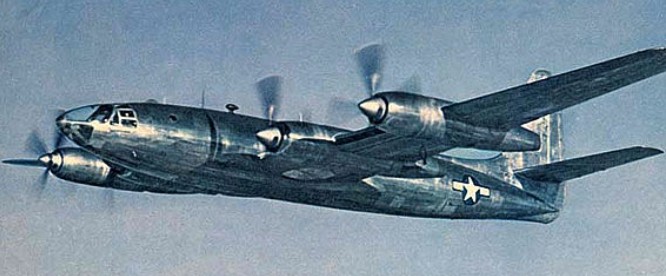
Development of the XF-12 photo-reconnaissance airplane began in 1944 when it appeared that a fast, specialized reconnaissance airplane would be needed during the final stages of the war in the Pacific. The XF-12 was roughly the same size as the C-54, hut it was much heavier and had more than twice as much power. The four turbo¬supercharged, 3,000hp (2,200kw) Pratt & Whitney Wasp Major engines were enclosed in long, slender nacelles that extended well beyond the wing trailing edges. The wing and empennage shared a resemblance with those of the F-84 Thunderjet. The fuselage was a slender teardrop shape, unbroken even by the windshield. Each main landing gear had a very large single wheel to fit inside the confines of the laminar flow wing. The Rainbow had its own darkroom in order to develop reconnaissance images on the way back from a long photo mission.
The first of two XF-12 prototypes was completed and flown on February 7, 1946. Subsequent experimental flight tests showed that it had lived up to its promise, and it passed into the service-test phase in June 1947. The XR-12 delivered to the Air Force crashed on its second test flight. The other Rainbow was sent to a gunnery range.
Unfortunately, the day of high-performance reciprocating engine-powered military airplanes had passed and the anticipated contract for 20 production F-l2As never materialized.
Republic still hoped to make the Rainbow into a 46-seat airliner, which they called the RC-2. Their selling point was speed, for which customers would pay a premium. Unfortunately, the expected postwar boom was not immediate and the airlines bought the slower but roomier DC-4 and Boeing 377 instead.
XF-12 Engine: 4 x Pratt & Whitney R-4360 Wasp Major, 2250kW Max take-off weight: 45950 kg / 101303 lb Wingspan: 39.36 m / 129 ft 2 in Length: 28.59 m / 94 ft 10 in Height: 8.63 m / 28 ft 4 in Wing area: 152.30 sq.m / 1639.34 sq ft Max. speed: 684 km/h / 425 mph Cruise speed: 640 km/h / 398 mph Ceiling: 13000 m / 42650 ft Range: 7000 km / 4350 miles Crew: 5-7
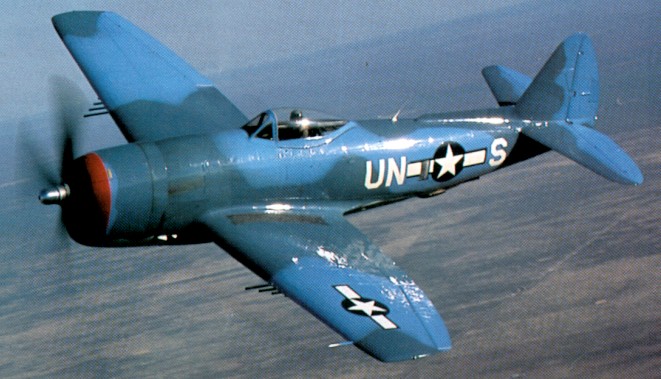
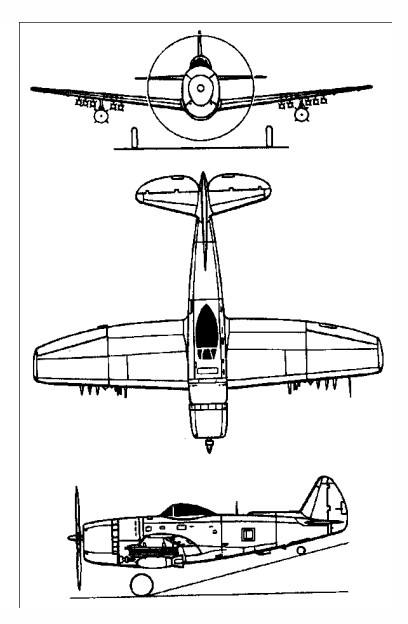
The P-43 Lancer design developed further into the P-47 Thunderbolt for USAAF. Designed by Alexander Kartveli, to provide ground clearance for the 12′ four-blade prop, the unique telescoping landing gear was 9″ shorter when retracted. First flew in its XP-47B prototype form on 6 May 1941.
Eglin Field testing effects of machine gun and cannon on P-47
The first P-47B production delivery was on 18 March 1942.
The P-47C had a mach .73 (556 mph) terminal dive and a .69 (525 mph) red-line.
A dorsal fin was added to compensate for the loss of aft keel surface and introduced on P 47D 27 RE and subsequent batches. P-47D had a mach .72 (550 mph) red-line dive speed and rolled 91 d/s @ 300 mph
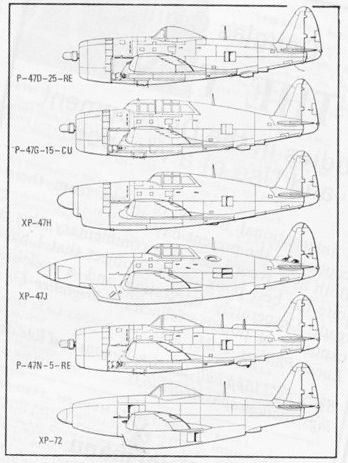
XP-47H
In 1943, two P-47D-15-RE airframes (serials 42-23297/23298) were selected for testing with the new experimental 2300 hp Chrysler XIV-2220-1 sixteen-cylinder inverted Vee liquid-cooled engine. These aircraft were redesignated XP-47H. The liquid-cooled Chrysler engine with its large under-fuselage radiator radically changed the appearance of the Thunderbolt, and increased overall length to 39 feet 2 inches. With the increased power and improved streamlining, a maximum speed of 490 mph was anticipated.
Although the project was begun in August 1943, the two P-47D-15-RE airframes were not actually converted until 1945. Test flights began on July 26, 1945. One of the XP-47Hs actually attained a speed of 490 mph in level flight. The Chrysler engine failed to deliver the promised power output, and the maximum speed attained during tests was only 414 mph at 30,000 feet, poorer performance than the “stock” P-47D. In any case, the Chrysler XIV-2220 engine never achieved production and the advent of jet propulsion killed any further USAAF interest in the development of even faster piston-engined fighters. Consequently, no further work was undertaken on the XP-47H project.
The XP-47J differed from other Thunderbolts in its engine, being powered by a ‘C’ series Double Wasp or Pratt & Whitney R-2800-57 driving a four-blade 13-ft Curtiss Electric propeller —employed after a plan to try out a contra-rotating propeller was dropped. But the XP-47J also had a distinctive cowling shape with an engine-cooling fan below and set back from the propeller hub. And there were other differences from standard Thunderbolts, some trivial: the six .50-calibre guns with 267 rounds per gun protruded from the wing leading edge in a different manner from those of other P-47s. The XP-47J was first flown on August 2, 1944 at the manufacturer’s Long Island, New York, facility and subsequently evaluated at Wright Field, Ohio. Apart from its remarkable high speed, the XP-47J could climb at 4,705 ft/min, reached a speed of 811kph, and the service ceiling was 45,000ft. Maximum range was 1,070 miles at 10,000ft. The XP-47J did not enter production.
XP 47J
P-47M had a P&W R2800-56.
Modified with longer, stronger wings, the P 47N could carry addi¬tional fuel for long distances flown in the Pacific War. Some 1,816 of this last production version were built. The P-47N dove to mach .83 (632 mph)
XP-47N Thunderbolt
Production began at Republic’s plant in Farmingdale, though others were also built at a Republic factory in Evansville, Indiana, and by Curtiss Wright in Buffalo, New York. A total of 15,863 built, of which 15,329 were built during Second World War. They were priced at $83,000+ Production was at Farmingdale (suffix -RE) and Evansville IN (suffix -RA), as well as subcontract to Curtiss for P-47G.
During WW2, Thunderbolt’s ratio of aerial combat victories to losses was 4.6:1 in downing 2,752 enemy aircraft, besides destroying 3,315 more on the ground. Official records also credit P-47 with some 9,000 locomotives and 86,000 railroad cars, 6,000 armored vehicles and tanks, and 68,000 trucks.
P-47B Engine: Pratt & Whitney R-2800-21 Double Wasp, 2000 hp Wingspan: 40 ft 9.25 in / 12.4 m Length: 34 ft 10 in Height: 12 ft 8 in Empty weight: 9010 lb / 4087 kg MAUW: 12,700 lb / 5760 kg Max speed: 412 mph ROC: 2800 fpm / 855 m/min Service ceiling: 38,000 ft Range int/fuel: 575 mi Armament: 8 x 0.5in Colt-Browning 267, 350 or 425 rds each
P-47C Engine: Pratt & Whitney R-2800-59 Double Wasp, 2300 hp Wingspan: 40 ft 9.25 in / 12.4 m Length: 36 ft 1.25 in / 11.03 m Height: 14 ft 2 in / 4.03 m MAUW: 14,925 lb Max speed: 433 mph ROC: 2800 fpm / 855 m/min Service ceiling: 42-43,000 ft / 13,000 m Armament: 8 x 0.5in Colt-Browning 267, 350 or 425 rds each
P-47D Engine: Pratt & Whitney R-2800-59 Double Wasp, 2300 hp (most) Wingspan: 40 ft 9.25 in / 12.4 m Length: 36 ft 1.25 in / 11.03 m Height: 14 ft 2 in / 4.03 m Empty weight: 10,700 lb / 4853 kg MAUW: 19,400 lb / 8800 kg Max speed: 428 mph / 690 kph ROC: 2800 fpm / 855 m/min Service ceiling: 42-43,000 ft / 13,000 m Range int/fuel: 1000 mi / 1600 km Max range ext/fuel: 1900 mi / 3060 km Armament: 8 x 0.5in Colt-Browning 267, 350 or 425 rds each Hardpoints: 3-5 Bombload: 2500 lb / 1134 kg
P-47D Engine: 1 x Pratt & Whitney R-2800-59W Double Wasp, 1890kW / 2800 hp Propeller: Hamilton Standard 24E50, 6507 A. O. Wingspan: 12.43 m / 41 ft 9 in Wing area: 27.87 sq.m / 299.99 sq ft Length: 11.02 m / 36 ft 2 in Height: 14 ft 2 in Empty weight: 4513 kg / 9950 lb Max take-off weight: 7938 kg / 17500 lb Fuel capacity: 308 Imp.Gal Max. speed: 697 km/h / 433 mph at 25,000 ft Max ROC: 7280 fpm Ceiling: 12495 m / 41000 ft Range: 950 mile Range w/max.fuel: 3058 km / 1900 miles Crew: 1 Armament: 6 x 12.7mm machine-guns, 1134kg of weapons External load: 2500 lb
Republic P-47D-28-RA Engine; 1 x 2,430 h.p. Pratt & Whitney R-2800-59 radial Prop; 13ft-diameter Curtiss Electric C5425-AI14 Wingspan; 40ft 9.5in Length; 36ft 1.75in Height; 14ft 0in Wing area; 300 sq.ft Empty weight; 10,0001b Gross weight; 14,5001b Maximum weight; 17,5001b Maximum speed; 423 m.p.h. at 30,000ft Landing speed; 105 m.p.h. Climb to 15,000ft; 6.2min Climb to 20,000ft; 8.5min Climb to 25,000ft; 11 min Climb to 30,000ft ; 14min Service ceiling; 42,000ft Maximum range; 1,030 miles at 10,000ft (5.3hr) Normal range; 590 miles at 25,000ft Armament; 6 or 8 x 0.50in machine guns 267-425 rounds per gun Maximum bomb load; 2,5001b Number built 1,028 P-47D-28-RA at Evansville, Indiana, USA
P-47G Engine: R2800, 2300 hp Max speed: 433 mph @ 30,000ft Service ceiling: 40,000 ft.
P-47M Engine: Pratt & Whitney R-2800-55 or -77 Double Wasp, 2800 hp Wingspan: 40 ft 9.25 in / 12.4 m Length: 36 ft 1.25 in / 11.03 m Height: 14 ft 8 in MAUW: 14,700 lb Max speed: 470 mph ROC: 2800 fpm / 855 m/min Service ceiling: 42-43,000 ft / 13,000 m Armament: 6 x 0.5in Colt-Browning mg
P-47N Engine: Pratt & Whitney R-2800-55 or -77 Double Wasp, 2800 hp Wingspan: 40 ft 9.25 in / 12.4 m Wing area: 321.951 sq.ft / 29.91 sq.m Length: 36 ft 1.25 in / 11.03 m Height: 14 ft 8 in Weight empty: 11003.0 lb / 4990.0 kg MAUW: 21,200 lb / 9616 kg Internal fuel: 594 Imp.Gal Wing load: 67.45 lb/sq.ft / 329.0 kg/sq.m Max speed: 467 mph / 751 kph / 406 kt Cruising speed: 261 kt / 483 km/h ROC: 2800 fpm / 855 m/min Service ceiling: 42-43,000 ft / 13,000 m Max range ext/fuel: 2350 mi / 3800 km Armament: 8 x 0.5in Colt-Browning 267, 350 or 425 rds each Hardpoints: 3-5 Bombload: 2500 lb / 1134 kg Crew: 1
XP-47H Engine: Chrysler.
XP-47J Max speed: 504 mph ROC: 4705 fpm Service ceiling: 45,000 ft Max range: 1070 miles
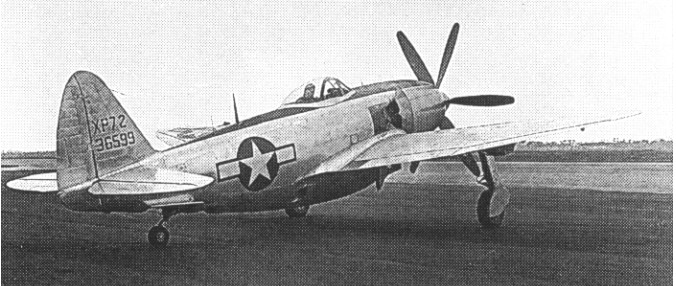
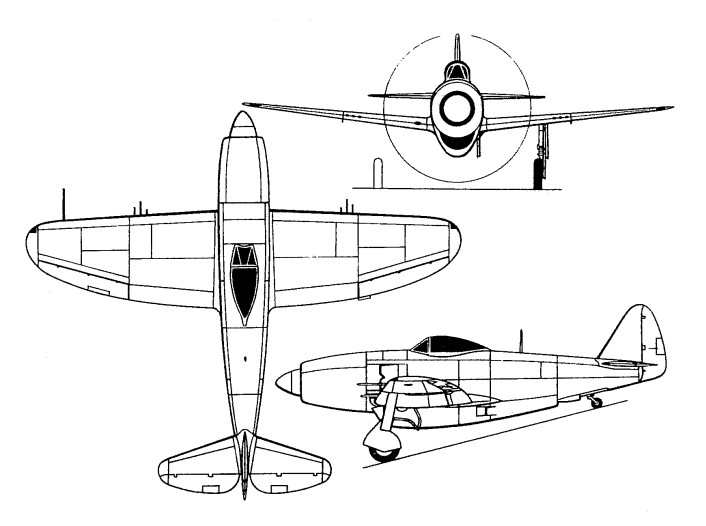
The Republic XP-72 was based upon the P-47 airframe and was designed by Alexander Kartveli’s fighter team as a ‘Super Thunderbolt’ around the 3,000-hp / 2237kW Pratt & Whitney R-4360-13 Wasp Major radial engine. The powerplant was the most powerful piston engine to reach production in any country during World War II.
Intended primarily to be faster than the Thunderbolt, the XP-72 was viewed in part as a remedy for the Third Reich’s high-speed V-l buzz bomb. The USAAF planned to use the fighter to intercept buzz bombs, with a maximum speed of 490mph and an initial climb rate of 3,100ft/min the XP-72 could reach 6000m / 20,000 ft in just under five minutes. Operational P-72s would have been armed with six .50-calibre (12.7-mm) guns.
The first of two examples flew at Farmingdale on 2 February 1944 using a large four-bladed propeller. The second XP-72 flew in July 1944 with the intended Aeroproducts six-bladed contra-rotating propeller. The second aircraft, however, was lost on an early flight.
With priority shifted to long-range escort fighters, this promising interceptor was not needed. Even with a range of 1,200 miles, the XP-72 failed to get a production order. The other XP-72 airframe is thought to have been scrapped at Wright Field around VJ-Day.
Engine: Pratt & Whitney R-4360-13 Wasp Major, 3,000-hp Max take-off weight: 6690 kg / 14749 lb Empty weight: 4973 kg / 10964 lb Wingspan: 12.49 m / 41 ft 0 in Length: 11.17 m / 37 ft 8 in Height: 4.42 m / 15 ft 6 in Wing area: 27.87 sq.m / 299.99 sq ft Max. speed: 788 km/h / 490 mph Ceiling: 12800 m / 42000 ft Range: 1930 km / 1199 miles Armament: 6 x 12.7mm machine-guns, 2 x 450kg bombs
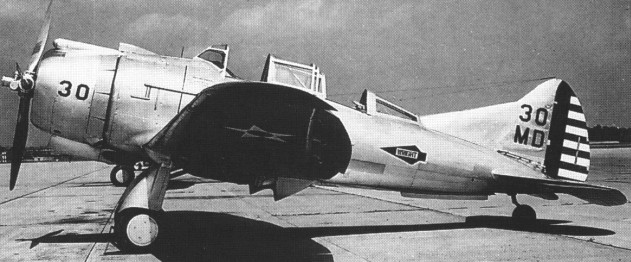
From its P-35 single-seat tighter Republic (latterly Seversky) developed the Model 2PA Guardsman two-seat escort fighter and fighter-bomber with the same type of rearward semi-retracting main landing gear units and the glazed rear portion of the cockpit expanded rearward to accommodate the second crewman. There was no US market for such an aeroplane, so the company looked for export sales.
Two were sold to the USSR as 2PA-L/As, 20 2PA-B3s went to Japan with the local designation A8V1, and 52 2PA-204Ls were ordered by Sweden to supplement her J 9 fighters (P-35s sold with the company designation EP-1-06s). Early in World War II the US administration embargoed the delivery of the 2PA-204Ls to Sweden, and these were taken into the USAAC inventory as AT-12 advanced fighter trainers with the designation AT-12. The aircraft saw limited use in this role during the first part of World War II.
AT-12 two-seat advanced tighter trainer Span: 12.5m (41ft ) Length: 8.43m (27 ft 8in) Powerplant: 1 x Pratt & Whitney R-1830-45, 783kW (1,050 hp) Armament: 4 or 7 x 7.62-mm (0.3-in) mg Bombload: 227 kg (500 lb) under wings Max T/O weight: 2918 kg (6,433 lb) Max speed: 285 mph at 10,000ft Operational range: 1,200 miles