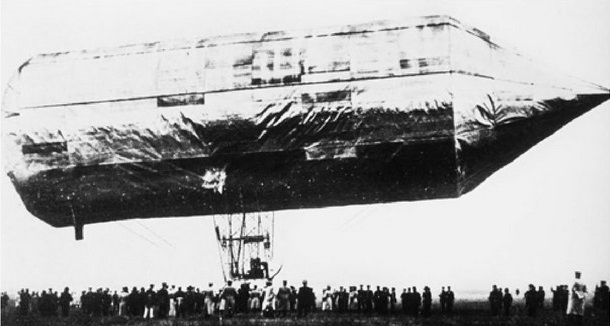
Schwarz No.1 / No.2

In 1895 Austrian timber merchant David Schwarz produced plans for a rigid-framed airship. It was built in St Petersburg for the Russian government but, although completed, never flew due to political complications; the Russians constantly regarding Schwartz as a spy. Schwartz was forced to leave Russia in secrecy, retuning to Germany where he built a second airship of similar design for the Prussian Airship Division in Berlin.

Schwarz died before the constuction was complete. The work was taken over by his able and practable widow until completed. The airship was a bottle-shaped craft of cylindrical form with a conical nose and shallow rounded stern, an internal framework constructed of tubular aluminium members and girders was covered by a skin of sheet aluminium .008in in thickness. The hull contained a single gas cell.

The filling of the envelope was accomplished by introducing a series of paper bags within the framework to be filled with hydrogen gas, which at the same time expelled an equal volume of air contained within the metal hull. A two-cylinder Daimeter petrol motor of 12 hp provided power, driving three airscrews through fabric transmission belts.

Two wing screws mounted above the car were assigned to drive the craft through the air, while a third larger diameter propeller mounted on the centre line, able to move through 90˚ vertically and horizontally, was supposed to control direction.
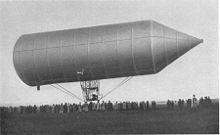
Schwarz No.2 crashed on its initial flight at Tempelhof on 4 November 1897. With the engines running, the ground crew released the ropes and the airship rose to approximately 100 ft. Maintaining its position against the breeze for some minutes, the airship was beginning to make headway against the wind when the left-hand driving belt jumped off its sheaves.

The airship continued to rise to 1300 ft as the pilot, a soldier named Ernst Jagels, struggled to maintain control, adjusting the angle of the central propeller to counter the wind. Just as he was turning into wind the right-hand driving belt also slipped off. Jagels valved gas to bring the craft down near the Tempelhof Field but the descent was too rapid, causing it to crash heavily on the ground, completely wrecking the airship. Jagels escaped unharmed but without further funding the project was abandoned.

Envelope capacity: 131,000 cu.ft
Length: 154 ft
Diameter: 46 ft
Height: 60 ft
Engine: Diamler 2 cyl, 12 hp
Speed: 17 mph
Crew: 1
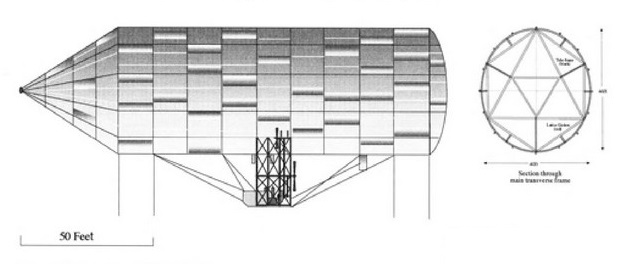
Schütte-Lanz SL

Conceived from the outset with an alternative construction to rival the metal Zeppelins, the SLs with their rigid ply framework were claimed to be lighter and more flexible than met¬al-framed airships, and most of those in German military service were oper¬ated by the army.

The Navy, responsi¬ble for most of the raids against the British Isles, rightly claimed that wooden vessels were incapable of lift¬ing a sufficiently large bomb load as their weight would be increased by moisture absorbed while crossing the sea.

Wire-braced wooden structures had been used by the Schütte-Lanz company since the design stages of their initial SL 1 that had first flown on 17 October 1911.

SL 11 was accepted by the army in June 1916, and after trials was sent to its operational base at Spich in August. Armament was two 7.92-mm (0.312-in) Parabellum machine-guns on free mountings in single gun position above forward hull, plus bombs. At the end of the month its initial oper¬ational sortie proved abortive because of the weather. The attack at the beginning of September was its first and last, such a brief career resulting in the airship having only one com¬mander, Hauptmann Wilhelm Schramm, who had gained experience in charge of three earlier rigids, all of Zeppelin design.

On the night of the SLll’s destruction, when Schramm died with all his crew, both incendiary and explosive bombs were dropped. The airship’s chief claim to fame lies in that it was the first enemy aircraft of any kind to be brought down on British soil. SL11 was brought down by William Leefe Robinson on the night of 3 September 1916. In recog¬nition Robinson was awarded the Victoria Cross.

SL 11
Type: bombing airship
Engines: four l79-kW (240-hp) Maybach HSLu six-cylinder water-cooled piston
Maximum speed 95 kph (59 mph)
Service ceiling 5400 m (17,717 ft)
Range 3700 km (2,299 miles)
Useful lift 21500 kg (47,399 lb)
Diameter 20.09 m (65 ft 10.9 in)
Length 173.98 m (570 ft 9.6 in)
Volume 31900 cu.m (1,126,540 cu ft)
Armament: two 7.92-mm (0.312-in) Parabellum machine-guns

Sclaves 1910 Biplane

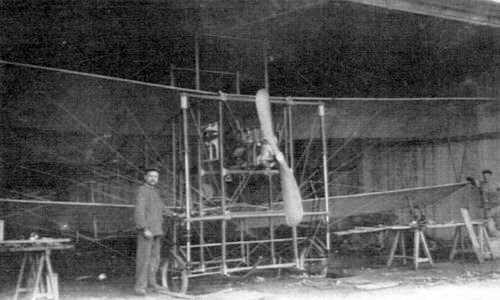
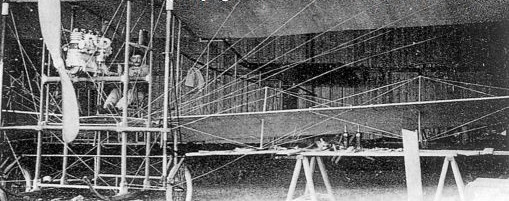
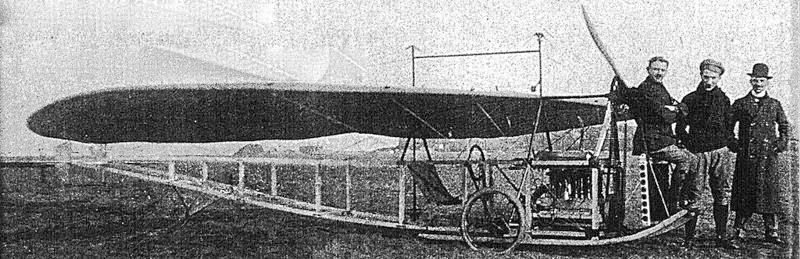
This tractor French biplane, constructed of metal pipes and an abundance of wire bracing, powered by an acetylene motor was tested at Amberieu in 1910 by a man from Lyon named Sclaves. At least one photo shows a 50 hp Prini-Berthaud engine. The rectangular wings were braced entirely by one pair of outboard struts on each side and wires from double kingposts on top. The heavy forward box structure seemed made of pipes; the rear fuselage was uncovered. The two wheels were castering.

Schüler 1909 Eindecker

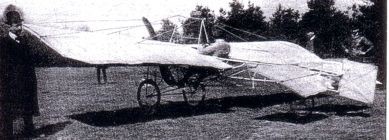
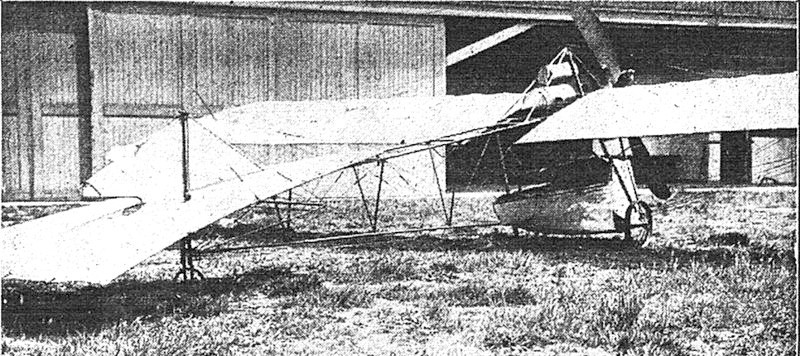
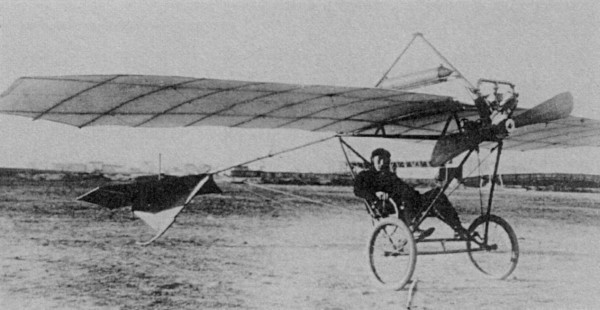
This high-wing monoplane was tested in late spring and summer of 1909 at the parade ground in Chemnitz, Saxony, after a public exhibition in April 1909. Schüler had completed his engineering studies there. It was probably inspired by the Demoiselle and was completed before Hans Grade had built his first similar “Libelle” in June 1909. The machine was not a great success and thus Schüler didn’t appear at the first German aeronautical exhibition (ILA) in Frankfurt or the first meeting at Johannisthal in September/October 1909, but he was among the first who rented a shed at this newly built airfield. At the beginning of 1910 Schüler was busy working on a monoplane for Leo Lendner and building engines for Hanuschke and others in his “Max Schüler Aeroplan-Fabrik”, which he had founded in his hometown Berlin in late 1909.