Sikorsky S-22 Ilya Mourometz

In August 1913 a military Voisin biplane broke up in the air over the airfield and its engine fell onto the Grand. Sikorsky subsequently redesigned the aircraft as the Ilya Muromets which was even bigger. Its wing span was 10 ft greater than that of Le Grand and it weighed 10,000 lb.

A four bay biplane with braced extensions of upper wings. With two spar wooden wings and wooden fuselage, all fabric covered, ailerons were fitted to the top wings.

The first flight of Ilya Mourometz No. 1, in January 1914, was made with a skid undercarriage. On 11 February 1914 this machine set a new world record by carrying aloft 16 people and a dog. A familiar picture of it shows the big biplane landing with two fur-coated passengers taking a stroll along its fuselage top promenade. Five months after the first flight, it flew several times as a seaplane.
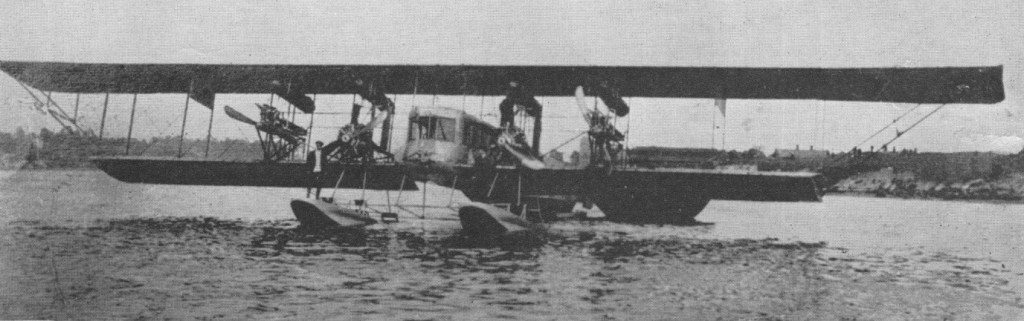
With the threatened outbreak of hostilities ten were purchased by the Russian Army for military trials.

The Ilya Muromets went into production as a heavy bomber for the Imperial Russian Air Service Eskadra Vozdushnykh Korablei (Squadron of Flying Ships) built at the Russo-Baltic Wagon Works. Seventy three were built, and few of these production aircraft were identical, improvement and developing being continuous, and short engines meant they were flown with a variety of powerplant which, in some cases, involved a mix of engines on one aircraft.

The first version used in combat was the Type B, with Salmson engines of 135-200 hp and an armament of only two machine guns. The largest of the series was the Type IMYe2, with a wingspan of 34.50m and a gross weight of 7,000kg.

After experimenting with various types of armament and bomb racks it was found to be too slow and with limited altitude for offensive purposes. Sikorsky designed a lighter version, the Il’ya Muromets Type V, and deliveries of these began in early 1915.

Ilya Muromets E

Sikorsky S-22 Il’ya Murometz Article

They were so effective on more than 400 bombing raids against Germany and Lithua¬nia in 1915 that Great Britain and France sought permission from Czar Nicholas II to produce the design under licence, though nothing came of the scheme before the 1917 Russian Revolution sent Sikorsky fleeing to the United States.

They made 400 successful raids for the loss of only one aircraft, shot down by German fighters after it destroyed three of the enemy aircraft.

Engines: 4 x Argus, 100 hp
Wingspan: 30.9/22.0 m / 101 ft 5 in / 72 ft 2 in
Length: 17.1 m / 56 ft 1 in
Wing area: 148.0 sq.m / 1593.06 sq ft
Max take-off weight: 5100 kg / 11244 lb
Max. speed: 110 km/h / 68 mph
Range: 600 km / 373 miles
Armament: 8 machine-guns, bombs
Crew: 10

Ilya Muromets E
Engines: 4 x Renault, 200 hp
Props: 2 blade
Wingspan: 102 ft 8 in
Wing area: 20050 sq.ft
Length: 59 ft 8 in
Empty weight: 10,600 lb
MTOW: 17,600 lb
Max speed: 85 mph at 5000 ft’
Endurance: 4 hr
Armament: up to 7 mg
Bombload: 1000-1500 lb

Sikorsky IM-W Ilya Muromet
Engine: 4 x Argus, 138 hp
Length: 56.102 ft / 17.1 m
Wingspan: 97.769 ft / 29.8 m
Wing area: 1345.5 sq.ft / 125.0 sq.m
Max take off weight: 9812.3 lb / 4450.0 kg
Max. speed: 67 kts / 125 km/h
Service ceiling: 12139 ft / 3700 m
Wing loading: 7.38 lb/sq.ft / 36.00 kg/sq.m
Endurance: 5 h
Crew: 5
Armament: 3-7x MG, 700kg Bomb.
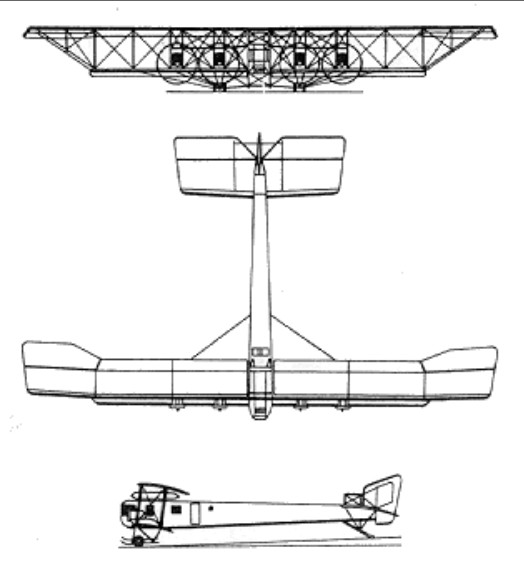
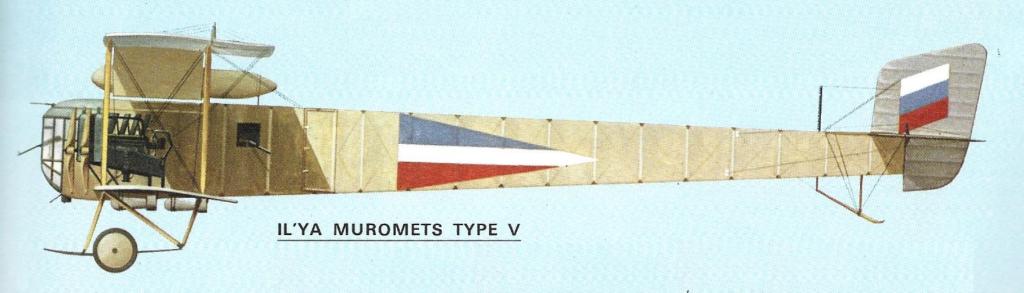
Sikorsky S-22 Ilya Muromet

Sikorsky Le Grand / Russkii Vitiaz (Russian Knight)

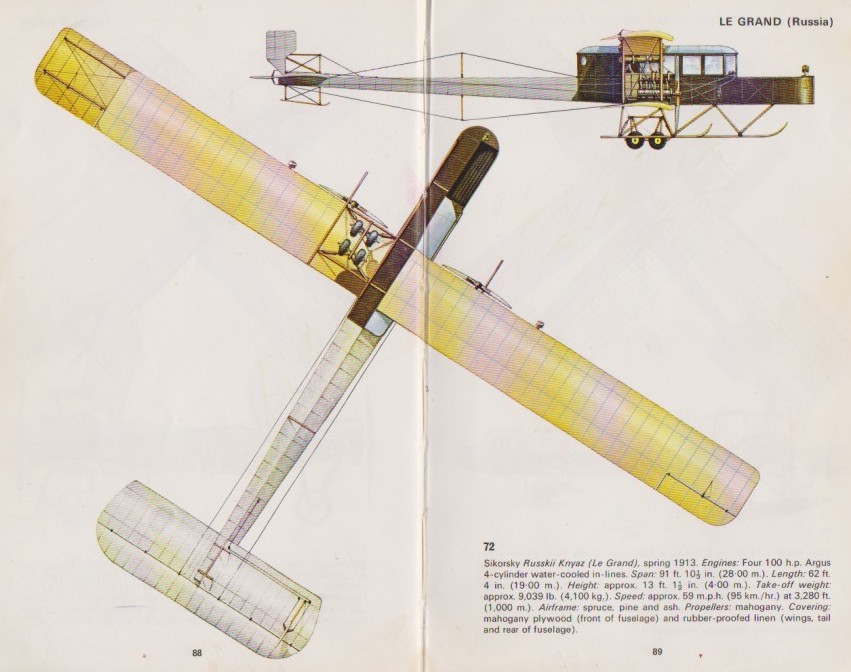
In 1912 Igor Sikorsky began construction of an aircraft with a wingspan of 28 m (92 ft) it was at that time by far the largest heavier than air craft to fly; the first to have four engines; the first with a fully enclosed passenger cabin; and the first designed specifically as an airliner.

Officially known as Russkii Vitiaz (Russian Knight), the big biplane was dubbed the Grand or Bolshoi before its first flight on 13 May 1913. The Grand weighed 4080 kg (8000 lb) and was powered by four 100 hp water cooled Argus engines arranged initially in tandem pairs, but after the first ten minute test flight the two rear mounted engines were moved outboard on the wings. In June 1914, Sikorsky piloted the 10,000-1b. S-22 named Ilia Mourotz on a 1,600mi. round trip from St. Petersburg to Kiev.

Czar Nicholas II inspected LeGrand with Sikorsky in the summer of 1913.

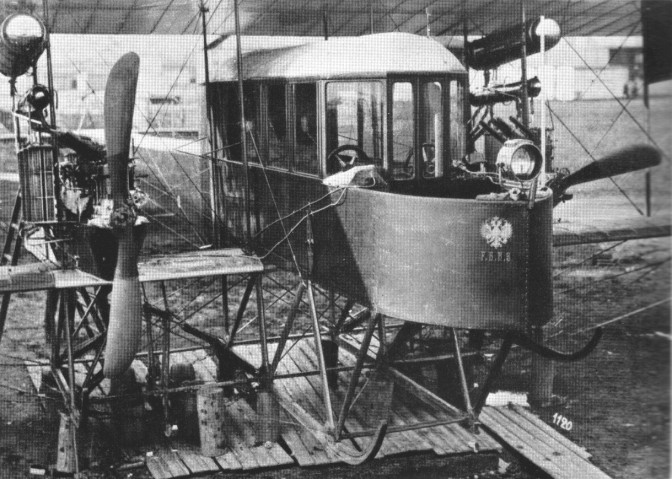
Numerous difficulties were encountered in the design and construction; there were no wheels of adequate size to support the Grand, so a 16 wheel bogie undercarriage had to be built. The cabin incorporated some novelties. At the front was a large open balcony with a searchlight mounted on a gimbal; next came the cockpit with dual controls for two pilots; behind this was the passenger cabin, luxuriously appointed with four seats, sofa, table, washroom and wardrobe.

The Grand flew well and subsequently made 53 flights including a record breaking duration flight of 1 hour 53 minutes with eight people aboard on 2 August 1913. Later that month a military Voisin biplane broke up in the air over the airfield and its engine fell onto the Grand. Sikorsky subsequently redesigned the aircraft as the Ilya Muromets.

Engines: 4 x 100 hp Argus four cylinder in line piston
Wing span: 91 ft 10.25 in (28.00 m)
Length: 62 ft 4 in (19.00 m)
Gross weight: approx. 9,039 lb (4,100 kg)
Max. speed: approx. 59 mph (95 km/h) at 3,280 ft (1,000 m)
Accommodation: Crew of 2 + 8 passengers
Typical endurance: 1 hr 45 min

1913 Sikorsky “Grand”
Span: upper 89′ lower: 66′
Length: 66′
Weight: 8800 lb gross
Speed: 56 mph

Sikorsky S-5

The S-3, S-4, and S-5 followed in quick succession, each a refinement of its predecessor, and each adding to Sikorskys’ piloting experience.

Finally, by the summer of 1911, in an S-5 with a 50-horsepower engine, Sikorsky was able to remain in the air for more than an hour, attain altitudes of 1,500 feet (450 metres), and make short cross-country flights. This success earned him International Pilot’s License Number 64.

Span: top 39’4″ bottom 29’6″ or 27’11”
Length: 27’11” or 26’3″
Weight loaded: 970 lb
Speed: 78 mph

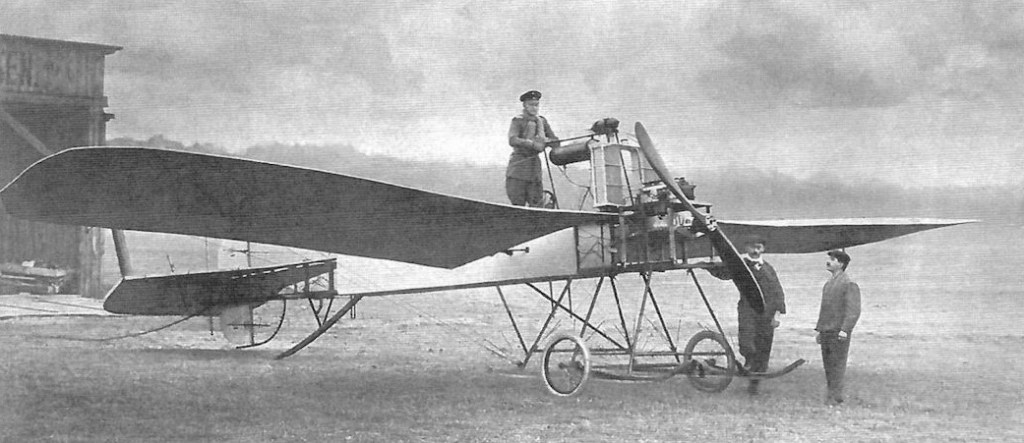
Sikorsky S-1 / S-2

S-2

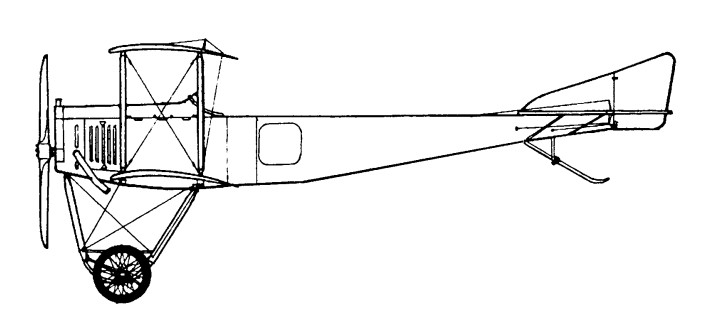
For the time being Sikorsky decided to enter the field of fixed-wing design and began construction of his first airplane. His S-1 biplane was tested early in 1910, and, although its 15-horsepower engine proved inadequate, a redesigned airframe with a larger engine (S-2) carried him on his first short flight. On 16 June 1910 it flew about 800 ft at 2 to 3 feet altitude. It crashed a few days later after a 49 second flight.

S-2
Engine: Anzani, 25 hp
Top speed: 50 mph

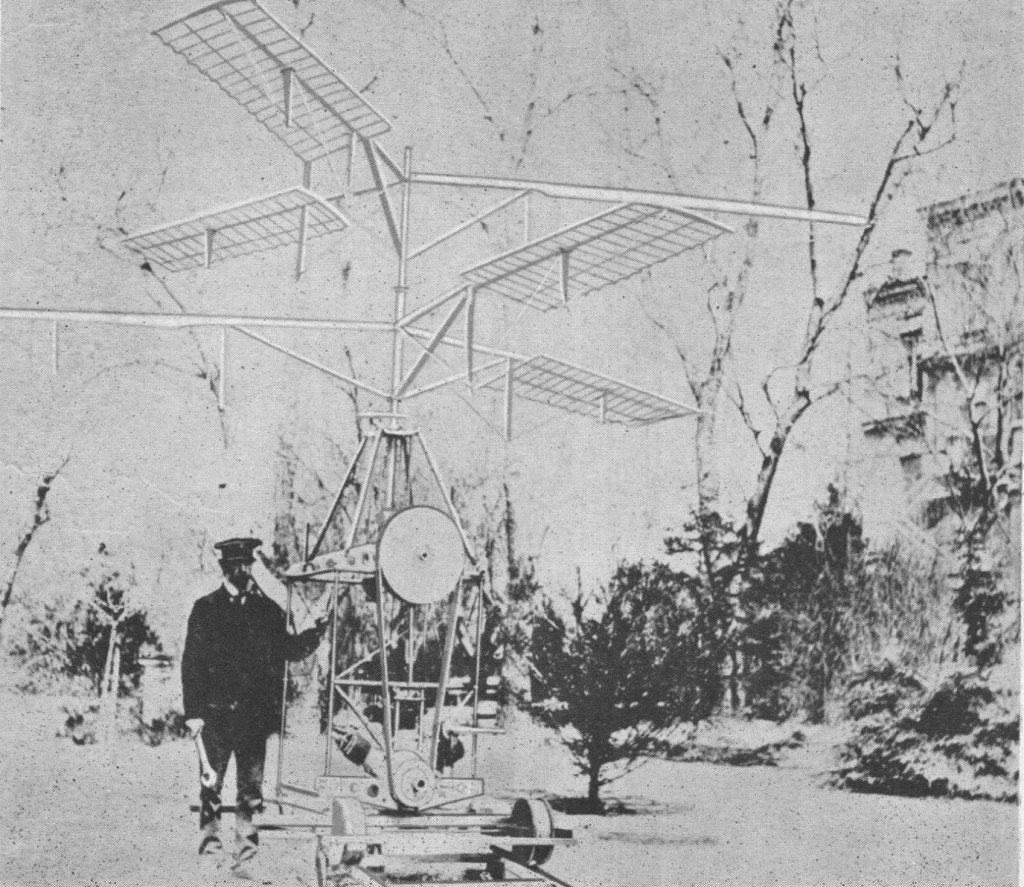
Sikorsky 1909 Helicopter

In Kiev in May of 1909 Igor Sikorsky began construction of a helicopter. Its failure revealed some of the practical obstacles. Powered by a three-cylinder, 25-hp Anzani engine that drove coaxial, twin blade rotors, the H-1 shook wildly but did not have enough power to lift itself off of the ground. A second machine with a larger engine was tested in 1910, but also failed to fly. He then made a major decision: “I had learned enough to recognize that with the existing state of the art, engines, materials, and-most of all-the shortage of money and lack of experience … I would not be able to produce a successful helicopter at that time.” In fact, he had to wait 30 years before all conditions could be met.

Siersma SRC-1

Designed by Earl Chelsea, Gerard Rogers and Herman Siersma, the 1962 Siersma SRC-1 was a single-place cabin, mid-wing monoplane midget racer,

Eleven years in construction, it was registered N4190C and first flew on 2 February 1962.

Engine: 85hp Continental C-85-12J
Wingspan: 17’0″
Length: 20’0″
Useful load: 330 lb
Max speed: 200 mph
Cruise: 170 mph
Stall: 85 mph
Range: 500 mi
Seats: 1

Sierra / Aircraft Industries BLW-1 / BLW-2

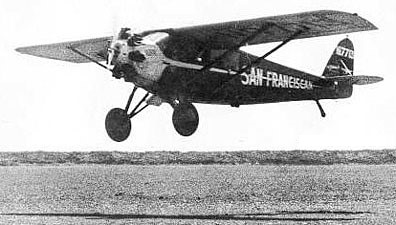
Sierra San Franciscan NR7713

Designed by H Sherman Tharpe, two 1929 Sierra were built with ATC 2-151. Priced at $8,000 and designated BLW-1 and BLW-2 registered NX215H and NX/NR7713, the latter as San Franciscan in unsuccessful endurance record attempts June-Aug 1929 at Mills Field, San Francisco (piloted by Jim Warner). It is said to have been sold after WW2 to someone in South America.

The design reappeared in the Hawke Duster.

Engine: 130hp Comet
Wingspan: 36’0″
Length: 25’8″
Useful load: 909 lb
Max speed: 125 mph
Cruise: 100 mph
Stall: 47 mph
Range: 400 mi
Seats: 3