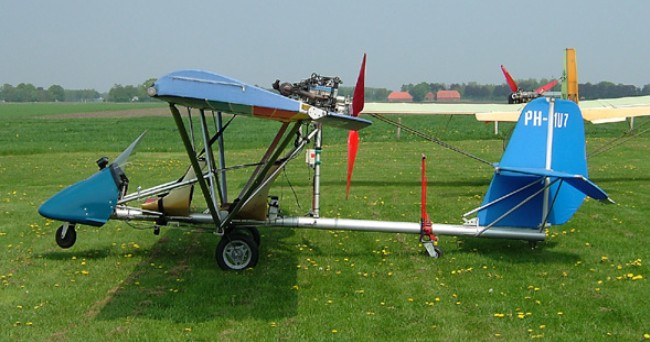
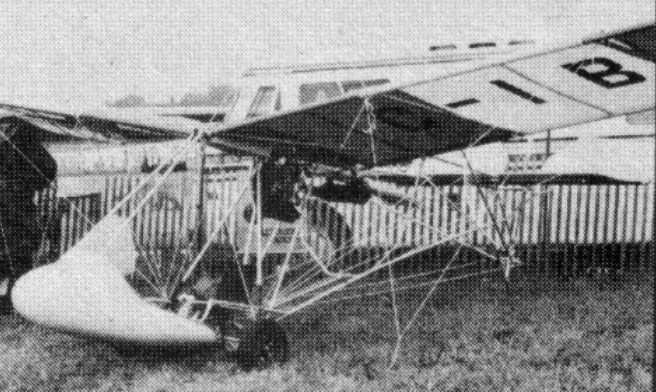
The two-seat Sky-Walker Sky-Walker 1+1 was popular as an ultralight training aircraft. The airframe exists out of an aluminium-tube construction. The plane is constructed out of alu-tube covered with sailcloth. As powersource the Sky-Walker 1+1 had a four cylinder, horizontal opposed air-cooled Limbach L 1700 EA engine. The L 1700 EA was a perfect engine for the ultralight Skywalker with a continous 56 hp (maximum 60 hp) and a weight of only 73 kg.
The dated Limbach engine of the PH-1U9 was replaced by a Rotax 462 UL CB.
Sky-Walker II Engine: Rotax 582 UL DCDI Stall: 32 kt / 37 mph / 60 kmh Cruise: 43 kt / 50 mph / 80 kmh VNE: 54 kt / 62 mph / 100 kmh Empty Weight: 68 kg / 150 lbs MTOW Weight: 159 kg / 350 lbs Climb Ratio: 1000 ft/min / 5 m/s Take-off distance (50ft obstacle): 330 ft / 100 m Landing distance (50ft obstacle): 490 ft / 150 m
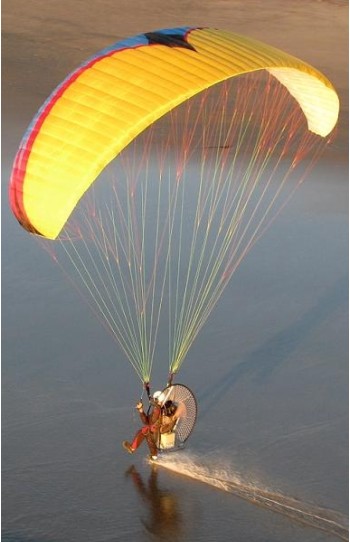
The Falcon is a paramotor and paraglider wing. The Falcon is an easy launching wing and cruises hands off. With trimmers set fast, the wing comfortably moves out. With trimmers in, the wing is a cruiser that can handle rougher air hands off.
It kites easily in zero to low wind conditions due to light, thin and strong Dyneema lines. In addition to the ease of kiting, the lines and strong fabric allow a wider weight range of pilots on each of the four different wing sizes.
Other features include: Larger high-strength D-clamps for added safety Easy keeper handle magnets that allow quick and easy handle stowing Larger carabineer loops to allow for quick attachment Bright split A-riser colors for easy line identification 9017/42 g/sq.m rip stop nylon to give the wing added strength for heavier wing loading E38A uv coating to ensure longer wing life and reduce fading
The Falcon paramotor / paraglider wing was available in four colors – blue, red, yellow, and orange.
Small Area flat: 24 sq.m Area projected: 21.14 sq.m Span flat: 11.16 m Aspect ratio flat: 5.27 Root cord: 2.63 m Cells: 52 Weight: 5.8 kg Pilot weight range: 68-95 kg Min Speed: 23 – 25 km/h Max Speed: 36 – 38 km/h Top speed: 48 – 50 km/h Glider ratio: 8.3 Min Sink rate: 1.15 m/s
Medium Area flat: 26 sq.m Area projected: 23.26 sq.m Span flat: 11.7 m Aspect ratio flat: 5.27 Root cord: 2.76 m Cells: 52 Weight: 6 kg Pilot weight range: 75-100 kg Min Speed: 23 – 25 km/h Max Speed: 36 – 38 km/h Top speed: 48 – 50 km/h Glider ratio: 8.3 Min Sink rate: 1.15 m/s
Large Area flat: 28 sq.m Area projected: 24.99 sq.m Span flat: 12.13 m Aspect ratio flat: 5.27 Root cord: 2.86 m Cells: 52 Weight: 6.2 kg Pilot weight range: 85-115 kg Min Speed: 23 – 25 km/h Max Speed: 36 – 38 km/h Top speed: 48 – 50 km/h Glider ratio: 8.3 Min Sink rate: 1.15 m/s
Skytoy Falcon I 24 Zoom flat: 92 % Area flat: 23.66 sq.m Area projected: 21.14 sq.m Span flat: 11.16 m Aspect ratio flat: 5.26 Chord: 2.63 m Cells: 52 Weight: 8.5 kg Weight range: 89-120 kg Min speed: 23-25 kph Max speed: 36-38 kph Min sink: 1.5 m/sec
Skytoy Falcon I 26 Zoom flat: 96.5 % Area flat: 26.03 sq.m Area projected: 23.26 sq.m Span flat: 11.7 m Aspect ratio flat: 5.26 Chord: 2.73 m Cells: 52 Weight: 8.5 kg Weight range: 100-130 kg Min speed: 23-25 kph Max speed: 36-38 kph Min sink: 1.5 m/sec
Skytoy Falcon I 28 Zoom flat: 100 % Area flat: 27.96 sq.m Area projected: 24.99 sq.m Span flat: 12.13 m Aspect ratio flat: 5.26 Chord: 2.86 m Cells: 52 Weight: 8.5 kg Weight range: 110-140 kg Min speed: 23-25 kph Max speed: 36-38 kph Min sink: 1.5 m/sec
Skytoy Falcon I 30 Zoom flat: 104 % Area flat: 30.24 sq.m Area projected: 27 sq.m Span flat: 12.6 m Aspect ratio flat: 5.26 Chord: 2.99 m Cells: 52 Weight: 8.5 kg Weight range: 130-150 kg Min speed: 23-25 kph Max speed: 36-38 kph Min sink: 1.5 m/sec
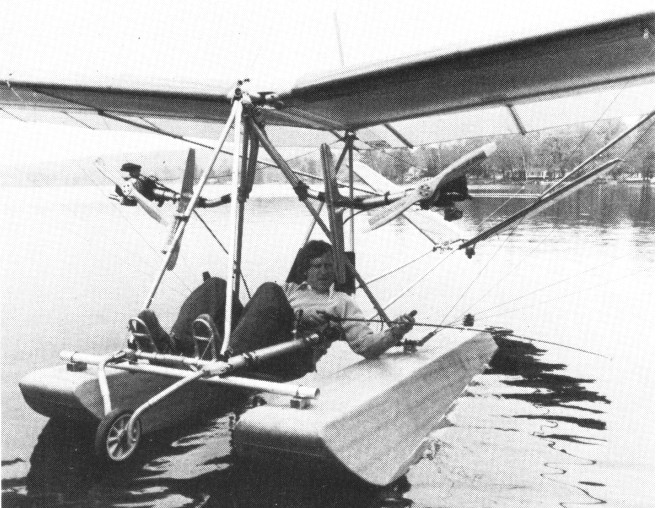
While the Humbug is foot-launchable and foot-recoverable, “auxiliary” wheels are available as well as floats, skis, ice skates or dune buggy wheels. The convenient mixer stick operates three-axis controls, and foot pedals operate the rudder. Construction, for the most part, consists of aluminum tubes and channel fittings, plastic end caps, nylon cable eyes, stainless cables and 3.8-ounce Dacron envelopes for the tail and wings. Power for the Humbug can come from several options; the most popular to this point is a twin-engine Gemini power system that uses a Partner (Swedish chain saw) engine which can be modified to develop from five to nine hp. Chrysler engines which are rated at 10 hp each are also available. Setting up the Humbug for flight requires only 20 minutes. It was available as a finished, test-flown airplane or as a kit.
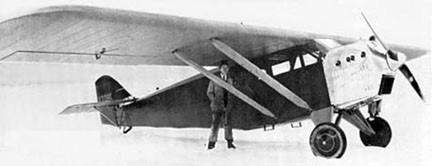
The Skyseeker Explorer bears a passing resemblance to the Worldwide Clipper, except that the company has stuck to aluminum tubing for the fuselage instead of the Clipper’s welded steel. Powered by a Rotax 277.