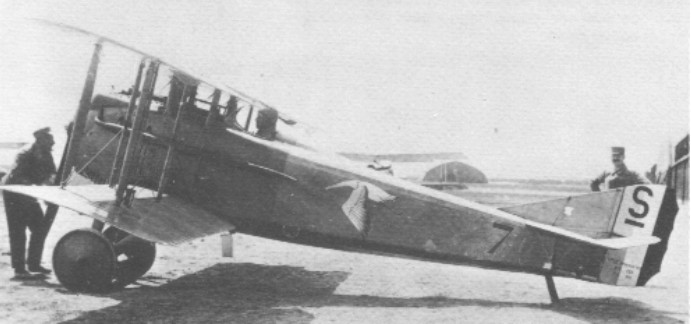
SPAD S.7 Scout

Swiss-born Mare Birkigt, chief designer of Hispano-Suiza, who had foreseen that the rotary engine was dose to its limit in development, embarked on the design of a new water-cooled V-8 engine. Designated Hispano-Suiza 8A, it produced 140hp; but even more important was Birkigt’s own design for a synchronising gear. Bechereau, therefore, found awaiting him a unique opportunity, of designing a completely new scout around the new engine and gun synchronising mechanism.
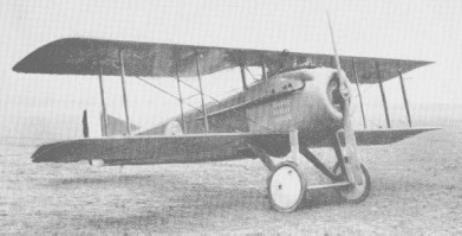
SPAD S.7 Scout Article

This single seat Spad Scout fighter of 1916 was one of the more successful aircraft of the First World War; 8,472 were built. It was used extensively by French, Italian and American air units and, on the Western front, two British squadrons who flew machines swopped from the R.N.A.S. for Sopwith Triplanes. SPADs equipped the French Cigognes whose insignia was a symbolic stork, and who used the machine’s ability to dive steeply without failing to bits to good effect in dog fights.

Engine: Hispano, 150 hp
Span: 25 ft 6 in
Wing area: 200 sq.ft
Length: 20 ft 3 in
Height: 7 ft
Empty weight: 1177 lb
Loaded weight: 1632 lb
Max speed: 119 mph at 6500 ft
Service ceiling: 17,500 ft
ROC: 810 fpm
Time to 6500ft: 6 min 30 sec
Endurance: 2 hr 30 min
Armament: 1 x Vickers mg
Crew: 1

Engine: Hispano, 175 hp
Span: 25 ft 6 in
Wing area: 200 sq.ft
Length: 20 ft 3 in
Height: 7 ft
Empty weight: 1177 lb
Service ceiling: 17,500 ft
Armament: 1 x Vickers mg
Crew: 1

Engine One 200 h.p. Hispano Suiza.
Length 20.7 ft. (6.34 m.)
Wing span 27 ft. (8.23 m.)
Weight empty 1,255 lb. (570 kg.)
Crew 1 pilot
Armament Two fixed machine guns, firing forward
Max. speed. 130 m.p.h. (210 km.p.h.) at SL
Ceiling 22,000 ft. (6,700 m.) fully loaded
Endurance 2 hours

SPAD A.4

Louis Bechereau, chief designer, had been responsible for the exotic A2 and A4, which had a gunner placed in a nacelle hinged to the forward fuselage – ahead of the tractor propeller. This was mainly due to the reluctance of British and French authorities to back the development of an interrupter mechanism, enabling a machine-gun to be fired through the propeller arc. Needless to say, this arrangement was extremely unpopular with its crews. While the A2’s career with the French was cut short, the Russians were forced to retain it in service due to shortage of aircraft, and even acquired a further 10 A4s, a development of the A2.

SPAD A.2

Lotris Bdchereau, chief designer, had been responsible for the exotic A2 and A4, which had a gunner placed in a nacelle hinged to the forward fuselage – ahead of the tractor propeller. This was mainly due to the reluctance of British and French authorities to back the development of an interrupter mechanism, enabling a machine-gun to be fired through the propeller arc. Needless to say, this arrangement was extremely unpopular with its crews. Still, some 90 examples of the A2 were built, 42 for the Aviation Militaire (French Army Air Force) and 57 for the Imperial Russian Air Service. While the A2’s career with the French was cut short, the Russians were forced to retain it in service due to shortage of aircraft, and even acquired a further 10 A4s, a development of the A2.

Spacek SD-1 Minisport

A mostly wooden UL single seater. Ply cover over foam ribs on wood / carbon spar. Two piece wing, flaperons with mix mechanism, T Tail.

Non-aerobatic.

Plans, parts, and kits were available. 51 % quick build kit from Czech Republic. All fabricated metal pre-made and materials to complete supplied. 2009 Price: 7950 EURO

Kit cost with engine but no instruments NZ$28000.00 incl ballistic chute in 2013.

Engine: 36 HP 2 cyl 4 stroke
Reduction: geared belt 6000RPM about 4 /1
Span: ~6 m,
Length: ~4m
Empty Weight: 130 kg / 287 lbs
MTOW Weight: 240 kg / 529 lbs
Fuel capacity: 28 ltrs
Stall: 35 kt / 40 mph / 65 kmh
Cruise: 92 kt / 106 mph / 170 kmh
VNE: 110 kt / 126 mph / 203 kmh
Climb Rate: 400 ft/min / 2,5-4 m/s
Take-off distance (50ft obstacle): 820 ft / 250 m
Landing distance (50ft obstacle): 980 ft / 300 m

Southern Microlight Developments Gazelle

SMD/Flexiform Sky Sails Gazelle/Medium Striker is a single seat single engined flex wing aircraft with weight shift control. Rogallo wing with keel pocket. Pilot suspended below wing in trike unit, using bar to control pitch and yaw/roll by altering relative positions of trike unit and wing. Wing braced from above by kingpost and cables, from below by cables; bowsprit construction with >70% double-surface; pre formed ribs. Undercarriage has three wheels in tricycle formation; no suspension on any wheels. Push right go left nosewheel steering independent from yaw control. Optional brakes on main wheels. Aluminium -tube trike unit, without pod. Engine mounted below wing driving pusher propeller.

Chris Scoble of Southern Microlight Developments builds only the trike unit, and normally mates it to a Flexiform Sky Sails Medium Striker wing, which he strengthens in a similar fashion to the one plus one Striker wing used on the Mainair Rapier.

Gazelles tend to be tailored to the customer’s own requirements and therefore vary in specification, but they are all double pole machines with the poles placed at the extreme ends of the axle for maximum strength, rather in the manner of a UAS Storm Buggy. Normal engine fitment is a 440 cc Robin, with electric start. Heavy duty alloy main wheels are standard.

Living near the sea has encouraged Chris to take an interest in float flying and in spring 1983 he introduced them as an option. The SMD floats can be fitted without disturbing the wheels and are constructed from glass-reinforced polyester in a colour to the customer’s choice. Each has three separate compartments to minimise the effect of leakage. Along the top of each float is a GRP beam which allows the fixing points to be moved at will until correct weight distribution is attained.

Engine: Robin EC44, 40 hp at 6500 rpm
Propeller diameter 58 inch, 1.47 m
V belt reduction, ratio 2.4/1
Max static thrust 270 lb, 122 kg
Power per unit area 0.20 hp/sq.ft, 2.2 hp/sq.m
Fuel capacity 6.0 US gal, 5.0 Imp gal, 22.7 litre
Length overall 11.0ft, 3.35m
Wing span 34.5ft, 10.52m
Sweepback 15 deg
Total wing area 200 sq.ft, 18.6 sq.m
Wing aspect ratio 7.5/1
Wheel track 5.0 ft, 1.52 m
Wheelbase 5.6ft, 1.70 m
Nosewheel diameter overall 13 inch, 33 cm
Main wheels diameter overall 16 inch, 41 cm
Optional floats: length 12.5 ft, 3.81 m; weight 38 lb, 17 kg each

Southern Crane 1929 monoplane / Manncraft Airplane Co 1929 monoplane

The 1929 monoplane was a two-place open cockpit, powered by a 60hp Anzani engine, replaced by a Chevrolet in December 1930. As NX817N it was sold to J C Norris of Collierville in November 1932, who may have reverted to an Anzani.

The registration was cancelled by the CAA in September 1934.

This could be the Fleming, according to findings by John M Jarratt, but this enigma has yet to be solved as the name of Fleming is not apparent. Mann Co officials of record also included Ricardo Houstee, Mann Jr, and E F Moreland.