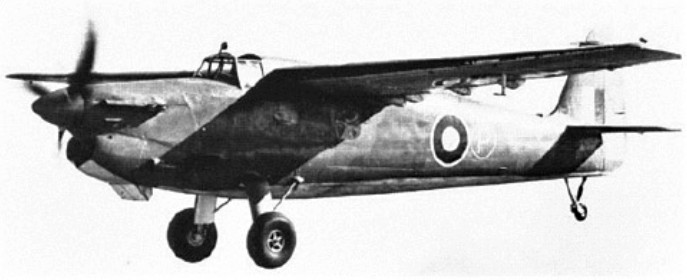
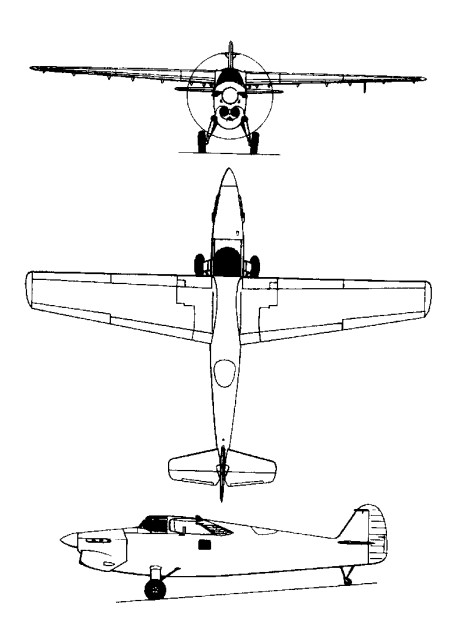
The first prototype flew on February 6, 1943. Did not enter production. Two built.
322 Dumbo Engine: 1 x Rolls-Royce Merlin 32, 1230kW Armament: 2 x 7.7mm machine-guns Bombload: 6 x 113-kg or a torpedo
322 Dumbo Engine: 1 x 1300hp Rolls-Royce Merlin 30 Max take-off weight: 5448 kg / 12011 lb Empty weight: 4165 kg / 9182 lb Wingspan: 15.24 m / 50 ft 0 in Length: 12.19 m / 40 ft 0 in Height: 4.32 m / 14 ft 2 in Wing area: 29.68 sq.m / 319.47 sq ft Max. speed: 449 km/h / 279 mph Range: 1328 km / 825 miles Crew: 3 Armament: 2 x 7.7mm machine-guns Bombload: 6 x 113-kg or a torpedo
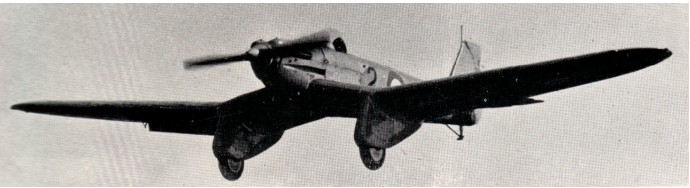
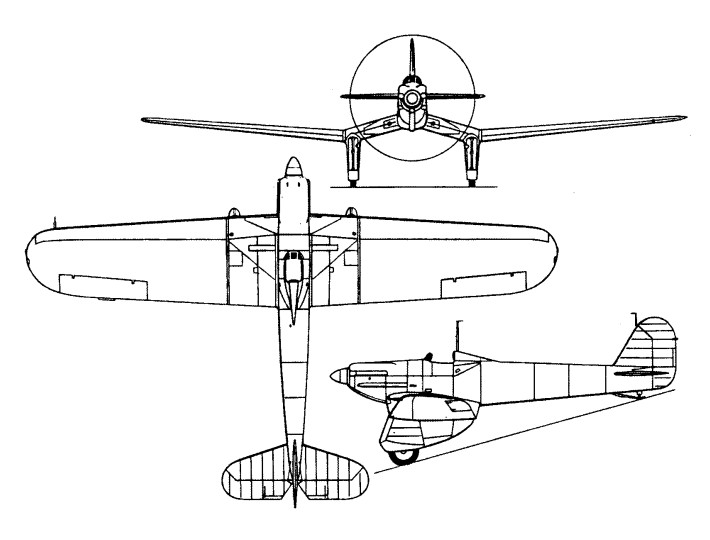
Issue of Specification F.7/30 in 1930 for a single-seat fighter led Supermarine to build its first aircraft intended for this role. Designed under the direction of Reginald J Mitchell as Type (or Drawing) 224, Supermarine’s proposal was one of three to gain Air Ministry backing for prototype construction (along with Westland and Blackburn), an order for one aircraft being placed in 1932.
Based on experience gained with the Supermarine float seaplanes designed for participation in the Schneider Trophy contests, the Type 224 was of all-metal construction with fabric covering of the wing aft of the mainspar and of the tail surfaces. Its 600hp Rolls-Royce Goshawk II engine had an evaporative cooling system, which was to prove to be a major reason for the eventual failure of the Type 224 to gain acceptance. Armament comprised two 7.7mm guns in the fuselage and one in each mainwheel fairing.
First flown on 19 February 1934, the Type 224 failed to achieve its performance estimates, and, after a prolonged sojourn at the RAE Farnborough, went to the A&AEE and eventually ended its days as a gunnery target.
Engine: 600hp Rolls-Royce Goshawk II Max take-off weight: 2151 kg / 4742 lb Empty weight: 1552 kg / 3422 lb Wingspan: 13.97 m / 46 ft 10 in Length: 8.97 m / 29 ft 5 in Height: 3.63 m / 12 ft 11 in Wing area: 27.40 sq.m / 294.93 sq ft Max. speed: 367 km/h / 228 mph Ceiling: 11825 m / 38800 ft
The Air Ministry felt that it could no longer stand by and see foreign aircraft winning the Schneider Trophy contest, so it ordered a number of racing seaplanes and formed a special RAF High Speed Flight to enter them in the 1927 contest at Venice.
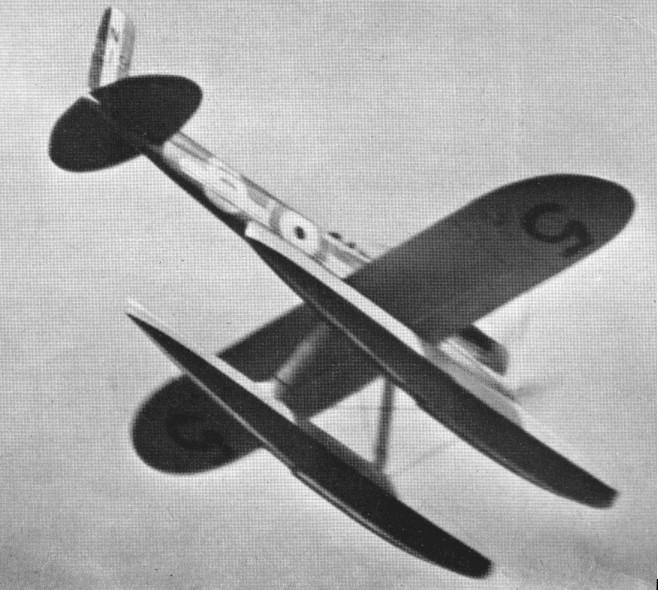
One of the types ordered was the Supermarine S.5, that won the race at a speed of 281.65 mph. Two years later (the contest became biannual from 1927) the success was repeated by a slightly larger machine on the same lines, the S.6, with a 1,900 h.p. Rolls¬Royce R engine.
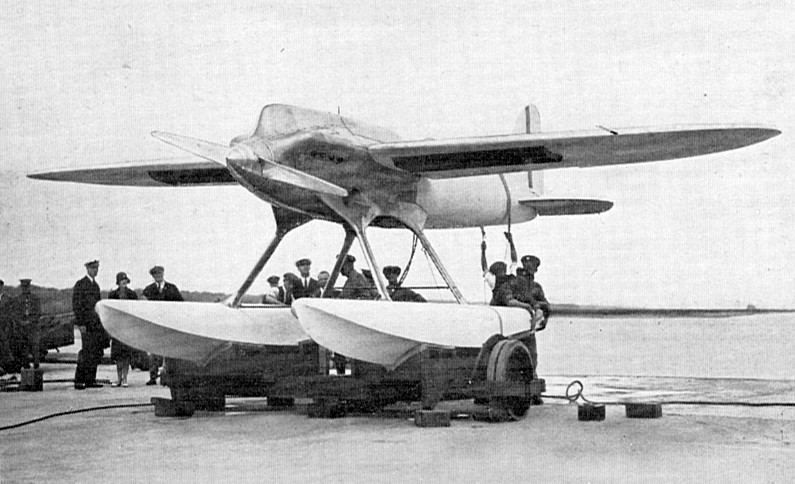
In 1929, the world absolute speed record went up to 358 mph when a British Supermarine S-6 seaplane made an official run.
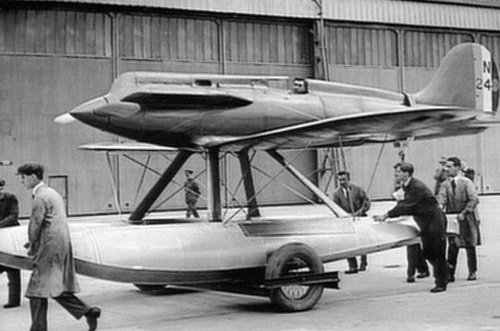
S.6 at Calshot 1929
The Air Ministry financed the Schneider racers until 1929, when they decided the cost was too high to continue. Two years later, at the last minute, Lady Houston provided the cash which enabled Britain to win a the third consecutive victory. Pilots of the winning machines in 1927, 1929, and 1931 were members of the specially formed RAF High Speed Flight.
In 1931 Britain gained the Trophy outright when the S.6B with its Rolls¬Royce engine boosted to give 2.300 h.p. won the third consecutive contest at 340.6 mph over the 189 mile course. The S.6 and S.6B also set up new world speed records of 357.74 and 406.99 mph (29 September 1931) respectively. They were forerunners of Mitchell’s Spitfire.
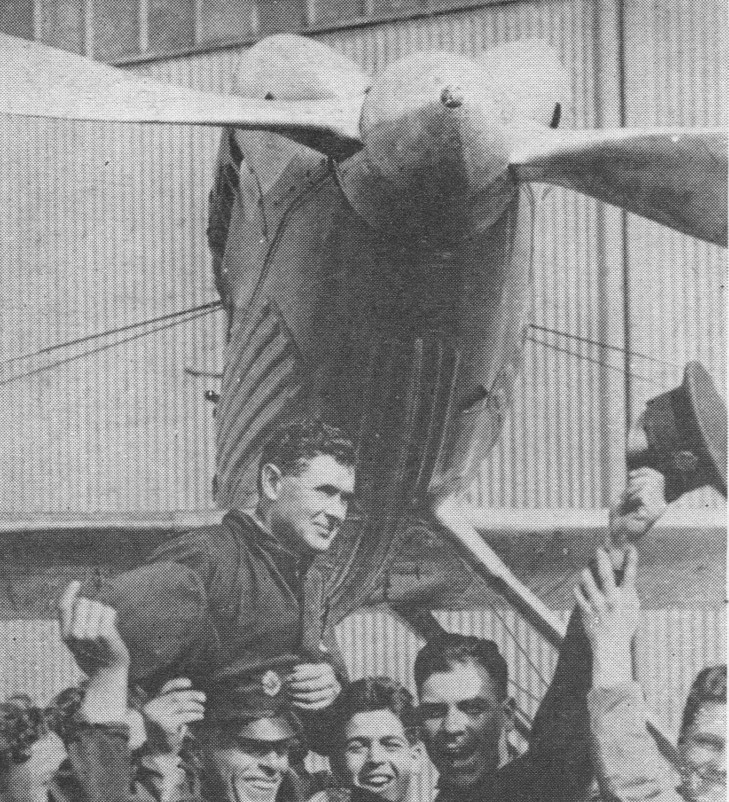
Flt,Lt. John Boothman – winner in S,6B at 340.6 mph
S.6B Engine: 1900 hp Rolls-Royce ‘R’ Span 30 ft Length 28 ft. 10 in Height 12 ft. 3 in Wing area 145 sq.ft Weight empty 4,560 lb Loaded weight 6,066 lb
The Air Ministry felt that it could no longer stand by and see foreign aircraft winning the Schneider Trophy contest, so it ordered a number of racing seaplanes and formed a special RAF High Speed Flight to enter them in the 1927 contest at Venice.
Supermarine S.5
One of the types ordered was the Supermarine S.5, a development of the S.4 with all metal air¬frame and an 875 hp Napier Lion engine. On June 7, 1927 the Supermarine S.5 racing seaplane took to the skies for its maiden flight.
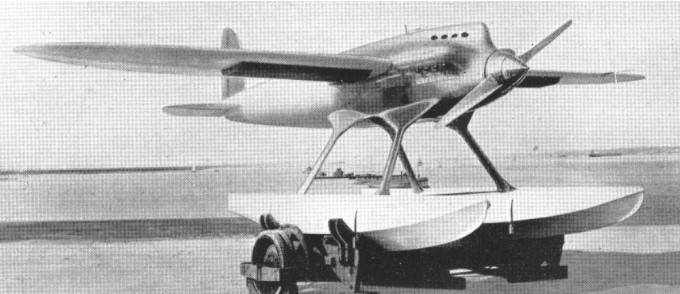
The first S.5 (N219) at Calshot during preparations for the 1929 Schneider Trophy Contest
Only three examples of the S.5 were constructed, but they quickly made their mark. At the 1927 Schneider Trophy contest at Venice, two S.5s dominated the field—finishing first (at a speed of 281.65 mph) and second, respectively. Purpose-built for speed and agility, the S.5 featured compact dimensions: a wingspan of 26 feet 9 inches, a length of 24 feet 3.5 inches, and a height of just 11 feet 1 inch. The airframe’s empty weight was 2,680 pounds, with a maximum gross weight of 3,242 pounds.
Flight Lieutenant Sidney N. Webster, RAF, leads the Schneider Trophy Race with the blue and silver Supermarine S.5 racer, N220.
Supermarine S.5
Powering the S.5 was a Napier Lion VIIA W-12 liquid-cooled engine, producing 900 horsepower. The aircraft achieved a top speed of 319.57 mph. Though none of the original S.5s survive.
The Schneider Trophy never experienced any casualties during competition, but several pilots were killed training for the races. Sam Kinkhead in 1928 and Jerry Brinton in 1931 in a Supermarine S.5, from Great-Britain.
R. J. Mitchell produced in 1925 a cantilever monoplane seaplane, the S.4, which broke the international speed record for seaplanes at 226.6 mph, but developed wing flutter and crashed before it could com¬pete in the Schneider Trophy contest that year. The S.4 was of wooden construction.
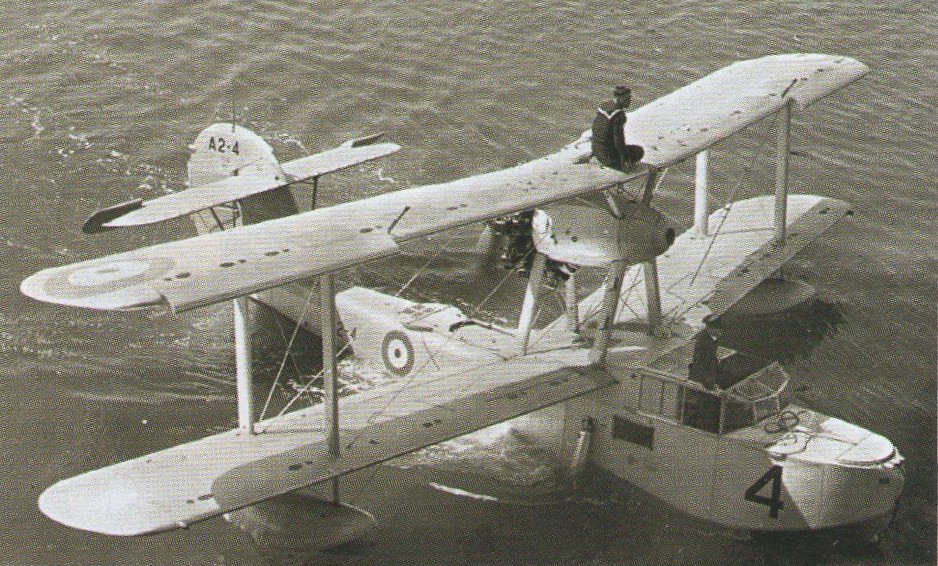
The Supermarine Walrus amphibian designed by Reginald Mitchell was a private venture development of the 1922 Seagull I, and first flew as the Seagull V on 21 June 1933.
An order for twenty-four followed from the Royal Australian Air Force, as the Seagull V, who required a reconnaissance amphibian that could be catapulted, with full operational load, from warships.
The Australian government prompted evaluation by the Royal Navy’s No. 702 Catapult Flight, which in turn led to an initial contract for 12 Walrus Mk I aircraft being placed by the Air Ministry in 1935.
Following further trials, during which a Walrus was catapulted fully loaded from HMS Nelson, production orders for 204 aircraft with the 474kW Pegasus II M2 radial were placed, and the flying-boat entered Fleet Air Arm service in 1936.
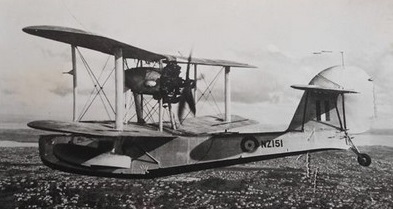
Walrus 1
All the metal hulled Walrus Mk I aircraft were manufactured by the parent company Supermarine. However, with Spitfire fighter production building up, responsibility for construction was transferred to Saunders Roe Ltd.(Saro). Most ASR Walruses were the wooden hulled MkII built by Saro which provided a marked improvement in take off and landing on water. When production ended in January 1944 Saro had built 461 of the total of 746.
It was the first British squadron service aircraft to have a fully retractable main undercarriage and a completely glazed cockpit.
Early in World War II Walrus amphibians were serving aboard battleships and cruisers of the Royal Navy all over the world as components of No. 700 Squadron, as well as with Nos 701, 711, 712 and 714 Squadrons, their principal duties being over-the-horizon search for enemy shipping; they were also employed for gunnery spotting, antisubmarine and convoy protection duties. A Walrus was even catapulted from the cruiser HMS Dorsetshire to bomb a target in Italian Somaliland on 18 November 1940.
The work for which the Walrus (affectionately known as the Shagbat) will be best remembered was air/sea rescue, serving in this role with Nos 269, 275, 276, 277, 278, 281 and 282 Squadrons at stations in the United Kingdom, and with Nos 283, 284, 292 and 294 Squadrons in the Middle East. Called out in any weather, day or night, Walrus air/sea rescue aircraft frequently alighted in enemy coastal waters to pick up ditched Allied airmen from their dinghies, sometimes putting down in minefields where rescue launches could not venture. The Walrus rescued more than 7500 Allied airmen.
The Walrus was slowly replaced in service from 1944 onwards by the tractor Mercury-powered Sea Otter, although No. 624 Squadron was re-formed at Grottaglie in Italy in December that year with Walrus aircraft for minespotting duties. A total of 740 Walrus aircraft was built, production of the Walrus Mk I with metal-clad hull being terminated at Supermarine after 287 had been completed; thereafter production was switched to Saunders-Roe who built 453 Walrus Mk II aircraft with wooden hulls before finally ending in January 1944.
The Walrus was used mainly by Britain, Australia and New Zealand.
Walrus Mk I Engine: 1 x Bristol Pegasus VI, 559kW, 775 hp Max take-off weight: 3266 kg / 7200 lb Empty weight: 2223 kg / 4901 lb Wingspan: 13.97 m / 46 ft 10 in Length: 11.35 m / 37 ft 3 in Height: 4.65 m / 15 ft 3 in Wing area: 56.67 sq.m / 609.99 sq ft Max. speed: 217 km/h / 135 mph Ceiling: 5210 m / 17100 ft Range: 966 km / 600 miles Armament: 2-3 Vickers K 7.7mm machine-guns Bombload: 272kg Crew: 3-4
Walrus Mk I Engine: Bristol Pegasus II M2, 764 hp Length: 37.5 ft / 11.43 m Height: 15.256 ft / 4.65 m Wingspan: 45.833 ft / 13.97 m Wing area: 609.996 sq.ft / 56.67 sq.m Max take off weight: 7166.3 lb / 3250.0 kg Weight empty: 4873.1 lb / 2210.0 kg Max. speed: 117 kts / 217 km/h Cruising speed: 82 kts / 152 km/h Service ceiling: 18537 ft / 5650 m Wing loading: 11.69 lb/sq.ft / 57.0 kg/sq.m Range: 521 nm / 965 km Crew: 4 Armament: 2 MG Vickers
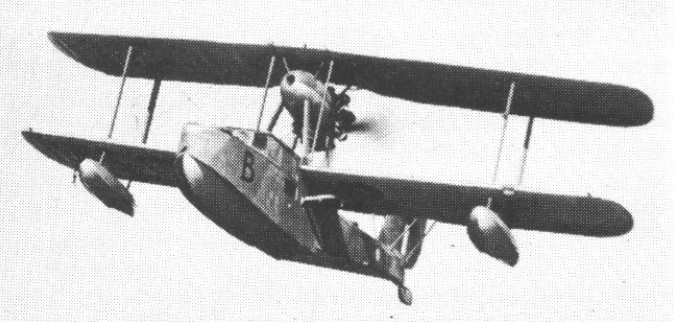
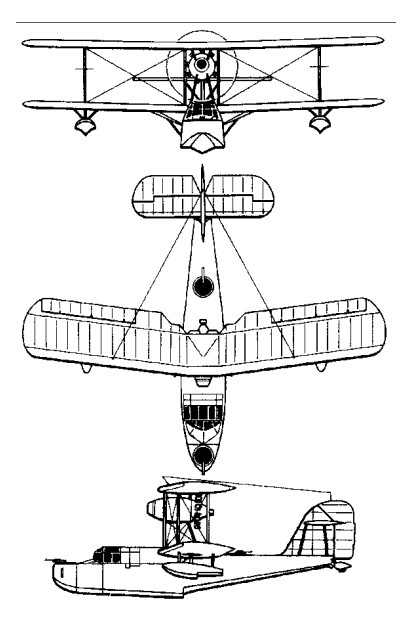
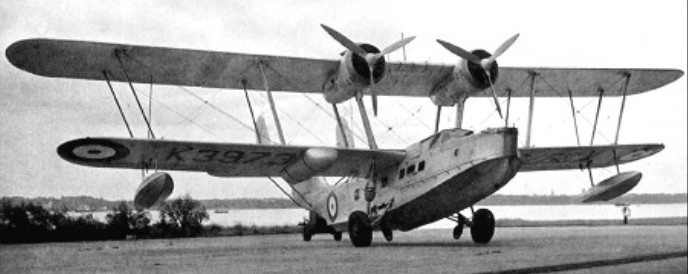
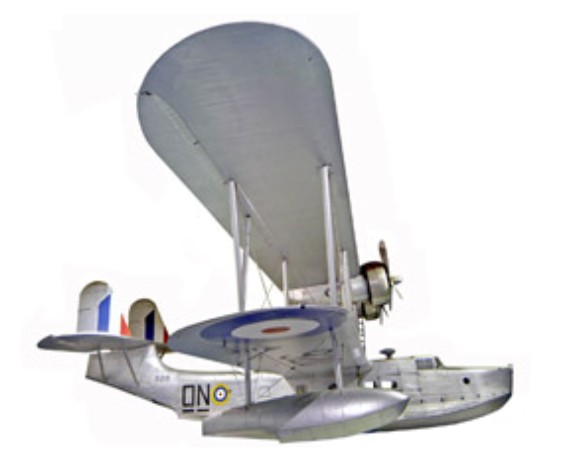
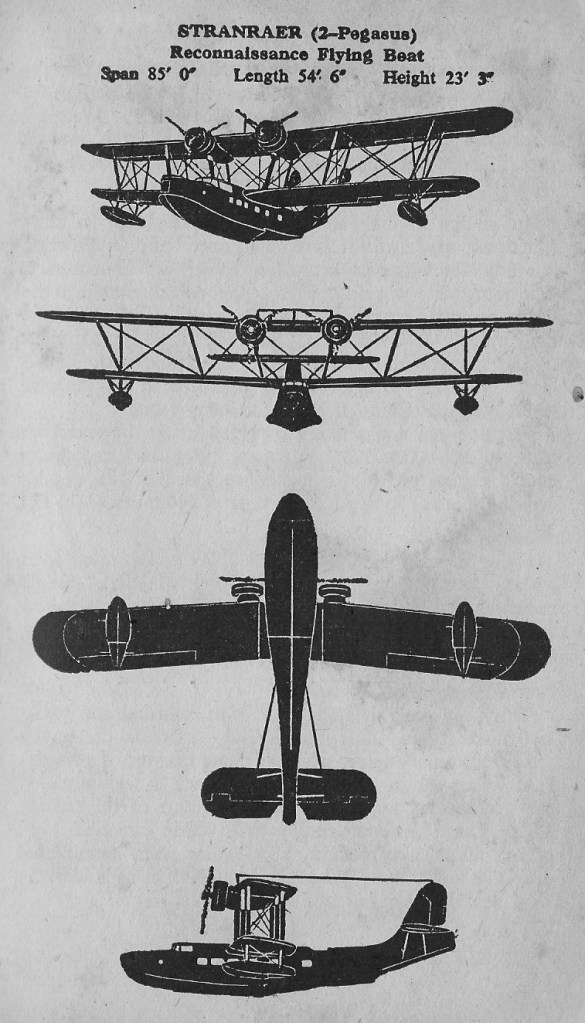
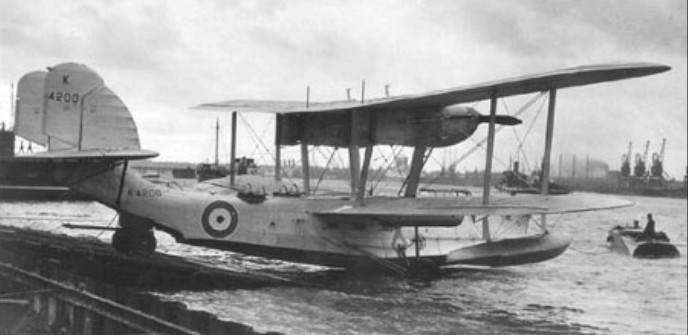
Designed to the same specification, R. 24/31, as the Saro London, the Supermarine Stranraer twin-engine biplane flying-boat prototype, originally known as the Singapore V, was powered by Bristol Pegasus HIM radials driving two-blade wooden propellers and first flew in mid-1935, but was immediately renamed Stranraer.
A production contract was placed in August 1935 for seventeen aircraft. It also underwent comparative trials with the London on No. 210 Squadron in October and November 1935, during which it was found to be somewhat underpowered.
Production deliveries of aircraft powered by a pair of Pegasus X radials driving a three-blade Fairey Reed metal propeller started December 1936, and the type was declared operational in April 1937 with No. 228 Squadron at Pembroke Dock, remaining with this squadron until April 1939.
In December 1938 Stranraers joined No. 209 Squadron at Felixstowe, and later moving to Invergordon and Oban for patrols over the North Sea until supplanted by the Lerwick the following year.
No, 240 Squadron was the only other RAF Coastal Command squadron to fly the Stranraer, converting to the aircraft in June 1940 at Pembroke Dock for short-range patrol work over the Western Approaches. The Stranraers were eventually replaced by Catalina ‘boats in March 1941, continuing to serve in a training capacity until October 1942.
Although RAF Stranraers did not serve at overseas stations, a total of 40 aircraft was licence-built by Canadian-Vickers between 1939 and 1941, and served in the coastal reconnaissance/anti-submarine role with the RCAF until finally replaced by the Consolidated Canso (Catalina) from 1943.
Eight were in service with the Canadians at the outbreak of war. Hese aircraft were used for patrol duties both on the Atlantic and Pacific coasts. They were finally retired from service in February 1945.
After retirement from service use, several Stranraers were registered for civil use. Queen Charlotte Airlines continued to use Stranraers into the 1950s, operating from Vancouver and providing a service along the pacific coast of British Columbia.
Engine: 2 x Bristol Pegasus X, 652kW Max take-off weight: 8600 kg / 18960 lb Empty weight: 5100 kg / 11244 lb Wingspan: 25.91 m / 85 ft 0 in Length: 16.71 m / 55 ft 10 in Height: 6.63 m / 22 ft 9 in Wing area: 135.36 sq.m / 1457.00 sq ft Max. speed: 266 km/h / 165 mph Cruise speed: 169 km/h / 105 mph Ceiling: 5640 m / 18500 ft Range: 1600 km / 994 miles Armament: 3 x 7.7mm machine-guns Bombload: 450kg
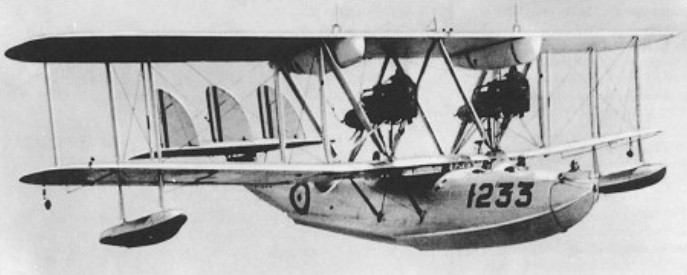
All-metal reconnaissance flying-boat developed from the Southampton in 1932 and powered by two 391kW Rolls-Royce Kestrel IIIS radial engines mounted in nacelles applied directly to the undersurface of the upper wing centre-section. Fourteen were built for the RAF, entering service in 1935.
By the mid-twenties the RAF was desperate to replace their First World War vintage Felixstowe flying boats and had almost given up the search when R J Mitchell’s development of his civilian Swan design was offered. It proved an immediate success and established not only the name of the designer but that of the company in military circles.
The first eighteen Southamptons delivered were Mk Is with wooden hulls. However a lengthy marine research programme had convinced the Royal Air Force of the superior qualities of metal over wood and so the final forty-eight were delivered as Southampton MkIIs with metal hulls and powered by two 335kW Napier Lion V engines. In a programme begun in 1929 all surviving wooden-hulled Southamptons were re-built with metal hulls.
Southamptons first entered service in August 1925 and quickly became famous for long-distance formation flights, ‘showing the flag’ in many parts of the world. The most notable was a 43500km (27000 mile) cruise of the Far East Flight’s four Southamptons from Felixstowe to Singapore via the Mediterranean and India in 1927 and 1928.
The Southampton flying-boat was one of the most successful ever used by the Royal Air Force. With a reputation for reliability, its service life of eleven years was surpassed only by that of the Sunderland.
Southampton Mk II Engines: 2 x Napier Lion VA W-12, 373kW Max take-off weight: 6895 kg / 15201 lb Empty weight: 4082 kg / 8999 lb Wingspan: 22.86 m / 75 ft 0 in Length: 15.58 m / 51 ft 1 in Height: 6.82 m / 22 ft 5 in Wing area: 134.61 sq.m / 1448.93 sq ft Max. speed: 174 km/h / 108 mph Ceiling: 4265 m / 14000 ft Range: 1500 km / 932 miles Armament: 3 x 7.7mm machine-guns Bombload: 500kg
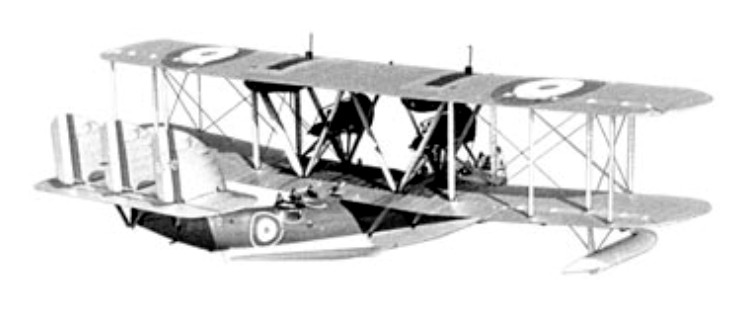
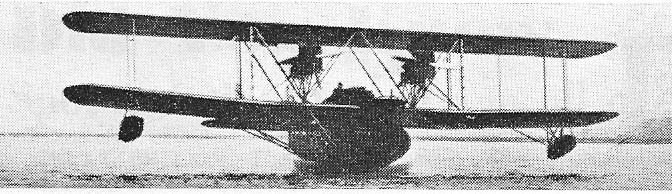
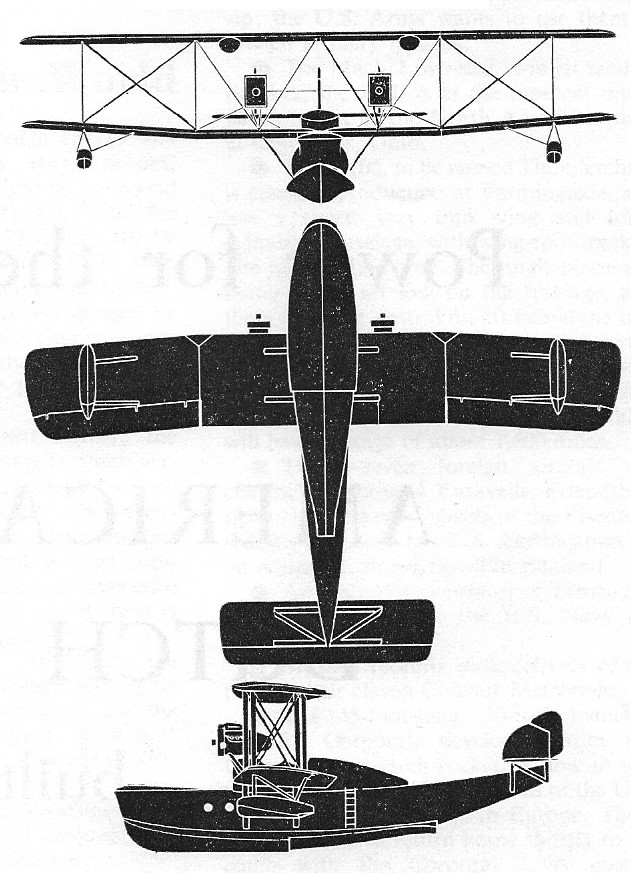
Shortly after World War I, Supermarine received two Air Ministry contracts to Specification 21/22, one in 1921 for a five-seat military seaplane and the other in 1922 for a commercial seaplane, the former named Scylla and the latter Swan.
The aircraft were equal-span, two-bay biplanes with monoplane tail units and triple fins and rudders. The raised cockpit seated the two-crew side-by-side.
The Scylla N174 emerged as a monoplane, but was apparently converted to triplane configuration in 1923, when it carried out taxi trials at Felixstowe. There is no evidence that it ever flew.
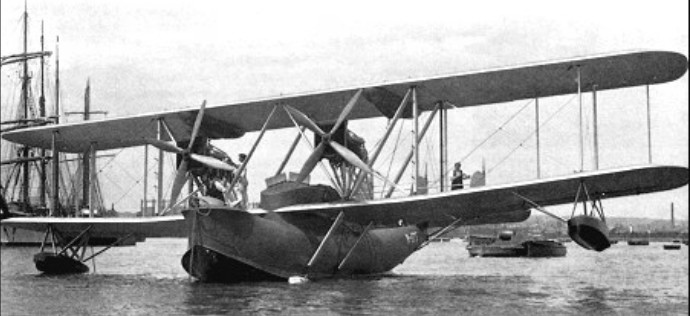
Swan
The Swan N175 was completed as planned in 1924, but as a maritime reconnaissance flying-boat biplane. After completing its flight trials, it was converted to civilian use. An Air Ministry Specification R18/24 was issued for a development, later built by Supermarine as the first Southampton.
Engine: 2 x 2 x 450hp Napier Lion IIB Max take-off weight: 5820 kg / 12831 lb Wingspan: 20.90 m / 69 ft 7 in Length: 17.06 m / 56 ft 12 in Height: 7.95 m / 26 ft 1 in Max. speed: 175 km/h / 109 mph Ceiling: 3089 m / 10150 ft Range: 1400 km / 870 miles Crew: 2 Passengers: 10





 All Aero