In 1971 Ralph Taylor built a two place cabin low wing monoplane, registered N2554, with retractable undercarriage.
Engine: Lycoming 180 hp
Max speed: 210 mph
Cruise speed: 197 mph
Seats: 2
In 1971 Ralph Taylor built a two place cabin low wing monoplane, registered N2554, with retractable undercarriage.
Engine: Lycoming 180 hp
Max speed: 210 mph
Cruise speed: 197 mph
Seats: 2
In 1936 L A Taylor of Longview TX built a single place, enclosed cockpit monoplane. Registered N13990, power was from a 65hp Velie.
In 1935 Truman F Taylor built the Territory of Taylor, single place, open cockpit biplane, registered N9409, powered by a 60hp LeBlond.
A two-seat cabin monoplane of all-metal construction with a high lattice girder with diagonal surface bracing.
Built at Hamsey Green, UK, by designer R.Taylor in 1936. Only one was built of three planned. The designer died in the crash of the prototype in 7 January 1937 on its first flight.
c/n TE.2 G-AEPX prototype built with Cirrus Minor I engine.
c/n TE.3 G-AEPY single seat, not built
c/n TE.4 G-AEPZ two-seater, not built
c/n G-AERA not built
In 1931 (H B) Taylor Automobile Works built the Thunderbird home-built NX12219 with an experimental license for “new type ailerons and flaps”.
A single place open cockpit monoplane, powered by a 30hp Szekely, by 1935 it had been repowered with an Anzani engine.
On 8/2/41 it was sold to the New Mexico Highlands University National Defense Training Branch, and the registration was cancelled in 1948.

Tatarinov started building his “Aeromobile” at Petrograd in 1909 with a grant provided by the Russian Ministry of War. The project was never completed, since Sukhomlinov, Russian Minister of War at the time, thought the work was progressing too slowly and consequently, the continuation of funding was denied. In despair, Tatarinov set fire to his rotorcraft and the hangar which housed it. The “Aeromobile” had four rotors, each turning at the end of an X-form of beams. Beneath it the chassis contained an EDTT 25 hp water-cooled engine which was to drive the rotors as well as a five-bladed “centrifugal propeller”. The pilot’s seat and controls were placed behind the engine. The total weight of the machine was 1300 kg.

This single pilot manned test-bed was built by Jim Kern’s TASK Research Inc. of Santa Paula, California in 1982, which supplied many composite structures/components for the Rutan designed Long-EZ, Defiant, and Voyager aircraft during the early to mid-1980’s under contract to Northrop’s Electric Mechanical Division in the late 1980s to test early avionics/electronic equipment for remotely piloted vehicles.
The Vantage was a single-seat pusher canard which resembled a Rutan Long-EZ, but was slightly larger with more rounded fuselage sides, a large bulbous two piece canopy. The craft also incorporated an extra long pitot tube in the front. Power was supplied by a single Lycoming O-360 (180 HP) engine turning a variable pitch wood or composite propeller. The aircraft incorporated a retractable nose gear which was powered by an electric motor. The wing root to fuselage joint was blended/contoured and flowed seamlessly into the cockpit. Nicknamed “Sneeky Pete” by its pilots, the undesignated aircraft was outfitted with various special avionics depending on the specific mission requirement. The exterior was painted white, with the name “Sneeky Pete” written along the side of the fuselage, though this is not apparent in the one picture that was released.
Although the maiden flight of “Sneeky Pete” took place at Mojave Airport on July 18th, 1982 with Dick Rutan at the controls (Mike Melvill, along with many others served as test pilots for this aircraft), Rutan Aircraft Factory or Scaled Composites apparently were not involved in the elaboration and building process of the aircraft. It is believed that the flight test program for “Sneeky Pete” first took place at the remote Groom Lake test site in Nevada widely known as “Area 51” (AFFTC DET. 3) in late 1982. The aircraft was periodically tested over the years with various equipment, put into seclusion at various times, but has never been officially retired. During its “down time”, “Sneeky Pete” was most likely stored in a top-secret facility known as “Dyson’s Dock” at Groom Lake which was also the location of the Northrop “Tacit Blue” technology demonstrator after it was retired in 1985.
In 1993, “Sneeky Pete” was acquired and rebuilt by Scaled Composites and experimentally fitted with a Williams FJ107 jet engine, a small turbofan engine designed to power cruise missiles and developed by the Williams International company from their WR19.The FJ107 was notably the powerplant for the AGM-86 ALCM, BGM-109 Tomahawk, and AGM-129 ACM, as well as the experimental Williams X-Jet flying platform. In its jet-powered form, the aircraft was first tested in August 1993 and was known at Scaled Composites as the Jet LEZ Vantage or Model 61-B. A striking feature of the revised aircraft was a square, flat section, as seen from below, added at the back of the aircraft. The section wasn’t as wide as the strakes at the front wing roots but was longer along the fuselage, in comparison.
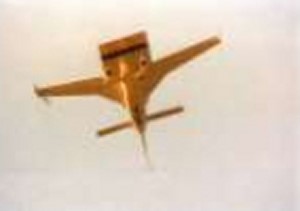
Only one airframe was ever constructed. The data gathered throughout the “Sneeky Pete” program contributed to today’s advanced UAVs such as the Northrop/Grumman Global Hawk, General Atomics Predator, Boeing X-45, Northrop/Grumman X-47 Pegasus. The aircraft was returned to a more conventional configuration and still appears on the civil register as being owned by Scaled Composites, but its current whereabouts are unknown, and, like many experimental variants of the Long-EZ, it is not properly documented, due to its classified use by the military.
N3142B c/n 1
Powerplant:1 x Lycoming O-360 (180 hp) / 1 x Williams FJ107 / 1 x Lycoming IO-320 (150 hp)
Wingspan: 28 ft.
Overall length: 17ft. (approximate)
Weight: up to 12,499 lb. (with Lycoming engine)
Crew/passengers: 2
The 1984 Task Research Inc Silhouette was a single-place cabin, low-wing monoplane of composite construction for kit builders.
The prototype was registered N84TR.
Engine: 44hp Rotax 447
Wingspan: 31’20”
Length: 19’4″
Cruise: 120 mph
Stall: 52 mph
Ceiling: 14,000′
Seats: 1

One patriot who felt he could fill this gap and strike a blow at the Kaiser was a Surrey building contractor, W. G. Tarrant, whose company had been involved in wartime contract work manufacturing wooden aircraft components. Tarrant hired Walter Henry Barling to design the aircraft, which was to be a ‘bloody paralyzer’ of a triplane made entirely of home-grown timber and constructed using a largely female work force, according to the terms of the contract issued by the Ministry of Munitions. The massive Tabor triplane was the first and last aeroplane built by W. G. Tarrant Ltd of Byfleet, Surrey. Designed in an attempt to enable Berlin to be bombed from bases in England, and assembled at RAE Farnborough, the aircraft was not completed until 1919.
When it appeared, too late for its intended purpose, it spanned 40m (131 ft 3 in) from tip to tip of its middle wing, and had a 22.25m (131 ft 3 in) fuselage of monocoque construction formed from ply skinning over Warren-girder type circular formers. Serialled F1765, the one and only completed Tabor was powered by a total of six 450 h.p. Napier Lion engines: two pairs in push-pull tandem between lower and middle wings, and another two tractor engines between middle and top planes. The fuselage was of finely streamlined monocoque construction, while the tail consisted of a biplane unit with twin fins and rudders.
The Tabor stood as high as a four-storey house, and its height, and particularly the location of its upper engines, brought about its speedy demise. On 26 May 1919 the giant Tabor was winched out of the balloon shed at the Royal Aircraft Establishment at Farnborough along a specially built railway track. Some 508 kg (1120 lb) of lead was loaded into the nose at the last moment when some final calculations showed that the aircraft might be tail heavy, and the long, wearisome process of hand-starting the six Napier Lions began. With all engines running the pilot, Captain F. G. Dunn, and his co-pilot, Captain P. T. Rawlings, began taxi trials. Also aboard were a technical observer from Tarrant’s, a fitter, an engineer officer, and two foremen from the RAE. When Dunn opened up the top engines, which had previously been throttled back, and the sudden extra thrust so far above the aircraft’s centreline caused it to nose-over and bury its forward fuselage in the earth just as it was about to leave the ground. The two pilots died shortly afterwards of their injuries and Tarrant, perhaps fortunately for other aviators, never again dabbled with aviation.

Construction of a second Tabor was abandoned.
Engines: 6 x Napier Lion, 450 hp
Wingspan: 40m (131 ft 3 in)
Fuselage length: 22.25m (131 ft 3 in)
Weight: 45,000 lb
UK
Building contractor of Byfleet, near Brooklands, Surrey, which undertook aircraft component manufacture during First World War. Only aircraft produced was Tabor long range bomber, designed with collaboration from Royal Aircraft Establishment; this six-engined triplane nosed-over and was wrecked in its first attempt to take off in May 1919.
 All Aero