Taylorcraft E-2 Cub / F-2 Cub / G-2 Cub / H-2 Cub

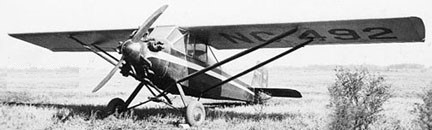
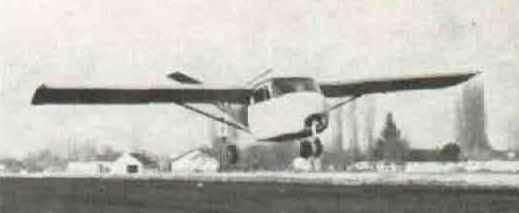
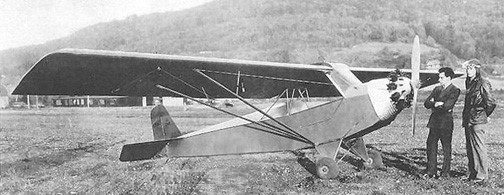
Taylor E-2 Prototype NC10547 with C G Taylor and company pilot Bud Havens

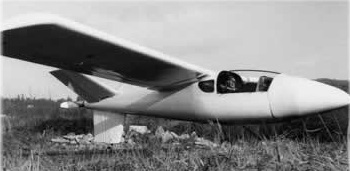
Taylor first built a glider that looked like a small Breezy and the E 2 Cub evolved from towing that glider behind a car up and down the Bradford runway.

Designed by C. Gilbert Taylor in 1930 and produced as the Taylor E 2 Cub in 1931, much of the inspiration and many of the design goals for the airplane came from W.T. Piper, Sr. Taylor selected the U.S.A. 35B airfoil for the Cub. This airfoil had a reputation for providing favorable flying qualities at low speeds; all subsequent Cubs. The E 2 was open air except for a windshield and had squared off wingtips and tail surfaces. The tandem cockpit of the E 2 was without side windows, but a young man named Waiter Jamouneau, subsequently chief engineer and now a vice president at Piper, designed optional sliding side windows and a door arrangement that remain features of the Super Cub.
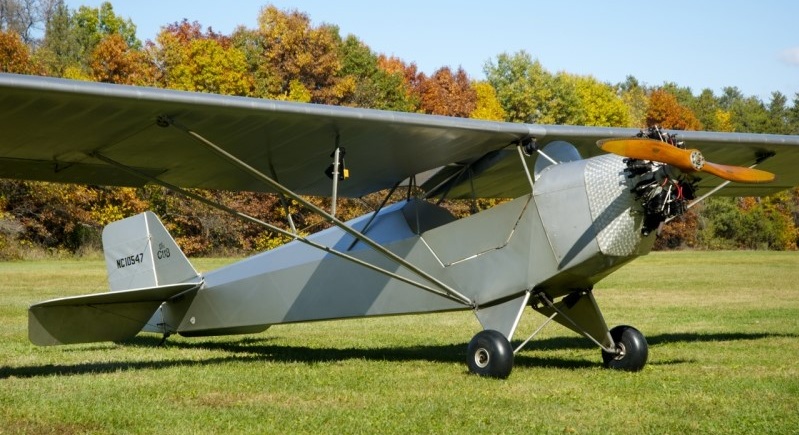
Reliable lightplane engines were virtually nonexistent when the E 2 was designed. For the first E 2, Taylor found a two cylinder engine of 20 horsepower. It was known as the Brownbach Tiger Kitten, and the name reportedly inspired the E 2 to be called the Cub. The plane handled fine on its first flight (in September 1930) but on 20 hp didn’t get too high five feet, actually The new Taylor E-2, now known as the “Cub,” was meant to be an affordable aircraft that would encourage interest in aviation and was awarded its type certificate on July 11, 1931 and licensed by the U.S. Department of Commerce for manufacture.

Twenty-two Taylor E-2 Cubs were sold during 1931, retailing for $1,325; by 1935, sales had increased to more than 200 E-2 Cubs.

A 45 hp, nine-cylinder French Salmson AD-9 was tried: its performance was spectacular, but it was too expensive.

Continental provided the solution with the A 40, a “40 hp” flat four that actually produced 37 hp. The E 2 was certified with this engine on June 15, 1932 and was put on the market for $1,325, or $1,495 with optional 40hp Aeromarine AR-3 engine, or $895 less motor.
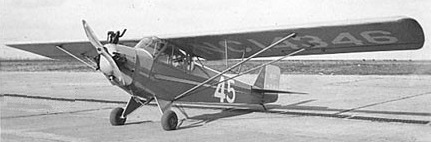
Taylor E-2 NC14346 with AR-3 engine

Unfortunately, the early Continentals were giving trouble, for the engine company was using the Cubs as test beds. One of Piper’s five children, Tony, said that he rarely got more than 20 miles per forced landing. Sales to people who wanted to fly longer between stops were, naturally, a little sluggish. There was a frustrating period before Continental improved the A 40 during which Taylor actually started designing his own engine.

Continental added dual ignition and cured the annoyances of blowing head gaskets and breaking crankshafts.
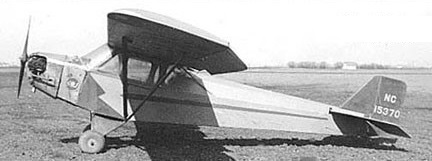
Taylor E-2 NC15370 with A-40 engine

The Prototype (s/n 11) was powered by a 20 hp Brownbach Tiger Kitten and was first flown on September 12, 1930. The E2 barely managed to leave the ground with the tiger kitten, however the engine left a legacy in that it prompted one of C.G. Taylor’s colleagues to remark that since the engine was called the Tiger Kitten the E2 should be called the cub. The engine was deemed too weak and a 40 hp French Salmson was tried and deemed too expensive. Ultimately the decision was made to try a brand new and untried 40 hp engine from continental. That engine was an air cooled flat four cylinder designated the A-40. An uncertified A-40 was fitted to s/n 12 which was completed on April 9, 1931. The engine had a number of teething problems and Taylor has been quoted as saying that in the first 30 days of flying with the A-40 the E2 had to make 26 forced landings. It was also discovered that the crankshaft’s tended to break at around 100 hours.

Continental eventually worked the bugs out and the A-40 received its certification on May 15, 1931 which cleared the way for the E2 aircraft certification on June 15, 1931. The E2 was originaly certified under group 2, no 2-358 which covered the first 14 aircraft. The remaining aircraft were certified under ATC A455 which was issued on November 7, 1931 (covering s/n 26 and up.) The aircraft originaly sold for $1325 and no options were offered. The fuel tank was moved from the wing as shown on s/n 12 to the fuselage where it was located between the panel and the firewall starting with s/n 13. A fully enclosed cockpit was introduced on February 9, 1932 and became standard starting with s/n 35 and up.

Sales reflected the improvements, and 351 E 2s were produced between 1931 and 1936.
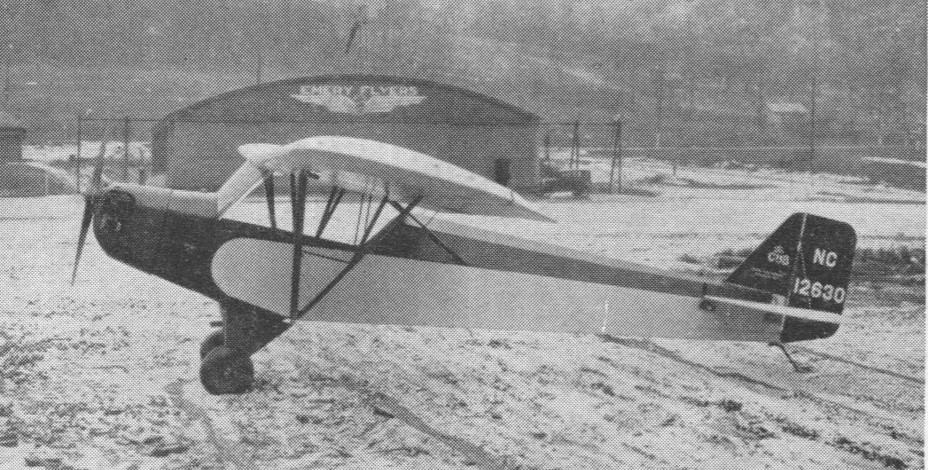
E-2

In the midst of the depression Continental announced that they were getting out of the aircraft engine business (a decision they later changed.) As a result the Aeromarine AR3-40 (40 hp) was installed starting with s/n 75 (3 Jan 34). This new configuration was designated the F2 cub. The Aeromarine was not satisfactory and several further engines were tried (models G2 with a Taylor designed T-40 and the H2 with a 35 hp Szekely SR-3-35.) Eventually Continental updated to the A-40-3 and this engine was used for s/n 178 and up.

The company was always sensitive to customer desires, and in 1936, Taylor introduced a refined Cub in order to incorporate design improvements as well as suggestions from the field. A young man named Walter Jamouneau was given the job of improving the E 2 resulting in the Piper J 2. In 1937 a fire destroyed the plant, prompting the company to relocate to a defunct textile mill in a town called Lock Haven. In November of 1937, the relocated company changed its name and became the Piper Aircraft Corporation.

The 1934 Taylor F-2 Cub (ATC 525) featured and open-sided cabin with optional side panels. Selling for $1,470, about 30 were built.

The 1934 Taylor G-2 Cub was an F-2 with a 40hp Taylor T-50 experimental motor. Only the one was coverted, N14756, which was rebuilt as an H-2 Cub in 1935.

The 1935 Taylor H-2 Cub (ATC 572) featured an open-sided cabin with optional side panels. Selling for $1,425, at least four were built.

Production Summary

YearModelQuantityS/N RangeNote
1931E-2 Prototype 111 
1931E-22112 to 32 
1932E-22233 to 54*
1933E-21855 to 72 
1934E-2173 
1934F-2 Prototype174 
1934E-2 & F-26475 to 139*
1934H-2 Prototype1140 
1934E-28141 to 148 
1935G-20149*
1935E-2 & H-2206150 to 358*
1936E-25359 to 380*
Total Production: 348

22 Aircraft in the batches marked * were not delivered. They were either not built or they were completed as later models and assigned new serial numbers.

Taylor E 2 Cub
Engine: Continental A 40, 36 hp
Length: 23 ft 3 in / 6.78 m
Wingspan: 35 ft 3 in / 10.74 m
Chord: 5 ft 3 in
Airfoil: USA 35B
Wing Area: 183 sq.ft
Empty Weight: 532 lb
Gross Weight: 925 lb
Useful Load: 393 lb
Gross Weight (ATC 455): 970 lb
Emp Weight (ATC 455): 556 lb
Useful Load (ATC 455): 414 lb
Fuel Qty: 9 gal (54 lb)
Oil: 1 gal (7 lb)
Fuel Consumption: 2.8 gph
Max speed: 74 kts / 137 km/h / 80 mph
Cruise speed: 68 mph
Stall: 28 mph
Best Climb: 450 fpm
Ceiling: 12,000 ft
Take off (ground run): 120 ft
Landing (ground roll): 95 ft
Range: 173 nm / 320 km
Crew: 2
Original Sales Price: $1325
Datum: Rear of Wing LE (aft positive)
CG Limits: +16 to +20.5 in
Incidence at Root: 2.5 deg
Incidence at Tip: 0 deg
Diehedral at Front Spar: 3/4 deg
Diehedral at Rear Spar: 1 deg
Horiz Stab Area: 24.2 sq.ft
Aileron Area: 9.77 sq.ft
Rudder Area: 7 sq.ft
Fin Area: 3 sq.ft

Taylor F-2 Cub
Engine: 40hp Aeromarine AR-3
Wingspan: 35’3″
Length: 22’0″
Useful load: 405 lb
Max speed: 85 mph
Cruise speed: 75 mph
Stall: 30 mph
Range: 240 mi
Seats: 2

Taylor F-2 Cub
Engine: 40hp Continental A-40
Wingspan: 35’3″
Length: 22’5″
Useful load: 407 lb
Max speed: 85 mph
Cruise speed: 70 mph
Stall: 29 mph
Range: 195 mi
Seats: 2

Taylor H-2 Cub
Engine: 35hp Szekely SR-3
Wingspan: 35’3″
Length: 22’0″
Useful load: 406 lb
Max speed: 80 mph
Cruise speed: 72 mph
Stall: 30 mph
Range: 215 mi
Seats: 2
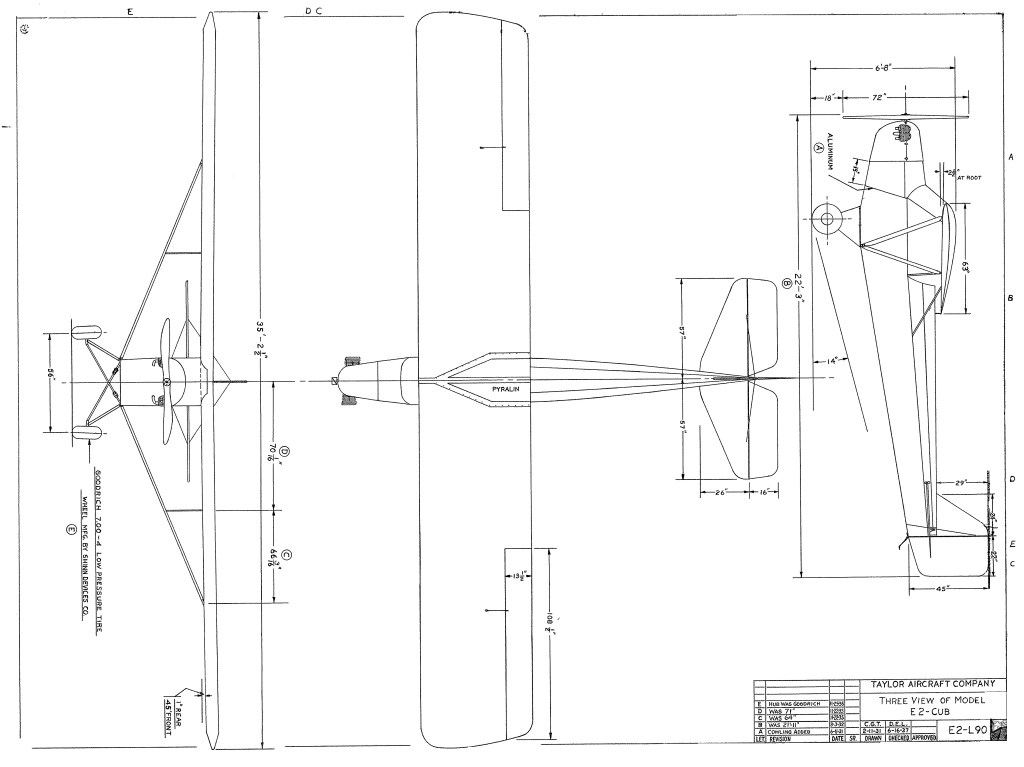
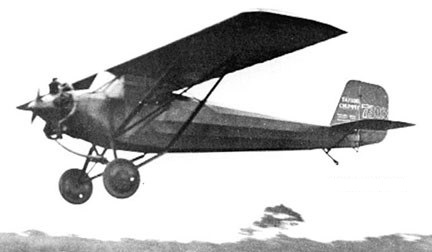
Taylorcraft A / Taylor-Young Model A / Alliance A

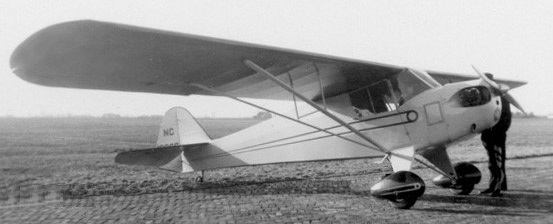
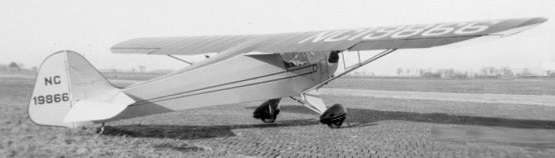
Taylorcraft A NC19866

The birth of Taylorcraft came in early 1936 when city fathers offered C G Taylor the old Hess-Argo factory rent-free in order to encourage new industry. William C Young entered the picture as a partner in April 1937, and city support was dramatically demonstrated in late 1937 in the sale to townspeople of more than 35,000 shares of company stock for needed capital.

The Taylorcraft A represents the first model series of the line, and it is powered by the 40-horsepower Continental A40-4 engine, one of the first to use opposed cylinders. The engine came out in the early 1930s and was used on the Taylor Cub that later became the Piper Cub. The huge tachometer, oil temperature gauge, and oil pressure gauge were bought by Taylorcraft from the same supplier that sold the units to the Dodge car company, and relabeled. (They were used in the early Luscombes, too.) As the model numbers increased, so did the number of doors: one with the A, two with the B, and three with the 15A and 20.

The prototype, NX16393 c/n 25, was built by Taylor Aviation Co under (2-529) and subsequent planes by Taylor-Young Airplane Co under (ATC 643). Selling in 1936 for $1,495 and $1,595 in 1938. With company reorganization in 1938 it gained a “craft” and the Taylor-Young A became known and advertised as Taylorcraft A.

Taylorcraft production includes 100 prewar Model As, 1800 military L-2s, more than 2800 post-war BC-12Ds, and more than 120 F-19 Sportsmans.

A total of 606 were built. Prototype NX16393, NC15757-15763, NC15776, NC18301-18347, NC18349-18373, NC19000-19099, NC19600-19699, NC19800-19818, NC19821-19895.

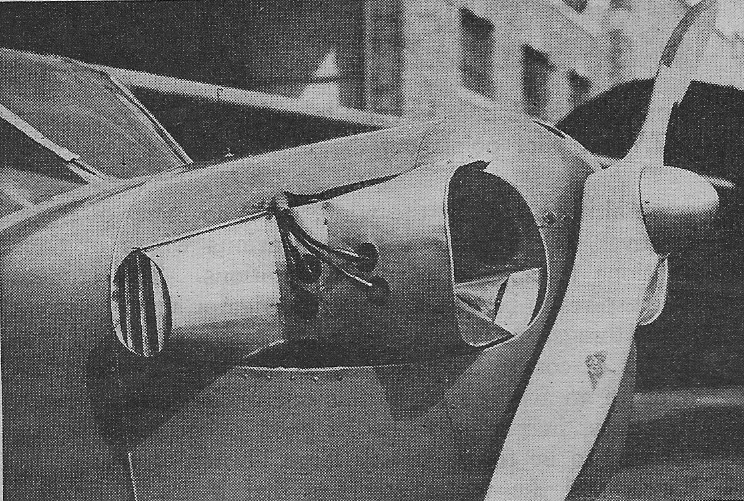
Fitted with special cooling sheath 1938

Engine: 40hp Continental A-40
Wingspan: 36’0″
Length: 22’0″
Useful load: 420 lb
Max speed: 91 mph
Cruise speed: 80 mph
Stall: 32 mph
Range: 240 mi
Seats: 2

Taylorcraft Chummy / Arrowing Chummy / A-2 Chummy

Arrowing Chummy NX4203

The Taylor Brothers Company had produced two two-place, side by side, high wing monoplanes called the Chummy. Designed by C G Taylor it was a fabric covered high wing airplane with a price tag of $3,985 during the Depression. The planes were first known only as Chummy or Arrowing Chummy; numeric designations came in 1930.

First flown in December 1927 piloted by Gordon Taylor. The two built were NX4203 and N4901 c/ns 3 and 4, powered by 90hp Anzani and 125hp Siemens-Halske SH-12 engines.

Wingspan: 34’0″
Length: 22’0″
Max speed: 110 mph
Cruise speed: 100 mph
Stall: 38 mph
Range: 500 mi

Taylor Bullet

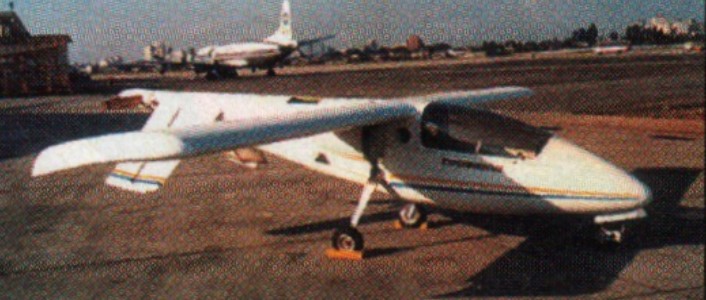
The 1982 Taylor Bullet was a two-seat counterpart of Micro-IMP. With retractable undercarriage, power was a 2100cc Revmaster pusher. He used the best features of his earlier designs, including the GA(PC)-1 airfoil with full length flaperons and optimal adaptations of TPG. With significant assistance from Jerry Holcomb, Molt wound up with a contoured fiberglass shell that gave no impediments to the smooth passage of air over it. The wings had a high angle of attack, allowing it to get in and out of small airstrips. Molt kept the nose low (tail high) for maximal forward visibility during low-speed take-offs and landings. This allowed him to mount the propeller on the tail and give clean airflow over the fuselage and wings. Its reverse pitch capability shortened the ground run after landing. By sweeping the wings forward and placing the Revmaster engine at the front of the plane, Molt assured that variations in pilot/passenger weight would not disturb the Bullet’s center of gravity.

As with most prototypes, there were some annoying glitches, such as difficulties with the long Flexidyne coupling between the engine in front and the propeller at the tail, and some trouble retracting the main gear, which were left extended during the 50 hours of flight-testing. Eventually the owner, Jim Berry, donated his Bullet to the Oregon Air Museum in Eugene, where it remains on display.

Engine: Revmaster 2100cc, 70 hp
Wingspan: 31’0″
Length: 18’9″
Useful load: 550 lb
Max speed: 150 mph
Stall: 50 mph
Range: 500 mi
Seats: 2

Taylor Mini-Imp

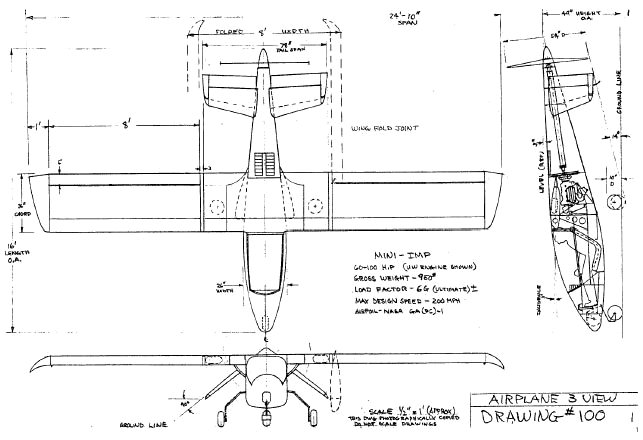
During the energy crisis of the mid 1970’s Moulton B. (Molt) Taylor decided to turn to a small, easy-to-build, light plane which focused on maximum cruise speed and efficiency. The result is the Taylor Mini-IMP.

Taylor Mini-Imp Article

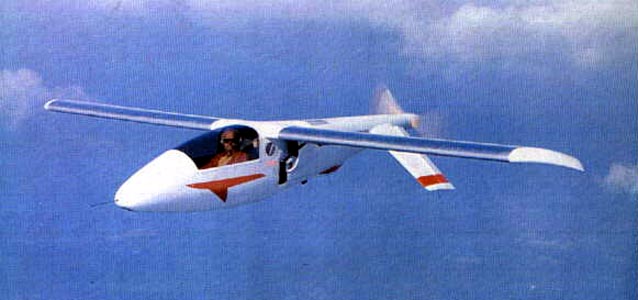
The Mini-Imp is a two-seat version of the single-seat Imp designed in 1975. It features an unusual configuration with a pusher prop aft of an inverted V-type tail assembly and cantilevered high wing that folds back for towing and storage. The wing is the latest NASA design with spoiler and flaps. The retractable gear is the tricycle spring-legged type. A controllable propeller is available. Power is provided by any engine from 60 to 115 hp with the 60-hp Franklin, 60-hp Limbach VW, 70-hp Turbo Revmaster VW, 100-hp Continental or 115-hp Avco Lycoming modification being the most common. The aluminum and fiberglass Mini-Imp requires a minimum of tools to construct, and all hard-to-build parts are available. It offers unequalled safe flyability and stability, positive spiral stability, limited acrobatic capability (stressed to 9 Gs), and good fuel economy (3 1/2 gph).

The O-200 powered price in 1982: $10,000 (Includes complete kit). All metal construction. Year. Units delivered to June 1982: 50.

The Model “C” version of the Mini-IMP is the long nose version which was developed after the prototype was flown with the Limbach converted VW engine. The Model “C” is powered with the Continental O-200 engine (100 HP at sea level at full throttle). The Model “C” also incorporates a larger baggage compartment and the nose is lengthened 12 inches so that the pilot sits one foot further forward of the main bulkhead. This lengthening of the nose required the installation of an additional vertical fin on tip of the tail boom giving the “long nose” Mini-IMP an inverted “Y” tail configuration. This addition was used instead of lengthening the tail boom to accommodate the longer nose length of the design rather than lengthen the shaft and to accommodate the further aft placement of the propeller (with its weight effect on the CG).

The O-200 powered Mini-IMP requires the use of a different propeller and due to the increased weight of the engine a heavier landing gear is used. The drawings indicate several other areas of change for the Model “C” needed to accommodate the higher power and resulting performance increases. These include heavier side frame members and a different nosewheel installation. When ordering “kits” be sure to advise of your preference in this regard. The same set of drawings is used to cover either version of the Mini-IMP (the long nose or the short nose).
It is practical to use the long nose version with the big baggage compartment if the builder intends to use the turbocharged Revmaster engine and controllable propeller. However, if the normally aspirated Revmaster engine and a fixed pitch propeller (or other such VW conversion) is to be used, the short nose configuration should be used.

A prototype of the Model “C” has been flown extensively and its improved performance with the higher power is evident. Flight tests of the O-200 powered Mini-IMP “C” have shown a cruise speed of approximately 175 MPH at 4000 foot altitude at 75% rated power. Climb speeds of better than 1500 FPM are initially available at full throttle. These performances are obtained at approximately 1000 pounds gross weight. Exact performance to be obtained with any engine combination is of course dependent on the power level the builder wants to pull from his engine/propeller installation. The O-200 Model “C” requires approximately the same takeoff and landing run as the VW versions, with exact performance dependent on temperature, altitude, and gross weight.

Following Taylor’s death, the plans and licensing for the Mini-IMP have been marketed by the Mini-IMP Aircraft Company of Weatherford, Texas. The Mini-IMP Aircraft Company was formed to provide builder support and to further promote the design.

Gallery

Engine: Continental O-200, 100 hp
Hp range: 8-125
Speed max: 200 mph
Cruise: 170 mph
Range: 500 sm
Stall: 45 mph
ROC: 1500 fpm
Take-off dist: 600 ft
Landing dist: 600 ft
Service ceiling: 20,000 ft
Fuel cap: 13 USG
Weight empty: 700 lb
Gross: 1000 lb
Height: 4 ft
Length: 16 ft
Wing span: 27 ft
Seats: 1
Cockpit with: 26 in
Landing gear: retractable nose wheel

Engine: 60-hp
Gross Wt. 800 lbs
Empty Wt. 500 lbs
Fuel capacity 12+ USG
Wingspan 25’
Length 16’
Cruise 150+ mph
Stall 48 mph
Climb rate 1200 fpm
Takeoff run 800 ft
Range 500 sm