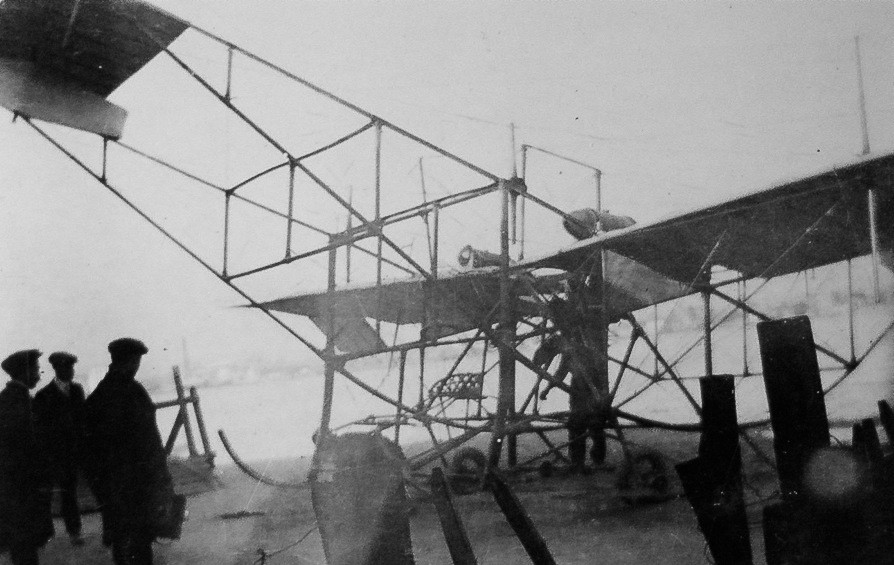
The Romanian inventor Ioan Teodorescu (French style name Jean Théodoresco) built a big high wing pusher monoplane, which flew successfully during September – November 1911 at Issy-les-Moulineux, France. Development was halted at that time, because Teodorescu ran out of funds.
Designed by Teodorescu and built by Raymond, Lecoq, Rossi.
Tennessee Propellers of Normandy, Tennessee, is a company better known for their wooden maple laminate aircraft propellers, but the company also acted as the exclusive distributor for the Zenoah G-25 and G-50 line of engines. To compliment these product lines they developed the Scout powered parachute which is powered by the 45 hp (34 kW) G-50 driving a Tennessee propeller.
The Scout was designed to comply with the US FAR 103 Ultralight Vehicles rules, including the category’s maximum empty weight of 254 lb (115 kg). The aircraft has a standard empty weight of 225 lb (102 kg). It features a parachute-style high-wing, single-place accommodation, tricycle landing gear and a single G-50 engine in pusher configuration. The 50 hp (37 kW) Rotax 503 engine was a factory option.
The aircraft carriage is built from powder coated welded 6061-T6 aluminum tubing and is a highly simplified design compared to other powered parachutes. In flight steering is accomplished via foot pedals that actuate the canopy brakes, creating roll and yaw. On the ground the same foot pedals control the nosewheel steering. The main landing gear incorporates fiberglass spring rod suspension. Standard equipment factory provided included a large canopy-stowage bag, electric engine starting, flight instruments and a four-point pilot harness.
The Scout was supplied as a complete ready-to-fly aircraft, introduced in 1999, but is no longer available. Unit cost in 2001 was US$10,000.
Engine: 1 × Zenoah G-50, 45 hp (34 kW) Wing area: 400 sq ft (37 sq.m) Empty weight: 225 lb (102 kg) Gross weight: 485 lb (220 kg) Fuel capacity: 5 U.S. gallons (19 L; 4.2 imp gal) Cruise speed: 25 mph (40 km/h; 22 kn) Rate of climb: 400 ft/min (2.0 m/s) Wing loading: 1.21 lb/sq ft (5.9 kg/sq.m) Crew: one
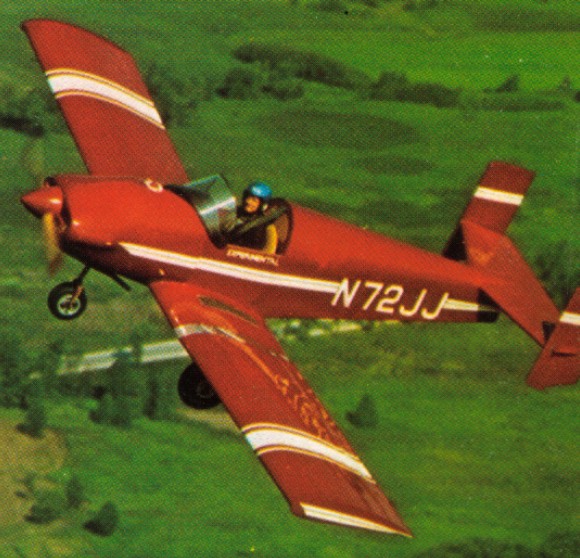
The Mini Coupe was designed by Bill Johnson and was the very first of the modern material kits. The Mini Coupe made its first flight in 1971 and was certified in 1972.
The Mini Coupe kit was purchased “complete” to the firewall in 1972, with all materials required to build the airplane. Ribs were formed along with the spars, wing skins, fuselage skins, tail assembly, controls assemblies, landing gear, brakes, tires, tubes, wheels, and about 5,000 pop rivets.
By late 1975, approximately 150 sets of plans had been sold. The Mini Coupe is a lightweight all-metal, single seat sporting aircraft powered by a 65-hp modified Volkswagen 1600-cc engine. Its wings are of constant-chord design with all-metal, stressed-skin construction with metal ailerons and no flaps or trim tabs. Its landing gear is the nonretractable tricycle type with oversize tires. The single seat is covered by a canopy or can be left open.
Price 1982: $2,850 Excludes instruments, wheels, bearings, axles, brakes, tires, tubes and cockpit covering. Units delivered to June 1981: 170.
The VW powered Mini Coupe in 2008 was available from DCS Inc.
Engines: VW-1600 Engine options: up to 100 hp MTOW utility: 850 lb MTOW Std cat: 900 lb Empty Wt. 497 lb Fuel capacity 13-15 USG Usefull load 353 – 403 lb Wingspan 22 ft 4 in – 24 ft Length 16’4” Vne 145 mph Cruise 90-110 mph Stall 48 mph Climb rate 750 fpm Ceil¬ing 12,500 ft Takeoff run 300 ft Landing roll 400 ft Range 300 miles Cabin width 24 in Seats: 1 Undercarrage: nose wheel Tires: 600 x 6
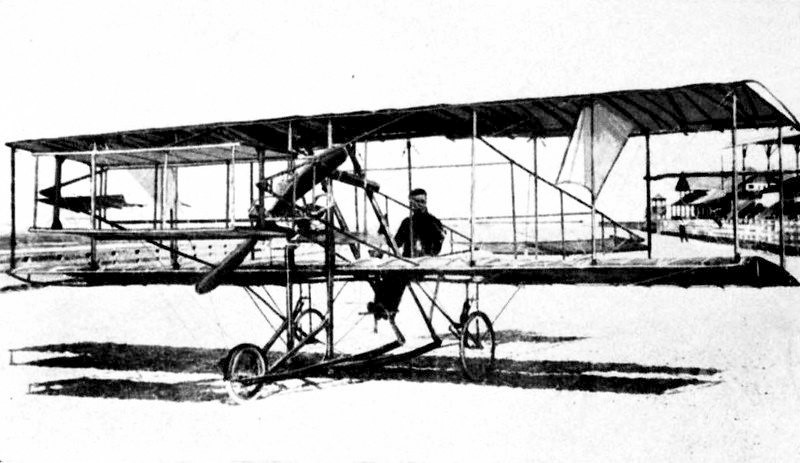
The Templeton-McMullen biplane was the first flying machine to have been built and flown in Vancouver, Canada. It was was built by William McMullen and William Templeton, assisted by Winston Templeton, brother of William . It was completed in April, 1911, and initial trials were made at Minoru Park race-track, Lulu Island. In April and May of 1911, it managed to make a few short hops – the longest being 260 feet – but it was limited by its under-powered 35 hp 3-cylinder Humber engine. The machine eventually came to grief by crashing into the railing of the race-track. It was intended to rebuild it and fit it with pontoons, but the plane was unfortunately destroyed by a factory fire.
A prototype was built in 1926 with an 80 hp (later 120 hp) Le Rhône rotary designed by Carroll and George Williams.
George Williams and Roy Sanderford designed the first plane manufactured by the company, the Temple Monoplane. George A. Carroll, a pilot and mechanic from Killeen, added adjustable landing lights and a fireproof mail compartment to the basic design.
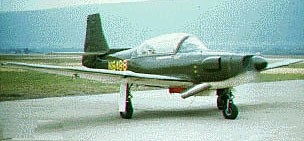
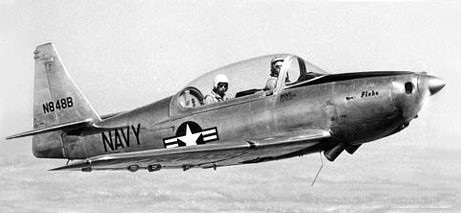
The TE-1A Buckaroo primary trainer development of Globe Swift lead in 1953 to the civil Model 33 Plebe. First flying on 23 August 1953, N848B, the sole example built, was an unsuccessful bid to replace the North American T-28.
Pappy Gunn landed a post-war job as technical advisor to the Philippine Air Force, and leaked word that the PAF just might be in the market for a tiny tandem trainer that could mount a pair of machine guns in the wing to go shoot up rebellious natives or whatever. Robert McCullough, who was then president of TEMCO, asked the sales department whether a commercial version of such a plane would find a market, and when they said yes, the engineers, under Dave Tacke, got busy and hand-built a modification of a standard Swift into what was called the TE-1A.
The only changes in this initial prototype were to install tandem instead of side-by-side seats, tandem controls, a new canopy and a squared off rudder, much like that of the T-6. The sirnilarity was not accidental TEMCO was originally founded to hold together a postwar production team of outstanding skill, and more than 90% of the employees had worked for North American building T-6s and P-51 Mustangs. To come up with something in a hurry, the prototype trainer was designed originally as a converted Swift, which was already in production at TEMCO since Globe went bankrupt.
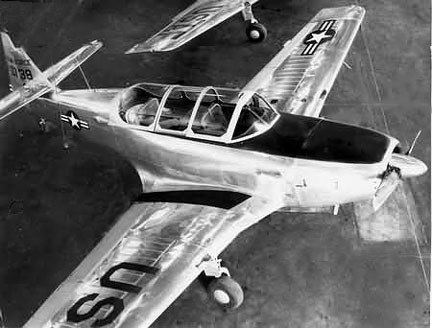
The TE-1A had tandem cockpits; 24v electrics, raised horizontal tail, strengthened wing with added fillets, and improved landing gear. In late 1948 the first TE-1A prototype was ready to fly, behind a 125-horsepower Continental, when word came that the USAF planned a competition in early 1949 for a new primary basic trainer. There was no time for a major redesign, so they cleaned up the canopy and sent the ship off to Wright Field to compete against the Fairchild T-31 and the Beech T-34, with Fairchild winning that round. Forgetting the Air Force’s interest, TEMCO decided to press on with the Buckaroo as a COIN aircraft for smaller foreign governments, brought in a noted small-plane engineer, H.G. Erickson, and went to work on a complete new program to come up with a really first class plane with no restrictions.
Scrapping the original TE-1A design, a whole new aircraft was evolved, still designated the TE-1A, of the same general weight, type, and configuration, but designed to military standards. Starting from scratch with a plaster and steel mockup, they, designed a brand new fuselage and wing center section, bulging the rear fuselage slightly, raising the deck, lengthening the nose and adding three inch’s to the overall length. Outer wing panels were stressed to 9 G’s and the tips squared off. The only vestige of its Swift lineage was to leave in the leading edge slot assembly, which gave more positive control at low airspeed.
About the only parts of the original airframe left were the cowl and canopy, neither of which survived the initial flight test stage. The canopy became a three-piece sliding type with magnesium framework, and the cowl was redesigned to provide downdraft rather than updraft cooling.
Other changes included a panel redesign to conform to the Air Force Standard Cockpit layout that originated with the T-6 Texan in World War 11, addition of an Aeromatic Model F-200H propeller with altitude control, a 24-voll electrical system, and a single fuel tank of 27.6 gallon capacity.
The finished product looked so good that in late 1949 TEMCO tooled up for limited production of 10 items, with 145-horsepower Continentals’ but just then they heard through the grapevine that the Air Force actually wanted to buy three YT-35s, as they were then called, for a new evaluation at Randolph AFB (the earlier USAF contract had been cancelled). So the horsepower went from 145 to 165 and the Buckaroo went to the lists as the TE-1B.
The official policy line was no more taildraggers in the Air Force.
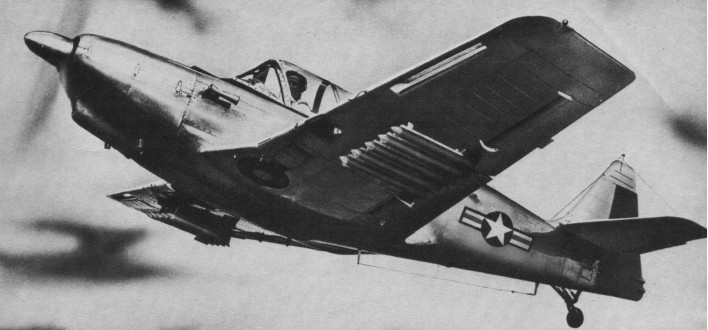
The Israeli Air Force got the first TE-IA, N90080, in June, 1950, with machine guns and ten 2.75-inch rockets, one TE-1A went to the Greek Air Force, while the original three TE-1Bs, designated YT-35 Buckaroos, went to the Air Force the next month. Saudi Arabia took delivery of ten more Buckaroos, 53-4465 to 53-4474. Saudi Arabia installed two .30 wing guns and ten underwing rocket launchers.
Temco T-35
The three USAF TE-1Bs, 50-738 to 50-740, were finally shipped to San Marcos AFB as instrument trainers for Field Force Liaison Pilots, and ten months later were returned to TEMCO for factory overhaul preparatory to still another round of evaluation tests at Goodfellow AFB, against the YT-34, with a T-6 Texan serving as control ship. Thus it was that Beech beat out TEMCO and the three TE-1Bs (or YT-35s) went up for sale as military surplus.
A Jack Hardwick picked up the three Buckaroos from the government and eventually disposed of them.
YT-35 Engine: 165 h.p. Franklin 6A4-165-B3 Span: 29 ft. 2 in Weight: 1,975 lb Max. Speed: 156 mph
T-35 Buckaroo Engine: Franklin 6A-165-B3, 165 hp Wingspan: 29′ 10″ Length: 21′ 8″ Useful load: 620 lb Max speed: 150 mph Cruise speed: 142 mph Stall: 56 mph Range: 550 mi Seats: 2 Tandem Undercarriage: retractable
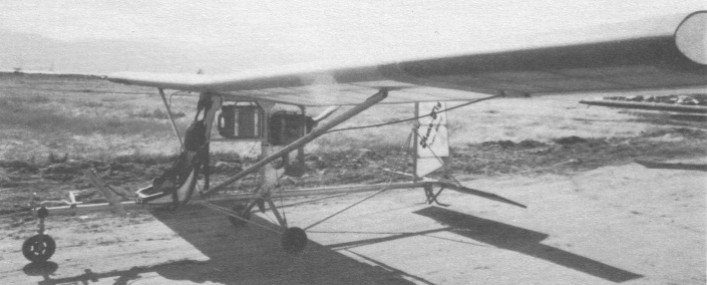
Single seat single engined high wing mono¬plane with conventional three axis control. Wing has unswept leading and trailing edges, and constant chord; conventional tail. Pitch control by fully flying tail; yaw control by fully flying rudder; roll control by one third span ailerons; control inputs through yoke for pitch/roll and pedals for yaw. Wing braced from below by struts; wing profile modified Clark Y (incidence: 6 deg at root, 3 deg at tip); double surface. Undercarriage has three wheels in tricycle formation with additional tailskid; steel spring suspension on nosewheel and bungee suspension on main wheels. Push right go right nosewheel steering connected to yaw control. Brake on nosewheel. Aluminium tube framework, without pod. Engine mounted below wing driving pusher propeller.
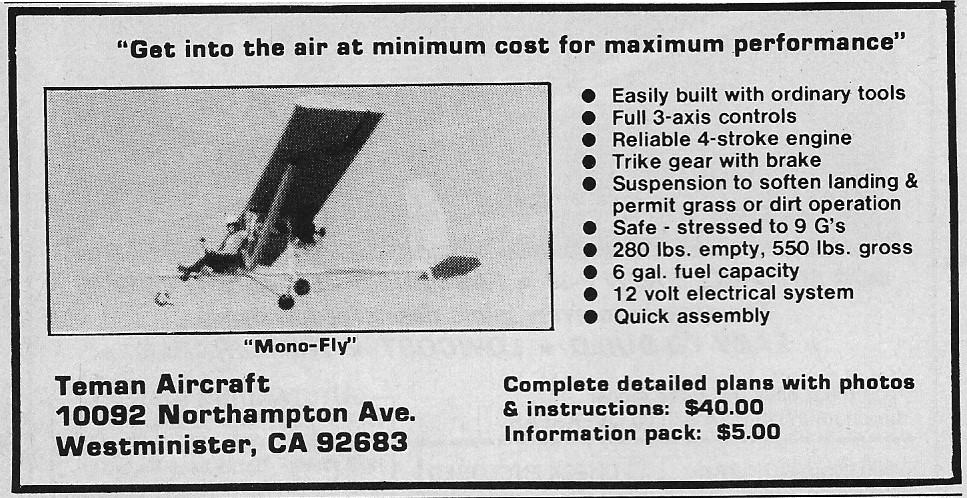
Bob Teman worked as a structural engineer on the space shuttle and Cruise missile programmes and over the last few years he has designed and built several aircraft including a man powered machine. His Mono Fly is the result of five years of development during which the main boom of the fuselage is the only part which has not been modified. Trials began in January 1976 and the first flight was made in duly 1979, experimental category FAA certification being granted on 7 July 1980, though the latest version just qualifies as an ultralight. Three different wings had been built the prototype even appeared once as a biplane three different engines, four types of suspension, two tails etc. Although he started by selling his MonoFly only as plans, Bob Teman was quickly overwhelmed by the demand and had to form Teman Aircraft to do it properly. This company now sells the Mono Fly as plans for $40, requiring around 300h labour and approximately $1910 for materials, engine included. In standard form, the engine was a twin cylinder, four stroke Onan (as used by Quickie) developing up to 22 hp and used with direct drive. Bob next offered as an option, the Kawasaki TA440 of 38.5 hp, whilst producing a prototype powered by a Rotax 503, which became the standard power pack in March 1983.
At Sun ‘n’ Fun in 1983 at Lakeland, Florida, where the Mono Fly put on several displays, Teman Aircraft also announced that two kits were now available. One, called the material kit, offers the Mono Fly complete except for paint and battery for $3540 or $2155 without the engine and requires around 150h assembly. The other, called the fast build kit, needs 80h assembly according to Teman Aircraft and is sold for $3900 complete or $2515 without engine. The latter offers, on top of that in the material kit, sheet, plate, angle and tube all cut to size including bends and pilot holes, while the engine is modified and ready to bolt on.
The Mono Fly is designed with demountable wings to facilitate transport and rigging without tools takes ten minutes for one person.
Engine: Rotax 503, 46 hp at 6500 rpm Propeller diameter and pitch 52 x 34 inch, 1.32 x 0.86 m Reduction ratio 2.0/1 Max static thrust 300 lb, 136 kg Power per unit area 0.37 hp/sq.ft, 4.0 hp/sq.m Fuel capacity 5.0 US gal, 4.2 Imp gal, 18.9 litre Optional fuel: 6.0 US gal, 5.0 Imp gal, 22.7 litre Length overall 17.2 ft, 5.23 m Height overall 6.6ft, 2.01m Wing span 30.8ft, 9.37m Constant chord 4.0ft, 1.22m Dihedral 3 deg Sweepback 0 deg Total wing area 124sq.ft, 11.5sq.m Total aileron area 8.0sq.ft, 0.74sq.m Rudder area 10.0 sq.ft, 0.93 sq.m Total elevator area 14.0 sq.ft, 1.30 sq.m Wing aspect ratio 7.6/1 Empty weight 250 lb, 113kg Max take off weight 550 lb, 249kg Payload 300 lb, 136kg Max wing loading 4.43 lb/sq.ft, 21.6kg/sq.m Max power loading 12.0 lb/hp, 5.4kg/hp Load factors; +10.0, 10.0 ultimate Max level speed 63 mph, 101 kph Max cruising speed 45 mph, 72kph Stalling speed 20mph, 32kph Max climb rate at sea level 1000ft/min, 5.1m/s Take off distance 100 ft, 30 m

 All Aero