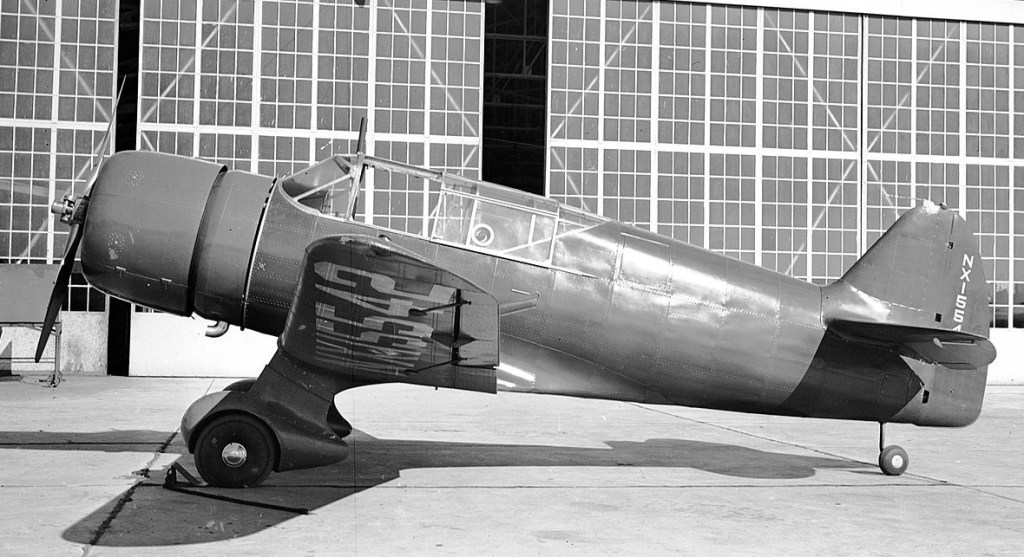
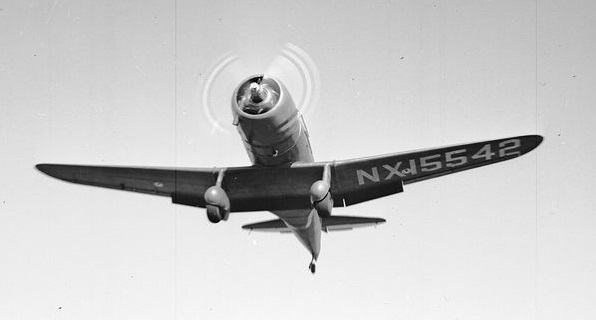
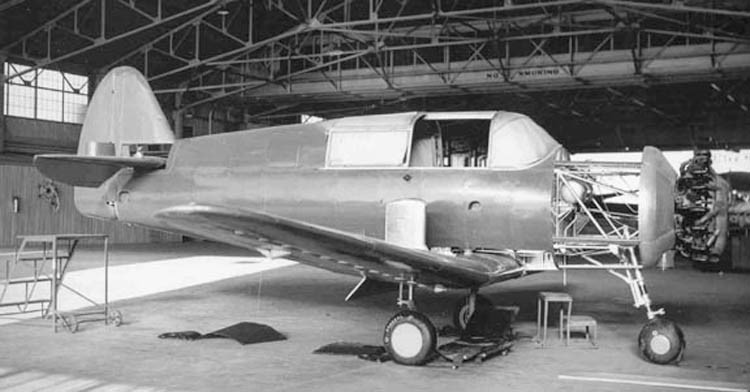
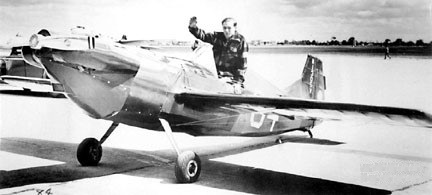
A two place cabin, low wing monoplane, produced in 1939 the Thorp T-5 NX15542 was a prototype trainer for the Boeing School of Aeronautics, based on Paulic XT-3B design, which had been dismantled.
The Boeing T-5 or Thorp T-5 was a student-built aircraft that was an all-metal, side-by-side configuration, low-wing, conventional landing gear-equipped aircraft. It was test flown by Eddie Allen in 1939.
Officially neither a Boeing Co design nor product, this attractive tandem-seat trainer was built by students at Boeing School and thusly adopted the Boeing name for licensing convenience as NX15542.
Refitted with tricycle gear and a 215hp Lycoming as the T-6 in 1939 by Paulic.
It was flown for 15-20 hours, then dismantled.
War clouds and metal shortages brought an end to the project and the T-5 / T-6 was scrapped.
A modern, higher horsepower version of John Thorp’s design, the Sky Scooter.
The Thorp T-211, was designed by John Thorp and first flown in 1945. The original airplane was designed and type certificated in 1946 as the Thorp T11 (ATC 791). Thorp was to construct eight prototypes, and had the design certified by the FAA, but was unable to find a foothold in the Cessna-dominated post-war US market. The post-war slump forced shelving of plans after three prototypes were built. With its low parts count and matched-hole drilling process, it is an easy airplane to build and an easy airplane to fly, for the first time builder/pilot. The price was originally projected as $1,000, which proved unrealistic, was $2,700.
The T-211 was developed with a 90 horsepower continental upgrade in 1953. The project was therefore shelved until the homebuilding boom saw the rights to the aircraft acquired first by Adams Industries and then by Thorp Aero in the 1970s, the latter firm building five examples as the Thorp Arrow or T-211 Aero Sport built in Sturgis Kentucky, but only sold overseas or part 141 operations due to current liability laws. The kits were then manufactured by AD Aerospace in the United Kingdom and Venture Light Aircraft in the United States.
Tubular Aircraft Products Company Inc built under licence from Thorp Aircraft Company the Model 211. From 1965, Tubular Aircraft Products built 100 parts kits with Continental O-200 powerplants and 11 production models. Eight built by Spring 1965; suspended 1966.
In 1964 the Sky Scooter 211 was in production at Tubular Aircraft Products Co Inc of Los Angeles, California. Powered by a 100 hp Continental engine, it has a cruise speed of 120 mph, gross weight of 1270 lb. Dual stick controls are standard, as are starter, nav-lights and anti-corrosion.
Tubular Aircraft Products Sky Scooter 211
In 2010 the aircraft was also back in production as a kit aircraft by AD Aerospace of Manchester, United Kingdom. This model is powered by a six-cylinder 120 hp (89 kW) Jabiru 3300 powerplant. The kit, less engine, sold for £15,000 in 2011.
Thorp T-211
A Wilksch Airmotive WAM-120 turbocharged 3-cylinder, 2 stroke, diesel, which burns 3-3.5 USGPH of Jet A fuel has been tested in a Thorpe T-211 in England. In four years to 2008, the aircraft completed 400 hrs. Performance included a 500 fpm climb at 14,000ft.
Updated to 100 HP in the 1960’s, and designated the T211, it was completely re-engineered, modernized and re-certified by the FAA in 1990. Thorp Aero of Sturgis, Kentucky purchased rights and tooling and in 1990-91, manufactured the T 211 under an FAA Production Certificate. The project was stopped due to the economic climate of the times.
Indus Aviation T211 Thorpedo LSA
Taneja T211
Thorp Aero of Sturgis, Kentucky in 1990-91, manufactured the T 211 under a production certificate. The project was stopped due to the economic climate of the times. IndUS Aviation acquired the rights to production, tooling and a large inventory of parts and spares in preparation for the manufacture of this airplane.
IndUS, formed by Indian-born surgeon Ram Pattisapu, acquired the rights to the T-211, including tooling and parts. IndUS had enough parts in hand to assemble an initial 20-25 aircraft, after which it is planned that TAAL will begin manufacturing parts. “We have shipped kits to India for assembly, to demonstrate what can be done,” Pattisapu says. “They will have 10 shipsets by the end of December 03/early January 04, with half the aircraft coming back to the USA for the light sport market.”
IndUS chose the name Sport E to reflect the fact that this FAA type-certified airplane was offered for the homebuilder to assemble under the Experimental category (51% rule), as well as the Light Sport Aircraft category. The Sport E was available in three product types depending on customer requirements and market regions: The Sport E / Certified, The Sport E / Experimental and the Sport E / Light Sport Aircraft.
The type-certified Part 23 Normal Category version Sport E, has the specifications as designated on the Type Certificate. A Continental O-200 Engine and a Sensinich metal propeller along with basic VFR instrumentation as standard. The aircraft were assembled at Dallas Executive airport.
Taneja Aerospace and Aviation Limited (TAAL) tied up with IndUS Aviation Inc., a Dallas, Texas-based company, to manufacture light aircraft in India. TAAL is scheduled to deliver the first aircraft for the Indian and US markets by 1 March 2004. IndUS was aiming for Indian certification of the Sport E, with TAAL assembling and delivering aircraft for the domestic market. Wings and fuselages will be shipped to Dallas, where assembly of aircraft for the US market will be completed.
The Sport E is expected to sell in the USA for $65,000-70,000 once the light-sport category is established. IndUS also planned to sell the aircraft as a fast-build kitplane, costing around $25,000, excluding engine and instruments.
There is also interest from flight schools in Australia and Canada in the fully certificated aircraft, Pattisapu says, but this will require TAAL to obtain a US Federal Aviation Administration production certificate, which will be difficult as there is no airworthiness bilateral between India and the USA.
IndUS Aviation began production of the T-211 to the guidelines of Light Sport Aircraft in the mid-2000s. The Thorp T-211 was the first US-designed Special Light Sport Aircraft to receive certification from the Federal Aviation Administration. The light-sport version uses the 120 hp (89 kW) Jabiru 3300 engine, while the type certified version uses a 100 hp (75 kW) Continental O-200 engine and is equipped for both VFR and IFR flying.
The Thorp T211 (also known as Sport E) was being manufactured in the US. Parts of two aircraft had already been delivered to TAAL for assembly in India. Parts for ten more aircraft were scheduled to arrive in December 03 for assembly. However, within six months, TAAL was to take up the manufacture of parts as well.
Thorp T-211 Sky Skooter on display at the IndUS Aviation booth at Sun ‘n Fun 2006
TAAL has also planned to get the approval from the Director General of Civil Aviation (DGCA) for flying this plane in India. At the introductory price in the range of Rs. 30 lakhs (including flying training), this aircraft was expected to give a boost to the absent owner-pilot category India.
Due to the high costs associated with product liability, the number of type-certified aircraft produced is a limited number of these aircraft available for sale in the USA and the United Kingdom to flight schools, clubs and individuals. IndUS was having the aircraft type-certified in India under the regulations of that country. Taneja, based in Tamil Nadu, southern India, manufacture the Thorp T211 two seater aircraft for domestic and export markets.
Thorp designed the T-211 to be an easy build aircraft. His innovative matched-hole drilling process makes it tremendously easy for even a novice builder to go from start to finish in the shortest amount of time. IndUS offered the Sport E / Experimental category aircraft in an EZ-Build configuration, which includes substantial finishout of sections of the airframe, allowing the builder to complete the project within the 51% rule.
Much of the assembly of the wings, empennage and fuselage completed, leaving bottom panels open for access to finish installation of the controls and other components by the builder. IndUS had available several builder assistance programs at the Dallas location. Through collaboration in India, IndUS were able to offer these fast and easy to build kits at tremendous cost and time savings.
IndUS has several different engine options for the Experimental and Light Sport Aircraft: Continental 0-200, Jabiru or Wilksch Airmotive WAM 120.
IndUS planned to re certify the Sport E (T-211) under the LSA category.
Variants:
SkySkooter (T-111) The 1946 SkySkooter is based on the T-111 with an 85 hp (63 kW) Jabiru 2200 engine and is certified as a Light Sport Aircraft.
Thorp T-211 1953
Thorpedo (T211) The Thorpedo is based on the Thorp T211 with a lighter 120 hp (89 kW) Jabiru 3300 engine and it is certified as a Light Sport Aircraft.
Certified T211 This aircraft is an FAA certified Thorp T211, similar to the original model and has a 100 hp (75 kW) Continental O-200A engine. It was available in two variants, one with VFR avionics and another with IFR equipment.
Thorpedo DP A prototype diesel-powered variant of the T-211 was produced in 2008, it is fitted with a WAM 120 two-stroke inverted diesel engine.
T-211 Engine: 1 x Continental O-200A, 100 hp (75 kW) TBO: 1600 hrs Prop: McCauley 2 blade, fixed pitch 67 in Length: 18 ft 2 in (5.49 m) Height: 6 ft 1 in (1.92 m) Wingspan: 25 ft (7.62 m) Wing area: 105 sq.ft (9.67 m²) Wing aspect ratio: 6.2 Empty weight: 750 lb (339 kg) Max ramp wt: 1270 lbs Max take off wt: 1270 lb (575 kg) Max useful load: 537 lb Max landing wt: 1270 lb Power loading: 12.7 lbs/hp Wing loading: 12.1 lb/ft² (60 kg/m²) Fuel capacity: 21 gal usable (78 l) Max useable fuel: 144 lb Baggage capacity: 40 lb (18 kg) Rate of climb: 750 ft/min (229 m/min) Climb gradient: 966 ft/nm Service ceiling: 12,500 ft (3,810 m) Max speed: 138 kt / 120 mph / 193 km/h Stalling speed clean: 50 kt Stall speed flaps down: 42 kt Range: 375 miles (764 km) Turbulent air penetration speed: 109 kt Fixed undercarriage. Seats: 2
The T-18 design was originally developed with the Lycoming O-290G (ground auxiliary power unit) in mind, by John Thorp. Which was easily converted to a Lycoming O-290D engine producing 125 hp. The T-18 is an all metal 2 place side-by-side high performance aircraft. Control response is exceptional and control forces are well harmonized. The T-18 is a very capable cross-country airplane. It will carry 2 people, 80 lbs. of baggage, and depending on engine and prop, can cruise around 180 mph. Powerplants range from Lycoming O-235 (115hp) to IO-360 (180 hp).
The T-18 Tiger is a side by side, two seat, all metal, semi-acrobatic, low wing monoplane, which was designed by John Thorp in 1961. The basic materials used are 2024-T3 aluminium alloy sheet for the fuselage frames, spar webs and outer skins. Where more severe forming is required, such as the flanged ribs, 6061-T4 aluminium alloy is used. The design utilises the matched hole method, i.e. rivet holes are drilled in the detailed parts which are then matched up during assembly. The wing consists of a centre section, and two up-swept outer panels. The complete wing may be removed from the aircraft by five quick release “pip” pins. The empennage incorporates an “all flying” tail, i.e. the entire tailplane rotates about its pivot on the fuselage, and an anti-servo tab supplies the necessary elevator feel. The main landing gear consists of a heavy gauge, heat treated chrome molybdenum steel tube “A” frame, which is attached to the fuselage by three bolts. A 23 Imp. gallon fuel tank is installed behind the firewall.
In 1962, John Thorp was toying with a friend’s suggestion that he develop a sport plane for homebuilders.He conceived the T 18 as a “modern antique”: a simple, sturdy little airplane that would take advantage of 1960s hindsight upon 1930s technology. He concentrated upon simplicity first. A polygonal fuselage, its curves optimized longitudinally and its other lines filled in with a ruler, facilitated layout and made jigging unnecessary; the airplane would jig itself once a few holes had been drilled. By depending on the tires and heavy, heat treated tubular steel legs for shock absorption, Thorp reduced the landing gear to an A shaped weldment. The engine mount was bolted to one side of it; to the other, the fuselage.
The T-18 was designed to be built from twelve 4′ x 12′ sheets of aluminum ranging in thickness from 0.016 to 0.040. Ribs and fuselage frames were designed to be hand formed with a mallet over plywood form blocks. Simple aluminum angle extrusions are used for stringers and longerons. The main wing spar caps are made from 1/4 “U” channel on top and angle on bottom with flat sheet for spar webs.
John Thorp designed the aircraft to be small, yet strong with excellent take-off and climb performance. The landing gear is a simple “A” frame of heavy wall 4130 steel tubing, heat treated to 180,000 lbs./sq. in. and bolted to the firewall with (3) 3/8″ bolts. The engine mount is also attached to the “A” frame allowing landing stresses not to be transmitted directly to the fuselage. This landing gear system has proven to be rugged and durable. The T-18 incorporates the “flying tail” which John Thorp held the patent for. This design also incorporates a sliding bubble canopy, like a fighter style.
The original design had no canopy, no flaps, no wheel pants and no pressure cowling. Fuel was gravity fed to the 125 hp GPU from a 28 gallon fuselage tank. That the back of the tank was only inches from the instrument panel didn’t matter, because this was to be a minimally instrumented, VFR only airplane. A narrow console between the seats housed the stabilator pushrod and trim actuator and provided a small boarding step. A folding side panel flipped down and you stepped over the low sill, put your leading foot on the center console, swung the other into the tunnel under the panel, and then lowered yourself into the seat while holding on to the heavy tubular frame that supported the canopy and served as a rollover structure.
The first T 18, which had been built by Bill Warwick as the plans were being drawn, flew in 1964. It was immediately apparent that the open cockpit would not do, since it was filled with an intolerable storm of whirling air. A sliding canopy was designed, and the turtledeck modified to accommodate it.
Warwick had used a 180 hp engine and a hybrid constant speed prop. With 180 horsepower and a fixed ¬pitch prop, theT 18 could cruise at 200 mph and reach a sea level top speed of about 220.
The T 18 suffered from a lack of preliminary design. Hence the large role modifications and afterthoughts have played in the development of the airplane canopy, flaps, folding wings and the persistence of certain flaws, like the cramped cockpit, about which, nothing can be done, and the nose heaviness and consequently marginal tail power that result from Thorp’s having failed to foresee the lengths to which dozens of builders would go in modifying and adding power to the design.
Versions:
T-18 The original design by John Thorp in about 1963
T-18C The original T-18 fuselage design, but incorporating Lu Sunderlands new Convertible or folding wing. Plans were available through John Thorp. The folding wing was a supplement to the original T-18 drawings. The plans were taken off the market in 1984 when John Thorp retired.
T-18W Not many of these exist, but is the wide body version of the fuselage as designed by Lu Sunderland, using the standard T-18 wing platform. Plans were available through John Thorp. The wide body modification was a supplement to the T-18 drawings. The plans were taken off the market in 1984 when John Thorp Retired.
T-18CW This is the predecessor to the S-18. It is the wide body version of the fuselage, and also the Convertible or folding wing as designed by Lu Sunderland. Drawings were available from John Thorp and they contained supplements for the fuselage and wing modifications. The plans were taken off the market in 1984 when John Thorp retired.
T-18’L’ Unofficial designation for a model using both the standard fuselage and the standard wing plan form, but incorporates the LDS airfoil designed by Lu Sunderland and used on the S-18. There are no actual drawings for the “L” version, as builders have taken it upon themselves to make the airfoil change.
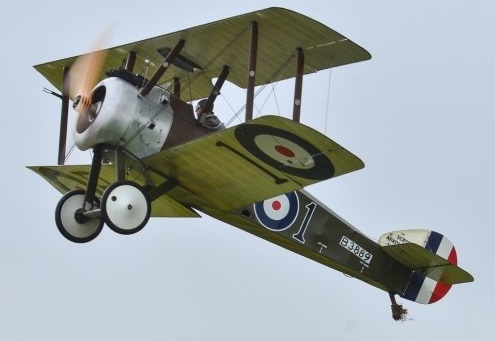
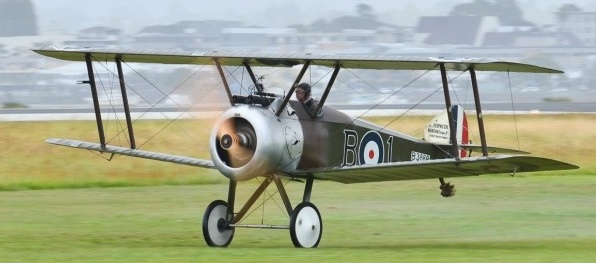
An authentic full-scale Sopwith Camel replica constructed by Gerald Thornhill of Hampshire, Illinois, USA, assembled in June 1985. A full size reproduction utilising a number of original parts including the engine.
It was imported to New Zealand in 1997 as ZK-JMU by film maker Peter Jackson and features a number of original components, including a 160 hp Gnome rotary engine, wicker seat and instruments.
The aircraft is painted as B3889 (coded B1) as used by Blenheim-born Capt Clive Collett of 70 Squadron RFC. This was the second of four Camels in which Collett was successful in combat and he achieved five of his twelve aerial victories flying it between August 13 and 25, 1918.
This Camel made its public debut at the Classic Fighters Air Show at Omaka during Easter 2001 where it spectacularly shed its cowling in mid-display. Flown by American pilot Gene de Marco saw it successfully return to earth.
A taildragger configuration and heavy-duty bungee sprung landing gear. The Canadian-built two-seater can also be fitted with floats or skis made at Thor Air’s Weston Ontario factory. The Thor 1-2 is basically a beefed-up version of the Thor 1, heavier tub¬ing and the cockpit frame is slight¬ly different. The Thor 1-2 features side-by-side seating, dual control sticks and rudder pedals and a center-mounted throttle. A full windshield, gold and black anodized aluminum tubing, in-cabin pulp start, remote choke, adjustable padded seat and a removable gas tank are also standard. The THOR-12-47 is basically the same as THOR-11-28 except Two-Place. The undercarriage is the same as Thor-11-28. 1984 PRICE: $7,482.
Thor 1-2 Empty wt 320 lbs Wingspan 32 ft 4 in Wing area 167 sq ft Height 7 ft 8 in Length 13 ft 8 in Fuel 5 gal Engine Rotax 447, 42 hp @ 6,600 rpm Stall: 27 mph Cruise 30-55 mph Top speed 63 mph Vne 70 mph Gross Wt 750 lbs Climb rate, 500 fpm
Thor 12-47 Engine: Rotax 503, 47 hp, geared drive Wingspan 32.3’ Wing area 167 sq.ft Empty weight 320 lbs Gross weight 700 lbs Cruise speed 3055 mph Stall speed 27 mph Climb 700 fpm Takeoff run 70-130 ft Landing roll 50-100 ft
The Thor-11-28 is a single-engine, high wing taildragger, strut braced, double-surface wings, independent 3-axis controls. The engine is tractor mounted and the undercarriage is independent fully suspended gear, tail-dragger type, fully suspended steerable tailwheel. 1984 PRICE: $6,236. The THOR-11-40 is of the same basic configuration as THOR-11-28. LANDING GEAR: Same as Thor-11-28. 1984 PRICE: $6,655.
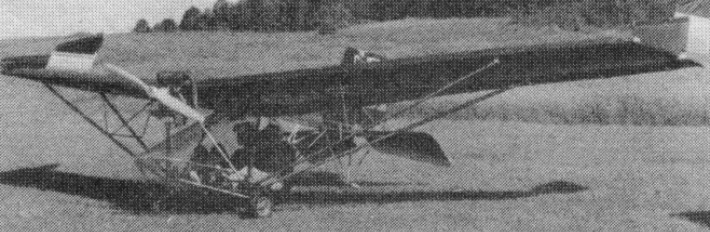
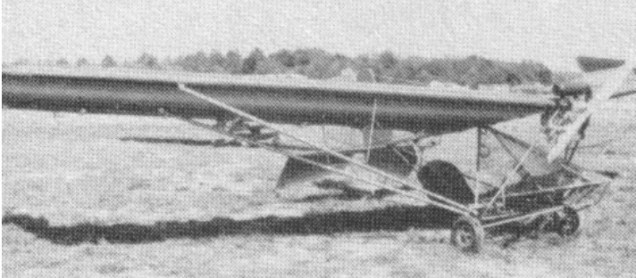
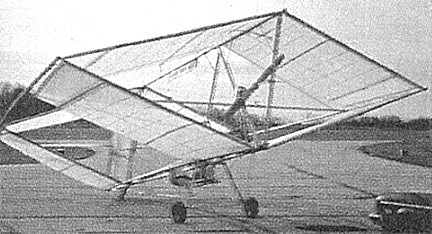
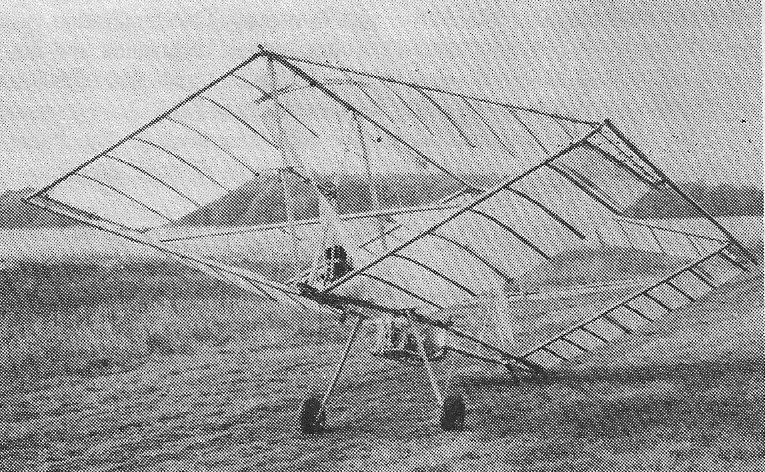
Thompson expanded his experiment in powering a boxkite with a model airplane engine into full-size reality with twin vinyl-covered aluminum-tube frames and a 55hp snowmobile motor and a prop in 1972. A two-place tandem “flying box-kite” a test pilot, reported in his own words, “Great stability. I was 35 feet off the ground before I realized I had taken off!”
FAA registration N64492 was issued on 30 March 1973, seen as still valid in mid-2007. Marketed plans for $75.





 All Aero