Townsend Thunderbird

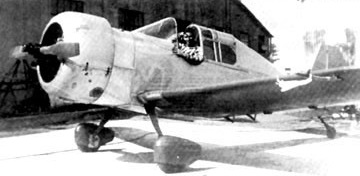
Townsend Thunderbird N749T

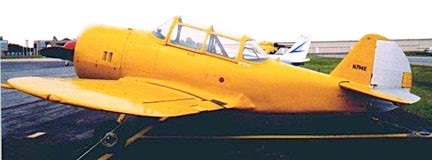
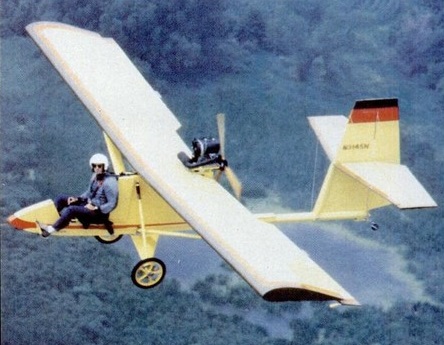
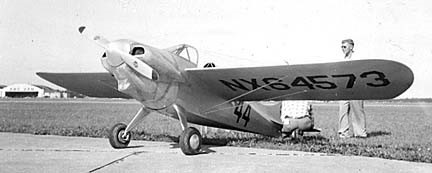
The Townsend Thunderbird was assembled in 1955 from parts of at least four different planes. The fuselage structure (20′ in length) appears to be a cut-down Fairchild PT-26 with its canopy. The cowling is from a Stearman, the landing gear from a Cessna 190 or 195. Its wings, vertical and horizontal stabs are from a Vultee BT-13 or -15. The wings are just the outer panels (wing span is 25′) and the stabs have been cut down in size. Engine is a Wright R-975, which suggests BT-15.

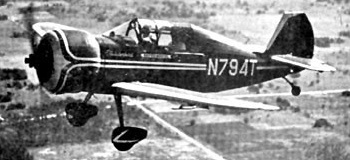
Registered N749T, the aircraft started out fabric covered, but was later metalized.

Townsend Thunderbird N749T

In September 2002 Tony Pileggi purchased the home-built Thunderbird. With quite a history and, while it’s a shame to change all that, it was not safe to fly. Actually, it was really great in the air. Take-off and landing were scary. It was too short-coupled and over-powered, and it had an aft c/g or not enough horizontal stabiliser. The tail would not come off the runway until about 65 mph with full forward stick.

During flight-testing, the clean power-off stall speed was about 80 mph. At the first flap setting, the power-off stall speed was between 85 and 90, with a very abrupt snap into a spin. Attempting to recover from the spin under 100 mph resulted in a secondary stall, again with a tight spin. This was attributed to the very small flap size as they ran from the fuselage outboard only 16″. The size of the flaps created a thicker wing section at the root, and so caused the tips to stall long before the roots.

Tony Pileggi decided to disassemble the ship after the landing gear collapsed and made for a very exciting landing. When he removed the forward fuselage aluminium, he found some old cracks and some scary welding on the frame. A first impulse was to scrap the entire aircraft, but he then began thinking about redesigning it and building a replica of a WWII-era fixed-gear fighter. After extensive research, he found a plane that the Thunderbird most closely resembled, the Nakajima Ki-27.

Thunderbird
Engine: Jacobs R-755-9, 245hp
Wingspan: 27’5″
Length: 21’3″
Empty wt: 1800 lb
Max speed: 220 mph
Cruise speed: 152 mph
Stall: 75 mph
Range: 200 mi
Seats: 1

Towle TA-2

Towle TA-2 was built as a successor to the WC model. In 1930 one was built, NX491H, powered by two 240hp Wright Whirlwind J-6 on a faired housing and wing struts were omitted. Only the one was built.

Engines: 2 x Wright Whirlwind J-6, 240hp
Wingspan: 56’0″
Length: 42’0″
Useful load: 2257 lb
Max speed: 120 mph
Cruise speed: 100 mph
Stall: 55 mph
Range: 500 mi

Towle WC / TA-1

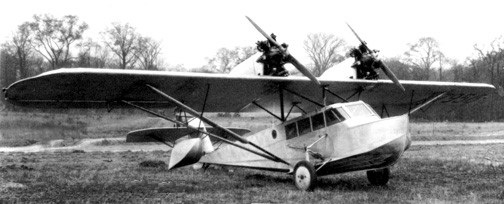
Towle WC NX7956

Thomas Towle was an engineer who had been involved with many early aircraft designs. Having just co-designed the Eastman E2 Sea Rover, Towle was commissioned by Henry McCarroll to promote Detroit’s aviation production capabilities.

The 1928 Towle WC was built for businessman H G McCarroll and USN Lt George Pond by a group of Detroit engineers under the direction of Towle. An all-metal wing design (Towle F-2) essentially eliminated ribs and spars with its unique, internal zig-zag pattern of corrugated aluminum as a framework. The covering also was corrugated sheet aluminum. Wings were strut-braced. One WC was built, NX7956.

Priced at $25,000, the WC flying boat was first flown in November 1928. The prototype WC flew as far as Brazil before engine reliability issues forced the cancellation of the round-the-world flight attempt.

The 1930 TA-1 was the first production version of the WC with 150hp Comet engine. The one bult was registered NX5328.

WC
Engines: 2 x Comet, 150hp
Wingspan: 52’0″
Length: 35’0″
Useful load: 11,670 lb
Max speed: 115 mph
Cruise speed: 95 mph Stall: 45 mph
Range: 350 mi
Seats: 6

TA-1
Engines: 2 x Comet, 150hp

Torigai Hyabusa-go

Shigesaburo Torigai with a new-found interest in aviation as a hobby, organized the Nihon Hiko Kenkyukai (Japan Flight Research Association). His ambition was to have an aeroplane of his own. To achieve this, he asked Toyokichi Daiguchi, who was associated with Narahara, for technical assistance in the building of his own aeroplane.

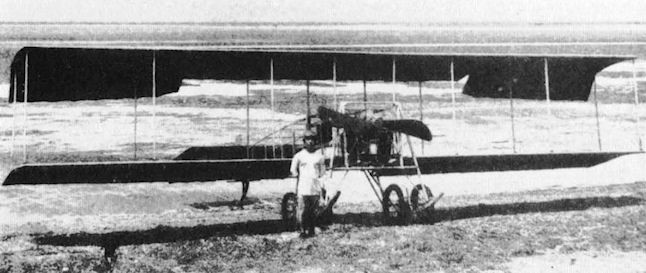
In 1913, to open the project, Torigai purchased a used 45hp Gregoire Gyp engine from Shinzo Morita of Osaka after his flying accident. Torigai completed his aeroplane in April 1913 and called it the Hayabusa-go (Falcon). It was an equal-span three-bay biplane with uncovered fuselage, tractor engine, ailerons on the upper wing and undercarriage comprising two sets of twin wheels and two skids. Otijiro Itoh assisted Shigesaburo Torigai, another Japanese pioneer, in the construction of the Torigai ”Hyabusa-go”.

He flew it for the first time on 3 May, 1913, at Inage, Chiba Prefecture, but at a height of about 20m the aeroplane stalled and crashed. Torigai survived, but the aeroplane was severely damaged.

After repairs by Daiguchi, Torigai took the aeroplane to Hokkaido. While preparing for a flying exhibition at the Tsukisappu Military Drill Grounds on 7 September, 1913, Torigai took off and, on the outskirts of Sapporo, soon crashed once again. Speculation about the cause of this and the earlier accident is that Torigai did not know how to fIy, for there was no record of him having been given formal flying lessons. Torigai escaped serious injury but the aeroplane was badly damaged. The wreckage was saved and eventually transferred to Otojiro Itoh, to help start his flying school at Inage the next year. Itoh made the necessary repairs along with his own modifications and made the aeroplane flyable.

Itoh eventually purchased the Gregoire Gyp engine from Torigai in August 1915 so that it could be installed in his first-built aircraft, the Emi 1 Aeroplane. This is the aeroplane that made the first flight to Tokyo from Inage on 8 January, 1916.
Tonini-Bergonzi-Negri Italia-1 / Italia-2

Italia I

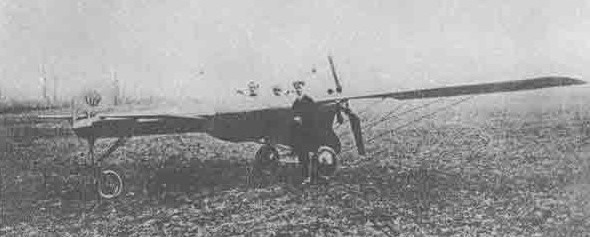
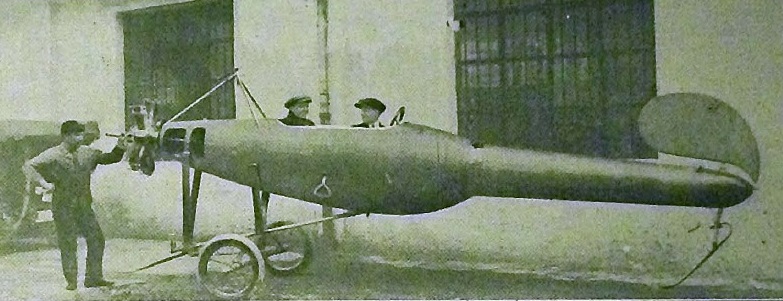
An earlier canard monoplane, the more streamlined Italia-1, was designed for the Italian 1913 trials but became badly damaged by Alessandro Tonini during a landing.

Italia I

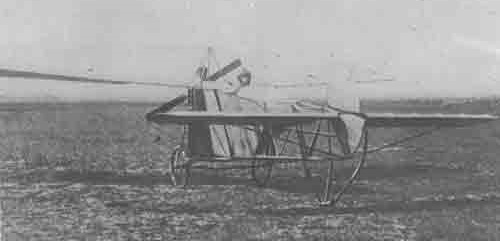
Due to a lack of funds and an underpowered airframe, Tonini shifted to a more “rough” and lighter configuration as a replacement: the Italia-2. According to Tonini’s son, the aircraft never flew.

Italia-2

The Tonini-Bergonzi-Negri “Italia II” was a lighter airplane with a smaller engine, and also a canard. This did not take off – the partners experienced serious financial problems because Negri lost the money in cards, and their team broke up.

Italia II

Italia-2
Engine: 35 hp
Span: 6m
Weight: 340 kg