Tupolev ANT-1

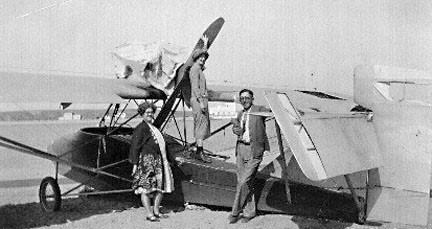
In 1922 Tupolev designed the ANT-1. First flew on October 20, 1923.

ANT-1
Engine: 1 x Anzani
Max take-off weight: 355 kg / 783 lb
Empty weight: 205 kg / 452 lb
Wingspan: 7.5 m / 25 ft 7 in
Length: 5.0 m / 16 ft 5 in
Height: 1.7 m / 6 ft 7 in
Wing area: 10.0 sq.m / 107.64 sq ft
Max. speed: 120 km/h / 75 mph
Cruise speed: 100 km/h / 62 mph
Ceiling: 400 m / 1300 ft
Range: 400 km / 249 miles
Crew: 1

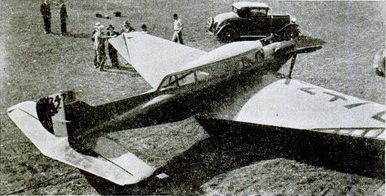
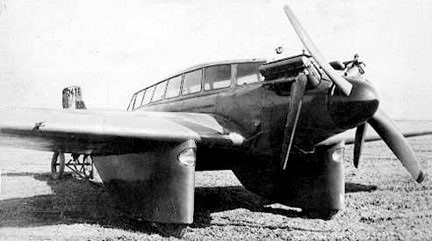
Tunison Scout / Scout Airplane Co 1929 Monoplane

Designed by M.C.Tunison, the 1930 plywood Scout was in the $2500 class. Influenced by the French Antoinette Monobloc design, it has wide-chord, sparless, molded-plywood wings with only four ribs on each side, bias ailerons. A monocoque fuselage with a “vista dome” canopy and deep, faired gear with built-in landing lights. Won a $2,300 prize for design.

It was especially constructed for photographic work and equipped with skies to accompany the Antarctic Byrd Expedition. Over 1500 photos of the region were taken.

Tunison Scout NX425

First flown on 21 December 1928 (piloted by Jimmie Angel) it was registered NX247E c/n MC-1, re-registered NX425, then refitted with 600hp Miller and re-re-registered as NX13795.

Plans by financial group, Pacific Air Industries, to produce three models of the plane with 150-480hp motor options never materialized.

NX13795 is the Zion Tunison Scout c/n 1, according to the 1936 register: “Community of Zion, Elsinore CA; Zion Tunison Scout; 3PCLM; #1 ’34; Miller 600hp or 800hp.” This is probably N425 rebuilt.
In 2/9/29, Air Transportation N425 is listed as a Junkers! “Scout Airplane Sales Co, Los Angeles CA. Long wing Junkers MC1 – Hispano-Suiza 3.” Tunison Scout might have been a heavily rebuilt Junkers-Larsen JL-6.

Engine: Wright-Hisso H-3, 300hp
Wingspan: 36 ft 0 in
Length: 29’0″
Useful load: 1391 lb
Max speed: 190 mph
Cruise speed: 165 mph
Stall: 45 mph
ROC: 1000 fpm
Range: 600 mi
Seats: 3

Tumansky M-87

In 1934, USSR licensed the French Gnome-Rhone 14K aircraft engine producing 800 hp (595 kW), which entered production as the M-85 radial. The engine was subsequently modified to M-86 which produced 960 hp (715 kW) at takeoff thanks to increased supercharging and a higher compression ratio. First run in 1938, the M-87 was created to further increase the power output. Cylinders and pistons were revised to increase the compression ratio and the supercharger was redesigned. The resulting engine had better high-altitude performance and entered production in 1938. However, the engine proved unreliable and suffered from failure of gears in the reduction gearbox. Later the M-88 was designed to address the shortcomings of the M-87. At first the M-88 was not a success, but the designers persisted, and the M-88 was made into a reliable and widely produced engine. The M-87 was used in Ilyushin Il-4 and Sukhoi Su-2 bombers, and the Polikarpov I-180 fighter.

Specifications:
M-87
Type: Two-row, 14-cylinder, air-cooled supercharged radial engine
Bore: 146 mm (5.75 in)
Stroke: 165 mm (6.5 in)
Displacement: 38.72 L (2,363 cu.in)
Dry weight: 640 kg (1,140 lb)
Supercharger: Centrifugal type supercharger
Cooling system: air
Power output: 950 hp (710 kW) at 2,250 rpm for takeoff and at 4,500 m (14,765 ft)
Specific power: 18.4 kW/L (0.4 hp/cu.in)
Compression ratio: 6.1:1
Power-to-weight ratio: 1.1 kW/kg (0.8 hp/lb)

Tugan Gannet

Tugan Aircraft Ltd built in 1936 six examples of the Gannet twin-engined, high-wing monoplane for cartographic survey/ambulance duties for the RAAF, designed by Wg Cdr L. J. Wackett. Taken over 1936 by Commonwealth Aircraft Corporation.

The seven-seat utility flew in RAAF colours from November 1935.

After Japan’s entry to the war in December 1941 they were used as air ambulances.

Tucker LGT-2 Pamela

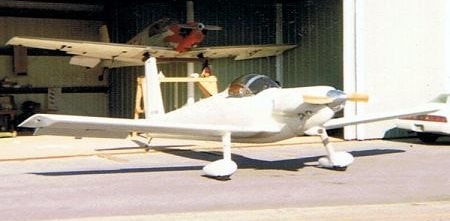
The LGT-2 Pamela was another original homebuilt aircraft designed and constructed by L.G. Tucker of Greeneville, Tennessee, USA.

Development and construction of the LGT-2 single-seat sporting monoplane started in 1972. It was conventional in configuration, constructed of wood and covered with Dacron. Power plant was a 125 hp Avco Lycoming O-290 flat-four engine, driving a Hegy two-blade wooden propeller. It had a 16 gal (60.5 l) fuel tank in fuselage, with a refueling point forward of canopy. Oil capacity was 2 gal (7.5 l).

Its non-retractable tail wheel type landing gear had cantilever spring steel main legs, McCreary 15×5 in (38.1×12.7 cm) main wheel tires (30 lb/sq.in, 2.11 kg/sq.cm), Rosenhan hydraulically actuated drum brakes, and streamline wheel fairings which were removable. A rearward sliding canopy enclosed the cockpit. The electrical system included a 12V battery and DC generator. Avionics comprised a Genave 200 radio and VOR; blind-flying instrumentation was fitted.

Registered N3988 the aircraft made the first flight in May 1981. Only one example was completed and this had a 125 hp Lycoming O-290 engine. The registration was cancelled in 1998.

Engine: 125 hp Lycoming O-290
Propeller diameter: 5 ft 10 in (1.78 m)
Span: 29 ft 0 in (8.08 m)
Wing aspect ratio: 9
Wing chord, at root: 4 ft 0 in (1.22 m)
Wing chord, at tip: 3 ft 0 in (0.91 m)
Length: 20 ft 0 in (6.10 m)
Height: 6 ft 0 in (1.83 m)
Tail plane span: 8 ft 0 in (2.44 m)
Wing area: 87 sq.ft (8.08 sq.m)
Wheel track: 7 ft 0 in (2.13 m)
Empty weight: 935 lb (424 kg)
Loaded weight: 250 lb (113 kg)
Max take off weight: 1,297 lb (588 kg)
Never-exceed speed: 200 mph (322 kmh)
Max level speed: 180 mph (290 kmh) at 2,000 ft (610 m)
Max cruise speed: 170 mph (274 kmh) at 10,000 ft (3,050 m)
Stall speed: 55 mph (89 kmh)
Climb: 1,600 ft (488 m)/min
Take off run: 400 ft (122 m)
Landing run: 1,000 ft (305 m)
Service ceiling: above 15,000 ft (4,570 m)
Range: 300 mls (483 km)
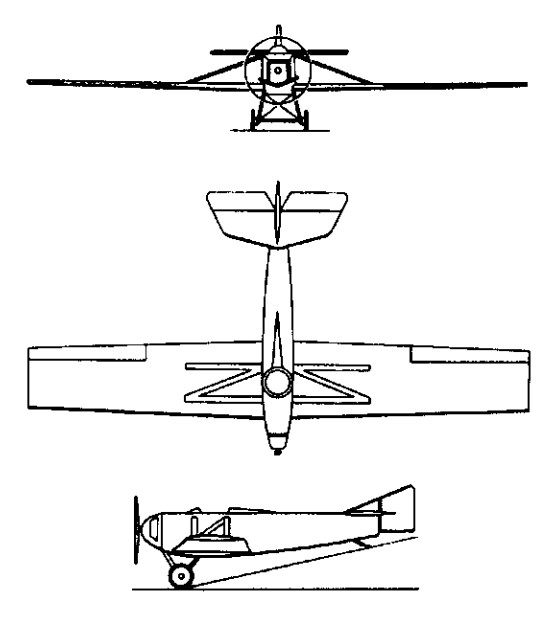
Tucker LGT-1 Le Petite Cygne / Little Swan

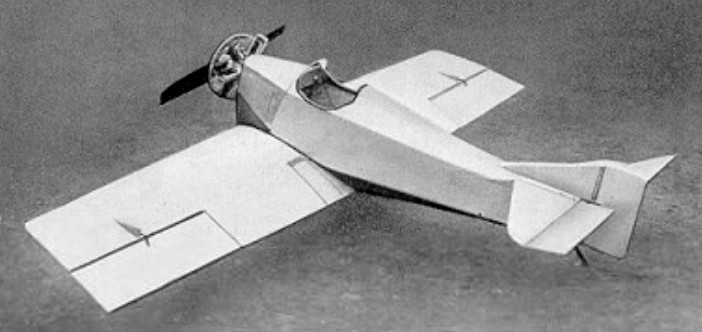
The one-of-a-kind LGT-1 Le Petite Cygne (Little Swan) N1295V was an original design homebuilt of L.G. Tucker of Greeneville, Tennessee, USA, with a mixed steel tube, wood and fabric construction. When first flown in April 1964 the aircraft had a 37 hp Aeronca E113-2 engine and an open cockpit. After a minor accident, the aircraft was rebuilt with a 40 hp Continental A40-4 and also received a cockpit canopy. Its registration was cancelled on June 25, 1983.

Le Petit Cygne
Engine: Aeronca E113-2, 36hp, later 40hp Continental
Wingspan: 28’0″
Empty weight: 505 lb
Max speed: 110 mph
Stall: 40 mph
Seats: 1

Tucker XP-57

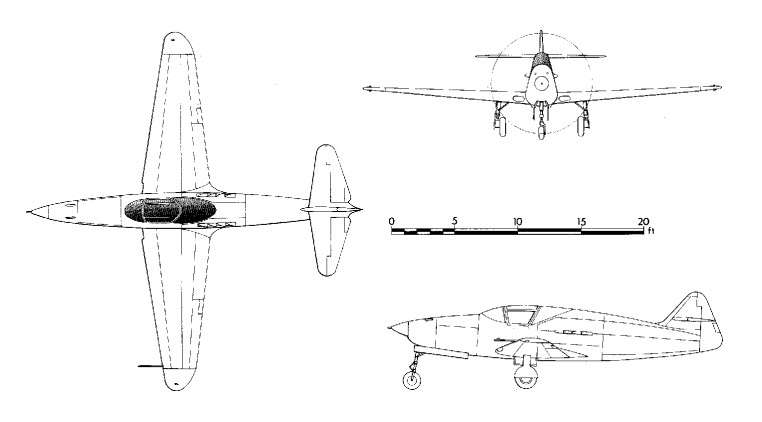
In 1940 the Tucker Aviation Co, of Detroit, proposed a fighter that was conventional, simple, and intended to yield thousands of cheap, easily maintained and tough pursuits in a matter of months. Powered by the 720 hp Miller L 510 V 8, driving a 2-blade propeller via a long shaft, it was to have, a metal skinned steel tube fuselage and wooden wings, with two or three guns in the nose, one firing through the propeller hub. Gross weight was estimated at 3,000 lb and speed 308 m.p.h. The company were unable to fulfil the Army contract.

Tube Works Phoenix

Phoenix
Empty wt: 239 lbs
Max wt: 489 lbs
Wing span: 32ft
Wing area: 160 sq.ft.
Wing loading: 3.06 lbs/sq.ft
Power loading: 17.46 lbs/hp
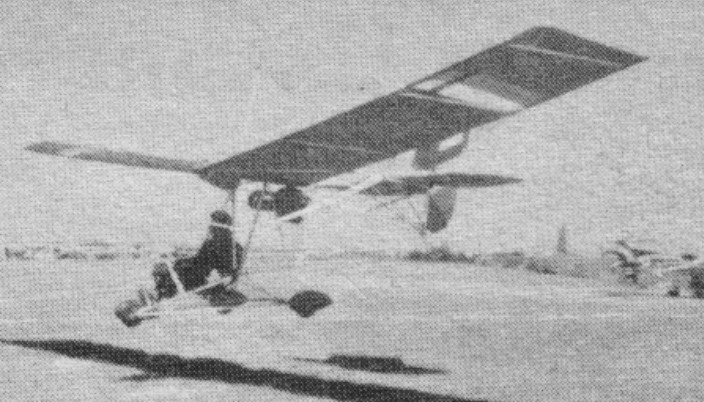
Engine: Rotax 277
Max speed: 52 mph
Cruise: 45 mph
Stall: 23 mph
Seats: 1

Phoenix II
Empty wt.: 312 lbs
Max wt.: 720 lbs
Wing span: 32ft
Wing area: 160 sq.ft
Wing loading: 4.5 lbs/sq.ft
Power loading: 14.4 lbs/hp
Engine: Rotax 503
Max speed: 52 mph
Cruise: 45 mph
Stall: 28 mph
Seats: 2

Phoenix Laser
Empty wt.: 252 lbs
Max wt.: 502 lbs
Wing span: 32ft
Wing area: 160 sq.ft.
Wing loading: 3.14 lbs/sq.ft
Power loading: 17.93 lbs/hp
Engine: Rotax 277
Max speed: 60 mph
Cruise: 45 mph
Stall: 23 mph
Seats: 1

Phoenix Laser II
Empty wt.: 330 lbs
Max wt.: 738 lbs
Wing span: 32 ft 8 in
Wing area: 180 sq.ft.
Wing loading: 4.1 lbs/sq.ft
Power loading: 14.76 lbs/hp
Engine: Rotax 503
Max speed: 60 mph
Cruise: 50 mph
Stall: 32 mph
Seats: 2