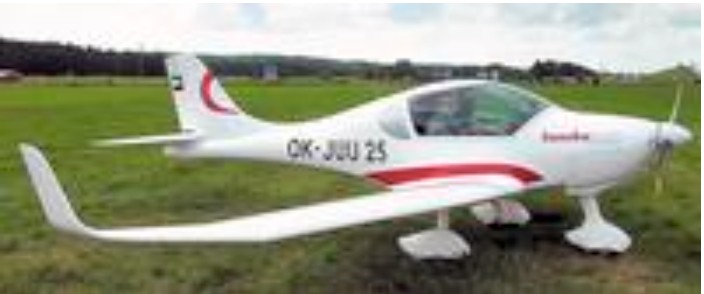
Urban Air UFM-10 Samba / Distar Air UFM-10 Samba

The Samba XXL is based on successful plane UFM-10 Samba. Excellent flight characteristics were preserved while the space for pilots was extended. That is why Samba XXL is ideal for travelling, training and towing sail planes.
SAMBA XXL – brief technical description:
The ultra-light plane Samba XXL is a double-seat, single-engine, self-carrying low-wing aeroplane with crew members sitting one next to each other. It is all-composite. The fuselage is made mainly of carbon laminate with local sandwich construction. The wing is of sandwich construction while the flanges are of carbon rowing.
The wing is equipped with a lifting flap with a slot. Positions of electrically adjustable flaps are 20° for take-off and 45° for land. The tail surfaces are of classic layout. The carriage is three-wheel with controlled front wheel and braked main wheels.
The main carriage legs consist of a laminate spring. Integrated fuel tanks (2 x 50 litres) are located in the wing leading edge.
The plane may be equipped with a towing device for sail planes towing with maximal climbing weight of 650 kg.
The Samba XXL may be equipped with removable wing extensions. 2009 Price: 50000 EURO
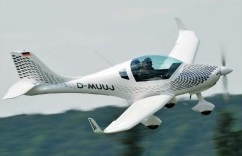
Samba XXL

Samba XXL
Stall: 35 kt / 40 mph / 65 kmh
Cruise: 119 kt / 137 mph / 220 kmh
VNE: 146 kt / 168 mph / 270 kmh
Empty Weight: 265 kg / 584 lbs
MTOW Weight: 472 kg / 1041 lbs
Climb Ratio: 1400 ft/min / 7,5 m/s
Glide Ratio: 1:18
Take-off distance (50ft obstacle): 490 ft / 150 m
Landing distance (50ft obstacle): 660 ft / 200 m
Unruh-Albright Special II

The Unruh-Albright Special II construction was begun in 1937 by Marion Unruh, but it was not until after he had retired from USAF in 1959 that it was finished, in 1966. Registered N8635E, the open cockpit biplane first flew on 27 June 1966.

Engine: 75hp Continental A-75
Wingspan (upper): 15’0″ (lower): 13’0″
Length: 15’5″
Useful load: 300 lb
Max speed: 150 mph
Cruise speed: 120 mph
Stall: 70 mph
Seats: 1

University of Toronto UTAIS Ornithopter No.1

The UTAIS Ornithopter No.1, which “flew” in 2006 was designed by the University of Toronto. The light No.1 used a small motor to power its flapping wings. Realizing that a motor wasn’t enough to flap it off the ground, the designers also fitted the airplane with a jet engine booster to launch it into the air. The University claimed that most of the thrust was coming from the wings.

When the No.1 did its first test flight, it jumped off the runway for 14 seconds after the jet booster activated, traveled awkwardly for a third of a kilometer, nosed down, and crashed. The University claimed the test was a success.

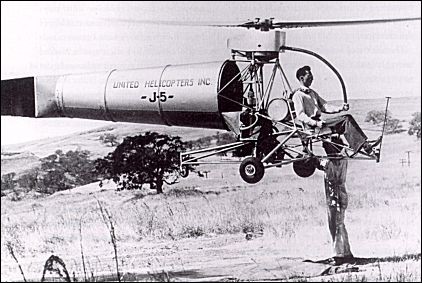
United Helicopters J-5

To counteract torque this two-bladed-rotor experimental helicopter used not a conventional tail rotor but a jet thrust system. The latter consisted of a fan blower placed just behind the engine with a ‘stove pipe’ tail forward. Air was thus forced under pressure through the hollow fuselage into a tail orifice where vanes directed the jet thrust laterally.
Main rotor torque was effectively overcome, but this torque compensation system’s power requirements proved markedly excessive at speeds greater than 64km/h. Single-seat experimental helicopter with open frame front mounting pilot and engine and metal cone tail with jet thrust duct. One built.