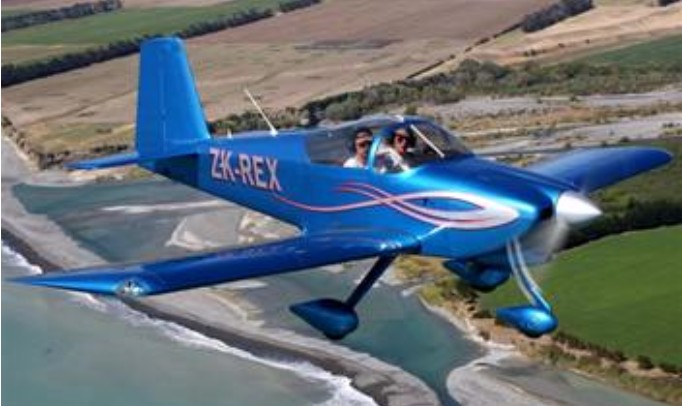
Vans RV-7

Van’s RV7A

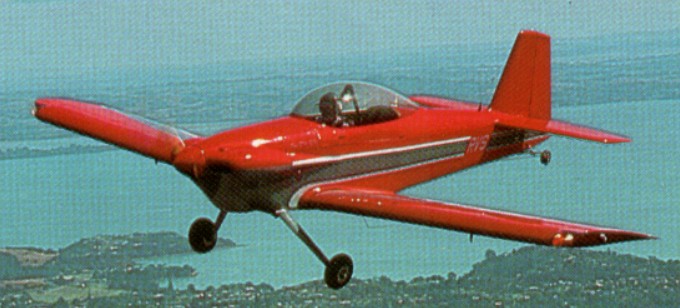
The RV-7 is the pre-punched fuselage of the RV-9 and the pre-punched wings and tail of the RV-8 married together. It comes in tail wheel or nosewheel, and sliding or tilt up canopy. The RV-7/7A replaced the RV-6/6A.
About 70% of our customers prefer side by side seating and the RV-7/7A has a roomy cockpit that will easily accept two 6’ + adults with sufficient leg, head and elbow room to stay comfortable for three to four hours at a time. The seating arrangement puts both occupants on an equal footing – standard dual controls and optional dual brakes give either occupant full control with equal visibility.
The RV-7/7A retains all the traditional RV virtues. It is an all-around sport airplane, with excellent cross-country capability, fine aerobatic qualities and superior handling. A typical RV-7 can hold two FAA standard pilots, 100 lbs. of baggage and full tanks: 42 gallons. At the aerobatic gross weight of 1600 lbs., the RV-7/7A complies with the +6/-3G standards of the FAA’s Aerobatic Category and can still carry two people, making it possible for a new pilot to get aerobatic instruction before he or she starts rolling and looping.
Both sliding and tip-up canopies are available. Both may be opened for taxi ventilation.
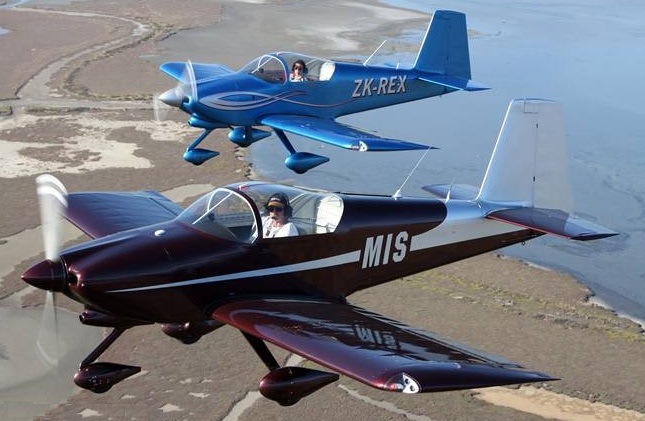
RV-7A

All RVs are capable of very short take-offs and landings and the RV-7/7A is no exception. Equipped with any Lycoming engine between 150 and 200 hp, and either a fixed-pitch or constant-speed propeller, it will leave the ground quickly and climb at impressive rates. The rugged fixed steel landing gear (tailwheel or tri-gear) makes it possible to operate from almost any airstrip, including grass or dirt.
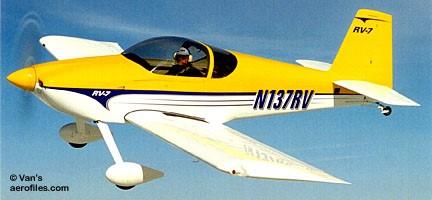
RV-7 N137RV

RV-7
Engine: 160 hp
Prop: Hartzell 2 Blade C/S
Span: 25 ft 0in.
Length: 20 ft 4 in.
Height: 5 ft 10 in
Wing Area: 121 sq ft
Empty Weight: 1061 – 1114 lbs
Gross Weight: 1800 lbs
Wing Loading: 14.8 lb/sq ft
Power Loading: 12.0 – 9.0 lb/hp
Engine: 150-200 hp
Propeller: Fixed or C/S
Fuel Capacity: 42 US gal
Baggage: 100 lbs
Top Speed: 201 mph
Cruise 75% @ 8000 ft: 191 mph
Cruise 55% @ 8000 ft: 172 mph
Stall Speed: 58 mph
Takeoff Distance: 650 ft
Landing Distance: 500 ft
Rate of Climb: 1,400 fpm
Ceiling: 18,500 ft
Range 75% @ 8000 ft: 835 sm
Range 55% @ 8000 ft: 1,025 sm

RV-7
Engine: 180 hp
Prop: Hartzell 2 Blade C/S
Span: 25 ft 0in.
Length: 20 ft 4 in.
Height: 5 ft 10 in
Wing Area: 121 sq ft
Empty Weight: 1061 – 1114 lbs
Gross Weight: 1800 lbs
Wing Loading: 14.8 lb/sq ft
Power Loading: 12.0 – 9.0 lb/hp
Engine: 150-200 hp
Propeller: Fixed or C/S
Fuel Capacity: 42 US gal
Baggage: 100 lbs
Top Speed: 209 mph
Cruise 75% @ 8000 ft: 199 mph
Cruise 55% @ 8000 ft: 179 mph
Stall Speed: 58 mph
Takeoff Distance: 575 ft
Landing Distance: 500 ft
Rate of Climb: 1,650 fpm
Ceiling: 20,500 ft
Range 75% @ 8000 ft: 775 sm
Range 55% @ 8000 ft: 950 sm

RV-7
Engine: 200 hp
Prop: Hartzell 2 Blade C/S
Span: 25 ft 0in.
Length: 20 ft 4 in.
Height: 5 ft 10 in
Wing Area: 121 sq ft
Empty Weight: 1061 – 1114 lbs
Gross Weight: 1800 lbs
Wing Loading: 14.8 lb/sq ft
Power Loading: 12.0 – 9.0 lb/hp
Engine: 150-200 hp
Propeller: Fixed or C/S
Fuel Capacity: 42 US gal
Baggage: 100 lbs
Top Speed: 216 mph
Cruise 75% @ 8000 ft: 206 mph
Cruise 55% @ 8000 ft: 186 mph
Stall Speed: 58 mph
Takeoff Distance: 500 ft
Landing Distance: 500 ft
Rate of Climb: 1,900 fpm
Ceiling: 22,500 ft
Range 75% @ 8000 ft: 765 sm
Range 55% @ 8000 ft: 935 sm

RV-7A
Engine: 160 hp
Prop: Hartzell 2 Blade C/S
Span: 25 ft 0 in
Length: 20 ft 4 in
Height: 7 ft 10 in
Wing Area: 121 sq ft
Empty Weight: 1077 – 1130 lbs
Gross Weight: 1800 lbs
Wing Loading: 14.8 lb/sq ft
Power Loading: 12.0 – 9.0 lb/hp
Engine: 150-200 hp
Propeller: Fixed or C/S
Fuel Capacity: 42 US gal
Baggage: 100 lbs
Top Speed: 199 mph
Cruise 75% @ 8000 ft: 189 mph
Cruise 55% @ 8000 ft: 170 mph
Stall Speed: 58 mph
Takeoff Distance: 650 ft
Landing Distance: 500 ft
Rate of Climb: 1,350 fpm
Ceiling: 17,500 ft
Range 75% @ 8000 ft: 825 sm
Range 55% @ 8000 ft: 1015 sm

RV-7A
Engine: 180 hp
Prop: Hartzell 2 Blade C/S
Span: 25 ft 0 in
Length: 20 ft 4 in
Height: 7 ft 10 in
Wing Area: 121 sq ft
Empty Weight: 1077 – 1130 lbs
Gross Weight: 1800 lbs
Wing Loading: 14.8 lb/sq ft
Power Loading: 12.0 – 9.0 lb/hp
Engine: 150-200 hp
Propeller: Fixed or C/S
Fuel Capacity: 42 US gal
Baggage: 100 lbs
Top Speed: 207 mph
Cruise 75% @ 8000 ft: 197 mph
Cruise 55% @ 8000 ft: 177 mph
Stall Speed: 58 mph
Takeoff Distance: 575 ft
Landing Distance: 500 ft
Rate of Climb: 1,600 fpm
Ceiling: 19,500 ft
Range 75% @ 8000 ft: 765 sm
Range 55% @ 8000 ft: 940 sm

RV-7A
Engine: 200 hp
Prop: Hartzell 2 Blade C/S
Span: 25 ft 0 in
Length: 20 ft 4 in
Height: 7 ft 10 in
Wing Area: 121 sq ft
Empty Weight: 1077 – 1130 lbs
Gross Weight: 1800 lbs
Wing Loading: 14.8 lb/sq ft
Power Loading: 12.0 – 9.0 lb/hp
Engine: 150-200 hp
Propeller: Fixed or C/S
Fuel Capacity: 42 US gal
Baggage: 100 lbs
Top Speed: 213 mph
Cruise 75% @ 8000 ft: 204 mph
Cruise 55% @ 8000 ft: 183 mph
Stall Speed: 58 mph
Takeoff Distance: 500 ft
Landing Distance: 500 ft
Rate of Climb: 1,850 fpm
Ceiling: 21,500 ft
Range 75% @ 8000 ft: 755 sm
Range 55% @ 8000 ft: 925 sm

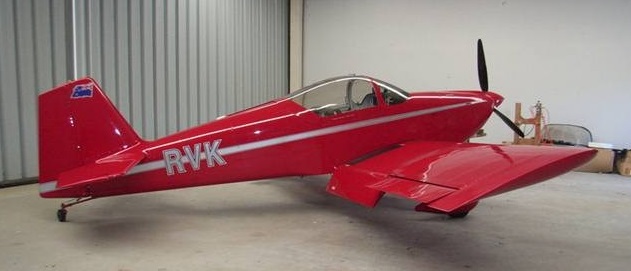
Vans RV-6 / Aeronautical Industrial Engineering and Project Management Company Ltd. / AIEP Air Beetle / T18

RV-6

Soon after the RV-4 proved that a two seat RV was practical, prospective customers began asking for a side-by-side RV.
When the demand became too big to ignore, Van went back to the drafting board. Using what he’d learned from the RV-3 and RV-4, he designed the RV-6.
He made it 43 inches wide and gave it a baggage compartment behind the seats. The wing on the RV-4 worked so well that there was no point in changing it, so he didn’t. The canopy was a forward opening bubble that closed almost seamlessly and the fuel capacity was increased.
The RV-6 made its first flight in 1985. When all the flight testing was done, it was only three miles per hour slower than the RV-4.
One limit to RV sales had always been the fact that they were all tailwheel airplanes. Installing a nose wheel solved the problem. The RV-6A featured a very simple tricycle gear, with steel rod main gear legs and a free castoring nosewheel. The nosegear leg was supported by the steel engine mount and required no complicated steering mechanisms or shock absorbers. The modification resulted in very little weight gain and almost negligible performance loss.
After the RV-6A was flying, Van’s designed a sliding canopy option on both the RV-6 and RV-6A.

Kits were priced at $11,810-12,565, and a quick-build kit at $19,320-19,995.

Eustace Bowhay, of Salmon Arm, BC, is a pilot with vast experience in both land and water aircraft. He carefully researched the matter and decided that the RV-6 had the potential to be an excellent floatplane. After consulting engineers, he designed a float installation and submitted it to the Canadian authorities for engineering approval. The Canadian Ministry of Transport determined that the RV-6 was strong enough, without modification, to handle the added stresses and loads imposed by flying off water. Cruise speeds, with the 180 hp Lycoming and constant speed prop, were 150 statue miles per hour. The water handling characteristics were excellent and the airplane was easy to land and taxi on land or water.
After flying the airplane on both wheels and straight floats for two years, Eustace and Jim decided they could have the best of both worlds, and installed amphibious floats. These worked just as well.
In 2005, Eustace, then over 80, decided that it was time to step out of the cockpit. C-GHAY was converted back to wheels and sold. Eustace died in 2006

Aeronautical Industrial Engineering And Project Management Company Ltd. / AIEP, in Nigeria was established 1979 to assemble kits of the Van’s RV-6A, known locally as Air Beetle and used by the Nigerian Air Force as the T18 trainer.

The RV 6s normal limit of plus or minus 6g, fully aerobatic in the sports category. The carburetted 160 hp Lycoming 0 320H2AD. Empty weight is 1010 lbs and the 1600 lb MAUW and full fuel of 144 litres.
Climb speed of 90 kts brings only about 2350 rpm, with around 1200 fpm indicated. This RV 6 will climb at 1600 fpm at MAUW at its best angle speed of 65 kts. Cruise at 75 percent power is slightly better than 150 kts, not much slower than full power.

Gallery

Variation:
Aviation Industries of Iran AVA-202

RV-6
Engine: Lycoming O-320, 150 hp
Span: 23 ft
Length: 20 ft 2 in
Height: 5 ft 3 in
Wing Area: 110 sq ft
Empty Weight: 965 lbs
Gross Weight: 1600 lbs
Wing Loading: 14.5 lb/sq ft
Power Loading: 10 lb/hp
Engine: 150-180 hp
Propeller: fixed or C/S
Fuel Capacity: 38 US gal
Baggage: 60 lbs
Top Speed: 197 mph
Cruise 75% @ 8000 ft: 186 mph
Cruise 55% @ 8000 ft: 168 mph
Stall Speed: 55 mph
Takeoff Distance: 550 ft
Landing Distance: 500 ft
Rate of Climb: 1,355 fpm
Ceiling: 15,800 ft
Range 75% @ 8000 ft: 775 sm
Range 55% @ 8000 ft: 950 sm

RV-6
Engine: Lycoming O-320, 160 hp
Span: 23 ft
Length: 20 ft 2 in
Height: 5 ft 3 in
Wing Area: 110 sq ft
Empty Weight: 965 lbs
Gross Weight: 1600 lbs
Wing Loading: 14.5 lb/sq ft
Power Loading: 10 lb/hp
Engine: 150-180 hp
Propeller: fixed or C/S
Fuel Capacity: 38 US gal
Baggage: 60 lbs
Top Speed: 201 mph
Cruise 75% @ 8000 ft: 190 mph
Cruise 55% @ 8000 ft: 171 mph
Stall Speed: 55 mph
Takeoff Distance: 535 ft
Landing Distance: 500 ft
Rate of Climb: 1,500 fpm
Ceiling: 17,400 ft
Range 75% @ 8000 ft: 775 sm
Range 55% @ 8000 ft: 950 sm

RV-6
Engine: 180 hp
Span: 23 ft
Length: 20 ft 2 in
Height: 5 ft 3 in
Wing Area: 110 sq ft
Empty Weight: 965 lbs
Gross Weight: 1600 lbs
Wing Loading: 14.5 lb/sq ft
Power Loading: 10 lb/hp
Engine: 150-180 hp
Propeller: fixed or C/S
Fuel Capacity: 38 US gal
Baggage: 60 lbs
Top Speed: 209 mph
Cruise 75% @ 8000 ft: 198 mph
Cruise 55% @ 8000 ft: 178 mph
Stall Speed: 55 mph
Takeoff Distance: 475 ft
Landing Distance: 500 ft
Rate of Climb: 1,790 fpm
Ceiling: 20,800 ft
Range 75% @ 8000 ft: 720 sm
Range 55% @ 8000 ft: 880 sm

RV-6A
Engine: 150 hp
Span: 23 ft
Length: 19 ft 9 in
Height: 6 ft 8 in
Wing Area: 110 sq ft
Empty Weight: 985 lbs
Gross Weight: 1650 lbs
Wing Loading: 15 lb/sq ft
Power Loading: 10.3 lb/hp
Engine: 150-180 hp
Propeller: fixed or C/S
Fuel Capacity: 38 US gal
Baggage: 60 lbs
Top Speed: 195 mph
Cruise 75% @ 8000 ft: 184 mph
Cruise 55% @ 8000 ft: 166 mph
Stall Speed: 55 mph
Takeoff Distance: 560 ft
Landing Distance: 500 ft
Rate of Climb: 1,305 fpm
Ceiling: 14,750 ft
Range 75% @ 8000 ft: 760 sm
Range 55% @ 8000 ft: 875 sm

RV-6A
Engine: 160 hp
Span: 23 ft
Length: 19 ft 9 in
Height: 6 ft 8 in
Wing Area: 110 sq ft
Empty Weight: 985 lbs
Gross Weight: 1650 lbs
Wing Loading: 15 lb/sq ft
Power Loading: 10.3 lb/hp
Engine: 150-180 hp
Propeller: fixed or C/S
Fuel Capacity: 38 US gal
Baggage: 60 lbs
Top Speed: 199 mph
Cruise 75% @ 8000 ft: 188 mph
Cruise 55% @ 8000 ft: 169 mph
Stall Speed: 55 mph
Takeoff Distance: 535 ft
Landing Distance: 500 ft
Rate of Climb: 1,450 fpm
Ceiling: 16,300 ft
Range 75% @ 8000 ft: 760 sm
Range 55% @ 8000 ft: 875 sm

RV-6A
Engine: 180 hp
Span: 23 ft
Length: 19 ft 9 in
Height: 6 ft 8 in
Wing Area: 110 sq ft
Empty Weight: 985 lbs
Gross Weight: 1650 lbs
Wing Loading: 15 lb/sq ft
Power Loading: 10.3 lb/hp
Engine: 150-180 hp
Propeller: fixed or C/S
Fuel Capacity: 38 US gal
Baggage: 60 lbs
Top Speed: 207 mph
Cruise 75% @ 8000 ft: 196 mph
Cruise 55% @ 8000 ft: 176 mph
Stall Speed: 55 mph
Takeoff Distance: 485 ft
Landing Distance: 500 ft
Rate of Climb: 1,740 fpm
Ceiling: 19,700 ft
Range 75% @ 8000 ft: 705 sm
Range 55% @ 8000 ft: 810 sm

Vans RV-5 Swinger

The RV-5 Swinger was a very small, metal single-seater cabin, high-wing monoplane, designed by Van and built by a group of friends from a local EAA chapter. First flown in May 1976, it flew quite successfully with a small two-stroke engine, only one was ever built. It is still in Van’s hangar and one of Van’s engineers recently surveyed it with an eye toward restoration…it may fly again.

Engine: VW, 32hp
Wingspan: 20’0″
Length: 16’5″
Useful load: 275 lb
Max speed: 95 mph
Cruise speed: 85 mph
Stall: 45 mph
Range: 300 mi
Seats: 1

Vans RV-4

Of the Van’s RV series, the RV-4 was by far the most popular. The two-seat RV-4 was developed from the company’s single-seat RV-3 and the philosophy behind the design of the RV-4 was to have a two-seat aircraft that handled as close as possible to the single-seat RV-3. When the RV-4 first flew in August, 1979, the result was a tandem seating arrangement, which allowed the frontal area to be kept to a minimum, and gave it a top speed of only about 8 knots less than the RV-3. Further, its handling characteristics are said to be “virtually identical” a result that surprised even the Oregon-based kit manufacturer.

The RV-4 is an aerobatic, two-place tandem, low wing monoplane of aluminum monocoque (stressed skin) construction. The propeller is a Cassidy Pacesetter 200 wood prop, which experience with the RV-3 has proven to have excellent overall performance. The engine used was a new Lycoming 0-320. Fuel is carried in two integral wing leading edge tanks. The standard canopy is a single-piece bubble which opens to the side.
It is flown from the front seat only, but the kit includes a stick for the rear-seater. It is designed for engines of 150-160 horsepower, although engines as small as 125 hp and as large as 180 work well and are commonly installed.

The RV-4 is capable of “sport” aerobatics. It was reported that around 600 were flying worldwide and the kit price was $10,905.

Engine: Lycoming 150 hp
Prop: fixed pitch wood
Span: 23 ft
Length: 20 ft 4 in
Height: 5 ft 5 in
Wing Area: 110 sq ft
Empty Weight: 905 – 913 lbs
Gross Weight: 1500 lbs
Wing Loading: 13.64 lb/sq ft
Power Loading: 10.0 – 8.33 lb/hp
Engine: 150-180 hp
Propeller: Fixed or C/S
Fuel Capacity: 32 US gal
Baggage: 50 lbs
Top Speed: 201 mph
Cruise 75% @ 8000 ft: 189 mph
Cruise 55% @ 8000 ft: 171 mph
Stall Speed: 48 mph
Top Speed: 200 mph
Cruise 75% @ 8000 ft: 188 mph
Cruise 55% @ 8000 ft: 170 mph
Stall Speed: 54 mph
Takeoff Distance: 475 ft
Landing Distance: 425 ft
Rate of Climb: 1,500 fpm
Ceiling: 18,000 ft
Range 75% @ 8000 ft: 640 sm
Range 55% @ 8000 ft: 790 sm

Engine: Lycoming 160 hp
Prop: fixed pitch wood
Span: 23 ft
Length: 20 ft 4 in
Height: 5 ft 5 in
Wing Area: 110 sq ft
Empty Weight: 905 – 913 lbs
Gross Weight: 1500 lbs
Wing Loading: 13.64 lb/sq ft
Power Loading: 10.0 – 8.33 lb/hp
Engine: 150-180 hp
Propeller: Fixed or C/S
Fuel Capacity: 32 US gal
Baggage: 50 lbs
Top Speed: 205 mph
Cruise 75% @ 8000 ft: 193 mph
Cruise 55% @ 8000 ft: 174 mph
Stall Speed: 48 mph
Top Speed: 204 mph
Cruise 75% @ 8000 ft: 192 mph
Cruise 55% @ 8000 ft: 173 mph
Stall Speed: 54 mph
Takeoff Distance: 450 ft
Landing Distance: 425 ft
Rate of Climb: 1,650 fpm
Ceiling: 19,500 ft
Range 75% @ 8000 ft: 640 sm
Range 55% @ 8000 ft: 790 sm

Engine: Lycoming 180 hp
Prop: fixed pitch wood
Span: 23 ft
Length: 20 ft 4 in
Height: 5 ft 5 in
Wing Area: 110 sq ft
Empty Weight: 905 – 913 lbs
Gross Weight: 1500 lbs
Wing Loading: 13.64 lb/sq ft
Power Loading: 10.0 – 8.33 lb/hp
Engine: 150-180 hp
Propeller: Fixed or C/S
Fuel Capacity: 32 US gal
Baggage: 50 lbs
Top Speed: 213 mph
Cruise 75% @ 8000 ft: 201 mph
Cruise 55% @ 8000 ft: 182 mph
Stall Speed: 48 mph
Top Speed: 212 mph
Cruise 75% @ 8000 ft: 200 mph
Cruise 55% @ 8000 ft: 180 mph
Stall Speed: 54 mph
Takeoff Distance: 400 ft
Landing Distance: 425 ft
Rate of Climb: 1,950 fpm
Ceiling: 23,000 ft
Range 75% @ 8000 ft: 590 sm
Range 55% @ 8000 ft: 725 sm

Vans RV-3

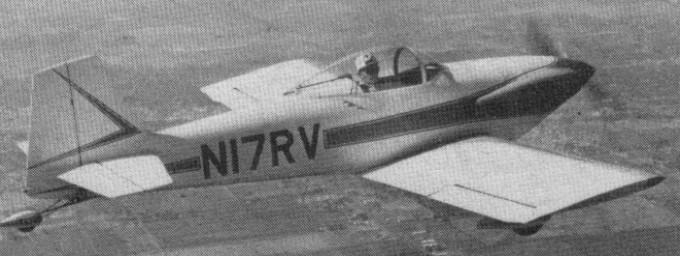
The Stits SA-3A Playboy served as a catalyst for Richard VanGrunsven, who, after modifying and improving the Playboy in 1965 (and calling it an RV-1), was further inspired to build an airplane of his own design — the RV-3.

Vans RV-3 Article

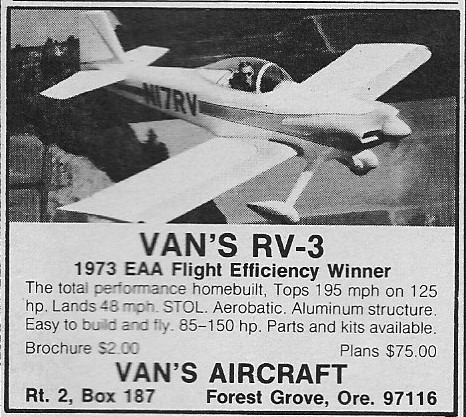
Richard VanGrunsven’s all-metal, single seat monoplane won the “Best Aerodynamic Detailing” award at the 1972 EAA Fly-in. The wings are built around a single I-beam spar and a lighter rear spar. The fuselage and tail unit are built of light alloy, and the engine is covered with a fiberglass cowling. The landing gear is the nonretractable tailwheel type with Cleveland brakes and fiberglass wheel fairings.

Feb 74

New sales of the RV-3 were suspended in 1996. However, in response to popular demand, the RV-3B with a new wing spar design is now back on the market. The empennage, fuselage, and finishing kits are essentially unchanged, however, the wing kits are new, and are available in two types: new and retro-fit. Builders also will have a choice between standard and QuickBuild wings, regardless if for a new project or retrofitting to an existing plane.

The difference between new and retro-fit spars is that some holes are left un-drilled in the retro-fit version so they may be matched to holes in the existing structure. Retro-fitting will mean removing the current fuselage center section and replacing it with the new one. While this may sound like major surgery, it is actually easier than trying to drill a spar accurately to a center section in an existing airplane.
The new RV-3B spars use four-piece construction, are gold anodized, and come completely assembled. New RV-3B wings have standard 15 gallon per side wing tanks, attached to the spar with screws and bolts so they may be removed for repair without taking a wing off the fuselage. Standard kit wing skins are not pre-punched. Bellcranks and tiedowns are now simple units that bolt on to holes already in the spar.
The RV-3B QuickBuild wings are similar in form to the RV-8/8A QuickBuild wings. They arrive with flaps and ailerons complete, tanks sealed and tested, leaving the builder only to add aileron brackets, flap braces, wing tips, and one outboard skin to complete the wing.
NOTICE: In order to operate RV-3/3A aircraft with pre-RV-3B wing designs in the aerobatic category, the owner must either complete appropriate spar Change Notices (materials provided at no charge) or purchase new wing kits. Until implementation of the appropriate spar Change Notice, kit/aircraft owners should comply with Van’s Aircraft’s previously published March 1996 flight recommendations:
“RECOMMENDATION: Until the spar modification is performed, we recommend that the RV-3 pilots immediately limit their flight G loads to a maximum 4.4 G’s; utility category. Based on our test results of an ultimate load of 7.3 G’s, a 50% over-strength margin would permit a flight limit load of 4.9 G’s at a gross weight of 1050 lbs. Since the 4.9 G’s is below the 6 G specification for the aerobatic category, no aerobatic maneuvers should be performed. Dropping back farther to utility category flight will offer an additional margin of safety.”
A logbook entry should be made prohibiting aerobatics until one of the Change Notice spar modifications is accomplished

More than 3,300 RVs were reportedly completed and flying by mid-2003.

Engine: Lycoming 125 hp
Prop: fixed pitch wood
Span: 19 ft 11 in
Length: 19 ft
Height: 5 ft
Wing Area: 90 sq ft
Empty Weight wo electrics: 703 lbs
Empty Weight with electrics: 750 lbs
Gross Weight: 1100 lbs
Wing Loading: 12.22 lbs/sq ft
Power Loading: 11.0 – 6.9 lb/hp
Fuel Capacity: 30 US gal
Baggage: 30 lbs
Top Speed: 195 mph
Cruise 75% @ 8000′: 185 mph
Cruise 55% @ 8000′: 166 mph
Stall Speed: 51 mph
Takeoff Distance: 350 ft
Landing Distance: 350 ft
Rate of Climb: 1,700 fpm
Ceiling: 20,500 ft
Range 75% @ 8000′: 640 sm
Range 55% @ 8000′: 770 sm
Speed Ratio: 3.82:1

Engine: Lycoming 150 hp
Prop: fixed pitch wood
Span: 19 ft 11 in
Length: 19 ft
Height: 5 ft
Wing Area: 90 sq ft
Empty Weight wo electrics: 703 lbs
Empty Weight with electrics: 750 lbs
Gross Weight: 1100 lbs
Wing Loading: 12.22 lbs/sq ft
Power Loading: 11.0 – 6.9 lb/hp
Top Speed: 207 mph
Cruise 75% @ 8000′: 196 mph
Cruise 55% @ 8000′: 176 mph
Stall Speed: 51 mph
Takeoff Distance: 300 ft
Landing Distance: 350 ft
Rate of Climb: 2,050 fpm
Ceiling: 23,500 ft
Range 75% @ 8000′: 595 sm
Range 55% @ 8000′: 715 sm
Speed Ratio: 4.06:1

Vans RV-1

One Stits SA-3A Playboy builders eventually sold his project to a young aviator who rebuilt the wing, getting rid of the struts and converting it from a fabric covered wooden frame to an aluminum wing in 1965 (and calling it an RV-1). The rebuilder was Dick VanGrunsven and his first airplane has been rebuilt and will be donated to the EAA museum this summer.

VanGrunsven was further inspired to build an airplane of his own design — the RV-3.

Van Pomer 1910 Biplane

In 1910 John Van Pomer built a single-seat copy of Curtiss A, one of the undocumented first attempts by early home-builders. Based on the then-popular Wright design, power was a 35hp Kemp engine.

A colleague, who as a teenager helped with the construction, said that he once had ridden on the wing in one of its short flights, which were always downhill and never involved turns.

The aircraft was located in a barn and recently restored to display condition at Empire State Aerospace Museum, Schenectady County airport NY.

Van Lith VI

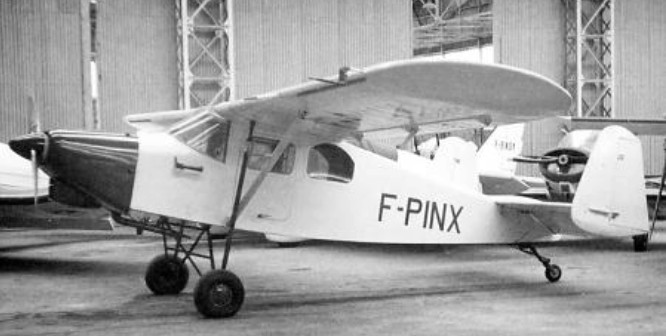
A one-off French-built light civil utility aircraft of the late 1950s, the Van Lith VI was a two/three seat light high-wing cabin monoplane of conventional wooden construction. The wing was a two-spar structure with plywood and fabric covering. The fuselage was of rectangular section with plywood cladding. The main undercarriage with fixed legs, wheels, brakes and tailwheel were adapted from those of the Stampe SV.4. The pilot and passengers were seated in tandem with an access door on each side hinging upward for entry and exit. The slotted ailerons could be drooped together to function as flaps. Designed and built by Jean Van Lith it was initially flown with a single fin, but this was replaced with twin fins.

One example of the design was completed. In original form the Model VI had the main wheels and wing struts of a Stampe (Nord) SV-4 biplane, one 125 hp Lycoming O-290-3 engine and a small third central fin. In this configuration the aircraft flew on 30 August 1958, registered as F-WINX. It completed it test flight program at Toussusle-Nobel on October 6, 1959, and was subsequently reregistered F-PINX.

The aircraft was later re-engined with one 150 hp Lycoming O-320, and also received with a steel sprung cantilever undercarriage, while the central fin was removed. The aircraft remained active well into the 1980s and later went to the RSA Museum, but was destroyed in an accident. This one-of-a-kind aircraft was also nicknamed the Bébé Broussard, because of the external resemblance to the Holste Broussard.

It was flown by the constructor from airfields at Toussus-le-Noble and Guyancourt near Paris. It was still registered to Jean Van Lith in 1964, but is no longer extant.

Engine: 1 × Lycoming O-290-3, 135 hp (101 kW)
Capacity: 1 or 2 passengers
Length: 20 ft 0 in (6.10 m)
Wingspan: 35 ft 5 in (10.80 m)
Height: 6 ft 6 in (1.98 m)
Wing area: 140 sq ft (13 sq.m)
Empty weight: 1,285 lb (583 kg)
Gross weight: 2,127 lb (965 kg)
Maximum speed: 124 mph (200 km/h; 108 kn)
Cruise speed: 106 mph (92 kn; 171 km/h)
Service ceiling: 13,780 ft (4,200 m)
Rate of climb: 785 ft/min (3.99 m/s)
Endurance: 6 hr
Crew: 1

Vaniman Triplane

Melvin Vaniman built his own aeroplane in 1906… a triplane, in fact… the first ever triplane. Made of three arched planes, supported by a frame of steel tubes, each measuring 11 meters (36-feet) in length and 2 meters 20 cm (7.2-feet) in breadth. Total surface area: 72 (square) meters (775-square-feet). 70/80 HP Antoinette engine with 8 cylinders driving a propeller with two arms placed to the rear. The length is six meters (19.7 feet). In front, two elevators (or rudders): one horizontal and placed in the lower part, serves to control the altitude; the second, vertical, placed about 2/3 of the height of the machine, controls the direction and the turning, whether one tilts to the right or the left. The function of warping the wings is made by means of an arrangement placed on the shoulders of the aviator, and the direction to the right or the left by means of two pedals. Total weight: 500 kilograms (1,102.3-pounds).

There seems to be some discrepancy over whether or not his triplane actually flew. In 1907 Vaniman appears to have given up on aeroplanes saying: “I once had great faith in aeroplanes… I am firmly set in my belief that the aeroplane will never be a cargo carrier.”

Vaniman did not participate in the 1909 Reims air show… because he was already heavily at work on his dirigible, and therefore, there is no way anyone anywhere saw him fly at Reims some 150 meters (492 feet).

The 1911-series of 75 Aviation cards from Wills’s shows the Vaniman triplane in flight… and despite the date, it actually shows the earlier machine… perhaps more for what they hoped it actually represented… a triplane…

The two machines are basically the same: a triplane, with twin-boom outriggers, a high rectangular vertical surface, a single pusher propeller. But the two Vaniman triplanes are otherwise quite different.

1907 Vaniman
1908 Vaniman

Span: 36’1″
Length: 19’8″
Weight: 1100 lb