Paramotor circa 1998.
Engine: Solo, 12 hp
Prop diameter: 68 cm
Fuel capacity: 3 lt
Empty weight: 18 kg
Price (1998) Fr 20,000
Paramotor circa 1998.
Engine: Solo, 12 hp
Prop diameter: 68 cm
Fuel capacity: 3 lt
Empty weight: 18 kg
Price (1998) Fr 20,000
Paramotor circa 1998.
Engine: Solo, 14 hp
Reduction ratio: 2.5-1
Prop diameter: 95 cm
Fuel capacity: 5/10 lt
Empty weight: 22 kg
Price (1998) Fr 25,000
1998: Le Castelas, F-07460 St Andre de Cruzieres, France
A biplane built by Abric and Calas in 1909, in France.
Span: 36’1″ Weight: 1190 lbs gross
Designed by Joaquin S Abreu, the one AE-5 built, N592, had a steel tube fuselage and wood-framed parasol wing. It was a high wing 2 place monoplane. The engine and belly fuel pod was a detachable unit that could be released from the cockpit in case of fire or a dire emergency, and the ship would become a glider. In its first test in 1929, this was demonstrated at Alameda CA. From 5,500′ the motor and tank unit was jettisoned, falling into sand dunes by the bay, and the ship glided for about 15 minutes before heading for the runway. There a group of people running toward the oncoming ship forced pilot Reed Vowles to swerve the plane and nose it into soft ground, sustaining minor damage.
Engine: LeRhône rotary, 90hp
Wingspan: 38’0″
Length: 29’0″
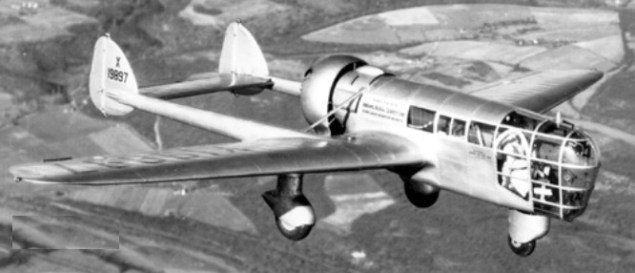
Explorer – a twin-boom pusher monoplane of 1936, to the design of Talbert Abrams. Incorporated a fully-glazed nose.
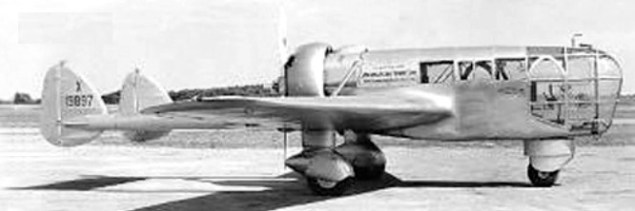
Designed by Talbert Abrams and Kenneth Ronan, a prototype, X19897, was constructed by Ronan & Kunzl of Marshall MI. Created as a photo-survey plane with a service ceiling of 21,000′, first flown in November 1937, it was repowered with 450hp supercharged Wright in 1938. Only the one was ever built.
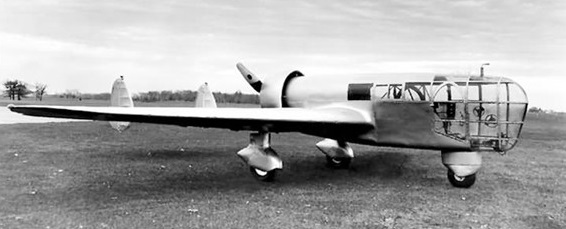
The Explorer is stored with the Smithsonian National Air and Space Museum, awaiting restoration.
Engine: Wright R-975, 330hp
Wingspan: 36’0″
Length: 26’6″
Useful load: 1410 lb
Max speed: 185 mph
Cruise: 165 mph
Stall: 66 mph
Range: 1400 mi
Engine: Wright, 450hp
Wingspan: 36’0″
Length: 26’6″
Max speed: 200 mph
Cruise: 185 mph
Stall: 66 mph
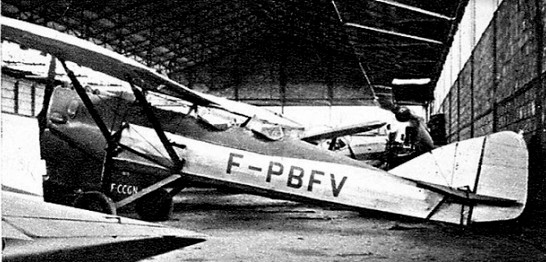
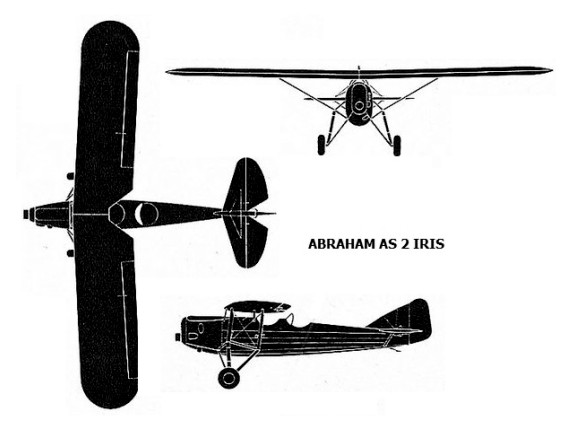
In 1930 Edmond Abraham built the Iris I, a 2 seat parasol monoplane. This was modified as the Iris II with a Renault, 95hp engine.
French regulations evolved and the craft ended at Avignon Chateaublanc.
In 1930 Edmond Abraham built the Iris I, a 2 seat parasol monoplane. This was modified as the Iris II with a Renault, 95hp engine.
French regulations evolved and the craft ended at Avignon Chateaublanc.
Iris II
Engine: Renault 4Pb, 95 hp
Prop: 2 blade wooden
Wingspan: 9.8m / 37 ft 2 in
Length; 6.97m / 22 ft 6 in
Height: 2.5m / 7 ft 7 in
Wing area: 15 sq.m / 161 sq.ft
Empty weight: 467 kg / 1027 lb
MAUW: 760 kg / 1672 lb
Max speed: 180 kph / 113 mph
Range: 400 km / 250 miles

Constructed during 1909–1910 at Kassel-Waldau by Carl Abelmann; the son of a Cologne factory owner. The monoplane had both tractor and pusher propellers with extra lift propellers (Hubschrauben). Carl Abelmann, FlAbt 254(A), along with his observer Ltn Heirich Schönberg, were the victims of Georges Guynemer on April 14, 1917 – his 36th victory.


Made by, Keiiche Abe, a teacher in Hokkaido, Japan, in 1977, the Mini-gyro-sail-motorplane has Bensen parts, Abe airfoils and a Toyota engine. It cruises at 48 mph, takes off in 510 feet, and lands in 160 feet. It cost around $1000.

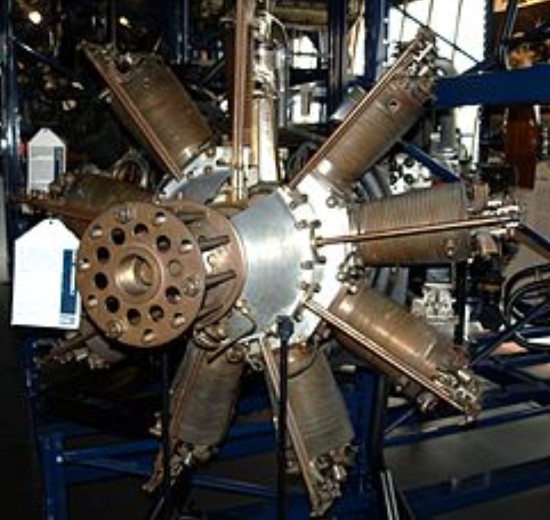
In 1917, after initial promising tests of the ABC Wasp air-cooled radial, Bradshaw produced a design for a larger and more powerful engine, the nine-cylinder Dragonfly. The engine was simple and easy to produce, and was predicted to give 340 hp (254 kW) for a weight of 600 lb (273 kg). One distinctive feature was the use of copper-plated cooling fins, which were claimed by Bradshaw to be so effective that water would not boil on the surface of the radiators.
On the basis of the promised performance, Sir William Weir, the Director of Aeronautical Supplies, made the decision to place large orders for the Dragonfly, with 11,500 engines having been ordered from 13 suppliers by June 1918. It was planned that a large proportion of RAF aircraft would be powered by the Dragonfly in 1919. Types designed to be powered by the Dragonfly included the Sopwith Dragon (a derivative of the existing Snipe), the Nieuport Nighthawk, and the Siddeley Siskin. Of this order 1,147 engines were built but only nine or ten actually flew.
Testing showed severe problems with the much vaunted engine. It was subject to extreme overheating, the copper-plated cooling fins proving useless; showed much poorer fuel consumption than expected; and suffered severe vibration, running at the resonance frequency of the crankshaft. These problems proved unsolvable, and the Dragonfly was eventually abandoned.
Variants:
Dragonfly I
1918, 320 hp (239 kW)
Dragonfly IA
360 hp (268 kW), revised pistons and cylinder heads, revised oil system.
Specifications
Dragonfly IA
Type: 9-cylinder air-cooled radial engine
Bore: 5½ in (139.7 mm)
Stroke: 6½ in, (165.1 mm)
Displacement: 1,389.86 in³ (22.78 L)
Dry weight: 600 lb (273 kg)
Valvetrain: 3 overhead valves, 2 inlet and 1 outlet per cylinder
Fuel system: Twin carburettors
Oil system: 2 oil pumps
Cooling system: Air-cooled
Power output: 340 hp (254 kW) at 1,650 rpm
Specific power: 0.24 hp/in³ (11 kW/L)
Specific fuel consumption: 0.56 pints per bhp/hour(0.32 L/kW)
Oil consumption: 7 pints per hour (3.97 L/hr)
Power-to-weight ratio: 0.56 hp/lb (0.93 kW/kg)

