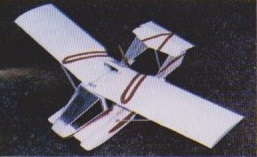
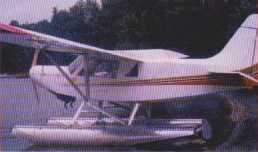
Created by Claude Guilbault, the Delta is an amphibious pusher with retractable undercarriage. The cabin is carbonfibre, and the floats and tail are aluminium. Wings are fabric covered aluminium. The Delte was in the experimental stage in 1998.
Engine: Arrow 1000, 100 hp Wing span: 9.75 m Wing area: 16 sq.m MAUW: 610 kg Empty weight: 390 kg Fuel capacity: 136 lt Max speed: 195 kph Cruise speed: 180 kph Climb rate: 3 m/s Seats: 2 Plan price (1998): Can$200 Kit price (1998): Can$18,000
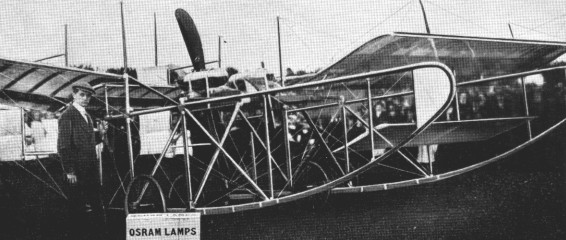
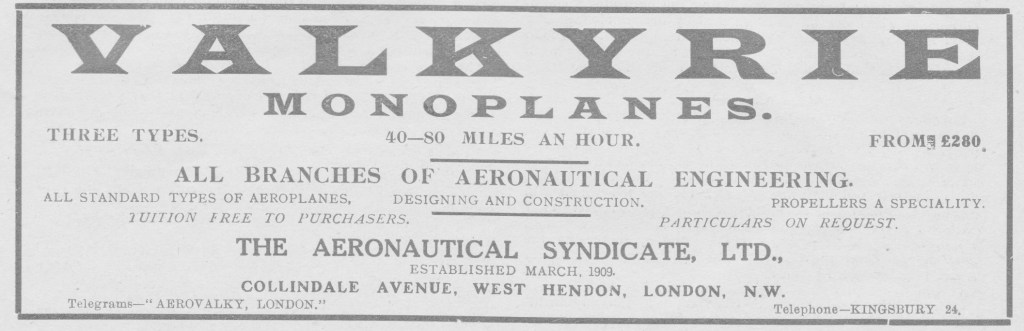
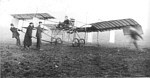
The Aeronautical Syndicate Ltd constructed Horatio Barber’s Valkyrie, tail first, monoplane circa 1911. Horatio Barber’s Aeronautical Syndicate Limited’s Valkyrie B became the first aircraft to transport aerial cargo in Britain on 4 July 1911, when it flew a box of lightbulbs from Shoreham to Hove in Sussex. Several Valkyrie canard pushers were built. Not easy to fly, but used successfully for training.
Designed by Horatio Barber and powered by a Green 35 hp engine, the type A was the second of the successful Valkyrie type machines.
Type A
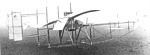
The 1911 ASL Valkyrie monoplane Type B – two-seater was designed and built by Aeronautical Syndicate Ltd.
1911 ASL Valkyrie monoplane Type B – two-seater
1913 Valkyrie Type C – pilot and 2 passengers
Type A Engine: Green 35 hp Propellor: Mahogany Span: 34 ft 0 in / 10.36 m Length: 22 ft 0 in / 6.71 m Height: 8 ft 6 in / 2.59 m Wing area: 190 sq.ft / 17.65 sq.m Loaded weight without pilot: 520 lb / 230 kg Speed: 45 mph / 72 kph Seats: 1 Airframe: Honduras mahogany and ash Fabric: un-proofed Egyptian cotton
Type B Span: 31′ Length: 26′ Weight: 550 lb Speed: 70 mph Price: £920
Type C Span: 39′ Length: 29’9″ Weight: 800 lb Speed: 70 mph Seats: 3
The NX1272 Model 3 of 1944 fuselage was of fabric-covered welded steel tubing, and resembled that of a light aircraft with the engine located in the forward section and placed horizontally forward of the cabin. Power from the engine, cooled by a fan mounted directly above it, was transmitted by pulleys and vee belts to a horizontal main drive shaft, then through a bevel gear drive to the main rotor shaft which passed between the pilot’s and the passenger’s seats. Mounted on the vertical rotor drive shaft was the main gearbox for the tail shaft operating the two-bladed anti-torque rotor, with a diameter of 1.71 metres, the pitch of which was controlled by rudder pedals. This rotor’s maximum rotational speed was 1200 r.p.m. The three blades of the main rotor were made with tapered tubular spars and also connected to the root spars by a double-action hydraulic shock absorber. Cyclic pitch control was obtained by a hanging stick while on the engine throttle support was the collective pitch control. The A-3 was tested in 1945.
A-3 Engine: 1 x Franklin 6AC-298, 165hp Number of Seats: 2 Rotor Diameter: 9.14m Weight Fully Loaded: 544kg Tail rotor diameter: 1.71 m Tail rotor speed: 1200 rpm
Two undergraduate engineers of the University of Michigan, Corwin Denny and Karl Schakel, with the Aeronautical Products Corporation of Detroit, Michigan, have designed and built a helicopter. Both of the designers left the corporation, but work progressed on the helicopter they initiated. First flown April 1944, during preparations for a trial flight, was damaged, and was rebuilt. The Denny and Schakel helicopter is a single, main-rotor machine with an auxiliary tail rotor for torque correction. The main rotor is 9m in diameter and is powered by a ninety-horsepower engine. The gross weight is reported to be approximately 540kg. It has a fixed tricycle landing gear. Built of welded-steel tubular construction, this helicopter is a single-seater with enclosed cabin. The pilot sits behind the engine, which is mounted in the nose. A long shaft extends under the pilot’s seat and is geared to the vertical shaft of the rotor. It was not put into production.
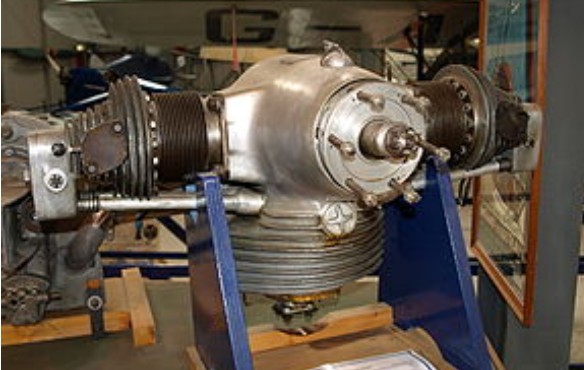
The E-113 was a small flat-twin, air cooled, piston engine developed by Aeronca for use in some of their light aircraft. First run in 1936, it was a development of the E-107.
Originally fitted with a single ignition system, this was uprated to dual ignition when changes in FAA regulations made this mandatory in 1939. By that time, however, both the engine and the aircraft that it powered were facing obsolescence. Altogether, some 1,800 examples were built by Aeronca and JA Prestwich (under licence as the JAP J-99).
Variants
E-113A Standard production model delivering 36-45 hp (26.85 – 33.56 kW) ATC 71
Aeronca-JAP J-99 The E-113-C was license built in England as the Aeronca-JAP J-99 by J A Prestwich Limited (JAP) and powered several British aircraft types, differing from the E-113 by being fitted with dual ignition.
O-113 Engines fitted to impressed aircraft were given the designation O-113.
Applications E-113:
Aeronca C-3 Aeronca K Welch OW-6M
J-99:
Aeronca 100 Aeronca 300 Britten-Norman BN-1 Currie Wot Dart Kitten Hants & Sussex Herald Heath Parasol Hillson Praga Luton Minor Peterborough Ely Slingsby Motor Tutor Taylor J.T.1 Tipsy Junior
Specifications E-113 Type: 2-cylinder air-cooled horizontally opposed aircraft piston engine Bore: 4.25 in (107.95 mm) Stroke: 4 in (101.6 mm) Displacement: 113.49 in³ (1.86 L) Dry weight: 118 lb (54 kg) Power output: 36-40 hp (26.9-29.8 kW) at 2,400-2520 rpm Compression ratio: 5.1:1
The Aeronca E-107 was one of the first low-cost reliable engines of the post-World War I era. A flat-twin aircraft engine designed by Ray Poole and Robert Galloway, the E-107 first ran in 1929.
The E-107A was a production engine designed to replace a Morehouse engine on the first prototype of the Aeronca C-2. The first five were produced without cooling fins on the crankcase. A Winfleld Model 5 carburetor was standard for the engine. The E-107 was replaced by the uprated E-113 engine based on the same design.
The major application for the E-107 was powering the Aeronca C-2. Number built: 115
Variants
E-107 Standard production engine
E-107A The E-107A was produced for Aeronca by the Govro-Nelson Company of Detroit, Michigan.
O-107 Designation given to engines fitted to impressed aircraft
Top of the Aeronca line was the 4-seat 15AC Sedan, (built 1948-1951) a high-wing monoplane powered by a 145 hp Continental. The last civilian airplane to be produced by the Aeronca Manufacturing Corp., the 15AC Sedan (ATC 802), was also Aeronca’s first four-seater airplane. A prototype (NX/NC39800) appeared in 1947, and production began in 1948. The Sedan soon became a familiar sight at civilian fields. It featured an all-metal construction with a metal-skinned single-spar wing and fabric-covered, welded, steel-tube fuselage. Optional Franklin 165 hp engines were fitted into a few 15AC Sedans. Another option put the Aeronca on floats, and that version was called the S15AC.
Aeronca 15AC Sedan
The final production test flight took place on 23 October 1951, piloted by Earl Balon, after 561 had been built.