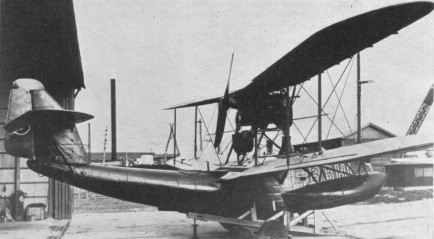
The Aichi Tokei AB4 was an all-metal, 7 seat, civil flying boat.
Engine: Tokyo-Gas-Denki, 300 hp
Seats: 7
The Aichi Tokei AB4 was an all-metal, 7 seat, civil flying boat.
Engine: Tokyo-Gas-Denki, 300 hp
Seats: 7
The Aichi AC-1 was an experimental 330 hp nine-cylinder air-cooled radial engine. First run in 1929, it was used to power the newly designed Aichi AB-2, a catapult-launched reconnaissance seaplane.
The AB-2 with its AC-1 engine is noted for being the first shipboard reconnaissance seaplane and engine combination designed and manufactured entirely in Japan, without foreign assistance. This was a major turning point, not only for Aichi, but for all of the other Japanese aircraft and engine manufacturers, as they no longer need rely on foreign designs.
The engine proved to be a disappointment by not performing as expected. On one test flight, an exhaust fire spread to the airframe and the aircraft was lost, and, soon after, the project ended.

The Agusta P.111 designed by Ing. Ermenegildo Preti was built in 1951 by by Construzioni Aeronautiche Giovanni Agusta, was derived from the CVV P.110 and intended as a three-seat basic trainer and communications monoplane.
Differing from the P.110 primarily in having a fixed, tailwheel undercarriage, and a 185 hp Lycoming O-435-1 engine, the P.111 did not receive production orders, and only a sole prototype flew.
Engine: 185 hp Lycoming O-435-1
Wingspan: 34 ft 9 in
Length: 24 ft 3.25 in
Height: 9 ft
Loaded weight: 2425 lb
Max speed: 136 mph
Cruise: 118 mph
Range: 404 mi
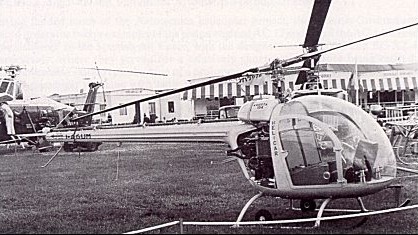
The all-metal two-seat A.104 developed from the A.103 was produced by the Cascina Costa works. With a single stabilised rotor, skid udercarriage and powered by one 140hp Agusta MV-A120 piston engine, the first of two prototype, I-AGUM, first flew in December 1960.
One A.104BT was built; an A.104 with a 270shp Agusta A.270 turboshaft engine.
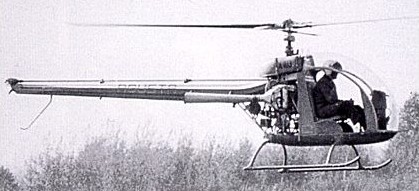
The single-seat A.103 and two-seat A.104 were produced by the Cascina Costa works with a 120hp Agusta 1MV-GA70 piston powerplant. A light single-seat single rotor ‘pod & boom’ helicopter, one prototype first flew in October 1959.

Agusta had gained experience from licenced building of the Agusta/Bell-47. Agusta designed a new fuselage around the Bell-47 that increased its capacity to eight passengers. The first prototype flew on 3 February 1959 and was seen in military colours at the 1959 Paris Airshow. Designed to fill the growing civilian helicopter market, the A.102 sold to several Italian commercial companies, powered by a Pratt & Whitney R-1340 piston engine developing 600hp, mounted in the aft cabin, had a range of 400km and a cruising speed of 160kph.
The name Agusta-Bell was applied because Agusta used in this aircraft a Bell two-blade main rotor system complete with stabilising bar below and at right angles to the rotor blades. In other respects it was of conventional pod and boom configuration, the tail pylon mounting a two-blade anti-torque rotor. Tubular skid landing gear was provided. The forward cabin was furnished to accommodate a pilot and 7/9 passengers. Up to 880kg of freight could be carried internally in an all-cargo role. An electric hoist was also available optionally for use in SAR operations.
The Elivie company, which was already running flights with AB-47J helicopters between Naples and the islands, took delivery of a couple of A.102s in spring 1961, to operate a regular service between the center of Turin and Milan airports. The availability of new turbine-powered helicopters, however, soon rendered the A.102 obsolete.
AB-102
Engine: 1 x Pratt & Whitney R-1340-S1H4 radial, 600 hp / 447kW
Main rotor diameter: 14.5m
Length: 17.92m
Height: 3.23m
Take-off weight: 3025kg
Empty weight: 1810kg
Max speed: 177km/h
Cruising speed: 160km/h
Service ceiling: 3900m
Range: 400km
Crew: 1
Passengers: 7-9
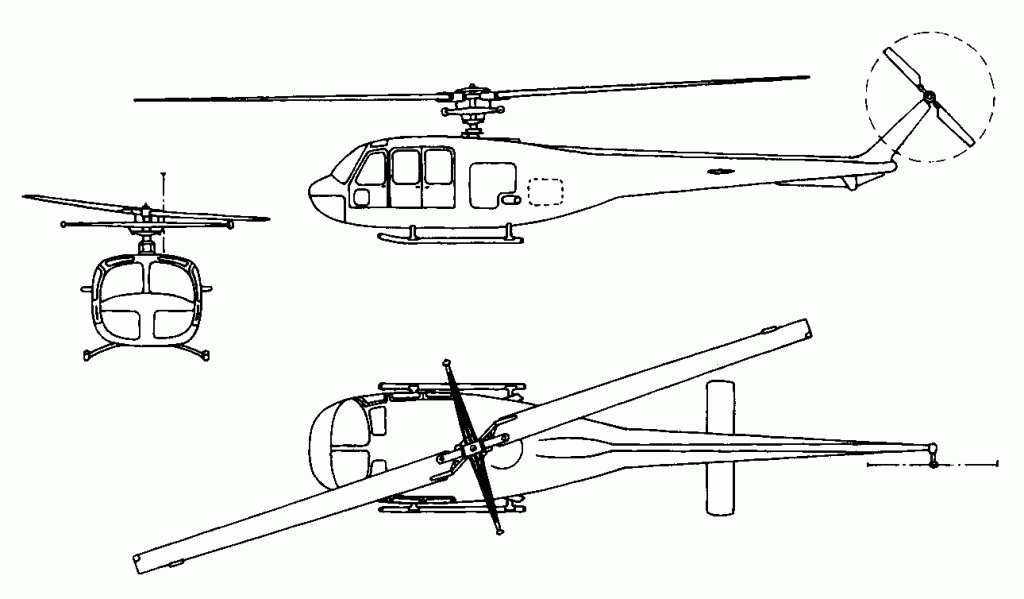
A twin-engined civil transport of 1954 designed by Filippo Zappata (noted for his work with CANT and Breda).

Designed as a 26 seat feeder-liner, the Agusta AZ-8L first flew in Italy, on 9 June 1958.
Engines: 4 x Alvis Leonides, 540 hp
Span: 83 ft 8 in
Length: 63 ft 9 in
Cruise: 233 mph
Pax capacity: 22-26
A 1927 small parasol monoplane
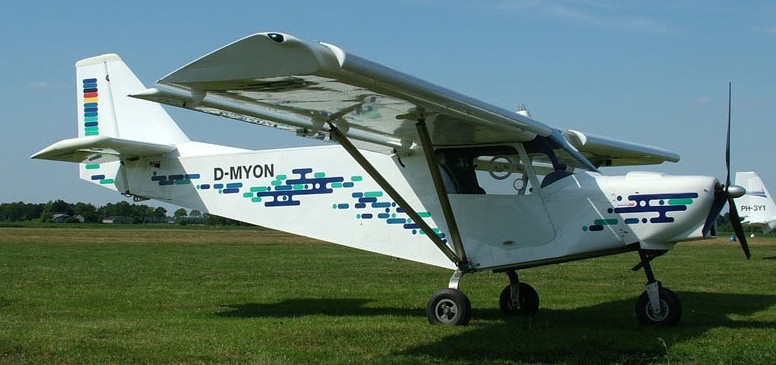
In development since 1990, Agrocopteros redesigned and built from scratch modified versions of the Zenair Zodiac CH 601HD and STOL CH 701 kitplanes, designating them MXP-640 and MXP-740.
The 740 features a Mitsubishi auto turbocharger fitted to a Rotax 912, increasing power from 80 hp to 118 hp. Electronically operated full-span flaperons are interlocked with elevator trim, and span 8 ft 8 in with 10 inch chord. They travel 18 deg down and 24 deg up. The vertical tail is a one piece, all moving type. Undercarriage is shock-absorbing spring aluminium.
An Italian distributor in Turin acquired 18 MXP-740s.
The ICP MXP-740 Savannah is a two-seat, single-engine, all metal shoulder-wing microlight airplane with a fixed tricycle undercarriage with steerable nosewheel wheel.
Engine: Rotax 912 turbo, 118 hp
Prop: Ivoprop vp.
Length: 10 ft 7 in.
Cruise: 4000rpm 34 in/ 130 mph.
Cockpit width: 45 in.
Baggage cap: 40 lbs.
Fuel cap: 14 USG usable.
Wing: NACA 65018

