The new company also had two other models that were built for special orders, the Bellanca Model J and the Model K.
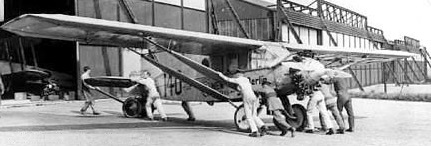
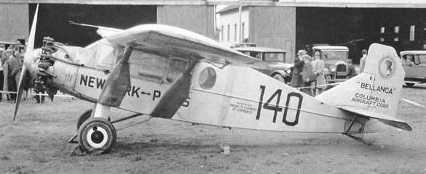
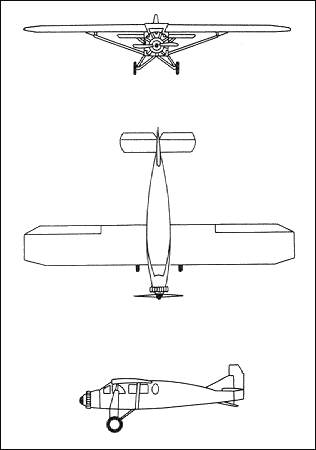
A transatlantic hopeful was the Bellanca K of 1932 which may be considered as the prototype for the P-200 Air bus. The Bellanca K c/n 117 NR4864 was originally named ‘Roma’ in connection with a proposed New York-Rome flight.
For the New York-Oslo attempt of 23 August 1932 the Model K was renamed ‘Enna Jettick’. Leaving New York, at 5.43am ‘Enna Jettick’ (piloted by Thor Solberg and Carl Petersen) reached Harbor Grace, Newfoundland, at 7pmm. The proposed landing for fuel before the transatlantic leg was frustrated by fog and the crew was forced to ditch, without injury, in Darby’s Harbor, 75 miles SW of Harbor Grace, with the loss of the Model K.
Engine: Pratt & Whitney Hornet, 500 hp Wingspan: 64 ft 6 in Length: 39 ft 1 in AUW: 12,000 lb Cruise: 115 mph
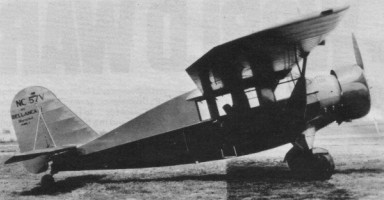
Disappointed because the ‘Columbia’ was not the first aircraft to accomplish the New York to Paris flight, Bellanca severed all relations with Levine, and started his own company, the Bellanca Aircraft Corporation of America, and rented facilities on Staten Island, NY. The new Bellanca model was designated the CH, and was basically a commercial version of the WB-2.
CH-200 Pacemaker First flown in 1928
CH-300 Pacemaker
CH-300
First flown in 1929 CH.300 six-seat Iightpiane, Pacemaker six-seater of 1929 and flown 1931 on an 84-hour 33-minute world non-refueled endurance record.
The CH-300, produced between 1928 and 1930, was powered by both the 330 hp Wright Whirlwind and the 450 hp Pratt & Whitney Junior.
The CH-400 was powered by the 450 hp Pratt & Whitney Junior or the 420 hp Wright Whirlwind.
Both Pacemaker and Pacemaker Senior are six-seat cabin monoplanes and generally similar externally.
PM-300 Pacemaker Freighter
E Senior Pacemaker
Senior Pacemaker Srs 8
JE-1
CH-400 Wingspan: 50 ft 6 in Length: 27 ft 11 in Empty weight: 3000 lb Loaded weight: 5350 lb Max speed: 165 mph Cruise: 155 mph ROC: 900 fpm Range: 1360 mi
During 1926, the WB-2 won two efficiency trophies at the National Air Races in Philadelphia. Wright considered putting the aircraft into production, but decided against it to avoid alienating other aircraft companies that were potential customers for their engines. Disappointed by Wright’s decision, Bellanca left the company and joined with a young businessman named Charles Levine to form the Columbia Aircraft Company. Wright sold the WB-2 and all drawings and production rights to the new company.
Built for the 1926 Nationals, the WB-2 won all efficiency events and the endurance title in 1927. The WB-2 went on to a long and fruitful flying career starting with establishing a new world’s non-refueled endurance record of 51 hours, 11 minutes, and 59 seconds in April of 1927, piloted by Clarence Chamberlin and Bert Acosta.
In the latter half of 1926, Charles Lindbergh wanted to buy the WB-2, now named the ‘Columbia’, for his proposed flight from New York to Paris. He was rebuffed by Levine who also had designs on the flight and the $25,000 prize money. When company president Charles Levine added a stipulation that he would supply the support crew, Lindy withdrew and went to Ryan Co instead. Lindbergh then went to Ryan for his “Spirit of St. Louis”. Meanwhile Levine, in choosing the crew, managed to promise two seats to three people. So while the Columbia was grounded by a court order brought by the third party, Lindbergh took off on his successful flight to Paris.
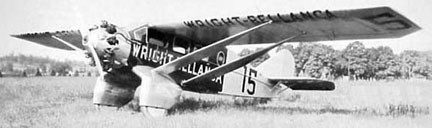
NX237 Wright-Bellanca WB-2 Columbia
Production rights were reacquired by Bellanca Corp to build NC/NX/NR237 Columbia for the 1927 New York-Berlin flight, piloted by Chamberlin with Charles A Levine, in which the useful load was increased to 3550 lb. Eventually, the ‘Columbia’ was cleared of litigation and took off on its successful transatlantic flight on June 4, 1927. In the cockpit were Clarence Chamberlin, one of the pilots of the endurance record and Charles Levine, who became the first transatlantic passenger. The plan was to fly all the way to Berlin, and Chamberlin had vowed to fly until they ran out of fuel. Forty-three hours later, they landed in Eisleben, Germany, the first of two successful Atlantic crossings for Bellanca’s most famous aircraft.
In 1925, Bellanca went to work for the Wright Aeronautical Corporation of Paterson, NJ. His assignment there was to develop an aircraft around the new Wright Whirlwind engine. He already had a design in mind, which was an improved version of the CF, called the CG. This design evolved into the Wright-Bellanca WB-1.
First flying in September 1925 piloted by Lt Fred Becker, the WB-1 enjoyed a short, but successful flying career. The aircraft had already won one race and efficiency contest at the 1925 Nationals, piloted by Becker, before an untimely accident destroyed the craft during preparation for an attempt to break the world’s non-refueled endurance record. It was destroyed in a crash-landing during speed and payload trials in 1926 at Curtiss Field, seriously injuring Becker.
At the time of the crash, Bellanca was already working on an improved version of the WB-1 designated the WB-2.
In 1921, a group of investors lured Bellanca westward to Omaha, NE, in hopes of establishing that town as a center for aircraft manufacture. Before the aircraft could be built, the company went bankrupt, but construction of the aircraft continued under the financial backing of a local motorcycle dealer named Victor Roos. The resultant aircraft, the Bellanca CF, was called by Janes’s All the World’s Aircraft “the first up-to-date transport aeroplane that was designed, built, and flown with success in the United States.” Among the local people helping to build the aircraft was the daughter of Bellanca’s landlord, Dorothy Brown. Giuseppe and she were married on November 18, 1922. Despite its advanced design, the Bellanca CF could not compete with the economics of the time. In the days just after World War I, a surplus Curtiss Jenny could be purchased for as little as $250.00. A Bellanca CF, with a price tag of $5000.00, was just too expensive and the aircraft never went into production.
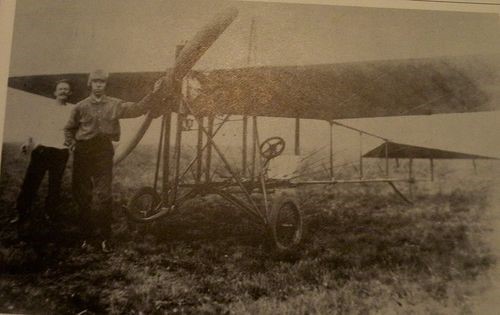
At the urging of his brother Carlo, who was already established in Brooklyn, New York, Giuseppe Bellanca immigrated to America in 1911. Before the end of the year, he began construction of his third airplane design, a parasol monoplane. The engine was a 3-cylinder Anzani of 30 hp, mounted before the wing. Built in the backyard of his brother Carlo’s grocery shop in New York, after construction was completed, he took the small craft to Mineola Field on Long Island, NY, and proceeded to teach himself to fly.
He began by taxiing. He then, taxied faster, which gave way to short hops. The hops got longer, until, on May 19, 1912, there was not enough room to land straight ahead, and Bellanca had to complete a turn in order land safely. Having successfully taught himself to fly, Bellanca then set about teaching others to fly, and from 1912 to 1916, he operated the Bellanca Flying School with two more copies he built. One of his students was a young Fiorello La Guardia, the future mayor of New York City. In return for flying lessons, La Guardia taught Bellanca how to drive a car.
Bellanca’s first aircraft design was a “pusher” aircraft, somewhat similar to the Wright Flyer. Lacking funds for such an endeavor, he joined with two partners, Enea Bossi, and Paolo Invernizzi. The union of the three produced the first flight of a totally Italian-designed and Italian-built aircraft in December of 1909.
Initially, the idea of a small, cheap, all-wood fighter built with few strategic materials had held high appeal. In early 1941, Larry Bell’s upstate New York fighter team had begun work on a plane at first called the ‘Tri-4’, shorthand for an informal USAAF requirement for ‘400hp, 4,000lbs, 400mph’. On 16 May 1942, the USAAF ordered 25 ‘Tri-4’ aircraft. Delays, technical problems with subcontracting on plywood construction, and disappointing wind-tunnel tests caused the manufacturer to suggest by early 1943 that the number of machines on order be reduced to six. In May 1943, the USAAF reduced this to two, seeing the XP-77 as having no operational utility but as useful in lightweight fighter research.
The all-wood Bell XP-77, using a Ranger inverted V-12 inline piston engine, was of Sitka spruce and intended to operate from grass and the first of two XP-77s flew on 1 April 1944 at Niagara Falls, New York, test pilot Jack Woolams at the controls.
Beginning in July 1944, the second XP-77 was tested at Eglin Field, Florida. Spin problems led to a crash of this aircraft on 2 October 1944, which the pilot survived.
Plagued by noise and vibration, an unexpectedly long take-off run, and general performance ‘inferior to the present fighter aircraft employed by the USAAF’, the XP-77 programme was stopped on 2 December 1944. The prototype went to Wright Field, then back to Eglin, then to Wright again. It was seen at post-war displays wearing spurious markings and its final disposition is unknown.
XP-77 Engine: 1 x Ranger XV-770-7, 388kW Prop: 2 blade Wingspan: 8.38 m / 27 ft 6 in Length: 6.97 m / 22 ft 10 in Height: 2.50 m / 8 ft 2 in Wing area: 9.29 sq.m / 100.00 sq ft Max take-off weight: 1827 kg / 4028 lb Empty weight: 1295 kg / 2855 lb Max. speed: 531 km/h / 330 mph / 285 kt Ceiling: 9175 m / 30100 ft Range: 885 km / 550 miles Crew: 1 Armament: 2 x 12.7mm machine-guns Bombload: 136kg / 300 lb
In 1938 the US Navy became involved in three new fighter projects the Grumman XF5F 1 and similar USAAF XP 50, the Bell XF1 1 and the Vought XF4U 1. The long term intention was to bolster the Navy’s car¬rier forces whose squadrons flew the Grumman F3F 2 biplane fighter of the mid¬1930s.
The XFL-1 experimental shipboard fighter was developed in parallel with the XP-39 Airacobra, and was flown for the first time on 13 May 1940 with test pilot Brian Sparks at the controls. Powered by a 1150hp Allison XV-1710-6 12-cylinder liquid-cooled engine, the XFL-1 had a tailwheel undercarriage and underwing radiators. The airframe was re-stressed for shipboard operation, and proposed armament comprised a single 12.7mm machine gun or a 37mm cannon firing through the propeller hub and a pair of fuselage-mounted 7.62mm guns, although, in the event, no armament was installed.
The use of the conventional undercarriage also worked against the XFL as problems began to develop during testing. As a result, the system had to be shipped back to Bell Aircraft for further revisions in late 1941. By this time, however, the United States Navy decided to pursue a different direction and cancelled development of the XFL in whole.
The XFL-1 failed its carrier qualification trials and further development was abandoned at the beginning of 1942. The single XFL-1 prototype cost US$125,000, and was then used in a series of armament tests until it was eventually scrapped.
Engine: 1150hp Allison XV-1710-6 Max take-off weight: 3271 kg / 7211 lb Empty weight: 2341 kg / 5161 lb Wingspan: 10.67 m / 35 ft 0 in Length: 9.09 m / 29 ft 10 in Height: 3.90 m / 12 ft 10 in Wing area: 21.55 sq.m / 231.96 sq ft Max. speed: 494 km/h / 307 mph Range: 1725 km / 1072 miles Rate-of-Climb: 2,630ft/min (802m/min) Service Ceiling: 30,922ft (9,425m) Accommodation: 1
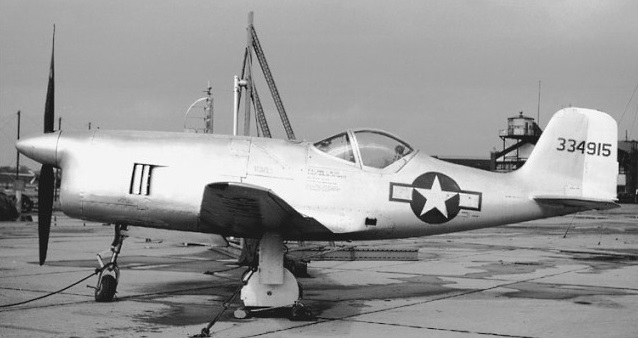
Two war surplus P-63s (1 P-63A / 1 P-63N) were modified by Bell under Navy contract for flight testing of low-speed and stall characteristics of high-speed wing designs. The aircraft received new wings with adjustable leading edge slats, trailing edge flaps and a pronounced sweep of 35 degrees. The wings had no wheel wells; only the nose gear was retractable. L-39-1 first flew 23 April 1946, demonstrating a need for extra tail surface and rear fuselage length to balance the aircraft in flight – the wing repositioning reduced empennage effectiveness and moved the center of lift aft.
A lighter three-bladed propeller from a P-39Q-10 was mounted and the necessary changes to the empennage were made. L-39-2 incorporated these adjustments from the start. L-39-1 later went to NACA at Langley for wind tunnel testing, where much valuable data were gathered. L-39-2 also served as a testbed for the Bell X-2 40-degree wing design.