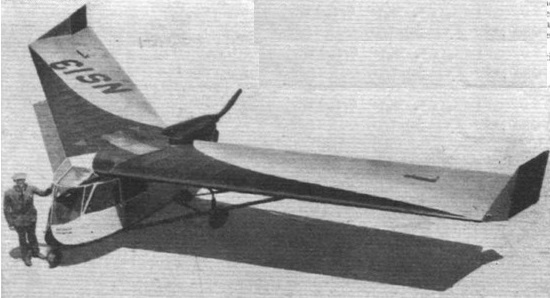
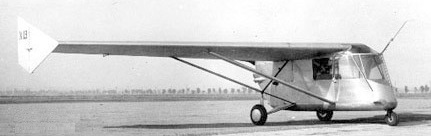
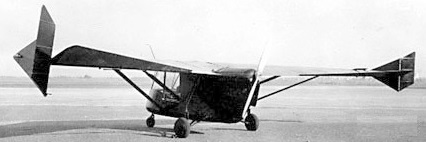
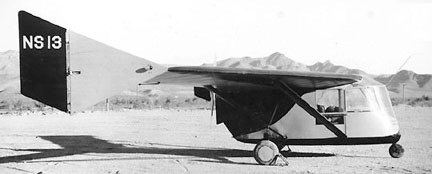
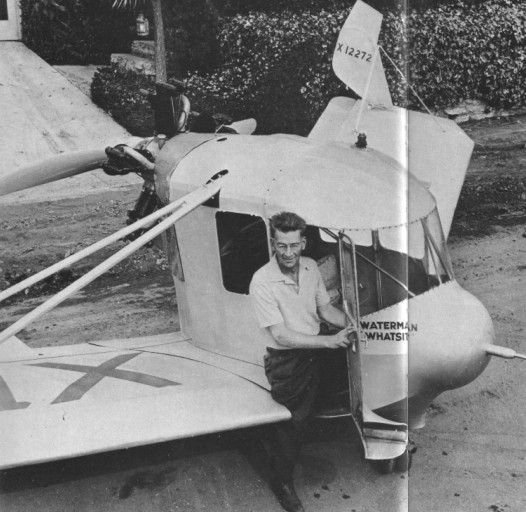
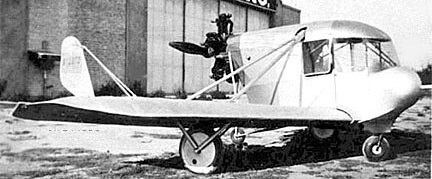
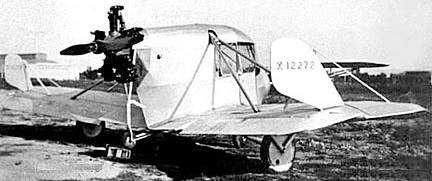
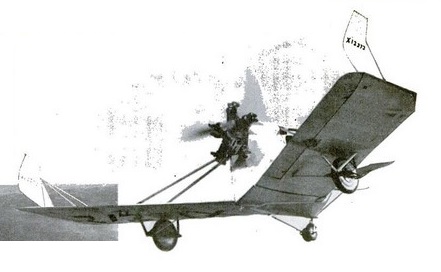
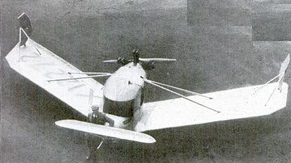
In May 1935 Waterman completed a submission to the government funded Vidal Safety Airplane competition. This was the Arrowplane, sometimes known as the W-4. Built with WPA subsidy established by CAA head, Eugene Vidal (father of author Gore Vidal), this adopted a similar layout to the Whatsit but had a strut-braced high wing on a blunt-nosed, narrow fuselage pod with a tricycle undercarriage mounted under it. Its wings had wooden spars and metal ribs and were fabric covered, with triangular endplate fins carrying upright rudders. Its fuselage was steel framed and aluminium covered. It was powered by a 95 hp (71 kW) inverted inline 4-cylinder Menasco B-4 Pirate pusher engine mounted high in the rear of the fuselage.
First flying on 21 Febuary 1936, the Arrowplane NX/NS13 was not intended for production or to be roadable, but its success in the Vidal competition encouraged Waterman to form the Waterman Arrowplane Co. in 1935 for production of a roadable version. The resulting Arrowbile, was referred to by Waterman as the W-5.
The W-4 accumulated more than 100 hours flight time before being intentionally (if not mysteriously) destroyed by a CAA official in 1937.
Engine: Menasco B-4 Pirate, 95 hp / 71 kW Stall: 40 mph Landing run: 30 ft Seats: 2
Waldo D. Waterman of Santa Monica, California, produced in 1934 design for a two-seat tailless monoplane as a simple private aircraft.
Waldo D. Waterman of Santa Monica, California, produced in 1931 a design for a two-seat tailless monoplane as a simple private aircraft. With a 15° swept-back conventional wing with tip rudders, mounting a fuselage nacelle; front elevator, a front boom featured a trim feature—two small machinists’ vises that could be slid to positions of advantage and then tightened.
With a tricycle gear with steerable nose wheel, this was the first airplane to be equipped with “elevon” control.
Waterman spent several days taxiing around the field, feeling out the plane’s characteristics, then finally tried a faster taxi down the runway, gradually advancing the throttle. On the threshold of take-off, the front wheel dropped into a gopher hole, the doors flew off their hinges, and the “Whatsit” flew at minimal altitude for about 30 feet before coming to a brutal halt. The first actual “flying wing” monoplane was rebuilt to enter a 1933 safety plane competition, winning one of the only two awards out of 30 entries.
Powered by a 100hp Kinner K-5 pusher engine, the two place Whatsit, registered NX12272 became known as Arrowplane and led to the 1937 version.
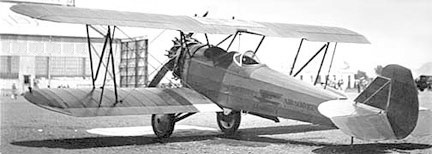
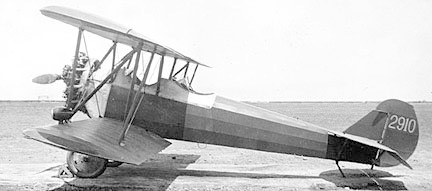
Designed by William Waterhouse and Lloyd Royer, the 1925 Roamair / Romair 2-3 place open cockpit biplane was built with various engines.
Both spellings were chosen, but Royer’s steadfast claim of “Romair” is tempered by some photos showing “Roamair” on the tail.
Waterhouse Roamair N2910
Five were built: NC990 c/n 18 with Wright J-5, to Pacific Coast Air Service, rebuilt in 1931 as a crop duster with 220hp Wright J-6, and re-registered NR12785
c/n 50 NR1637 with 160hp Curtiss C-6, also used as a crop duster
N2537 with 90hp Curtiss OX-5 in 1926, rebuilt in 1929 with 150hp Hisso as N4867
N2910 with 140hp Bailey Bulls-Eye, also for PAT
N3663 (possibly c/n 1) with 150hp Curtiss K-6, planned for 1928 Nationals cross-country race, but was damaged in a hard landing, possibly rebuilt in 1928 as NX7641 with 150hp Hisso.
The 1926 Cruzair two place cabin high wing monoplane was designed by William Waterhouse and built with assistance from Ryan Mechanics Monoplane Co.
Registered N1724 and N2138 it was also seen spelled Cruizair.
Partial plans reportedly were sold to T Claude Ryan as a project for the Mahoney-Ryan Flight School and were responsible for the Ryan M-1 Brougham design.
It was first flown on 12 July 1926 piloted by Franklin Young.
N2138 was bought from Pacific Air Transport by motion picture stunt pilot Dick Grace and extensively modified for his abortive Hawaii-San Francisco transpacific attempt on 4 July 1927. It was shipped back to California and rebuilt as Ryan Mechanics Co Miss Southern California for competitions.
Wassmer started development of an all plastics lightplane in 1962 with the object of producing a comparatively cheap but durable and easily maintained type for ihe private owner.
The WA-50 prototype flew in March 1966 as a four-seater powered by the 112-kW (150-hp) 0-320 engine. One of the first aircraft extensively constructed from glassfibre, production began in the form of the WA-51 Pacific with fixed tricycle landing gear and the 112-kW (150-hp) O-320-E2A engine, though a companion model was produced as the WA-52 Europa with the 119-kW (160-hp) IO-320-B1A driving a variable-pitch propeller. As these two initial models went out of production in 1973 the company introduced the WA-54 Atlantic with the 134-kW (180-hp) O-360-A engine, more baggage volume, revisions to the landing gear, and other modifications.
WA-54 Atlantic
Wassmer went into liquidation in 1977, and by that time sales of the WA-50 series totalled 190 aircraft.
WA-51 Pacific Engine: Lycoming O-320-E2A, 150 hp Wingspan: 30 ft 10 in / 9.40 m Length: 23 ft 11 in / 7.30 m Empty weight: 1320 lb / 600 kg MTOW: 2292 lb / 1040 kg Max cruise 5500ft/1675m: 120 kt / 138 mph / 222 kph ROC SL: 787 fpm / 240 m/min Service ceiling: 14,450 ft / 4400 m Range max fuel: 490 nm / 565 mi / 910 km Seats: 4
WA-54 Atlantic four-seat touring lightplane Powerplant: 1 x Avco Lycoming 0-360-A, 134kW (180 hp) Span: 9.40m (30ft 10 in) Length: 7.5m (24ft7.25in) Max TO weight: 1130 kg (2,491 lb) Max speed: 174mph at sea level Operational range: 839 miles
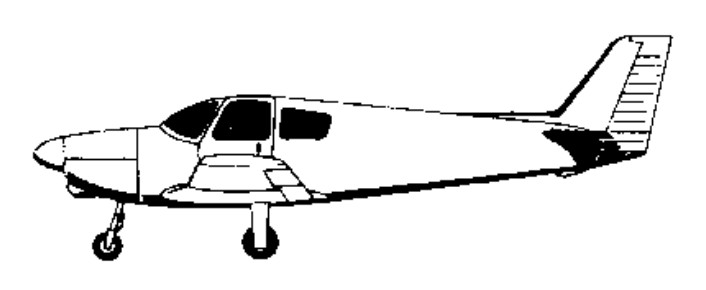
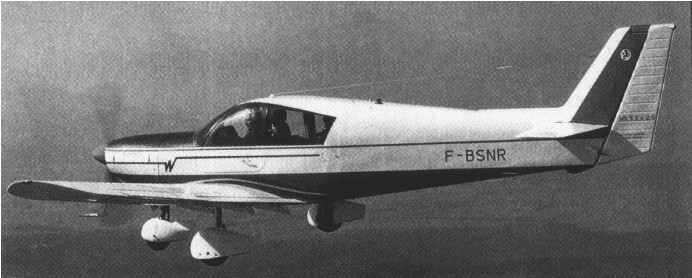
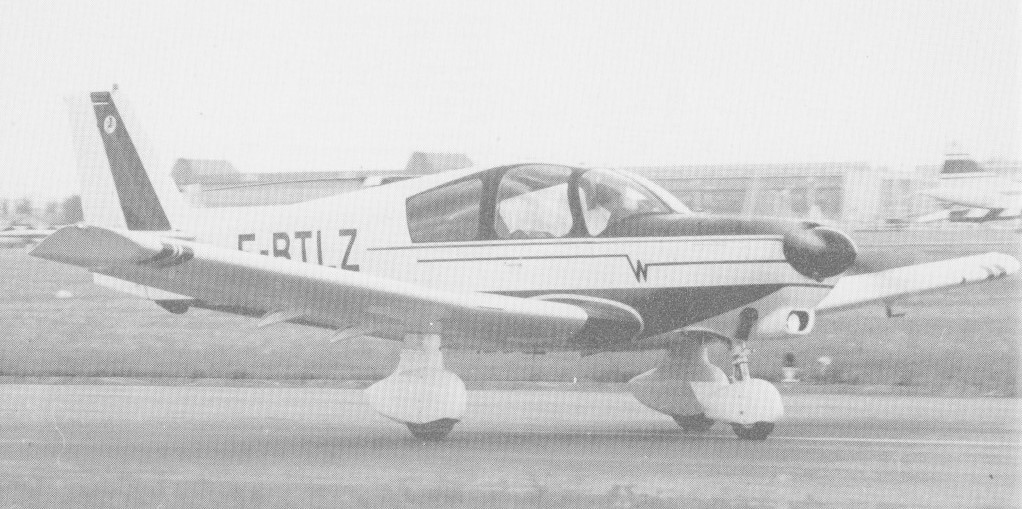
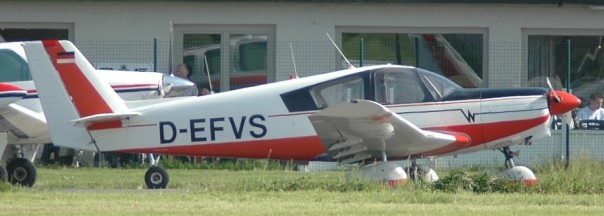
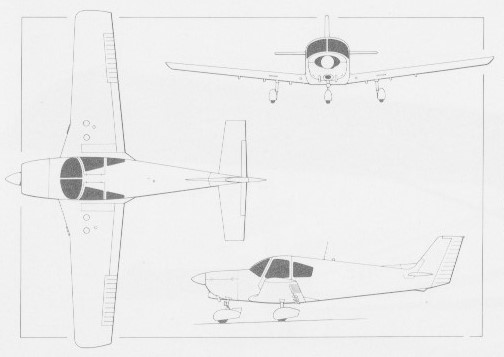
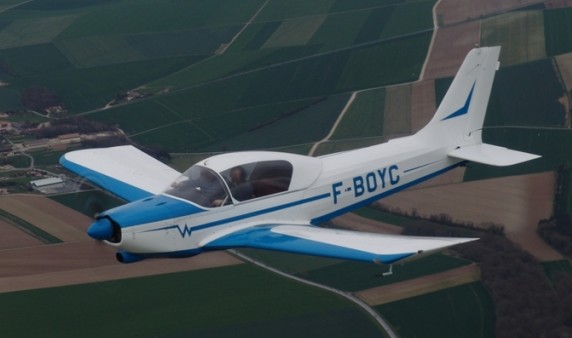
In 1955 Société Wassmer opened a design department, its first fully original aircraft was the WA-40 Super Sancy. This was a low winged four/five-seat tourer monoplane with a retractable nosewheel undercarriage. The fuselage was of steel tube construction with fabric covering, while the wings were of wooden construction.
The first prototype flew on 8 June 1959, receiving French certification on 9 June 1960. The WA-40 Super IV flew with the 134-kW (180-hp) 0-360-AlA.
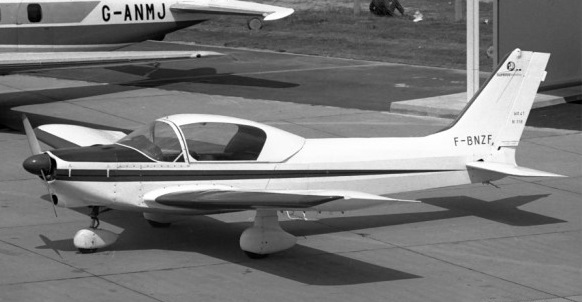
WA-41 Super IV F-BNZF (118)
Some 180 aircraft were produced in three variants (the Directeur basic model, the Commandant du Bord deluxe model and the President IFR model) with different equipment standards.
A revised version, the WA-40A, with swept tailplane, followed in 1963. In 1965 the company introduced a variant with fixed landing gear, and this WA-41 Baladou also had a different engine and simplified systems for lower purchase cost.
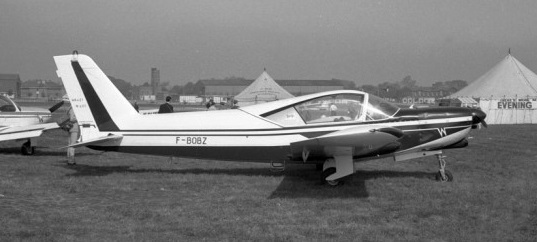
The final development of this initial series was the WA 4/21 Prestige in 1967 with the 175-kW (235-hp) IO-540 engine, a variable-pitch propeller and refinements such as an autopilot, blind-flying instrumentation and electrically operated flaps.
WA-421 F-BOBZ (401)
The Cerva CE-43 Guepard is an all-metal derivative of the Wassmer WA-40.
WA-40 Super IV Original production. Powered by 180 hp Lycoming O-360-A1A engine. Upswept fin. Two prototypes + 50 production aircraft.
WA-40A Super IV Revised production with swept fin. 180 WA-40 and WA40A built.
WA-41 Baladou Simplified version with fixed undercarriage. 60 built by 1970.
WA 4/21 Prestige More powerful version of the WA-40A with 250 hp Lycoming IO-540-C4B5 engine, electric flaps and landing gear, lengthened nose, the prototype was fitted with a 235 hp engine, 25 built by 1970.
WA-41-250 Alternate designation for the WA 4/21 production aircraft with a 250 hp engine.
WA-40A Powerplant: 1× Lycoming O-360-A1A, 134 kW (180 hp) Length: 8.09 m (26 ft 6.5 in) Wingspan: 10.0 m (32 ft 9.5 in) Height: 2.86 m (9 ft 5 in) Wing area: 16.0 sq.m (172 sq.ft) Empty weight: 740 kg (1,631 lb) Max takeoff weight: 1,200 kg (2,645 lb) Never exceed speed: 310 km/h (167 knots, 192 mph) Maximum speed: 270 km/h (146 knots, 168 mph) Cruise speed: 225 km/h (122 knots, 140 mph) (econ cruise – 55% power) Stall speed: 95 km/h (51 knots, 59 mph) Range: 1,700 km (917 nm, 1,055 mi) Service ceiling: 5,000 m (16,400 ft) Rate of climb: 4.6 m/s (905 ft/min) Crew: 1 Capacity: 4 passengers
WA-41 Baladou four/five-seat touring lightplane Span: 10m (32 ft 9.4 in) Length: 8.09m (26ft 6.5 in) Powerplant: 1 x Avco Lycoming O-360-A2A, 134kW (180 hp) Max TO weight: 1200 kg (2,646 lb) Max speed: 158 mph at sea level Operational range: 1,056 miles
WA 4/21 Prestige Engine: IO-540, 175-kW (235-hp) Prop: variable-pitch
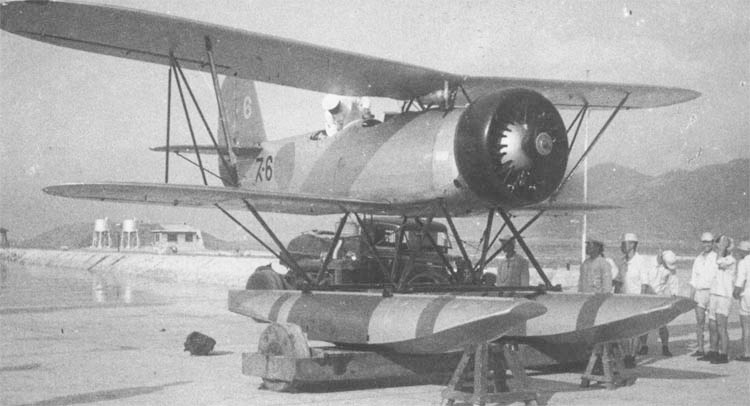
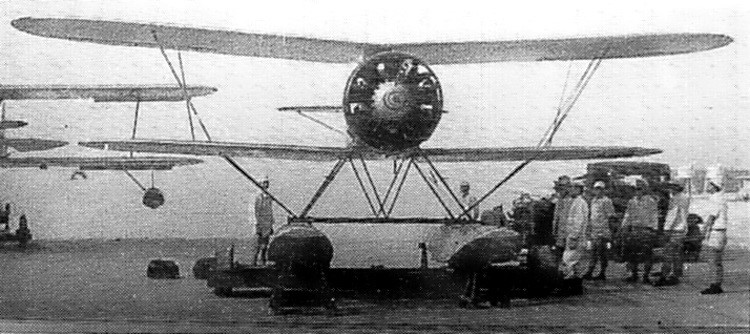
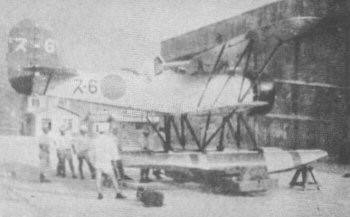
In January 1934, the Imperial Japanese Navy had a requirement for a two-seat reconnaissance seaplane to be operated from its J-3 type submarines, and placed an order with Watanabe Ironworks for design and development of an aircraft to meet this requirement.
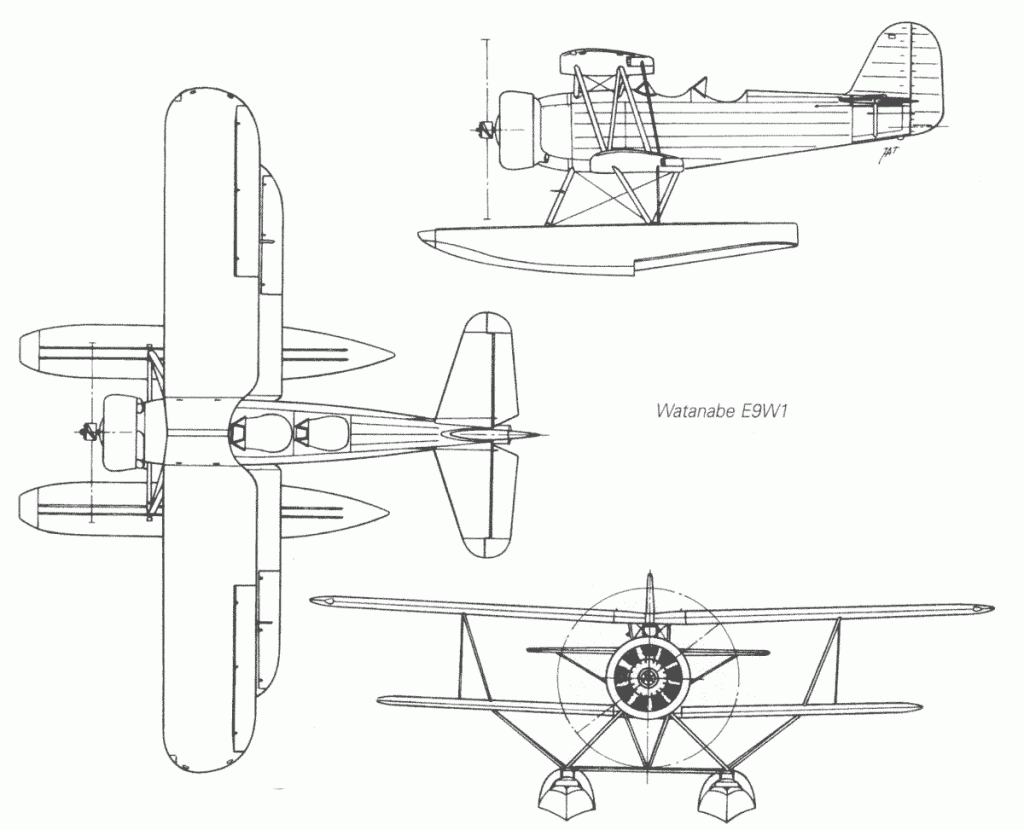
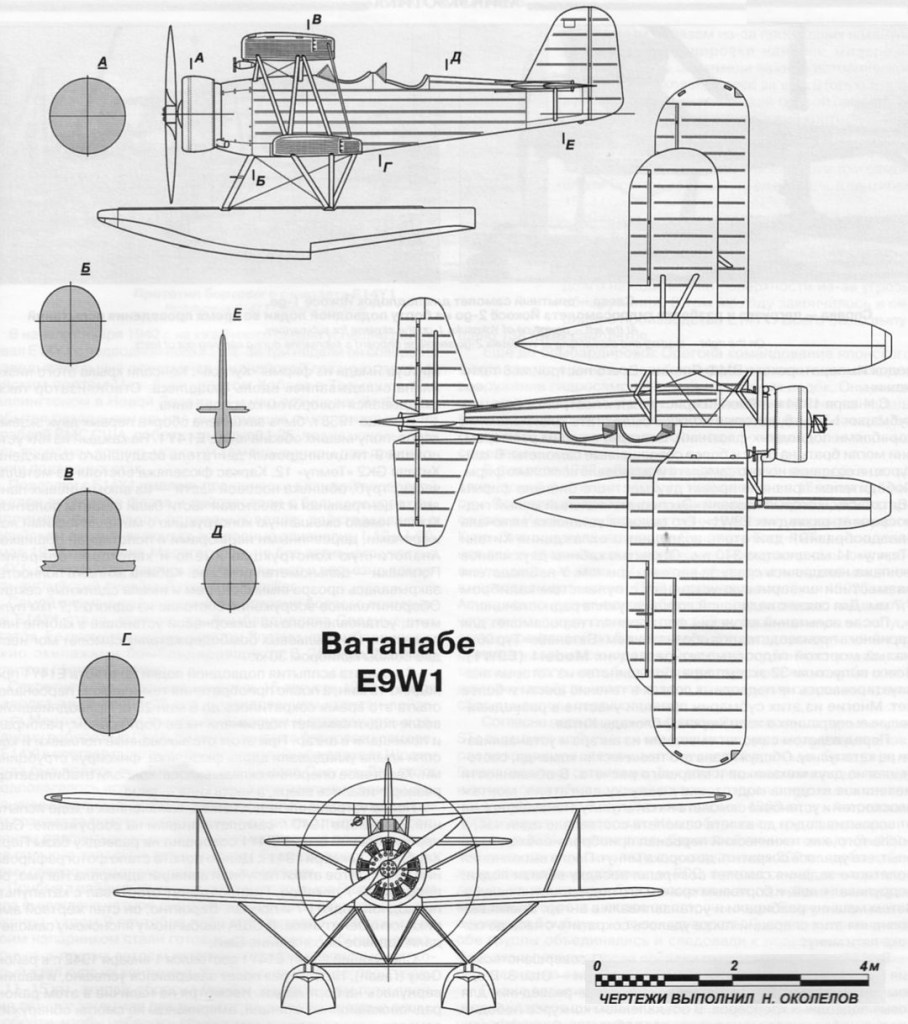
The E9W was a two-seat single-engine twin-float unequal-span seaplane designed to be easily dismantled for hangar stowage on a submarine, capable of being reassembled in two minutes 30 seconds and disassembled in one minute 30 seconds. It was armed with a 7.7 mm (0.303 in) machine gun operated by the observer.
The first of three prototypes flying in February 1935.
Following successful testing of one of the prototypes on the submarine I-5, an order for a production batch of 32 aircraft, designated E9W1, was placed. It was also built by Nakajima as the E9N1.
The aircraft entered service in 1938 with the Imperial Japanese Navy Air Service as the Navy Type 96 Small Reconnaissance Seaplane with the last being delivered in 1940. Although it was in the process of being replaced by the Yokosuka E14Y monoplane, it was still in front line service at the time of the Japanese attack on Pearl Harbor, remaining in service until July 1942, being used to direct their parent submarines onto Chinese ships attempting to pass the Japanese blockade of the South China Sea. The E9W1 was given the reporting name Slim in 1942 by the Allies of World War II.
E9W1 Engine: 1 × Hitachi Tempu II, 224 kW (300 hp) Wingspan: 9.91 m (32 ft 9½ in) Wing area: 23.51 sq.m (252.95 sq.ft) Length: 8.00 m (26 ft 3 in) Height: 3.71 m (12 ft 2 in) Empty weight: 882 kg (1,940 lb) Gross weight: 1,253 kg (2,756 lb) Maximum speed: 232 km/h (144 mph) Cruising speed: 148 km/h (92 mph) Range: 731 km (454 miles) Endurance: 4.9 hours Service ceiling: 6,740 m (22,100 ft) Crew: 2 (pilot, observer) Armament: 1 x 7.7mm (0.303in) machine gun
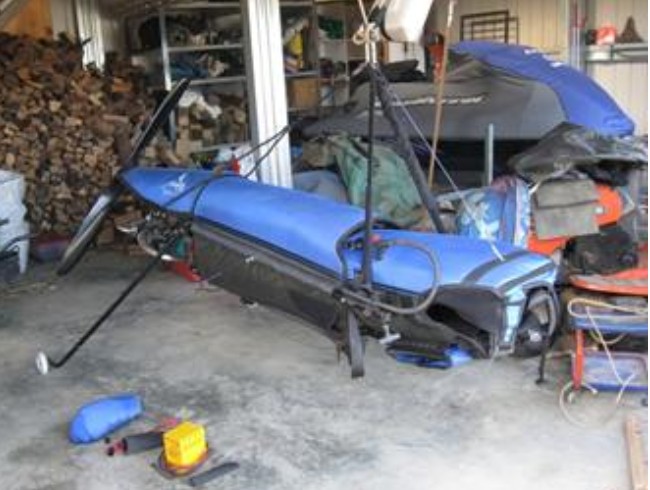
A powered hang glider harness, built by Chris Taylor in the UK in 2007. The SP-4 uses quality fittings, and the best buckles on the market. It is electric start, with the master switch and start button neatly fitted in the ends of the two main tubes of the frame. Has its own charger, tip protectors and carbon propellor. Comesw with a Radne engine and fits a Vittorazzi of more power. To launch you start off with a mouth throttle (which has a safety microswitch fitted), and then as soon as you are comfortably airborne, you swap over to the foot throttle. Climb in, zip up and enjoy the ride. It has a pouch for an emergency parachute. Pockets for all sorts, including your radio, a large storage area inside the main pod for those long x-countries.