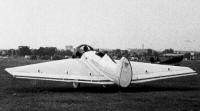
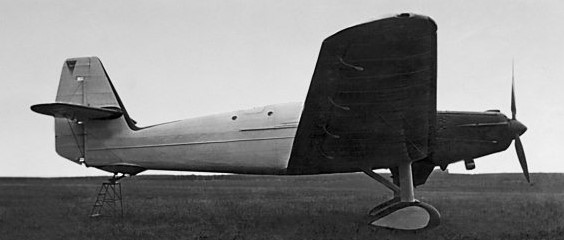
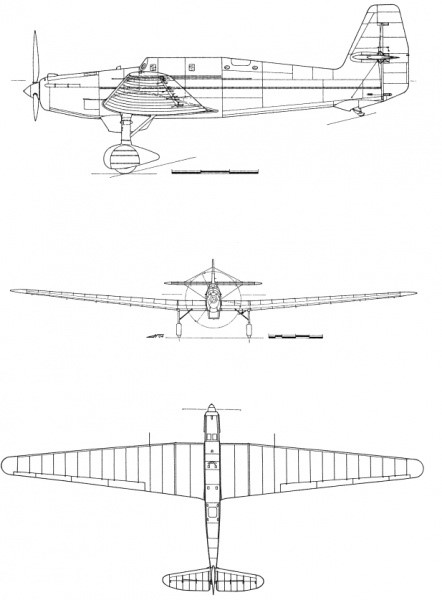
The high-altitude experimental aircraft project began in 1935. The BOK-7 or SR (from the Russian acronym for Stratospheric Reconnaissance Plane – Стратосферный Разведчик – СР) was designed based on experience gained with the BOK-1 and was generally similar to the BOK-1.
Originally conceived as a stratospheric reconnaissance aircraft, it ended up being developed as a record-setting aircraft. It began to be projected in 1935 as a development of the BOK-1.
The BOK-7 was designed as a stratospheric reconnaissance aircraft, hence its name SR (Стратосферный Разведчик), capable of photographic reconnaissance at heights of 14 – 16 km. Because it was designed as an airplane for military use, it was decided to equip it with weapons. The BOK-7 was designed with two ShKAS machine guns in the wings and two other machine guns defending the rear hemisphere. The possibility of transporting 400 kg of bombs was also envisaged.
In 1937 these original plans were modified. It was decided to build two copies as a development of the BOK-7, the first intended to establish a world height record and the second in the military version, originally known as BOK-8.
The BOK-7 from the structural point of view was designed similar to the BOK-1. The main difference was that in this new model the airtight cabin was designed as an integral part of the aircraft structure. Two domes with several skylights protruded above the fuselage, one located over the pilot’s station and the other over the observer’s position.
The initial project envisaged the use of a fixed landing gear with trouser-type fairings, but during development a similar gear was returned to that used in the BOK-1, with drop-type fairings on the wheels.
Until mid-1938 the construction of the BOK-7 was developed at Factory No.35 in Smolensk. Then, with the decision to transfer the BOK to KB-29, the unfinished plane was transferred to the Moscow suburb of Podlipki. In September 1938 Alexander Alexandrovich Mikulin delivered the AM-34FRN engine with two turbochargers requested for its structure, with which the assembly of the aircraft was completed. On December 20, the construction work on BOK-7 was completed and on the 28th of that month a first short-duration straight-line flight took place.
There is no data about the first test flight of the BOK-7, but it is known that for its successful completion the KB-29 collective was awarded and its main constructor NN Kashtanov received a cash prize.
The BOK-7 was tested at the end of 1938 and presented performances not very different from those of the BOK-1, therefore the tests were not concluded. The test pilots were IF Petrov and PM Stefanovski. The fundamental reason for abandoning the tests was due to the fact that they failed to exceed expectations of setting new world height records. Again, the blame fell on the power plants.
In the spring of 1939, it was decided to use the BOK-7 and BOK-11 airplanes to prepare the crews for long-haul flights. For this reason, on 24 May 1939 the aircraft was delivered to pilot Gromov. Various crews that included Gromov, Yumashiev, Spirin, Baidukov, Beliakov, among others; They lived for several days in the airtight cabin of the plane, based on the ground, checking the feasibility of executing the complete life cycle. This served as training for the projected long-haul flights on the BOK-15.
During these tests everything worked without problems. The cabin proved its ability to be airtight. The air losses due to the few holes for the cables and control systems were compensated by the delivery of the oxygen system. However, it was decided to add an additional compressor in the future that worked powered by the engine.
The BOK-8 was designed as an armed development of the BOK-7. The conception of a military aircraft operating in the stratosphere brought with it the impossibility of using defensive systems of the traditional type. The weaponry was made impossible to handle in the thick pressurized suits and diving suits. It was necessary to develop a defensive weapons control system that could be operated from the pressurized cabin. This task was successfully solved in 1938 with the design and laboratory testing of the first remote weapon control system.
The new armament control set consisted of a synchronized electro-automatic sighting system with collimator designed by Riezunov and located in the second turret above the navigator’s cockpit and a system capable of controlling fire from the sealed cockpit designed by the engineers. VS Kostishkin and KB Zhbanov, who operated a machine gun located on the fuselage, outside the cockpit.
The installation of this system was carried out on the BOK-7. It is noteworthy that this remote fire control system was developed long before the appearance of similar systems in the United States on Boeing B-29 Superfortress bombers. The development was materialized in the BOK-11.
Later, on the basis of the BOK-7, the BOK-10 projects were developed for a high-altitude reconnaissance plane, BOK-12, an atmosphere research plane and the BOK-13 as a passenger plane. All these variants did not go beyond the project table.
BOK-7 Powerplant: 1 M-34FRN 890hp Wingspan: 32.40 m Length: 14.85 m Wing area: 81.4 m² Empty weight: 3400 – 3600 kg Takeoff weight: 4814 kg Maximum speed at 9000 m: 350 km / h Landing speed: 86 km / h Practical ceiling: 15,200 m Accommodation: 2
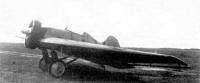
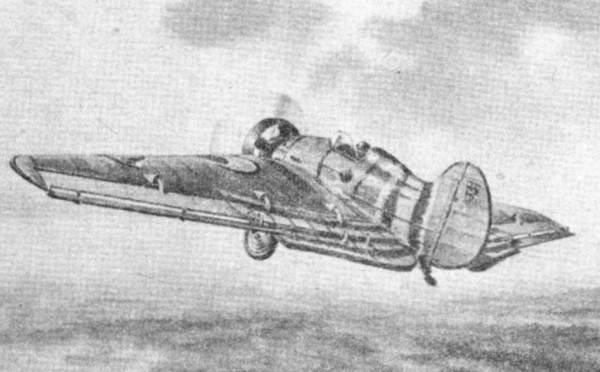
The BOK-5 or TsKB-13 (Russian: БОК-5 or ЦКБ-13) was designed by VA Chizhevski based on the Cheranovski BICH-7A of 1932. His initial idea was to develop a small single-engine aircraft with a flying wing scheme capable of improving the flight characteristics of the Cheranovski models. At the same time, this development would serve as a test bed for the conception of a twin-engine bomber with a similar scheme propelled by two M-34s.
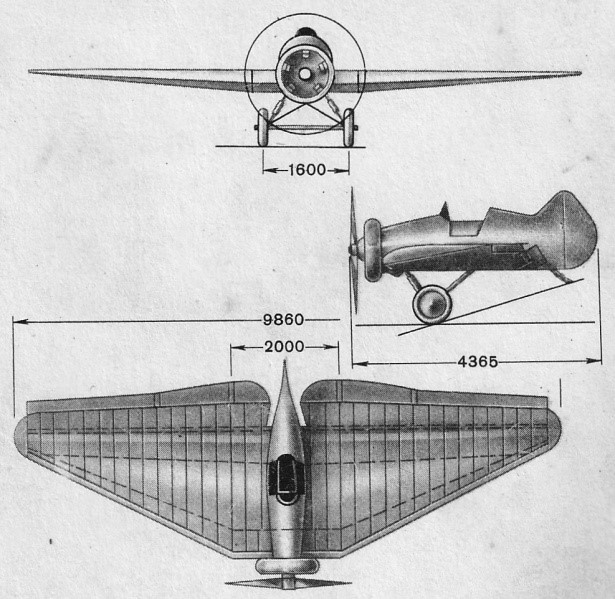
The BOK-5 was conceived as a low-wing monoplane with the vertical empennage located in the fuselage and propulsion propeller. Only in these features did it resemble the Cheranovski BICh-7A. The construction of the BOK-5 was fully metal with fabric coating. The entire fuselage, with an oval section, was built in aluminum and had a semi-monocoque structure.
The fuselage structure was made up of duralumin frames linked by cockpits. The first frame was conveniently reinforced to fix the engine support bench and behind it was located the fuel tank. The entire fuselage was covered with duralumin sheets.
In its central part was the cockpit with a front windshield. Just behind the cockpit was the empennage that ended in a spar to which the rudder was attached. In the lower part the tail skate was fixed.
The BOK-5 wing had a trapezoidal and non-parabolic shape, with a 28º wing loosening at the leading edge and a straight trailing edge.
A distinctive feature of Chizhevski’s design was the conception of a wing with a relative thickness in the lower centroplane of only 15% and 13% towards the ends. The flight experience of the Cheranovski BICh-14 showed that the relative thickness of 22% generated a disruption of the airflow that was reflected in a worsening of the effectiveness of the rudder at low flight speeds.
To be able to make the landing, it was necessary to make the descent with great angles of the elevons and elevator rudders, which resulted in an increase in the landing speed.
The double spar wings featured TsAGI-890 profile. The centroplane was integrated into the fuselage. The wing spars cut through the fuselage. The bases of these stringers were made of steel tubes and the walls of duralumin slats. A third auxiliary spar made of duralumin but with a rectangular section was located in the tail section, at the fixing height of the wing movable elements.
Each wing console featured 6 reinforced ribs, constructed of duralumin tubing. Steel stringers were located between these ribs and the spars to reinforce the wing structure. In addition to the 6 reinforced ribs, the wing had 24 normal ribs. The wing and control surfaces were covered with fabric. The central part of the wing, at its junction with the fuselage, had a 0.5 mm thick corrugated duralumin sheet coating.
Along the entire wing span, behind the second spar, there was a movable surface that acted as a stabilizer. The structure of this mobile section was made up of duralumin frames and longitudinal beams. The coating was made of 0.5 mm thick duralumin sheets. At the rear edge were the fixings for the control surfaces.
With the help of an attachment, located on the left wall of the cockpit, the pilot could set positions of these surfaces in the range of -5º to + 3º, which allowed regulating the balance of the aircraft and therefore the force to be applied. at the controls. Ailerons and elevator rudders were attached to these surfaces. In the BOK-5 the aileron functions were performed only by the external surfaces. Pulling the joystick activated the ailerons and elevator in unison. Chizhevski concluded that by shifting the aircraft’s center of gravity back and using this control system he could achieve excellent stability, both in the longitudinal and lateral axis.
The control of the moving part of the wing, the elevator, the ailerons and the rudder were operated by cables. The tail skid was steerable and operated according to the direction of the rudder.
The BOK-5 was powered by an M-11 radial engine with the piston heads covered by an annular bonnet to decrease aerodynamic drag.
The landing gear was fixed, of the conventional type with tail skid. The main landers featured rubber shock absorbers. Attachments from a Po-2 Polikarpov were used in the construction of the landing gear. The wheels had dimensions 100 x 700 mm.
The structure of the plane was calculated to withstand 8 g, so the BOK-5 was capable of aerobatics.
The BOK-5 was painted in the colours of the “Firebird” (Zhar-ptitsa): a combination of green, red and blue bands. The annular bonnet was painted silver, the propeller red, the engine cylinders and the landers black. The triangular BOK logo was located on the empennage, also painted with stripes.
The construction work of the BOK-5 began in 1934 and Chizhevski used all the experience gained during the flights of the Cheranovski models. Construction was carried out at Factory No.35 in Smolensk.
The factory tests were carried out in 1937 in conjunction with the state tests in the NII VVS. At the beginning they were declared unsatisfactory. During takeoff, the aircraft had a marked tendency to deviate to one side, preventing takeoff. This problem was quickly solved by modifying the tail skid to an adjustable configuration. After this modification, the aircraft was returned for testing.
In September 1937 the test pilot of the NII VVS I. Petrov made the first flight. The BOK-5 was also flown by pilots P. Fedrovi, P. Stefanovski, M. Nyuxtikov in a total of 65 flights with a total duration of 20 hours and 42 minutes. They all concluded that this model behaved positively in all flight regimes, did not have a tendency to slow down and its handling did not differ much from other traditional aircraft. The BOK-5 was considered in the report to be affordable to low- and mid-time pilots.
The negative aspect reflected the desire of the pilots to increase the effectiveness of the rudder and achieve a better amortization system for the landing gear.
Initially, there was a strong engine vibration which prevented the tests from being carried out effectively, but this problem was soon solved.
In 1938 Chizhevski presented the military with an improved version of the BOK-5. This version had somewhat larger dimensions and a certain angle of inclination of the fuselage during takeoff operations.
The surface of the ailerons was decreased to achieve better control coordination and the surface of the rudder, on the contrary, was increased. As a result of the modifications, the weight of the aircraft increased by 32 kg.
In August 1938, during the aerial demonstration in Túshino, the BOK-5 made three flights.
The subsequent state assessments on the NII VVS were rated as successful. The report concluded: “ The BOK-5 tailless plane is easy to pilot, presents good stability and maneuverability at speeds up to 150 km / h and allows the execution of high-school piloting figures. “
The evaluation of the characteristics of the BOK-5 during the piloting maneuvers is described in the memoirs of P. Stefanovski, who was very impressed by the results obtained during the first flight of execution tests of these figures.
After completing the tests in September 1938, the management of the NII VVS recommended to the Narkomat of the Defense Industry requesting Chizhevski to develop the BOK-6 twin – engine bomber with the same conceptual scheme. The development of this model was stopped due to the arrest of Chizhevski in early 1939 under the accusation of “enemy of the people.” After this all work on the BOK-5 was suspended.
БОК-5 Engine: 1 x М-11 100 hp Wingspan: 9.86 m Wing area: 23.15 m² Length: 4.37 m Height: 2.00 m Elevator and aileron surface area: 4.3 m² Empty weight: 596 kg Normal takeoff weight: 764 kg Wing loading: 33 kg / m² Power load: 7.6kg / hp Fuel capacity: 90 kg Payload: 168 kg Maximum speed at sea level: 155 km / h Maximum speed at altitude: 174 km / h Landing speed: 85 km / h ROC: 2 m / s Range: 600 km Ceiling: 4850 m Endurance: 4 hours Take-off run: 120 m Landing run: 200 m Seats: 1
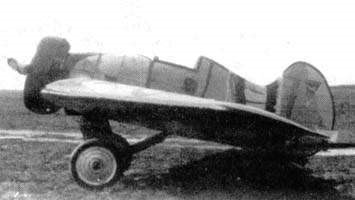
The development of the Executive Airplane or IS (Russian: Исполкомовскый Самолет “- ИС), designated BOK-3 by BOK (Russian: БОК-3, ИС or ЦКБ-9), began in 1933 at the TsKB of Factory No.39 Menzhinski, which is why it was also known as TsKB-9. The works were transferred to the BOK’s new location at Factory No.35 located in Smolensk.
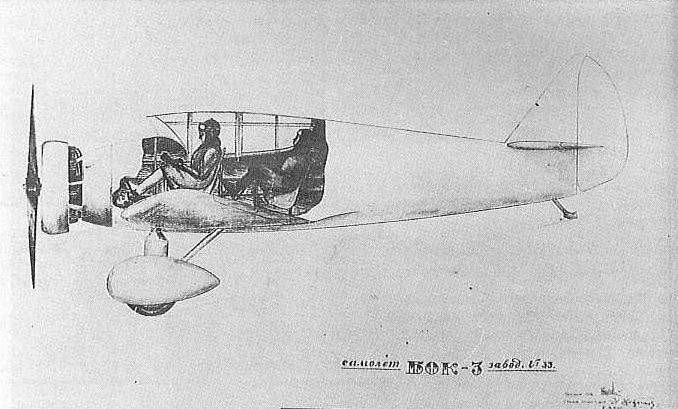
The conceptual drawings of the original version of the model are preserved, signed by II Tsiebrikov, at that time a recent graduate who was already directing the general types section of the BOK.
Original BOK-3 design with inverted-angle cockpit glazing.
The prototype completed in Smolensk in 1936 basically differed from the original concept design in the shape of the cockpit cover. The original angled front led to a more streamlined and modern shape. Other differences were the bracing of the tail planes in the produced model with their transfer to a higher position on the empennage and the absence of a fairing on the landing gear. The rudder and tail skid were also modified.
The BOK-3 was designed as an all-wood cantilever low-wing monoplane. As a remarkable detail, the wingtips were folded to reduce the area during transport or parking in hangars.
The fuselage had a monocoque structure. Both the wing and the tail were made of wood with a textile coating. The ailerons and the empennage featured a fabric-covered duralumin frame. The tailplane sat high on the empennage and was braced by inverted V posts.
The landing gear was of the conventional type with fixed and tail skid.
The BOK-3 was designed to use an M-48 radial engine protected by a Townend ring. This engine was also installed in the U-3 experimental aircraft and only a few units were built.
The BOK-3 was designed for short-distance shuttle service, but other possibilities of use such as pilot training and agricultural tasks were possible. The training version provided for the installation of double flight control and a PV-1 machine gun firing through the propeller shaft, another machine gun in a rear defensive position, a camera for aerial photography and the ability to install supports for a general capacity of 100 kg.
In agricultural versions the BOK-3 could have a chemical spraying system installed.
Only one prototype was built and successfully flown in 1936 but the development of the BOK-3 was abandoned.
Powerplant: 1 x М-48 piston engine Wingspan: 11.00 m Length: 7.10 m Fuel capacity: 190 liters Endurance: 3 hours Accommodation: 2
The BOK-2 (RK or TsKB-5) (Russian: БОК-2, РК or ЦКБ-5) was one of the three BOK designs not related to stratospheric flight and was characterized by the implementation of a high lift sectional wing design and hence it was known as RK – Razreznoe Krylo or Section Wing (No. confuse with the RK – Razdivizshnoye Krylo of Pashayev).
Designed by S. Krichevski the BOK-2 was conceived as an experimental type single-seater cantilever-wing monoplane with an M-11 engine. The distinctive feature of this aircraft was the long, sectioned wing with a special profile. The airplane was conceived to fly with different positions of the section. Each movement of the rudder and flaps caused a variation of the wing profile, so the pilot had the possibility to adjust the wing to the most practical regime for the real flight conditions.
The development of the BOK-2 brought with it a large amount of studies and tests in the wind tunnel with the aim of studying the wing aerodynamics in the different configurations.
A single example was built at the TsKB of Factory No.39 Menzhinski, as the TsKB-5. Its construction was very clean equipped with an M-11 engine. The plywood overlay was polished to a smooth, shiny surface.
The BOK-2 was tested between 1935 and 1936, being flown successfully. The development of the model was interrupted by the death of its designer.
The project of the “stratospheric” aircraft (as they were commonly called at that time) SS or BOK-1 was conceived using as a base the long-range monoplane ANT-25 developed by the Sujoi brigade in the collective led by AN Tupolev. Basically the BOK-1 was an ANT-25 with reduced wingspan and fixed landing gear fairing and was the first work of the Bureau of Special Constructions (BOK) under the leadership of Chizhevski.
BOK-1 or SS (acronym for Stratospheric Plane from Russian Стратосферный Самолет) was a 1935 experimental aircraft designed to test flight capability at heights between 12000 and 13000 meters.
A single prototype was built which was successfully flown and the first pressurized cockpit manufactured in the USSR was testad.
Construction of the BOK-1 was started at the TsAGI’s Experimental Construction Factory (ZOK) in late 1932. This factory had been created at the beginning of that same year, after the unification of the constructive capacities of the TsKB and the TsAGI.
In February 1933 the BOK was transferred to the TsKB of Factory No.39, under the direction of SV Ilyushin. The roughly 60 workers under Chizhevski’s leadership became Brigade No.3 and BOK-1 received the TsKB-2 designation. A short time later, in the summer of 1934 the group was again transferred, this time to Smolensk, to the base of Factory No. 35 dedicated to automotive repair and maintenance.
Despite the low qualification of the personnel and the lack of management cadres, Chizhevski managed to concentrate the group towards the main task and in this way the production of the BOK-1, begun in Moscow in 1932, could be completed three years later.
The BOK-1 was conceived entirely in metal. The wing consisted of the centroplane and removable three-spar consoles. The removable consoles have 16 ribs, the upper edge of which is exposed on the wing surface. The first two stringers of the consoles up to the middle of the span were made of steel tubes with a chromium-molybdenum alloy and from there up to the wing end were made of duralumin. The third stringer, to support less load, was built entirely of duralumin. The wing skin was corrugated metal, similar to that used on the ANT-25. During the tests, the corrugated surface of the wing surface was covered with glued calico, which was then polished and painted.
The fuselage was made up of three sections: bow, center (built integrally with the center plane) and tail. The front of the aircraft could be easily removed to allow the installation of different power plants. The central section was built in such a way that the pressurized cabin could be installed from above.
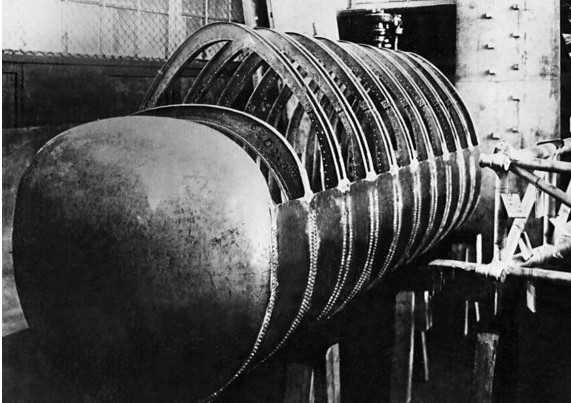
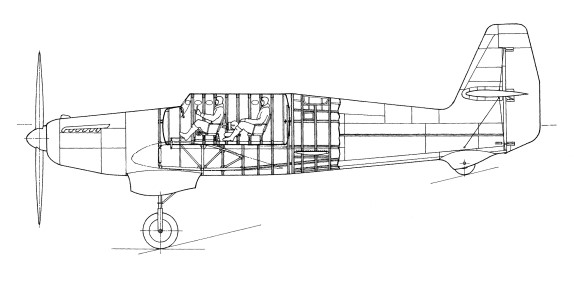
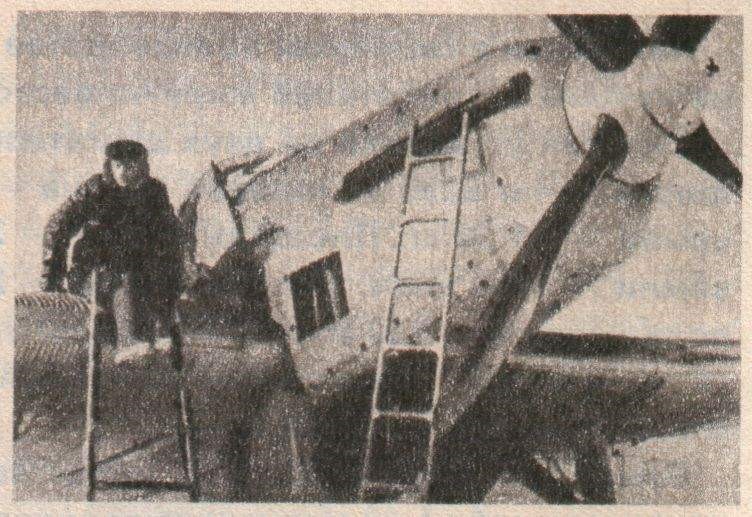
The pressurized cabin was calculated to accommodate two crew members and conceived as an independent element, not forming part of the aircraft’s structure. It was built in the shape of an oval cistern, made up of 11 metal frames and covered by a 2 mm sheet of duralumin. The pilots’ access was through a hatch similar to those used in submarines, located in the upper part of the center of the aircraft that gave access to a cylindrical area. There it was necessary to leave the parachutes and then go to the cockpit, which was accessed through another hermetic hatch located in the rear wall. Space was tight and the cabin uncomfortable.
Structure of the pressurized cabin used in the BOK-1
Felt layers were placed between the top of the cabin and the fuselage skin. This coating functioned as a thermal insulator for the cabin, while providing acoustic insulation, so that the crew could converse without the need for headphones.
The cabin was located above the water cooling radiator of the engine. In flight, the temperature in the cabin as a result of the heating received from below reached 40ºC. To regulate the heating there was a small hatch governed from the cabin.
To guarantee a certain degree of visibility, seven windows similar to the skylights of the boats were fitted. The pilot had five windows and the observer had two. Each window was double glazed. The 15-16mm outer glass was tempered. The interior was 3-4 mm thick and was constantly blown with hot air. Mechanisms were created inside the cabin to absorb carbon dioxide produced by respiration and inject fresh oxygen at a constant rate of 120 liters per hour. The two crew members had oxygen masks for emergencies.
The landing gear of the BOK-1 was of the fixed and conventional type, with oleo-pneumatic dampers and drop-shaped aerodynamic fairings on the main landings. The wheels had dimensions 900 x 200 mm.
Structural drawing of the BOK-1 clearly showing the location of the crew in the cockpit.
The BOK-1 in its original version used an AM-34RN engine designed by Mikulin, capable of developing 800 hp at a height of 4000 meters. This engine was later replaced by turbocharged versions. The cooling radiator was located at the bottom of the fuselage and featured adjustable gates. A little forward was the oil cooler. During the first flights, a 4.0-meter diameter four-bladed wooden propeller was used, which was later replaced by a 4.35-meter double-bladed propeller and finally by a 4.1-meter diameter metal one.
The total fuel capacity reached 500 kg and was distributed in 4 cylindrical tanks located between the first and second spars of the centroplane.
The BOK-1 was painted in a combination of two colours: red and silver. In the empennage it wore the triangular outline, symbol of the BOK.
The 13 of December of 1935 the IF test pilot Petrov and chief engineer for testing (and one of the developers of the model) NN Kashtanov, made the first flight in the BOK-1.
The BOK-1 “stratospheric” aircraft, equipped with an AM-43FRN engine with a three-bladed propeller, was the first Soviet aircraft to have a pressurized cabin. During the first flight it was found that at 9000 meters the pressure inside the cabin corresponded to a height of 2 – 3 km above the ground and the temperature oscillated around 25ºC.
The flight program was continued in 1936. IF Petrov was forced to constantly move from Moscow (where he worked at the NII VVS) to Smolensk for the development of these tests, so the decision was made to continue them with PM Stefanovski, who in the summer of 1936 moved to Smolensk on secondment.
During the tests the 25 of June of 1936 Stefanovski and Kashtanov reached a height of 10,875 meters flying. At this point, two problems were manifested: the exterior glass of the windows was completely fogged, impeding the vision and the wing ailerons were frozen, losing all effectiveness.
The BOK-1 was transferred to Moscow, to the NII VVS test airfield . The fight for the dominion of the heights entered a new stage. It was a question of the tests to determine the maximum ceiling. To this end, the plane was especially lightened. On Stefanovski’s first flight on the NII VVS a ceiling of 14,100 meters was reached.
In the fall of 1936 the BOK-1 flights on the NII VVS were canceled. The atmosphere was getting too cold. By that time, 42 flights had been made reaching speeds of 230 km / h at sea level and 242 km / h at 400 meters with a normal takeoff weight of 4162 kg.
The results obtained so far were recorded in the report presented by the head of the NII VVS Korobov on December 10, 1936. These results are summarized in the following:
The feasibility of using the pressurized cabin for high-altitude aircraft was verified.
The design of the selected cabin was shown to be functionally correct, so that it was possible to go from experimental construction to the development of specific objectives.
The BOK-1 experimental aircraft proved to be an excellent research device that could be used as a flying bed for future experimental developments of pressurized cabins, equipment and weapons tests in the conditions of the stratosphere.
The tasks to be solved in the short term were: BOK-1 flight ceiling increase Fixing the problem with glass hatches Improved visibility Weapons installation and testing Creation of defensive firing points operable from the watertight cockpit Armor of the cabin to prevent its de-sealing due to the impact of projectiles.
As conclusions, the Narkomat of the Defense Industry was asked to create military aircraft with a hermetically sealed cabin, improve the working conditions of the BOK, develop the BOK-7 version in a military version as a high-altitude bomber and force preparation in the TsIAM of the AM-34TN turbocharged engine to locate in the BOK-1.
On December 22, the report was signed by the head of the VVS Ya. I. Alksnis, who requested to raise the ceiling to 20 thousand meters.
The new AM-34RNB-TK engine was installed in the BOK-1 in the spring of 1937. After the ground set-up tests, the test flights were continued. In the period between June 6 and October 1, the new engine worked for 5 hours 40 minutes on the ground and 24 hours 1 minute in the air.
The 27 of August of 1937 Stefanovski, with Reno as an observer, reached a ceiling of 14100 m before the turbocharger is damaged. Repairs continued until February 1939. In April 1939, a new AM-34FRNV engine with TK-1 turbocharger was installed in the BOK-1, with which several flights were made without exceeding 14,000 meters.
In the second half of the 1930s, the BOK-7, BOK-8 and BOK-11 models were created on the basis of the BOK-1, in which the concept of a pressurized cabin and the use of turbochargers were developed. Some of these models were designed with remotely controlled weaponry, which was a major technological achievement.
The BOK-1 development versions include:
BOK-7 – Originally conceived as a stratospheric reconnaissance aircraft, it ended up being developed as a record-setting aircraft. It began to be projected in 1935 as a development of the OKO-1. It was used on the ground for crew training for the BOK-15. BOK-8 – Conceived as an armed development of the BOK-7 (the second copy). It was not built, but it became the BOK-11. BOK-10. Exploration version project on the BOK-7. High altitude bomber developed on the BOK-7. It was used on the ground for crew training for the BOK-15. BOK-12. Project for a twin – engine version of the BOK-7 conceived as an experimental flying laboratory. A large aperture camera for exploration was planned to be installed in the BOK-12 fuselage. It was never realized. BOK-13. High altitude passenger plane project with capacity for 6 people developed on the basis of the BOK-7. BOK-15. A powerful stratospheric plane conceived in 1937 to set a new world record for flight distance. Two copies were built in 1939. The start of the Great Patriotic War brought about the cancellation of flights.
Retired in 1939, the BOK-1 served as the basis for a series of experimental developments.
BOK-1 Engine: 1 x Mikulin AМ-34RN 830 hp Wingspan: 30.00 m Wing area: 78.80 m² Length: 12.86 m Height: 5.50 m Wheelbase: 5.19 m Empty weight: 3481 kg Normal takeoff weight: 4600 kg Maximum takeoff weight: 4880 kg Maximum speed SL: 240 km / h Maximum speed at 9000 m: 315 km / h ROC: 500 m / min Landing speed: 85 km / h Practical ceiling: 12000 m Maximum ceiling (lightened): 14,100 m Seats: 2
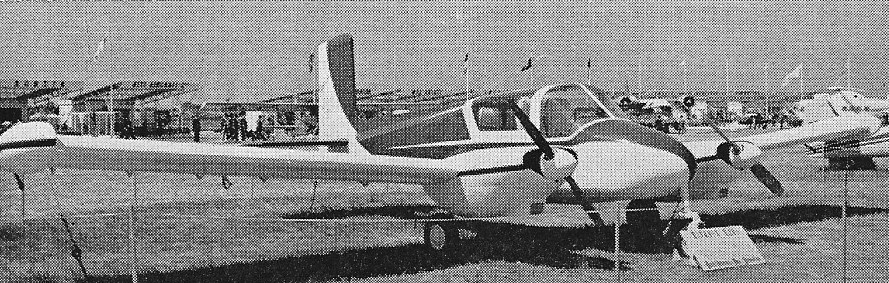
The Boisavia B.260 Anjou was a four-seat twin-engine light aircraft developed in France in the 1950s. It was a low-wing cantilever monoplane of conventional configuration with retractable tricycle undercarriage but fabric-over-tube construction.
Intended by Boisavia as a touring aircraft, it did not find a market and only the single prototype was constructed, first flying on 2 June 1956. At this point, the firm, via NORD, sold the design to SIPA, which modified the design and re-engined it with Lycoming O-360 engines as the Sipavia Anjou, but found that they could not sell it either.
Plans to develop a stretched version with three extra seats and Potez 4D engines were also abandoned.
Avia France says 1 built. But Flight says at least 5 B.260 Anjou were built – or were under construction in 1955 – incl. 2 prototypes by Boisavia and 3 pre-production versions built by SNCAN at Meaulte.
Variants: B.260: Boisavia prototype with Regnier 4L engines (1 built) B.260: 1953 plan was for DH Gipsey Major-powered 4/5-seater B.260: 2 x 170 hp SNECMA-Régnier 4 LO-2 4-cyl inline, B.261: 2 x 190 hp Lycoming O-360-A, 1 B.260 conversion S.261: SIPA designation for the B.261 conversion (1 converted) S.262: Planned seven-seat version (not built)
Specifications: B.260 Engines: 2 × SNECMA licence-built Regnier 4L-02, 127 kW (170 hp) each Wingspan: 12.85 m (42 ft 2 in) Wing area: 21.5 sq.m (231 sq.ft) Length: 7.10 m (23 ft 3 in) Empty weight: 992 kg (2,187 lb) Gross weight: 1,870 kg (4,123 lb) Maximum speed: 260 km/h (160 mph) Range: 1,250 km (780 miles) Service ceiling: 7,125 m (23,370 ft) Rate of climb: 6.0 m/s (1,180 ft/min) Crew: one pilot Capacity: 3 passengers
The Chablis was designed by Lucien Tieles and constructed by Avions Boisavia in 1950. It was a two-seat ultra-light monoplane with a high parasol wing supported by struts. The seats were arranged in tandem. It was a simple all-wood design with fabric covering and was intended to be fitted with a variety of engines in the 50-80 h.p. range.
Two Chablis were built by Boisavia, the first F-PBGO making its first flight on 16 July 1950. Claude Piel built the second, F-PBYF, in 1953. These were powered by a 65 hp (48kW) Continental A65 engine. The Chablis was intended for construction by amateur builders using kits supplied by the firm. In the event, no further examples were completed and further development was not proceeded with.
Engine: 1 × Continental A65, 48 kW (65 hp) Wingspan: 9 m (29 ft 6 in) Length: 7 m (22 ft 11 in) Gross weight: 513 kg (1131 lb) Max speed: 87 mph Cruise: 65 mph ROC: 540 fpm Crew: 2
In 1946, Lucien Tieles built the prototype of a three-seat high wing monoplane – the B.50 Muscadet. This aircraft, powered by an 100 hp Renault engine, was then redesigned with a higher rear fuselage decking to provide full four-seat capacity. Fitted with a 140 hp Renault 4 Pei engine, and designated B.60 Mercurey, the first aircraft made its maiden flight on 3 April, 1949 and Tieles established the Société Boisavia to build the aircraft commercially. It was a conventional high-wing braced monoplane with fixed tailwheel undercarriage. Forty six were built and found use in the normal general aviation roles of tourer, trainer, agricultural aircraft, and glider tug.
While the prototype Mercurey had used a Renault engine, most production units were the B.601L with an 190 hp Lycoming flat four engine. With the same airframe the company was able to produce small numbers of other versions with different engines and Mercurey production continued until the middle of 1962 with virtually all sales being made in France or its overseas territories. Serial numbers ran from c/n 1 to 5, 18 to 29, 51 to 55 and 100 to 116. In addition, the various prototypes had unique serial numbers.
Boisavia B-601L Mercurey
After the two B-60 and three B-601 models, the B-602 was powered by a 165 hp Continental E165-4.
The B-603 Mercurey-Special glide tug variant has a 240 hp Salmson-Argus As 10.
On 29 April 1954 the first B-605 Mercurey flew with an initial production batch of 14 underway.
B-605 Mercurey
Variants:
B.60 Mercurey 3 prototypes powered by 100 kW (140 hp) Renault 4Pei engine Prototype F-WFDV c/n 01, first flown April 3, 1949. B.60 tourer/trainer also employed for ag work and as glider tugs c/n 01 F-BFDV, 02 F-BFLL/F-BFLM, 03 F-BFLP
B.60 Engine: 1 × Renault 4Pei, 104 kW (140 hp) each Length: 7.10 m (23 ft 3 in) Wingspan: 11.38 m (37 ft 4 in) Height: 2.10 m (6 ft 10 in) Wing area: 18.0 sq.m (194 sq.ft) Empty weight: 520 kg (1,146 lb) Gross weight: 1,000 kg (2,205 lb) Maximum speed: 235 km/h (146 mph) Cruising speed: 190 km/h (118 mph) Range: 1,100 km (684 miles) Service ceiling: 5,500 m (18,045 ft) Rate of climb: 4.0 m/s (790 ft/min) Crew: one pilot Capacity: 3 passengers
B-605 Mercurey Engine: 170 hp SNECMA-Regnier 4L-02 Wingspan: 37 ft 4 in Wing area: 182.986 sq.ft Length: 23 ft 5 in Height: 6 ft 10 in Empty weight: 1190 lb Loaded weight: 2204 lb Max speed: 140 mph Cruise: 124 mph Range: 745 mi Seats: 4
In 1946, Lucien Tieles built the prototype of a three-seat high wing monoplane designed by Lucien Tieles, Claude Piel, and M. Dorose – the B.50 Muscadet. This aircraft, c/n 01 F-WBBG/’CZE, powered by an 140 hp Renault Bengali engine, was then redesigned with a higher rear fuselage decking to provide full four-seat capacity and designated B.60 Mercurey.
A low wing microlight of mixed construction, the Bohem 3 has wings of sheet dural partially fabric covered, while the fuselage and tailplane are welded steel spaceframe construction.
Empty weight: 270 kg Wing span: 9 m Wing area: 11.5 sq.m Fuel capacity: 45 lt Certification: CS Engine: Verner, 70 hp MAUW: 450 kg Seats: 2 Max speed: 230 kph Cruise speed: 180 kph Minimum speed: 60 kph Climb rate: 6 m/s Fuel consumption: 10 lt/hr Price (1998): 70.000 DM