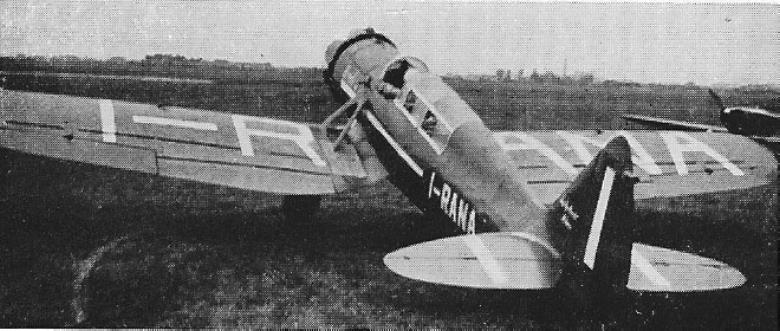
Developed from the Ba.39, the Ba.42 was powered by a 180 hp Fiat A.70 S radial, and slots replaced slats. It used the Breda-Mazzini “wing-valve”. A slot in front of the ailerons and flaps which, operating in conjunction with the trailing edge flaps, is closed by a movable section of the wing which lowers to act as an airflow deflector.
Built for the 1934 Challenge de Tourisme International, registrations: I-GOGA, I-OMBO
Ba.42 Engine: 180 hp Fiat A.70 S Wingspan: 33 ft 1 in Wing area: 170 sq.ft Length: 25 ft 7 in Empty weight: 1232 lb Loaded weight: 2002 lb Max speed: 163 mph Cruise: 138 mph Seats: 2
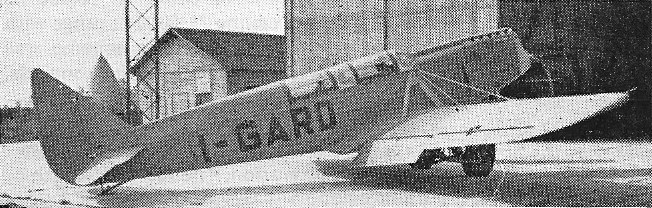
The 1932 Breda Ba.39 was a 2-seat low-wing braced-monoplane tourer, 10.40m span. An enlarged version of the Ba.33, powered by a 130hp Colombo S63 inline, 60 were built.
The Ba.39 Metr: Metropolitano, was a military version intended for home use. 20 were built.
The Ba.39 Col: Coloniale, military version was intended for use abroad. 20 were built.
Three Ba.39 S 3-seat version were built in 1934 (MM55848 / I-LUDA, I-LUDO, I-VICE).
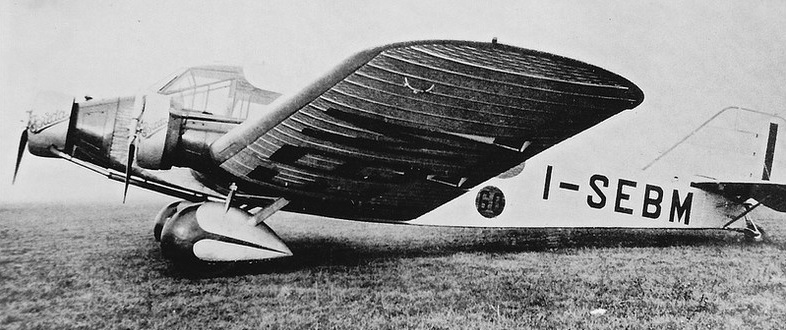
I-SEBM c/n: 3232001 Ministero Aeronautica /Centocelle 17 June 1932
A 1931 trimotor low-wing monoplane light airliner
The Breda Ba.32 was an Italian three-engine medium civil/transport aircraft, which had room for 8/10 passengers or freight. The maiden flight was in 1931. Only one aircraft was built known to have gone in June 1932 to the Ministero Aeronautica and it was powered by 3 x 320 hp P&W Wasp Junior and demolished in March 1940.
Other sources record I-ADDB as registered on 3-12-34 to SAI, Torino, and it had gone to Militar Aviation August 1935, it should have Fiat engines.
The Ba.28 training biplane was similar to the Ba.25 except that power was provided by a 380 hp / 290kW Piaggio Stella VIIZ (Gnome-Rhone K-7) radial engine.
Built in both single- and two-seat configurations, the Ba.28 had ailerons on both wings, a cowl, spinner, and larger Ba.25 I-style rudder.
The Ba.28 idro twin float version was exported to Norway.
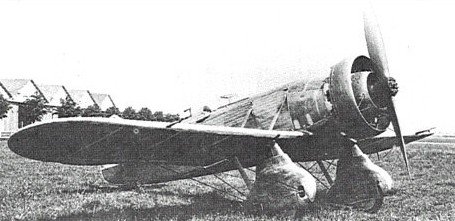
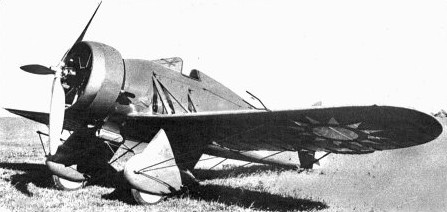
Designed by Cesare Pallavicino, the unsatisfactory characteristics of the Breda 27 low-wing braced monoplane fighter prototypes led, in late 1933, to the complete redesign of the fighter by engineers Parano and Panzeri, and the construction of a further prototype. The first prototype, MM.216, powered by a 530 hp Alfa Romeo Mercury VI, originally was fitted with a 2-blade prop, later replaced by 3-blade metal prop.
The fuselage was of welded steel tube with corrugated light alloy skinning and the wing was of wood. Proposed armament comprised two 12.7mm synchronised machine guns.
Two prototypes were built, flight testing commencing early 1933, and the second prototype, MM.217, flying from Milan to Rome-Montecelio on 10 July of that year in 90 min at an average speed of 334km/h. The second prototype differed from the first in several respects, additional bracing struts being introduced between the wing and fuselage, and struts added to increase the rigidity of the tailplane. The tailplane enlarged compared with MM.216.
The characteristics were generally unsatisfactory, the poor view from the cockpit being the subject of particular criticism, and, Ing Pallavicino having meanwhile left Breda, a total redesign of the fighter was undertaken by engineers Parano and Panzeri as the Breda 27 Metallico, in late 1933, and the construction of a further prototype.
Breda 27 Metallico
Unlike preceding Breda 27s, the new prototype (I-BAWA / MM.218) was entirely of metal construction, the wing being of steel and duralumin with duralumin skinning, and the corrugated skinning of the fuselage gave place to a smooth duralumin covering. Criticism of forward view for take-off and landing was answered by moving the cockpit bodily forward and raising it by deepening the fuselage. The 540hp Alfa Romeo-built Mercury IVA engine was retained, but the two-bladed wooden propeller gave place to a three-bladed metal propeller. The new prototype was flown in June 1934, and in September of that year it was ferried from Milan to Oslo (for demonstration to the Norwegian air arm) at an average speed of 283km/h, being exhibited at the Salon de l’Aeronautique in Paris in November.
The fifth example was purchased by Italy’s Ministero dell’Aeronautica.
Similar to the redesigned third prototype, the series version was designated Breda 27 Metallico (signifying that it was of all-metal construction) and 18 were ordered by China. In the event only 11 were delivered (in 1936), these being assigned to the 29th Pursuit Sqn at Canton. An armament of two 12.7mm machine guns was carried.
The prototype was obtained by the Regia Aeronautica, serving with the 86a Squadriglia, 5° Stormo Assalto, until December 1937.
Breda Ba.27 Take-off weight: 1903 kg / 4195 lb Wingspan: 10.68 m / 35 ft 0 in Length: 7.75 m / 25 ft 5 in Height: 3.40 m / 11 ft 2 in Wing area: 19.60 sq.m / 210.97 sq ft Max. speed: 385 km/h / 239 mph
A 1936 2-seat primary trainer version of the Ba.25. One was built (I-ABFM) with an 11.60m span and one 130 hp Walter NZ-120 engine. Performance was poor.
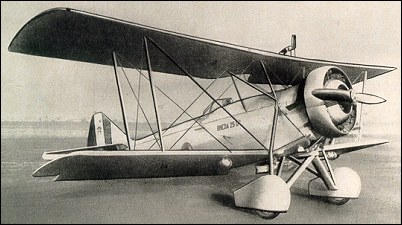
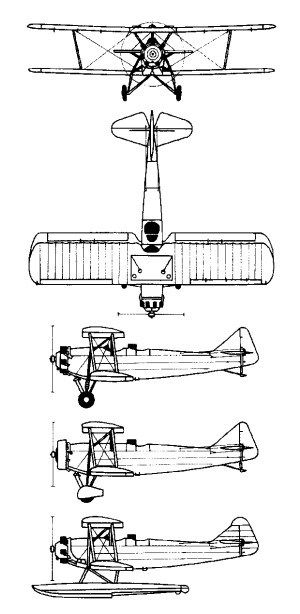
Evolved from the Ba.19A, the Ba.25 training biplane was powered by a Lynx or Castor engine. The Ba.25 was operated by the Regia Aeronautica as a landplane and as a twin-float seaplane.
Ba.25 Prototype Wingspan: 10m Wing chord: 719 mm Seats: 1
Ba.25/D2 Engine: 1 x Alfa Romeo D-2 C.30, 250 hp / 175kW Take-Off Weight: 1038 kg / 2288 lb Loaded Weight: 790 kg / 1742 lb Wingspan: 9.8 m / 32 ft 2 in Length: 7.8 m / 25 ft 7 in Height: 2.8 m / 9 ft 2 in Wing Area: 25.0 sq.m / 269.10 sq ft Cruise Speed: 195 km/h / 121 mph Ceiling: 7500 m / 24600 ft Range W/Max.Fuel: 500 km / 311 miles Crew: 2
The Breda B.1 of 1920 was an enclosed-cabin airliner conversion of surplus Caproni Ca.5 bomber. A twin-engined twin-boomed biplane six passenger airliner with a 25m wingspan the fuselage was rebuilt for passengers and two engines.