In 1909 John H Wilson, of Middlesex PA., USA, built an open cockpit biplane with two chain-driven pusher props. It appears to be a Wright copy in essence, except for wings with one lateral rib, around which the surfaces are bowed in an airfoil shape.
Engines – Power
Wilson Sky Mouse
The 1950 Sky Mouse N6840 midwing midget racer was built by James Wilson powered by an 85hp Continental C-85.
Wilson Li’l Rebel
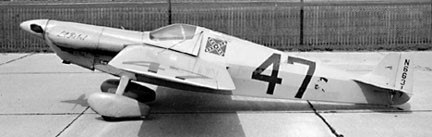
The 1948 Li’l Rebel N66317 midget racer was built by James Wilson from salvage of a Pack C racer. Powered by an 85hp Continental C-85, the single seater was piloted by M L LeFevers and Jimmy Wilson.
Wilson Baby Cyclone
The 1959 Baby Cyclone N121W was a single place cabin midwing midget racer built by James Wilson. It was not raced until 1965 at Reno where it qualified ninth at 162 mph.
Wilson Privateer
A motor glider designed by D.A.Wilson, UK.
Two examples are known;
PFA.1357 D.A.Wilson. c/n 1. Privateer Series 1. Possibly not finished and used in PFA.1568.
PFA.1568 G-BCTH D.A.Wilson & C.Pattison, Bishop Auckland. c/n 2. Privateer Series 2.
(Dr Frank M) Wilson Aircraft Comp Mid-Wing 3-B
Designed by E H Gustavson, the 1930 Mid-Wing 3-B N124W was a three place open cockpit monoplane powered by a 150hp Axelson B, later 220hp Wright.
Reportedly it passed all flight tests successfully with no changes in engineering and production was planned, but did not materialize.
Wingspan: 37’0″
Length: 27’0″
Empty wt: 1600 lb
Max speed: 125 mph
Cruise speed: 110 mph
Stall: 44 mph
Seats: 3
Wilson 1917 Monoplane
Al Wilson’s 1917 two place open cockpit, mid-wing monoplane was a Blériot copy built for Cecil B de Mille’s film, “We Can’t Have Everything.”
Power was an 80hp rotary.
Wilson 1913 Biplane
The 1913 single place, open cockpit biplane was motion picture and stunt pilot Al Wilson’s first effort as a teenager, a Curtiss pusher type that only gained 50′ altitude and refused to turn. It was abandoned because of structural fatigue after a few hard landings.
Wilmington Aero Club / WAC Delaplane
Built in 1910, the Delaplane was designed by Robie Seidelinger as a single place open cockpit biplane. Powered by a 45hp Elbridge engine, the elevator was in the front, rudder in the back, and ailerons were under the lower wings.
The machine made a couple of short flights in 1910, rising from the ground a few feet, according to Delaware Aviation History. It was later destroyed in a hangar fire.
Wills 1910 monoplane
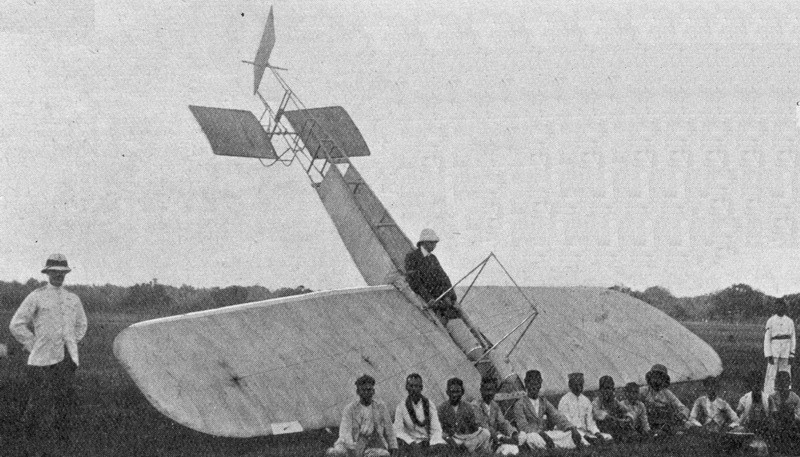
Wilfred Wills, motor engineer of Messrs Addison and Co., Madras, India, built a Blériot-inspired monoplane, powered by a 20 hp Ford engine, in four weeks. It was tried out on 2 November 1910 on the Island at Madras.
Although there was a strong wind blowing Wills succeeded in making three very short flights. During the last one the machine was somewhat damaged, but the repairs were put in hand at once and two days later a further trial was made with the result that a flight of 30 yards at the rate of 35 to 49 miles an hour.
 All Aero