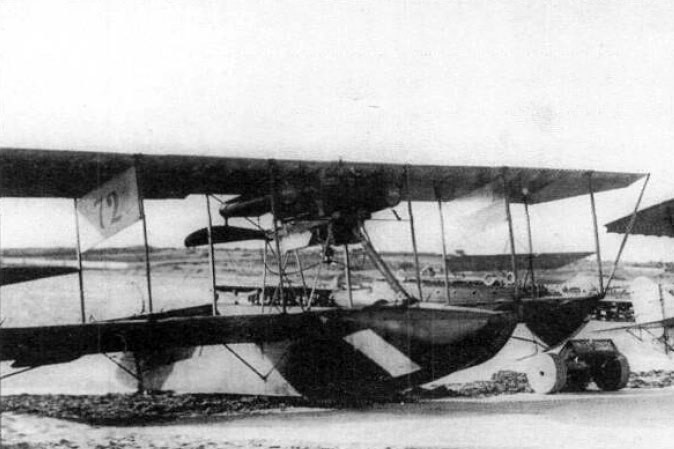
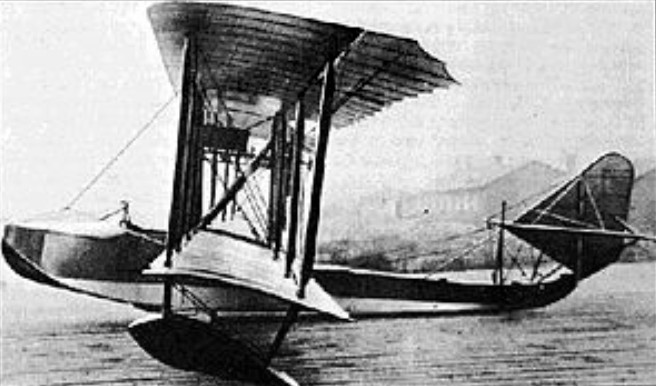
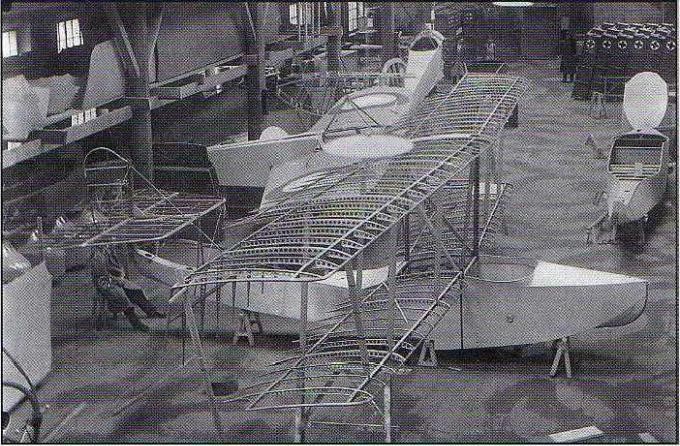
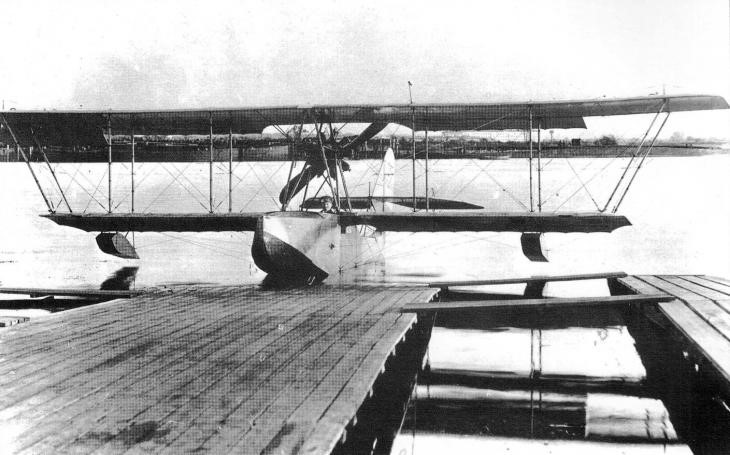
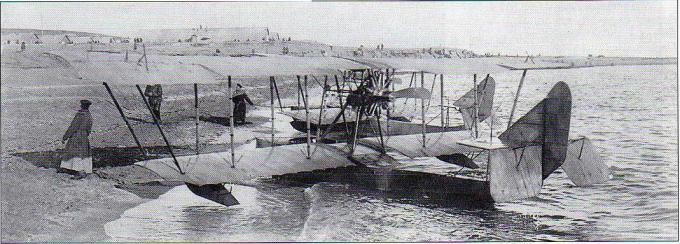
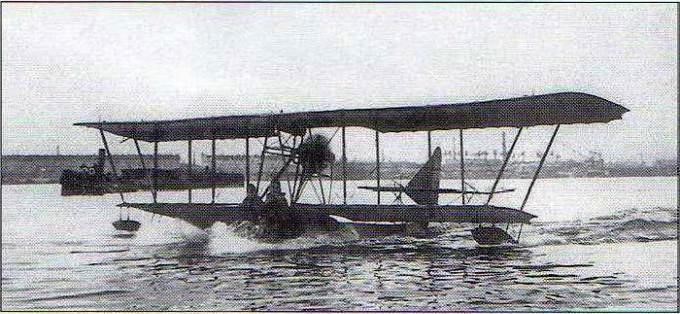
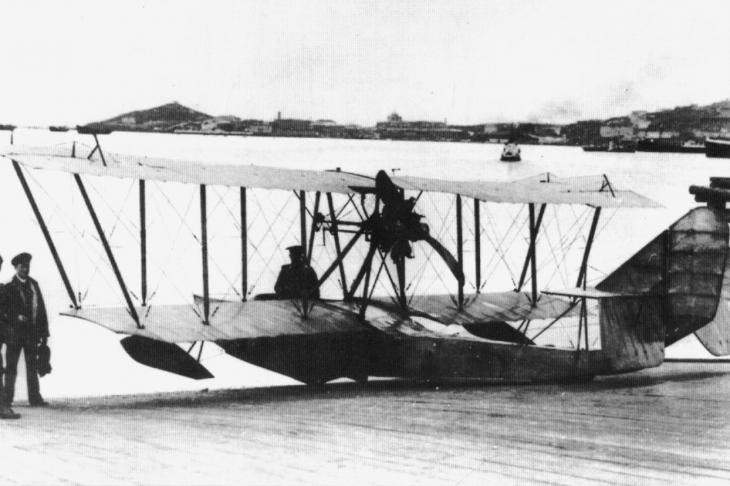
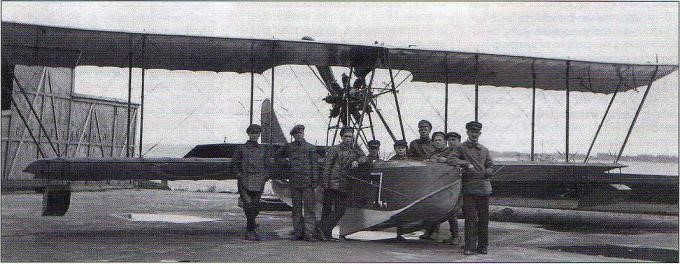
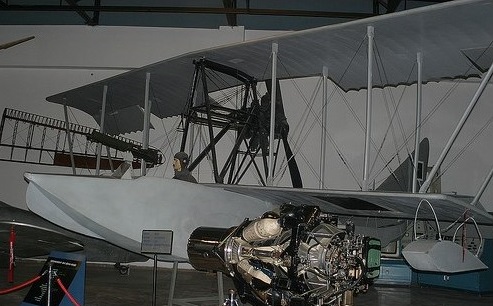
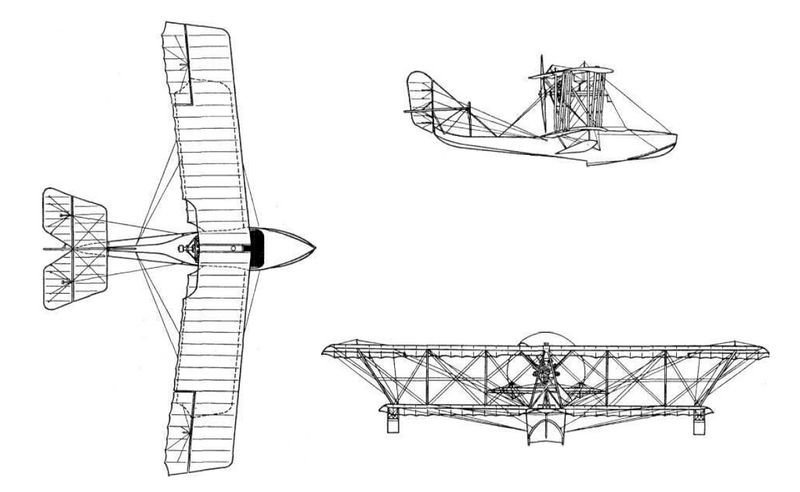
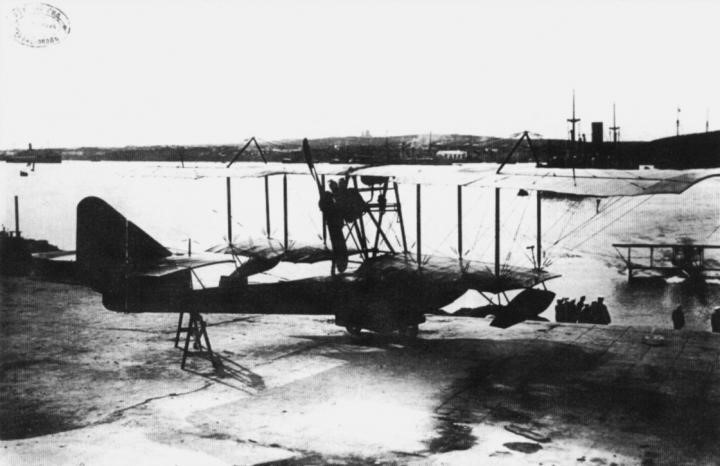
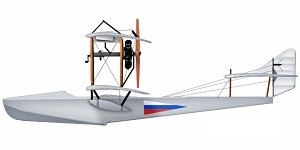
According to Shavrov the Grigorovich M-8 (Russian: Григорович М-8) was a new prototype on the way to the M-9, in which the contours of the hull were once again modified with a higher recess (about 150 mm). In this case the prototype did not even manage to take off from the water.
AO Alexandrov handles another theory since the following statement appears in a Navy document dated October 26, 1915: “Currently at the Schetinin factory two large experimental flying boats with increased range are being built. At this time one of them (the minor) is ready and is in the testing stage…”
According to Alexandrov this document refers to the M-7 and M-8 models.
The idea of creating the M-8 as a large flying boat with a long range could respond to a request from the pilots of the Baltic Fleet. In the Naval General Staff, many plans related to naval aviation were related to the giant models of Igor Sikorski and their possible modification to navalized versions. Unfortunately, the only example of the Ilya Múromets bomber in floatplane configuration with floats was destroyed by an accident caused by its pilot’s error during landing in the first days of the war.
At the end of July or beginning of August 1915 D. P. Grigorovich presented to the Aviation Committee of the Baltic Fleet the project of a biplane and twin-engine flying boat with an empty weight of 3.1 tons and a payload capacity of 2 tons. The large fuel capacity (970 kg) allowed it a range of 8 hours of flight at cruise power from its 600 total hp engines. The calculated speed was about 105 km/h.
On August 12, the military pilots supported the idea and proposed giving the aeronautical manufacturer an advance of 50% of the value requested to start the construction of the experimental prototype. The other 50% would be delivered once the specimen was finished and successfully tested, considering that the data presented could only reach a deviation of 10% with respect to the calculated ones.
On August 22, Captain 2nd Rank BP Dudorov, Head of the Aviation Department of the Baltic Sea Liaison Service , approved the idea, but expressed his disagreement with the proposed form of payment. Instead he proposed that the firm apply for a loan and deliver the engines of the requested power.
Everything indicates that SS Shchetinin put great hopes in the project, for which he ordered to start its construction at risk. It was also oriented to expand the factory with new workshops capable of accommodating large flying boats under its roof.
According to a report from the Naval General Staff (MGSh), issued on September 24, the model was built with two 220 hp engines, which would allow a horizontal speed of 95 km/h with a climb of 2,000 meters in 30 minutes. Cargo capacity was also reduced to only 1.7 tons, including crew, weapons and fuel capacity for 7 hours of patrolling. Neither the Navy nor the company were able to obtain the long-awaited 300-hp engines, but hope remained that they could be delivered before construction of the prototype was completed.
From then on, all the evidence that could link the fate of the M-8 disappears. Probably the requested power plant could not be obtained and the performance with the 220 hp engines ceased to be of interest to the Navy, but these are only guesses.
In a paper presented to a meeting of the Imperial Flying Club on November 25, 1915 , AO Alexandrov found some technical data on an airplane that he associated with the M-8. These data are the following: Number of motors: 2 Total power: 600 hp Take-off weight: 5100kg Payload Capacity: 2000kg Endurance: 8 hours Fuel weight for 10 hours of flight: 970 kg Armament weight in 5-hour flight: 650 kg Armament weight in 10-hour flight: 135 kg Crew: 5 people Speed with maximum load: 105 km/h Wingspan of upper plane: 33 m Wingspan of the lower plane: 24 m Height: 3.8m Length: 14.6m
The Grigorovich M-7 (Russian: Григорович М-7) appears in different literary references with great contradictions, even denying their existence. Given that there is no documentary evidence to confirm which of the versions could be closer to reality, we will have to present them all referring to their main speakers.
Mijaíl Maslov, researcher and historian and author of innumerable works in relation to the M-7 writes: The M-7, like the earlier M-6 appears to be an enlarged and unsuccessful version of the M-5 with a 150 hp Sunbeam engine. During the tests it failed to take off from the water. Modification attempts were of little help and eventually the aircraft was disassembled for spare parts. VB Shavrov however alleges that the M-7 featured modified contours, higher tread and a wide angle keel. The takeoff was heavy but in the air the model behaved normally.
AO Alexandrov agrees with Maslov that the M-7 was originally unflyable, but tells of possible later tests in Baku.
According to Alexandrov, the M-7 was a three-seat development model of the M-7 created in the PRTV in a period between July and August 1915. A document dated September 24 is preserved where it is detailed that in a few days this three-seater model would be tested.
Apparently the decision to build the M-7 was generated as the company’s own initiative with the aim of presenting a model that would compete with the Curtiss K.
For unclear reasons, which could be due to the lack of the right engine or the terrible autumn conditions, the tests did not begin until November. On the 4th the prototype was sent to Revel, but the trip to that city took about two weeks.
SS Shchetinin considered it essential to participate personally in the development of the tests, since he had a great interest in their results. Unfortunately, her hopes were dashed when the M-7 flying boat refused to take off from the water at the end of November. The company’s specialists kept hoping for an effective design and for this reason continued to work on the model. By mid-January 1916 the flying boat with a 150 hp Sunbeam linear V engine known as “Crusader”, was tested at the branch of the Petrograd Naval Pilot Officers School opened in Baku, on the shores of the Caspian Sea.
The results obtained with the new model M-9 led to the abandonment of attempts to continue working on the M-7. The subsequent fate is unknown.
M-7 Power plant: 1 Sunbeam 150 hp Propeller: 3 m diameter / 2.25 m pitch Accommodation: 3 Payload Capacity: 450kg Calculated top speed: 95km/h Calculated time to 2000 m: 30 min Calculated endurance: 5 – 5.5 hours
Vadim Borisovich Shavrov, aeronautical constructor, coworker of DP Grigorovich at OMOS and historian in his encyclopedic work “Aeronautical Construction in the USSR up to 1938” defines the M-6 (Russian: Григорович М-6) as a temporary version in the towards the M- 9:
M-6 with 150 hp Sunbeam engine. The hull of the flying boat was similar to that of the M-5 but with an enlarged keel. The forms were not very successful and the takeoff from the water was difficult.
Mijaíl Maslov, another prominent researcher and historian and author of innumerable works of recognized historical value, has not found clear evidence and in relation to the M-6 he writes:
Possibly this denomination was assigned to a new Grigorovich flying boat with a 150 hp Sunbeam engine that showed unsatisfactory results during the tests. In any case, to date no documents have been found that confirm the existence of a model with that name.
The aeronautical historian AO Alexandrov in his book “The airships of the Imperial Fleet 1894 – 1917 expresses, however, another theory that is still interesting:
There is evidence that SS Schetinin clandestinely built five copies of the Curtiss F model for the Black Sea Fleet, which were delivered between October and December 1915 at a unit cost of 5,595 rubles per unit.
According to Alexandrov, it could have happened that this adventure of creating the necessary flying boats without a license had led SS Schetinin to seriously think about the possibility of establishing an important production contract without development expenses and given the possibility that the M-5 model would not approved (especially since the Baltic Fleet rejected this flying boat in favor of the French FBA) to have an “Ace up the sleeve” in the form of a proven and successful design that could be presented to the Navy under the name public M-6 in order to avoid pretensions of the North American firm.
It is noteworthy that no Navy document mentions the M-6 model and the 5 copies of the Schetinin Curtiss F delivered to the Black Sea Fleet in the documents are only referenced with their registration number and sometimes with the letter “k” at the end.
Grigorovich M-5 (alternative designation Shch M-5, sometimes also Shchetinin M-5 (Russian: Григорович М-5)) was a successful Russian World War I-era two-bay unequal-span biplane flying boat with a single step hull, designed by Grigorovich. It was the first mass production flying boat built in Russia.
During the summer and autumn of 1914 several flights were made on the M-2, proving that it still needed to work on the design in order to achieve a model capable of satisfying the needs of the Russian naval forces. The improvements introduced in the M-3 model did not bring the expected success either and this was understandable considering that the M-3 was just a version of the previous model with a more powerful engine and a new wing profile. The tests of this model did not show great differences in relation to the base model. Also unsuccessful was the later model M-4, a version with slight improvements to the hull design, new changes to the airfoil, and the same engine as the M-3.
It was produced, primarily to replace foreign built aircraft, including Curtiss Model K and FBA flying boats.
In his design Grigorovich used the information obtained from the French FBA models, which operated with the Baltic Fleet. On the way to obtaining the best possible design for the new model, Grigorovich decided to go to the Petrograd Polytechnic Institute, where one of the best aerodynamics laboratories in all of Europe existed, with a wind tunnel run by VA Sliesariev.
The M-5 was of a wooden construction, the hull was covered in plywood and the wings and tailplane were covered in fabric. Aft of the step the hull tapered sharply into little more than a boom, supporting a characteristic single fin and rudder tail unit, which was braced by means of struts and wires. It was normally powered by a 100 hp Gnome Monosoupape engine mounted as a pusher between the wings, but some used 110 hp Le Rhône or 130 hp Clerget engines. The pilot and the observer were accommodated side-by-side in a large cockpit forward of the wings, the observer provided with a single 7.62 mm Vickers machine gun on a pivoted mounting.
The M-5 was a development of the previous models with better hull hydrodynamics and modifications to the tail section for greater efficiency. Unlike earlier models, the wings were inserted into the sides of a deeper hull. The wingspan and surface of the lower plane were increased.
Grigorovich devoted great attention to strengthening the hull structure, especially in the areas that were in direct contact with the water. The railing was modified with a decrease in its height in the center to 70 mm and towards the sides of 140 mm. The sides of the bottom had some slats that allowed the flying boat to stay on the launching surface when leaving the water.
The structure was made of ash covered with 3 mm plywood on the edges and 5 – 6 mm on the bottom. 10 mm plywood was used in the recess area. The internal structure was made up of frames with diagonal reinforcement supports.
The assembly of the hull was done with brass screws with a lead or zinc coating. The joints in the hull skin were reinforced by plywood plates fixed with copper rivets from the inside. In the lower outer area of the hull, the joints were covered with 0.3 mm copper sheets and soldered together with tin. On the outside the wood coating was covered with varnish and on the inside with pitch. A special “marine” glue was also used during the assembly of the different pieces. It is interesting to note that all the work was manual. The hull had good rigidity, but even so breakages were common in aviation schools by inexperienced students.
The construction of the wings, the stabilizer and the keel of the vertical empennage was made of pine wood. The elevators and rudders were built from a light structure of thin-walled steel tubes (30×28 and 20×18 mm) with some wooden ribs and fabric covering.
The wing featured a double spar structure, built from I-profile pine pieces with holes to save weight. The wing ribs were made from 20 x 5 x 5 mm pieces of plywood, also lightened by perforations. Its wing profile was extremely thin (4% chord bristle). The interplanar supports were made of wood and the cross tensors were made of 5-8 mm cables. Cables were also laid between the wing box and the nose of the flying boat. The cables for the control surfaces were located on the outside of the flying boat, making them easy to service and repair.
The horizontal plane of the tail was raised to distance it from the effect of the water by means of a pyramidal structure of steel tubes and tension cables. This structure failed to ensure good rigidity and as a result the M-5’s tail twisted appreciably during turns and constantly vibrated. Despite this, an accident due to breakage of the tail unit was never recorded. The stabilizer was fixed to the tail bar and could be adjusted on the ground to change the angle of incidence. The bottom ski-paddle tested on the M-4 was eventually removed.
Most of the M-5s used the 100 hp Gnôme Monosoupape, which was installed in a steel tube structure fixed to the central supports of the wing box. This engine drove a 2.60 meter Shauviere propeller. Grigorovich constantly tried to improve the characteristics of the M-5 by using more powerful power plants (the 110-120 hp Le Rhône and the Clerguet were tested) of 130 hp, but when using these engines the performance worsened instead of improving, because as the weight increased, stability worsened and control became more difficult.
The manual ignition crank was located in the front region of the engine. The main fuel tank was located in the hull, behind the cockpit. The M-5 eliminated the tank from the upper plane. To get the fuel to the engine, a manual pump was used, which generated pressure in the tank, causing the fuel to rise constantly. The oil tank was originally located at the junction of the upper half-planes, but was soon enlarged to be located a little lower, at the junction of the central supports.
Pilot and observer were accommodated side by side in an open cabin, located immediately in front of the planes; In a few examples, the observer, located on the right, was in charge of handling a single machine gun mounted on a mobile mount. Additionally, the M-5 could carry an assortment of 8 kg bombs or two 50 kg bombs, directly in the cabin in the case of the small ones and hung in the case of the larger ones.
Assembly of M-5 at the Schetinin Factory
The first prototype M-5 was built at the Schetinin Factory in April 1915 and in May Ya. I. Siedov-Sierov carried out the tests on Kestovski Island. As early as April 16, S. S. Schetinin informed the Naval General Staff (MGSh) about the readiness of the factory to build four M-5 specimens at a cost of 9,500 rubles per unit, with deliveries from May 10 to 5 June. This proposal was accompanied by the promise to send, if necessary, all these planes and the assembly brigade made up of engineer, pilot and mechanic to Sevastopol to carry out the tests in which it was expected to reach a climb of 500 meters in 10 minutes. with a payload of 310 kg.
One of the first M-5s factory number 331 during the tests at the PRTV experimental station in July 1915.
In response to this proposal, a group of naval pilots visited the factory and on April 20, 1915, the commander of the port of Petrograd received the instruction to negotiate the contract, signed on May 27 for 12 copies to be delivered between May 30 and June 15. The closeness between the dates of signing the contract and the first delivery implies that the Schetinin Factory had several ready at that time.
Famous pilot George Friede, who flew on the M-5 under all the bridges on the Neva River, described the plane as outstanding. They possessed excellent seaworthiness, on tests exceeded some characteristics recorded in the technical specifications. For example, instead of the recorded 275 kilograms of cargo, it took 300 kg, the maximum height was gained not in ten minutes, but in three and a half.
The production company managed to fulfill the contract with only 5 days of delay in delivery. The reception was entrusted to Lieutenant GA Fride, an experienced pilot recognized as an aeronautical constructor.
M-5 number 331 showing the tail unit fixed by brackets and cables and the upper plane trailing edge fins.
Production of the series began in June 1915 and ran until mid-1917. By the time production was completed, some 200 examples had been delivered, of which the majority were built at the Schetinin Factory in Petrograd and another quantity at the Anatra factory in Odessa. After the October Revolution, production at Factory No.3 “Krasni Liotchik” in Petrograd was maintained until 1923, registering a total of about 300 copies.
M-5 contracts
Contract date: 27 May1915 Number: 12 Serial numbers: 316-327 9500 rubles per unit without motor Deliveries from May 30 to July 15
Contract date: 17 July 1915 Number: 10 Serial numbers: 331-340 Delivery for September 10, 1915
Contract date: 10 August 1915 Number: 3 Serial numbers: 328-330 Post-delivery contract. Delivered on July 20, 1915.
Contract date: 12 November 1915 Number: 16 Serial numbers: 440, 441, 537-542 10500 rubles per unit without motor Deliveries from November 1915 to March 1916.
Contract date: 21 December1915 Number: 10 Delivery of 10 frames without glue and motor. 4750 rubles per unit.
Contract date: 1 April1916 Number: 35 Serial numbers: 656-683, 687-690, 892,893, 895 Completed by September 23
Contract date: 16 June 1916 Number: 20 Serial numbers: 684-686, 894, 896-899,907-909, 993-995, 998, 999, 1001, 1018, 1020, 1021 10,500 rubles per unit without motor. Deliveries between July and August of that year.
Contract date: June 1916 Number: 20 Serial numbers: 904-906, 910, 996, 1000, 1002, 1019, 1022, 1023, 1028, 1030-1036 Contract intended for reserve, but later several entered service
Contract date: 2 September 1916 Number: 30 Serial numbers: 900-903, 911, 1024, 1025,1027, 1029, 1037-1045, 1047-1055. 1057 11,000 rubles per unit without motor Deliveries between October 1 and December 1, 1916
Contract date: 27 April 1917 Number: 70 11,000 rubles per unit without motor Deliveries between December 1, 1917 and April 1, 1918. Cancelled
Contract date: 29 April 1917 Number: 10 10 spare frames Completed for May 25, 1917
Contract date: 26 May 1917 Number: 25 Serial numbers: 1441-1460, 1461-1465 (possibly) 11,000 rubles per unit without motor Deliveries for July 20, 1917
Contract date: 28 July 1917 Number: 40 16,000 rubles per unit with a 125 hp Le Rhône engine Deliveries September 1, 1917 to January 1, 1918 Contract assigned to the new experimental factory Grigorovich
The M-5 was used primarily in the Black Sea and Caspian and in various flight schools, initially with the Imperial Russian naval air arm and later with both sides in the Russian Civil War. The low speed and the poor range did not allow it to stay for a long time in front-line tasks and by 1916 almost all went to the role of trainers. By 1917 the M-5 was already obsolete and did not meet to the requirements of the Navy. Some remained in service until the late 1920s as trainers, reconnaissance and utility aircraft.
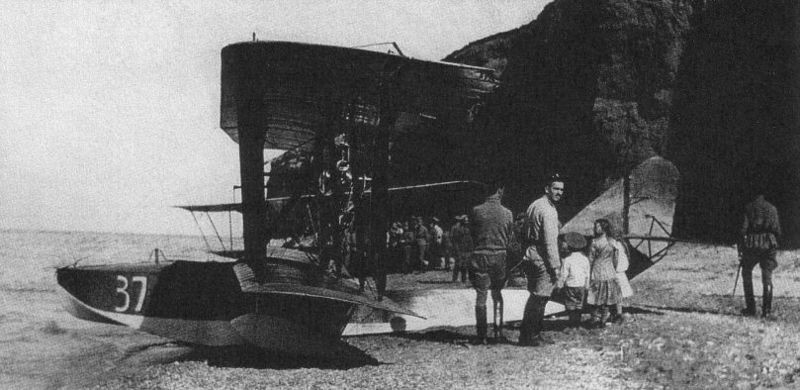
M-5 “37” Black Sea 1916.
The installed armament consisted of a Maxim, Vickers or Lewis machine gun installed on a bracket in front of the right-hand post usually with 450 rounds and an assortment of 8 kg or two 50 kg bombs. Small hand bombs could be carried in the cockpit and heavier ones could be hung under the wing. Starting in November, radio-telegraphy stations with a range of 40 km and Potte cameras (designed by Russian Army Sub-Colonel VF Potte) were installed on some. It was a 9-kg semi-automatic camera of weight with a lens of 21 cm of focal length and cassettes for 50 photos of 13 x 18 cm.)
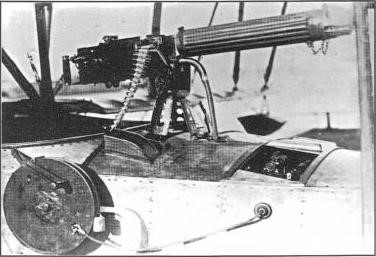
Maxim machine gun installed on an M-5 of the Black Sea Fleet.
In the Black Sea Fleet the M-5 model saw the most active use. By 1915 this force had outdated Curtiss F flying boats, which due to their performance and length of service were much inferior even to the Grigorovich M-4, of which two had been received. For this reason, the arrival of the first M-5 on May 16, 1915 was very well received. Soon this would generate an order for 12 serial copies. In total during the operational period of this flying boat in the Black Sea Fleet 71 were received.
In 1916 the naval pilots of the Black Sea receivef instruction called “Fight in the air” in which the combat methods of the M-5 were defined. The authors considered that the position of the machine gun on the M-5 guaranteed an excellent firing sector to the front, up and to the right. To the left it was only possible to cover about 60º. For this reason, M-5 crews were recommended to operate in pairs, with the second flying boat to the left and above the leader. At a distance of about 500 meters the first machine was to open fire in short salvos of 15-20 projectiles and upon reaching 100-150 meters begin continuous fire. In case the machine gun jammed, the crew had to use their Mauser pistols or Nagan revolvers.
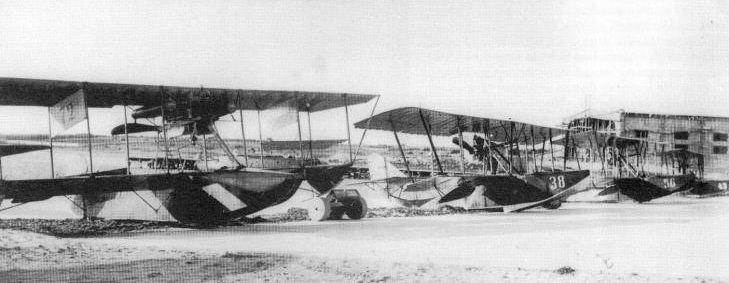
M-5 numbers 38, 56 and 43 next to Schetinin Curtiss F with number 72 at the naval station in the Kruglaya Bay in Sevastopol.
The aircraft of the Black Sea Fleet were based in Sevastopol, serving in the 1st and 2nd brigades of the air division, in Odessa and in Batumi. A certain amount was delivered to the 1, 2 and 3 air brigades on the cruisers “Alexandr I” and “Nikolai I” (capable of transporting 14 aircraft) and sometimes in the “Almaz” and “Pamyat Merkurya”. Aircraft of these cruisers participated in raids on the Turkish and Bulgarian borders. The most significant was the attack on the Turkish port of Zonguldak on January 24, 1916. This was carried out by the ship of the line “Empress María”, the cruiser “Kagul” and the cruisers “Alexandr I” and “Nikolai I”. 14 seaplanes were used, of which 11 managed to hit the target. The attack was carried out under heavy cloud conditions and return fire from the ground. Despite this, and due to the direct impact of a bomb, it was possible to sink the transport ship “Irminhard”, damaging several smaller ships and port facilities.
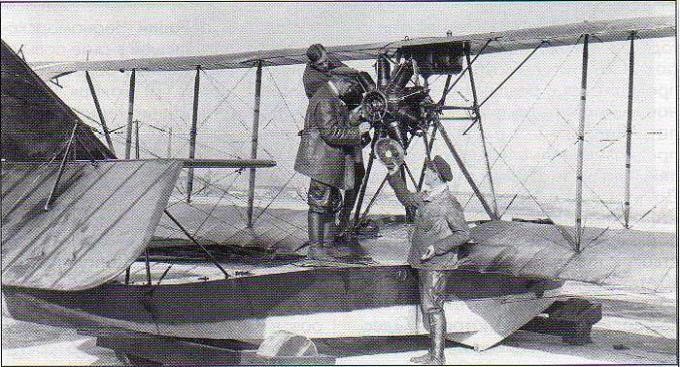
Repair of the Gnôme Monosoupape engine in an M-5
At the beginning of 1918 practically all the M-5 based in the Black Sea were in the zone occupied by the white troops or the Austrian interventionists. They continued to fly until 1919 – 1920.
On July 28, 1915, the Naval Aviation Officers’ School was opened in Petrograd. This center initially had four M-5 flying boats and two FBAs. Soon it was decided to open a branch of this school in Baku, on the Caspian Sea, which began operations on November 22, 1915.
Two flying boats of the Baku Flying School on the shores of the Caspian Sea.
The total number of M-5 flying boats used by the Petrograd school is unknown, but evidence has been found that in 1918, when the decision was made to evacuate the school to Nizhni-Novgorod after the start of the war with Germany, there were five in flight conditions, which were evacuated.
That same number existed at the Trotsky school, opened on November 1, 1918, on Gutuyevskaya Island in Petrograd. In the period from May to October 1919, the M-5s of this school participated in combat actions against the army of General Yudenish, who was advancing towards Petrograd.
M-5 navigating the Neva River in Petrograd.
In December 1919 the two former schools were unified into the Aviation Military Naval School, which was transferred to the Volga River near Samara. The school was installed on a barge called “Yevpraksya” specially equipped with hangars and systems for raising and lowering seaplanes into the water. Between 1920 and 1921 and basically using the M-5, 44 naval pilots were trained. In December 1921 this school was transferred to Sevastopol, where some M-5 were used until the mid-20s. By December 1925 in the Soviet naval aviation there were 22 M-5 and M-20 (version with different engine plant.)
An M-5 flying boat launched in Baku in the winter of 1915.
Starting in 1917, the Baku branch became an independent training center equipped with excellent material conditions in terms of hangars, workshops and support systems for the operation of flying boats. Up to 20 M-5 were accumulated in this unit. Some of these flying boats participated in mid-1918 in the response to the Turkish offensive in the South Caucasus or Transcaucasia area. Active use resulted in most soon becoming unusable and by 1919 only two were still in flight condition. Due to the consequences of the Civil War, the school of naval pilots of Baku ceased to exist.
M-5 “7” Trotsky flight school on Gutuyevsky Island November 1918.
At least one M-5 flying boat was used in Finland after 1918 when it was found drifting at Kuokkala in 1918. This example was captured at Kuokkala in that year and remained in service with the Finnish Air Force until 1919, when it sank.
It is also known that at least one other fell into the hands of the Turks (possibly number 31 and delivered to the Black Sea Fleet on June 10, 1915), and is preserved to this day in the Hava Museci museum in Istanbul.
The M-5 was soon obsolete and was generally used as a training model. According to the evaluation of its pilots, the “Pyatak” (nickname assigned to the model and that could be translated as Little Fifth) was “pleasant” in flight, light and easily steerable. At sea it behaved well, being able to remain operational in rough seas with waves of 0.5 meters. The strong bottom allowed it to land directly on ice and snow and its excellent design made take-offs and landings easy.
On the other hand, its performance was not high. Flight speed was 100-105 km/h with a ceiling of only 3000 meters.
The M-5 basic production version was usually powered by a 100 hp Gnôme Monosoupape engine. Nearly 300 examples were produced at the Schetinin and Anatra factories before the Bolshevik triumph and later at Factory GAZ No.3 in Petrograd.
The 1916 М-10 version was characterized by maintaining the same Gnôme Monosoupape power plant and hull but with a reduced wing span which allowed the speed to be increased to 125 km/h. DP Grigorovich did not participate in the development of this version.
The М-20 1916 version was developed on the basis of the M-5 model with a new 120 hp Le Rhône power plant. A small series of 5 examples was built, characterized by a 40 cm shorter hull, which did not show great increases in performance.
Despite the poor results obtained with the M-1 flying boat, the Russian fleet command was predisposed towards an effective national flying boat model. On June 28, 1914 , the Naval General Staff (MGSh) wrote: “The General Staff… to get out of the position, considers it very advisable to start the indigenous construction of hydroplanes and establishes the following conclusions: 1 – Because the hydroplane designed and built at the SS Schetinin and K Society is available, allowing the factory to carry out the tests at the Puerto del Emperador Alexander III aviation station, but on the condition that the pilot be from the factory. In case of success of the tests the flying boat will be acquired for the needs of the Baltic Sea aviation. ‘ In the event that the hydroplane shows good results, the Naval General Staff considers requesting several of these boats after the problems presented have been solved.”
On the other hand, with the war approaching, the Navy leadership, the 2nd rank captain BP Dudorov requested the MGSh without delay to buy from the PRTV and the RBVZ (Russian Baltic Wagon Factory) all the hydrofoils, finished or not, that could be ready in a short period of time.
These factors encouraged Schetinin to redirect the fundamental activity of PRTV towards the development of navalized models. DP Grigorovich was working on a development of the M-1 model, so on July 29, 1914 a contract would be signed for the production of four new improved examples.
The changes introduced were so significant that the resulting aircraft earned the right to be defined as a new model, which came to light as the M-2 (Morskoi (Naval) – 2), Russian: Григорович М-2.
The contract established the delivery of the first copy for the 7th, the second for the 12th, the third for the 17th and the last for August 23, 1914. Each flying boat was valued at 8,000 rubles and instructions were given to collect four Gnôme engines between 80 and 100 hp in Moscow.
The acceptance conditions established the reach of a height of 500 meters in 12 minutes with the 100 hp engine and 15 minutes with the 80 hp, carrying a load of 75 kg above the weight of the crew and the necessary fuel for three flight hours.
The M-2 was a propeller-driven biplane flying boat, generally similar to that of the M-1 and originally the same engine, but its overall dimensions were increased. The hull grew in width in order to accommodate both crew members side by side. The bow also changed its shape from flat to tapered with a concave bottom in the front, while a new three-sided tail section featured new, much higher mounts, to which the considerably larger area stabilizer was attached.
The wingspan of the upper wing was considerably greater than that of the lower wing, but unlike the M-1 the diagonal supports at the wingtips were not used. The biplane box maintained its location on supports above the fuselage and had only large-area ailerons on the upper plane. The lower wings were installed 1m above the hull on the engine support frame.
The triangular section rear fuselage was raised from the water, tail was equipped with a skid, often referred to as the “shovel”.
According to Shavrov the M-2 to M-4 were used to test some novelties such as the variable incidence stabilizers in flight (for this purpose they had an elevator in the lower part of the leading edge) and in the M-4 a ski – paddle with rubber buffer hinged under the tail to improve launch.
The types of wood used were generally similar to those used during the construction of the M-1.
The construction of the model in the Schetinin factory introduced a constructive novelty: for the first time in Russia, the hull was formed inverted, with the keel up. The first M-2 was delivered to the naval experimental station located in the Grebni port of Petrograd only on August 18, 1914, because before that date the hangar was not found ready for its conservation.
The tests of the prototype with the 80 hp Gnôme engine plant began in August 1914. Unfortunately, the prototype was destroyed on the 31st of that month causing the death of its pilot PV Evsyukov. It is noteworthy that VB Shavrov defines this engine as an 80 hp Clerget, which makes this statement appear in multiple articles and sites that reference this source.
The construction of the other examples was stopped until the investigations were completed. The causes of the accident were never established, but no problems related to structural weaknesses or linked to the construction of the model were found, so it was agreed to continue production.
On October 8 at the Schetinin factory, 4 Gnôme Monosoupape engines of 100 hp were received (The engine of the damaged unit was delivered to the RBVZ) and on November 28, 1914 the first of the new units with this power plant and modifications in the selection of the airfoil was received at the Third Naval Station in Revel (Tallinn). Only 12 days later a second copy would arrive. The test flights were developed until December 22 by the pilot of the factory Ya. I. Siedov-Sierov and the fleet pilot Lieutenant II Kulniev, resulting in numerous remarks and proposals for improvements.
On December 20 three FBA (Franco-British-Aviation) flying boats of the six contracted to France on September 12, 1914 arrived at the Third Station. Both because of their construction and because of their performance, they were quite superior to the M-2, which is why the representatives of the Navy took a negative position towards the Schetinin – Grigorovich model. By the end of the year none of them had been able to present themselves to the acceptance tests.
During the winter the company’s mechanic and pilot made the changes so that by the spring of 1915 flights could be resumed. At that time, a series of improved components arrived from the factory and were installed in the second prototype. General tests continued until April 1915, resulting in a climb time of 15 minutes to a height of 1,300 meters.
The third flying boat М-2 code Sch-3 in the fleet register, with Lieutenant VA Litvinov, head of the Kilkond naval station in the cabin.
In general, they received a positive assessment, so on April 25, 1915 they entered service with the Baltic Fleet aviation with the registrations Sch-2 and Sch-3. These served in the Third Revel Station, basically in training missions, until they were discharged in the winter of 1915-1916 (in the month of November according to Maslov). After that date the engines were removed and for some time were kept in Revel. Due to the fact that these examples underwent changes in the wing profile and hull lines during the tests, their name was changed to M-3 (according to Maslov the name M-3 only corresponded to the second of these, since the first kept as M-2 (Sch-2)).
In the summer of 1914 in the Black Sea the situation was calm and by the month of September the Naval Aviation only had six military planes. The situation would change radically in October, when Turkey declared war on Russia. The new situation made it necessary to take urgent measures.
M-4 number 29, belonging to the Black Sea fleet
From a request of the Black Sea pilots and after several talks held by the head of the Russian aviation, Grand Prince Alexander Mikhailovich Romanov, the commander of the Baltic Fleet NO von Essen; the head of the MGSh AI Rusini and the head of the Aeronautical Department of the MGSh AA Tuchkov, the remaining two copies of the contract of four were sent to Sevastopol on March 10, 1915. This measure was aimed at strengthening the capacity of the air forces for the operations to be carried out in the Bosphorus area.
Ten days after the arrival, a PRTV brigade would arrive under engineer AN Sidielnikov and also made up of pilot Ya. I. Siedov-Sierov, two mechanics and two assemblers. On March 24 the flying boats were transferred to the assembly site and on the 31st the commission from the port of Sevastopol arrived to carry out the tests.
They had to make a flight of 25 minutes and another of 13 minutes in which they should reach the contracted height in 7.5 minutes. The planes received the numberings “29” and “30” and were to complement a varied group of seaplanes that made up the Black Sea Fleet aviation. These M-2s would later be referenced in documents as M-2/M-4 or simply M-4.
M-4 number 29
On April 8, 1915, military pilots began familiarization flights and after a series of acceptance tests, the two were accepted by the Fleet, eventually being used in military actions. On April 12, 1915, number 29, armed with a Maxim machine gun in an installation designed by Kryltsov, was lowered into the water from the cruiser “Emperor Nikolai I” in the Bosphorus region. Crewed by A. Ye. Zhukov and SN Korsakov the flying boat managed to carry out an attack on a Turkish gunboat of the type “Burak Reis”, dropping a bomb that exploded about 70 meters from the stern. This was considered the first military action of a flying boat in Russia and could have ended as a major catastrophe: a hose rupture forced the crew to make a landing a considerable distance from the base, but they managed to reach it by sailing.
Reports on the use of the Schetinin / Grigorovich flying boats in the Black Sea theater were promising, but the Aviation Committee had some doubts about the structural resistance of the model, especially since “30” began to present problems with the hull cladding slats, which came off even after normal landings. As a result, on May 15, a document was issued to the factory in which it recommended reducing the angle of attack of the stabilization floats, reinforcing their fixation and modifying the hull in order to add a rudder that would improve operation in the water. PRTV received the considerations but there was little that could be done because the production had culminated with the delivery of the four copies.
The flying boat “30” was decommissioned in October 1915. In the case of “29”, no evidence has been found to define its operating time.
The factory numbers of the delivered were 196 and 197 (the numbers of the others are unknown), The Baltic Sea Fleet of M-3s were Sch-2 and SCh-3. The Black Sea Fleet of M-4s were naval register ”29”, factory number 196, and naval register ”30”, factory number 197.
M-2 prototype Powerplant: 1 x 80 hp Gnôme Upper plane wingspan: 13.68 m Wing area: 33.5 m² Length: 8.0m Normal takeoff weight: 870 kg Wing loading: 26 kg/ m² Power Load: 10.9kg/hp Speed at sea level: 115km/h Cruising speed: 76km/h Ascent time to 1000 m: 7 min Ceiling: 4000m Practical range: 320 km Endurance: 3.5 hours Accommodation: 2 side by side
M-4 Powerplant: 1 x 100 hp Gnome Monosoupape Wingspan: 13.62m Wing area: 37.90 m² Length: 8.00m Normal takeoff weight: 870 kg Wing loading: 26 kg/m² Power load: 8.7kg/hp Top speed: 100km/h Cruising speed: 76km/h Practical range: 320 km Accommodation: 2 side by side
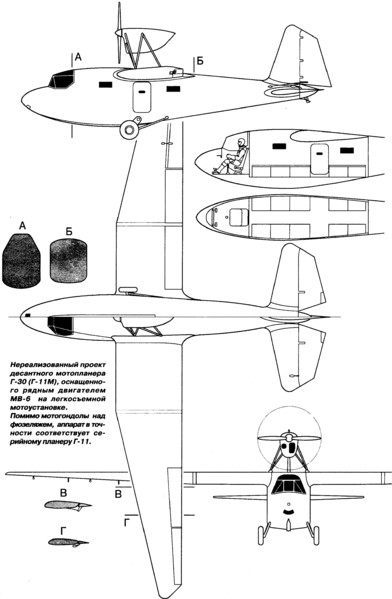
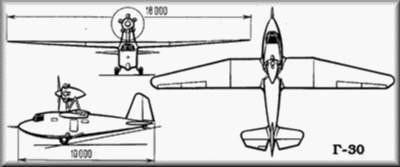
In 1942 Gribovski began development of a motorized version of the G-29 glider with a 100 hp M-11 engine. Two possible variants of the powerplant installation were analyzed: on the nose of the glider or on a pylon on the centroplane. After analyzing the advantages and disadvantages, the second option was finally decided, considering that it could be executed with minimal changes in the production chain.
The moto-glider was named G-11M (G-30 in consecutive Gribovski models) Russian: Грибовский Г-11M (Г-30).
One example was modified in the summer of 1942 at Factory No.471, but it is not clear whether it was ever tested. Maslov states that it was successfully tested in 1942, but other sources such as Shavrov state that it was never tested without explaining reasons. In any case, the need to increase motive power was valued, so the wing installation of two M-11 or MV-6 engines was recommended. In this way the G-30 became a transport airplane.
The decision to produce the model was affected by the cancellation of serial production of the G-11 glider in 1942 itself. On the other hand, the need for a small twin-engine transport aircraft had already been covered by the Scherbakov Sche-2. The VVS did not approve production, so development was abandoned. Other competitors such as the Polikarpov MP or the Moscaliov SAM-22 would have the same fate.
G-30 (G-11M) Engine: M-11 100 hp Wingspan: 18.0 m Wing area: 30.0 m² Length: 9.71 m Empty weight: 1500 kg Loaded weight: 2400 kg Fuel + oil load: 70 kg Payload: 830 kg Wing loading: 80 kg / m² Power load: 24kg / hp Surface of the horizontal planes: 5.64 m² Vertical plane surface: 2.7 m² Spoiler area: 3.1 m²
Initially, in December 1939, a new Construction Bureau was created as a subsidiary of Factory No.301. This new organization was based on a garage under construction belonging to the “Mosvoyentorg” located in the Pavshino village, belonging to the Moscow suburbs.
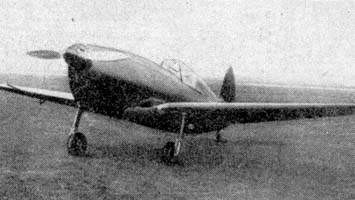
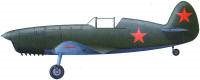
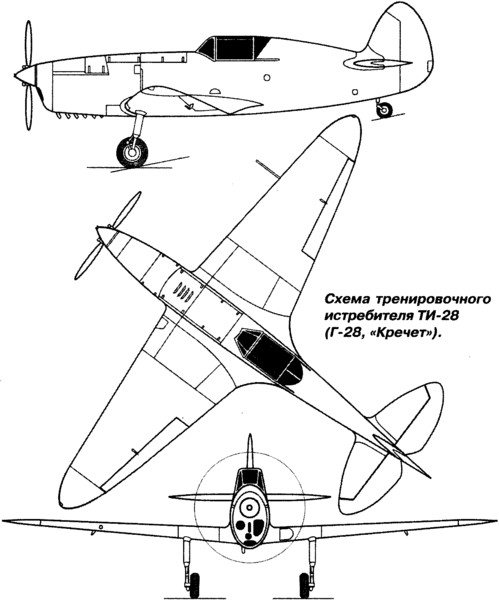
In this period under the direction of Gribovski, several conceptual projects of training aircraft would be developed, among which a fighter trainer called G-28 and nicknamed “Krechet” (Gyrfalcon) (Russian: Грибовский Г-27 Кречет) stood out.
In order to ensure its development, the order was issued on March 10, 1940 to create the Experimental Construction Bureau No.28 (OKB-28), subordinate to the NKAP structure and under the leadership of VK Gribovski. At the VVS controls the plane would be registered as TI-28, an acronym for Trenerovochni Istrebitiel or Fighter Trainer.
The G-28 was designed as a low-wing cantilever aircraft with a trapezoidal shape in the plane and rounded ends. The construction was developed mostly with wood. The entire structure of the wings and the fuselage was built with this material. Only the stabilizers and flight control surfaces featured a fabric-covered duralumin frame.
The wings featured a double-spar structure with an RAF-34 airfoil. Aerodynamically balanced spoilers were located on the trailing edge.
The fuselage featured a semi-monocoque structure with plywood skins and ended in a conventional-type tail unit. The empennage was built as an integral part of the structure of the fuselage tail section. The elevators and rudders had weight balance and aerodynamic compensation.
In order to simplify the construction of the model it was decided to use a fixed landing gear of conventional type. The main landing gear was attached directly to the forward wing spar and the tailwheel was located at the rear of the fuselage.
In the nose there was an inverted six-cylinder in-line MV-6 engine (a copy of the French Renault Bengali 6 engine manufactured in the USSR under license) of 220 hp. The propeller had two blades and constant pitch. The tunnel-type radiator was located at the bottom of the engine.
The pilot’s cabin was enclosed and rearward in the fuselage. The transparent top cover featured rear opening. As a fighter trainer, the TI-28’s instrument panel featured a fairly complete set of equipment, allowing it to perform day and night flights.
For training in the use of weapons, the TI-28 received a 7.62 mm ShKAS synchronized machine gun with 400 rounds, a photo machine gun and a PAK-1 type collimator. Under the wings were located some supports capable of carrying bombs of 10, 25 and 40 kg.
The TI-28 trainer was built in the spring of 1940. The first flight took place on May 22 of that year with the pilot of LII V. Gravrílov.
In less than a month the TI-28 passed the entire test flight program. In addition to Gavrilov, the TI-28 was air-tested by well-known Soviet NII VVS test pilots such as MM Gromov, AB Yumashiev, and PM Stefanovski, who gave the aircraft an excellent rating. Unfortunately, the beginning of the Great Patriotic War prevented the completion of the tests in Moscow, so in 1941, when the NII VVS was evacuated, the TI-28 prototype flew to Sverdlovsk. Its fate thereafter is unknown.
In order to improve the aircraft’s characteristics, the military recommended replacing the power plant with the improved 240 hp MV-6A and repeating the tests. It was felt that the landing run of 280 meters could be shortened and by installing a slightly more powerful engine some gain in speed could be obtained.
The construction of a second example had begun. During the evacuation, Gribovski decided to keep it, with the aim of continuing its development when the situation allowed. These ideas also did not happen. With the beginning of the war the needs for fighter training aircraft would be covered from the conversion to two-seaters of single-seater models in production.
Г-28 Powerplant: 1 x 220 hp MV-6 Wingspan: 9.00m Wing area: 11.60 m² Length: 7.66m Height: 2.80m Empty weight: 897 kg Normal takeoff weight: 1157 kg Wing loading: 100kg/m² Power load: 4.8kg/hp Fuel + oil capacity: 122+15kg Maximum speed at sea level: 275 km/h Top speed at 1600m: 303km/h Cruising speed: 226km/h Landing speed: 90.5km/h Practical range: 500 km Practical ceiling: 6600 m Take-off run: 280m Armament: One 7.62mm ShKAS synchronized machine gun, one photo-machine gun Bombload: 40kg Accommodation: 1
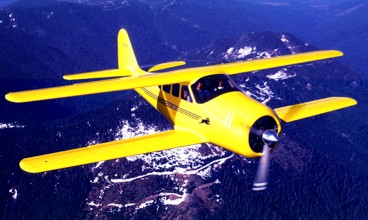
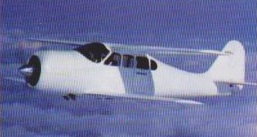
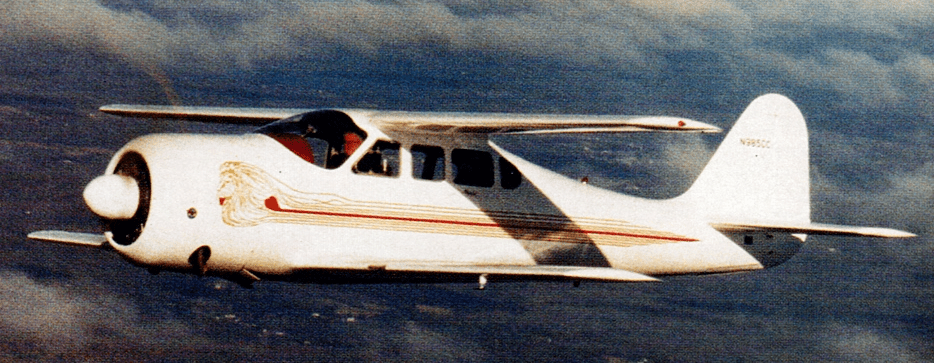
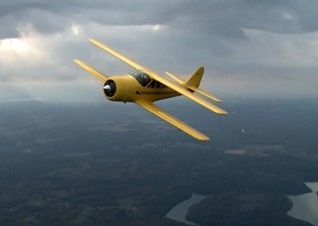
Developed for flying enthusiasts as a “kit” aircraft and designed to make the building process pleasant, fun, and memorable, the Lionheart is an elegant and spirited, 220+ mph, six place, long-distance cruiser. Its design is inspired by the classic Beech Staggerwing and features a fuel capacity of 180 gallons with a range of around 1450nm, payload around 2,000 pounds, and stall characteristics in the mid-fifty knot range. The aircraft’s primary structure consists of high-temperature glass and carbon composites molded in precision production tooling. Lionheart’s powerplant is the reliable and powerful 450HP Pratt & Whitney R-985 Wasp Jr. Radial engine. The fuselage is about 20 feet long from firewall to rudder post making Lionheart a cabin class aircraft that can be constructed in a relatively small space. Interior cabin volume and seating is similar to the Malibu but wider at the shoulders. A small aisle exists between the first two rows of seats and cabin access/egress is via a single split door between the mid and rear seats on the left side of the fuselage (ala Malibu and Staggerwing).
Lionheart accommodates 6 full size, FAA 170 lb passengers and is designed with a 5200 lb gross weight at +6,-3 G limit loads. Following structural testing the gross weight is increased for +4.4, -2.2 G limit loads (utility category). With an estimated empty weight of 3100 to 3300 lbs, Lionheart has a payload of about 2000 lbs. Just about right for the wife and kids… and lots of fuel. Dual control sticks are designed for the pilot and co-pilot seats. Ailerons and elevator are pushrod actuated while the rudder is cable operated. The four ailerons and flaps of the upper and lower wings are interconnected at the wing roots via cables. With the exception of the landing gear attachment fittings, the upper and lower wings are identical. Lionheart uses a fully retractable conventional (taildragger) landing gear. The mains use pressurized gas for spring and damping while the tailwheel is sprung via a gas charged air/oil cylinder. Retraction is accomplished using electro-hydraulics. Landing gear track and wheelbase are both wider and longer than the stock Staggerwing, so ground handling is improved. Lionheart prototype N985L flew for the first time Sunday morning, July 27, 1997.
Chuck Cianchette of Palmyra, Maine, built the first customer-built Lionheart, first flying in 2000.
Chuck Cianchette
In 2009 the Lionheart was out of production.
Top speed: 230 mph Cruise: 210 mph Stall: 56 mph Range: 1500 sm Rate of climb: 2500 fpm Takeoff dist: 800 ft Landing dist: 1400 ft Service ceiling: 20,000 ft Engine: Pratt & Whitney R-987, 450 hp HP range: 350-600 Fuel capacity: 160 USG Empty weight: 2900 lb Gross weight: 5200 lb Height: 8 ft Length: 26.6 ft Wing span: 31 ft Wing area: 238 sq.ft Seats: 7 Landing gear: retract/tail
Engine: Pratt & Whitney Wing span: 9.45 m Wing area: 21.9 sq.m MAUW: 1905 kg Empty weight: 1043 kg Fuel capacity: 530 lt Max speed: 370 kph Cruise speed: 322 kph Minimum speed: 98 kph Climb rate: 15 m/s Seats: 6 Fuel consumption: 12 lt/hr Kit price (1998): $89,900
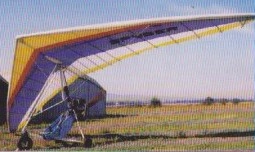
In 1998 Grif were making two microlight wings; the Spyder and the Trainer. The Spyder trike was made under subcontract and marketed under the Grif name.
Spyder trike Empty weight: 172 kg Wing span: 10.35 m Wing area: 14 sq.m Fuel capacity: 40 lt Engine: Rotax 503, 48 hp MAUW: 400 kg Seats: 2 Max speed: 120 kph Cruise speed: 90 kph Minimum speed: 42 kph Fuel consumption: 12 lt/hr Price (1998): 6 800 000 L