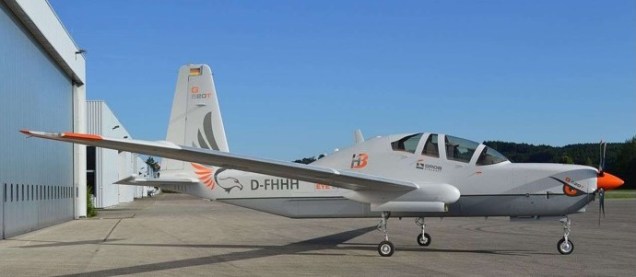
The 1995 Grob G-850 Strato 2C high-altitude and long-duration atmospheric/ stratospheric/ climatic research aircraft with a unique compound propulsion system using two turbocharged piston engines and two gas generators, was first flown March 1995. Featuring an extremely long span wing of composite construction, one aircraft was built in the 1990s, but was abandoned despite setting a world altitude record for piston engined aircraft on its last flight.
Engines: 2 x 300kW Teledyne Continental TSIOL-555 piston Max take-off weight: 13350 kg / 29432 lb Empty weight: 6650 kg / 14661 lb Wingspan: 56,50 m / 184 ft 9 in Length: 23,97 m / 75 ft 6 in Height: 7,76 m / 23 ft 12 in Wing area: 145.00 sq.m /1560.77 sq ft Cruise speed: 520 km/h / 323 mph Ceiling: 26000 m / 85300 ft Range: 18100 km / 11247 miles
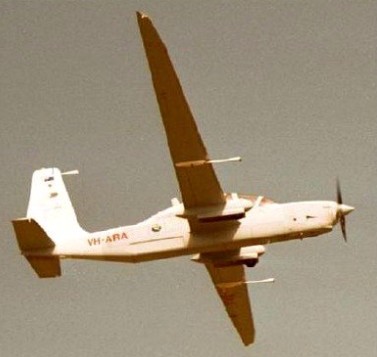
The Grob/E-Systems/AlliedSignal Egrett was a surveillance aircraft developed in Germany in the 1980s by an international partnership. It was intended to fill a joint Luftwaffe-USAF requirement for a high-altitude, long-duration surveillance platform for treaty verification and environmental monitoring.
Germany’s Grob Aircraft, teamed up with E-Systems and Garrett AiResearch, both in the United States. The name EGRETT comes from a combination of the three companies’ names.
Grob G 520 EGRETT II
According to the publicly available accounts, the official purpose of the program, which the U.S. Air Force reportedly nicknamed Senior Guardian, was to provide a cheaper alternative to the U-2 Dragon Lady spy plane for both treaty verification and environmental monitoring purposes. In the 1980s, the United States and the Soviet Union were negotiating the terms of what would become the Intermediate-Range Nuclear Forces Treaty (INF) and the Treaty on Conventional Armed Forces in Europe (CFE). INF entered force in 1988, while CFE did not go into effect until 1990. Both required robust verification methods.
The turboprop-powered G-520 Egrett and Strato 1 high-altitude and long-duration research platforms are capable of carrying different electronic payloads in 12 separate compartments (first flown June 1987 in G-500 Egrett form.
Grob and the rest of the team ultimately built total of five aircraft in various versions, starting with the prototype D 450 EGRETT, followed two more D 500 EGRETT II aircraft.
The contractors then modified the D 500s into the final G 520 configuration before building a third of these pre-production planes. Finally, Grob produced a two-seat G 520T trainer version.
A two-seat Grob 520T
The German manufacturer claims its G 520NG variants has the “lowest operational cost in class.”
The aircraft with its composite airframe was able to carry more than 2,000 pounds of sensors and equipment in any of 12 separate, modular bays, five of which lined the bottom of the fuselage. There was enough room there for turreted day- and night-vision cameras, as well as synthetic aperture radars and other gear.
The G 520 could fly this equipment to an altitude of 50,000 feet. The aircraft has a very narrow cord wing with a span of just more than 108 feet. Depending on the exact load out and flight profile, the plane reportedly could have a range of more than 1,500 miles or loiter over a particular area for up to eight hours.
In the end, the existing prototypes filtered out onto the open market through the original partners. In 1995, Raytheon bought E-Systems, ultimately renaming it as their Intelligence, Information and Services division. The company’s flight test outfit continued flying at least one EGRETT II for some time afterward, providing support to NASA’s Airborne Science Program. According to the Federal Aviation Administration, this aircraft, N520DM, apparently passed to Bear Defense circa 2012.
The D 450 EGRETT aircraft is also still in the U.S. civil registry, listed as N520EG, and property of a company called Gentran Corporation. This Omaha, Nebraska-based “trucking company” has one employee, according to publicly available records. Spotters caught this all-white aircraft in California in 2012 and it does not appear to match the one flying in Indiana earlier in July 2017.
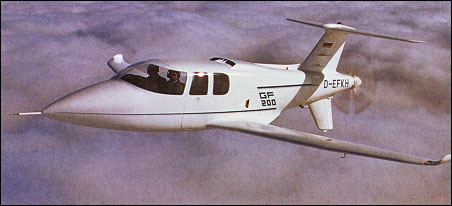
The GF 200 pusher piston-engined and pressurised 4/5-seat lightplane was first flown in November 1991.
Engine: 1 x 233kW Teledyne Continental TSIOL550 turbocharged flat-six Take-off weight: 1600 kg / 3527 lb Wingspan: 11.00 m / 36 ft 1 in Length: 8.70 m / 28 ft 7 in Height: 3.42 m / 11 ft 3 in Cruise speed: 370 km/h / 230 mph Ceiling: 7625 m / 25000 ft Range: 1850 km / 1150 miles Crew: 2 Passengers: 4
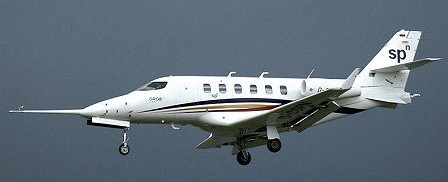
The Grob G-180 SPn (or spn) is a low-wing twin-engined corporate jet projected by Grob Aircraft in 2005. It can land on both paved surfaces and unimproved runway capability.
Engines: 2 x 1270kg Williams FJ44-3A turbofans Max take-off weight: 6300 kg / 13889 lb Wingspan: 14.86 m / 49 ft 9 in Length: 14.81 m / 49 ft 7 in Height: 5.12 m / 17 ft 10 in Cruise speed: 754 km/h / 469 mph Ceiling: 12497 m / 41000 ft Range: 3334 km / 2072 miles
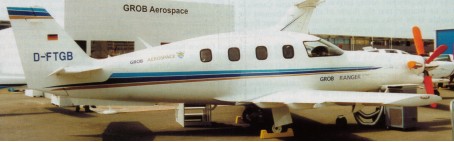
A seven seat business aircraft, considered a competitor for the TBM700, the Ranger maintains the German company’s tradition to produce composite carbon fibre. It has a big cabin for a single engined aircraft in this business market segment 16ft long, over 5ft wide and 4.7ft high and in addition to pressurisation, it has various internal options for a toilet, folding tables and power connections for laptops.
G160 Ranger – (provi¬sional) Powerplant: One 850shp Pratt & Whitney Canada PT6A-42A turboprop. Max cruise speed, 270kt (500km/h). Range with six people at 25,000ft with 30min reserves, 1,800nm (3,300km). Sea level take-off to 50ft (15m): 2,130ft (650m). Max take off wt: 7,275 lb (3,300kg). Max payload, 1,587 lb (720kg). Span, 42ft 8in (13m). Length, 37ft 8in (11.5m) Height: 11ft 3in (3.4m).
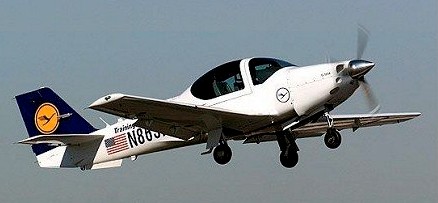
The 1999 Grob G 120A is a two seated training and aerobatic low-wing aircraft with a carbon composite airframe. It is based on the Grob G 115TA training aircraft and is specially designed for military and civil pilots training.
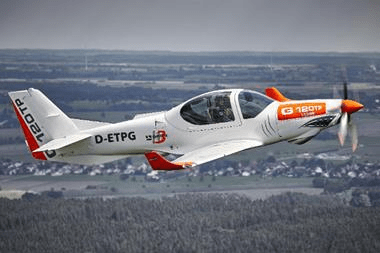
G120TP
In 2025 the Royal Canadian Air Force (RCAF) planned to operate 23 G120TPs under the designation CT-102B Astra II. To be based at CFB Moose Jaw in Saskatchewan, they will serve as a basic flight instruction platform, succeeding Canada’s Grob CT-120A (G120A) trainers.
The prototype Grob G-116 was a four seat, composite 200 hp Lycoming powered single. A four-seat version of the Grob G.115, the G 116 first flew on 29 April 1988 (D-EGRF), and was certificated in 1989.
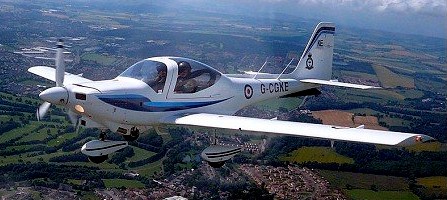
By 1990 the G 115 had orders totalling more than 100 since production began in 1987. The two-seat, side-by-side light aircraft makes extensive use of composite materials in its construction and the resulting smooth finish gives low drag and high efficiency. The production G 115-C is powered by a single 150 hp (112 kW) Lycoming O-320-E2A piston engine driving a constant speed propeller. The Royal Navy Flying Grading Flight operate the G.115D as the Heron. Ninety-nine G.115E (at Tutors) were purchased for Air Cadets and University Air Squadrons in the UK. The E variant with a 3-blade variable pitch propeller is in Royal Air Force service as an elementary flying trainer.
G 115C Engine: 150 hp (112 kW) Lycoming O-320-E2A Propeller: constant speed
G.115D / Heron
G.115E Engine: 1 x 134kW / 180 hp Textron Lycoming AEIO-360-B1F Prop: Hoffman 3 blde CSU Max take-off weight: 990 kg / 2183 lb Empty weight: 690 kg / 1521 lb Wingspan: 10,00 m / 33 ft 10 in Length: 7,79 m / 23 ft 12 in Height: 2,82 m / 7 ft 7 in Wing area: 12,21 sq.m / 129.17 sq ft Max. speed: 270 km/h / 168 mph Cruise speed: 230 km/h / 143 mph Initial climb rate : 1399.61 ft/min / 7.11 m/s Service Ceiling: 4875 m / 16000 ft Range: 1250 km / 777 miles Crew: 2
The G110 got into an un-recoverable spin on its second spin flight. The pilot bailed out and the plane was destroyed. The pilot pulled the chute a bit early and some chute shrouds were cut by the prop. The pilot, a German TP, has no interest in flying any other Grob aircraft. The program was cancelled two weeks later.