Wren Aircraft Wren

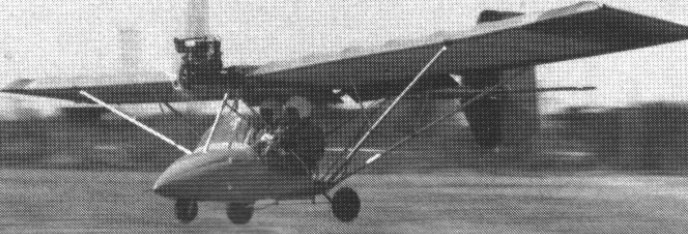
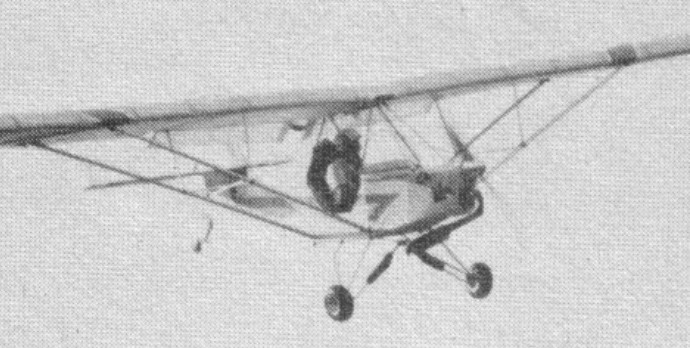
Single seat single engined high wing mono¬plane with conventional three axis control. Wing has swept back leading edge, swept forward trailing edge and tapering chord; conventional tail. Pitch control by elevator on tall; yaw control by fin mounted rudder; roll control by half span ailerons; control inputs through stick for pitch/roll and pedals for yaw. Wing braced from below by struts; wing profile; double surface. Undercarriage has two wheels side by side with tailskid. Composite construction fuselage totally enclosed. Engine mounted below wing driving tractor propeller. Composite con¬struction with glass/Kevlar/graphite in an epoxy matrix over foam cores; fir, birch, plywood, pine and redwood also utilised.
The single seater Wren was a prototype in the course of test flying and whose development has been undertaken by Mark Calder since 1981. He has made his principal parameter passive security ‘crash survivability’. In January 1983, Mark Calder announced that he was going to undertake a programme of static tests on the machine, the prototype having made its first flight in the course of the previous year. The machine was to be offered with a Zenoah G25B engine or optionally a Kawasaki 440ce unit. Projected prices for the Zenoah engined machine were $6200 ready to fly and $4400 in kit form in 1983, the Kawasaki costing $300 more in each case. Options include wheel pants $100, custom interior $125, electric start $150 including battery, floats $1500, skis $100 and custom paintwork $250 minimum.
The prototype with Zenoah engine has returned a fuel consumption of 1 2 US gal/h (1.0 Imp gal/h, 3.8 litre/h).

Engine: Zenoah G25B, 18 hp
Power per unit area 0.13 hp/sq.ft, 1.4 hp/sq.m
Wing span 36.0 ft, 10.97 m
Mean chord 3.9 ft, 1.19m
Wing aspect ratio 9.3/1
Wheel track 4.7 ft, 1.42 m
Empty weight 240 lb, 109kg
Max take off weight 450 lb, 204kg
Payload 200 lb, 95kg
Max wing loading 3.21 lb/sq.ft, 15.7 kg/sq.m
Max power loading 25.0 lb/hp, 11.3kg/hp
Load factors; +8.5, 5.0 ultimate
Max level speed 60mph, 97kph
Cruising speed 60mph, 97 kph
Stalling speed 25 mph, 40 kph
Max climb rate at sea level 500ft/min, 2.5m/s
Wren 460

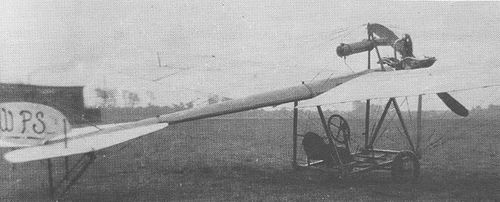
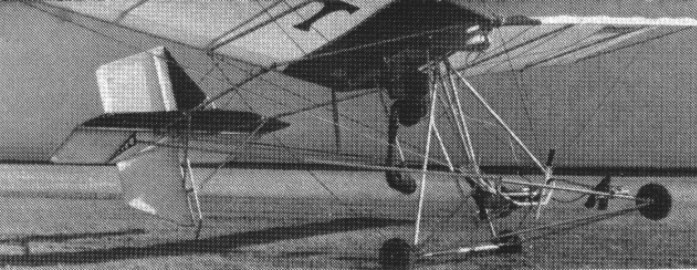
In the late 1950s Jim Robertson designed the Skyshark featuring many STOL features. The best of these features was then applied to the Cessna 182G/H airframe to produce the Wren 460. These featured full span, double slotted flaps, moveable spoilers on the upper surface of each wing (called Wren’s teeth) to assist in roll control and a moveable high lift canard wing.

The Wren 460 first flew in 1958, and the 460 Beta STOL in 1968.

In August 1964 it was reported the Wren was building an initial production fleet of 10 Wren 460 STOL, two monthly. A second fleet of 40 was scheduled.

There were reported 34 conversions to Wren 460.

460
Engine: 260 hp
Wingspan: 36’7″
Length: 28’1″
Max speed: 170 mph
Cruise speed: 151 mph
Stall: 31 mph
Range: 1150 mi
TO & Ldg dist: 300′

Wren Goldcrest

A small single-seat low-wing monoplane designed by R.E.Carr in 1946 and built by his Wren Aircraft Company in the UK.

Of all-wood construction and powered by a Scott Squirrel engine, registered G-AICX c/n 1, it first flew in 1947.

It found certification problems and was broken up in 1947.

Span: 23.00 ft
Length: 16.08 ft

Worldwide Ultralite Industries Model T

A single-surface high wing monoplane, cruciform tail, open cockpit, 3-axis controls with spoilers, aluminum tubing construction.

Engine: Rotax 277, 27 hp
Prop: Worldwide wood
Wingspan 30’
Wing area 160 sq.ft
Empty weight 210 lbs
Gross weight 610 lbs
Cruise speed 40 mph
Stall speed 19 mph
Vmax 45 mph
Climb 500 fpm
Takeoff run 100 ft
Landing roll 100 ft
Lan¬ding gear: Tricycle
Price 1984: $3,995

Worldwide Ultralite Industries Spitfire

Spitfire II

The Spitfire has a centre mounted joy stick, rudder pedals, tail wheel steerable through rudder pedals. The Spitfire II is a side-by-side two place version.

Spitfire
Engine: Kawasaki 440A
Wing span: 30’
Wing area: 154 sq.ft
Max wt: 550 lbs
Empty wt: 250 lbs
Stall: 19 mph
Cruise: 60 mph
Vmax: 63 mph
Climb rate: 850 fpm
TO run: 100 ft
Ldg roll: 100 ft

Spitfire II
Engine: Rotax 503, 53 hp
Prop: 6-foot wood Worldwide
Landing gear: Tricycle
Wingspan 30’
Wing area: 154 sq.ft
Empty to 330 lb
Gross weight 720 lbs
Cruise speed 60 mph
Stall speed 25 mph
Vrnax 63 mph
Climb 500 fpm
Takeoff run 150 ft
Landing roll: 150 ft

Worldwide Ultralite Industries Clipper

Centre mounted joy stick, rudder pedals, tail wheel steerable through rudder pedals.

Empty wt: 252 lbs
Wing span: 30’
Wing area: 154 sq.ft
Height: 6’6”
Length: 17’10”
Fuel cap; 5 USG
Construction: Aluminium, Dacron
Engine: Rotax 277 (268 cc) 28 hp
Static thrust: 165 lbs
Max wt: 612 lbs
Stall: 20 mph
Max speed: 63 mph
Vne: 85 mph
Climb rate: 450 fpm @ 40 mph
Design limit: +6, -4g
Glide ratio: 10-1
Wing loading: 3.97 lbs/sq.ft
Power loading: 21.86 lbs/hp

World Aircraft Vision

World Aircraft of Paris (Tennessee, that is), offers the Vision and Spirit S-LSA (also in kit form), now with new Garmin radios and “value pricing.” The Vision is a STOL bird with outsized doors, full elevator control at steep angles of attack, and it climbs out with full flaps, sports a beefy landing gear and routinely demonstrates 100-foot takeoff rolls! Price range: $85,000 to $125,000.