Helio was founded 1948 as Helio Aircraft Corporation to develop the two-seat Koppen-Bollinger lightplane. Otto Koppen may best be known as the creator of the Helio, the first modern short takeoff airplane. “We built the Helio before STOL was invented,” Koppen remembers. “I felt that an effective short field airplane shouldn’t have to fly at the obstacle, it should be able to fly around it.” Koppen wanted an airplane that could climb steeply and maneuver safely at low airspeeds and high angles of attack.
The Helio development model, put together in 1944, was a Piper Vagabond with an 80 horsepower engine swinging a nine foot prop. Leading edge slots and full span flaps com¬pleted the rig. With the propeller turning at a maximum 960 rpm, the airplane took off in 125 feet. It climbed steeply with two people aboard, and it flew quite happily at 26 mph.
Engines – Power
Helicraft Skylark 1
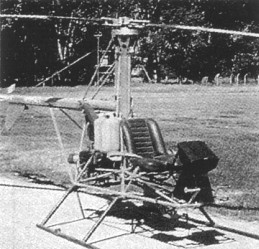
Circa 1990.
Engine: Rotax, 97hp
Height: 7 ft
Length: 12.5 ft
Empty weight: 310 lb
Gross weight: 725 lb
Payload Total: 415 lb
Main rotor diam: 19 ft
Tail rotor dia: 3.5 ft
Max speed: 85 mph
Cruise: 63 mph
Ceiling: 12,500 ft
Seats: 1
Helicopter Technik München / HTM Sky-Trac 4 Aerocar / Wagner Sky-Trac 4 Aerocar
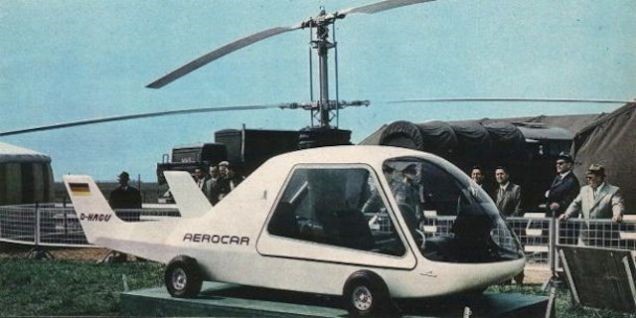
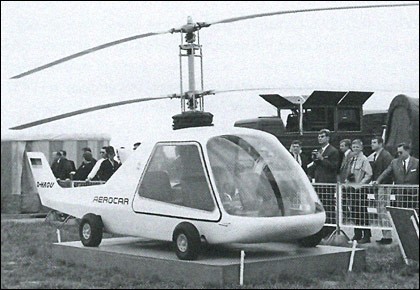
The Rotocar III has developed into the Aerocar. This has a 4-seat cabin, a twin tail assembly, and four road wheels hydraulically driven from the Oredon IV engine mounted behind the rotor pylon.
Wagner built a prototype (D-HAGU) Aerocar roadable helicopter, powered by a 260hp Franklin 6AS-335-B engine, which had a complete body shell. It was first flown in 1965. It was subsequently rebuilt with a Turbomeca Oredon turbine engine.
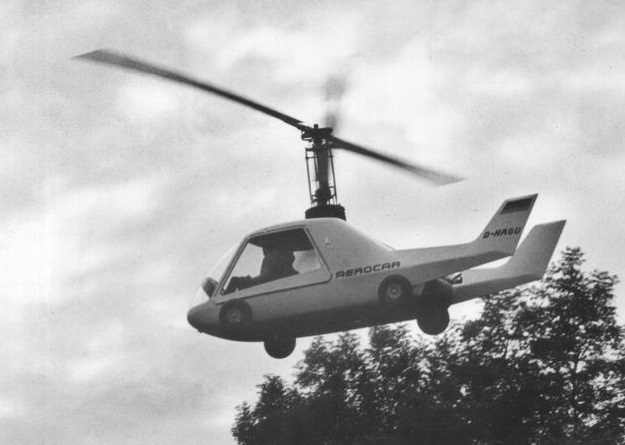
After extensive development work had been carried out, the Wagner designs were passed to a new company, Helikopter Technik Munchen (HTM) in 1971. HTM abandoned the Aerocar.
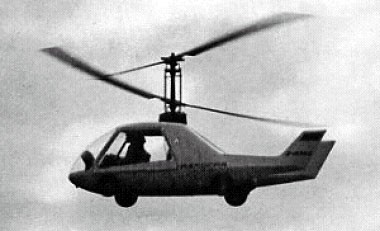
Helicopter Technik München / HTM Skytrac / Skyrider

The first five designs evolved by Alfred Vogt of the Helicopter Technik Wagner since the company’s formation in 1960 included two experimental helicopters, each powered by a 95hp rotary engine. One was a simple 2-seater with a skid undercarriage and pod-shaped body. From this Wagner produced the Sky-Trac torque-less helicopter, which is basically a chassis frame carrying the engine and rotor system, to which a variety of cabins or equipment can be fitted to fulfil different roles.
Development commenced in the mid-1960s as an offshoot of the Wagner firm’s attempts to develop a roadable helicopter, and utilised the same coaxial dynamic components that had been developed for that project. Each design utilized a contra-rotating rotor system in which the lower three-blade rotor was attached to the crankcase of a 95 hp three-cylinder rotary engine, rotating around the rotor pylon, with the upper two-blade rotor driven by the crankshaft. The Skytrac featured a narrow single-seat cabin at one end of a box-like “keel” structure, a horizontally mounted Franklin flat-6 engine at the other end, and the transmission and rotor mast between them. The pilot’s seat was enclosed by a sliding, bubble canopy. The prototype flew in this form in July 1965. The Wagner Sky-Trac 1 (D-HAJE), still had a frame structure but was fitted with a 260hp Franklin 6AS-335-B engine, and had a sliding canopy forming an enclosed cabin for the single pilot.
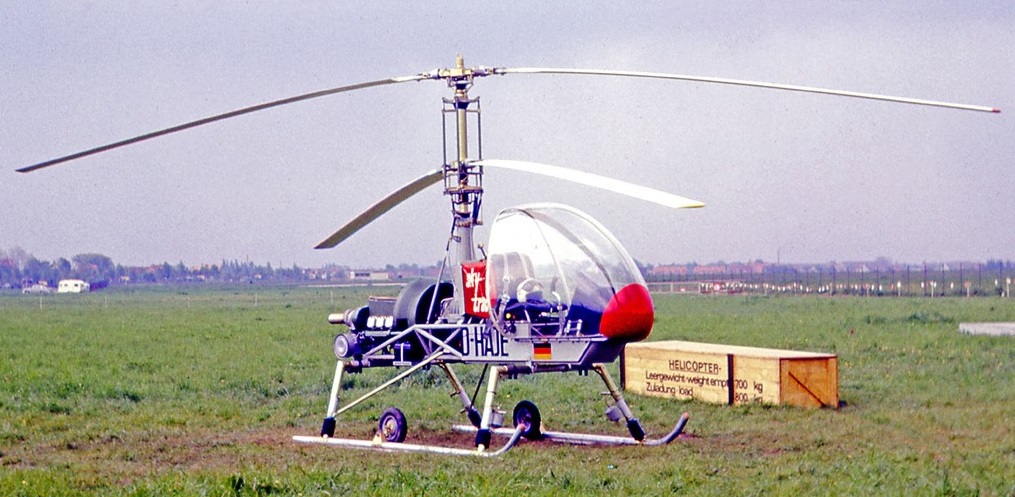
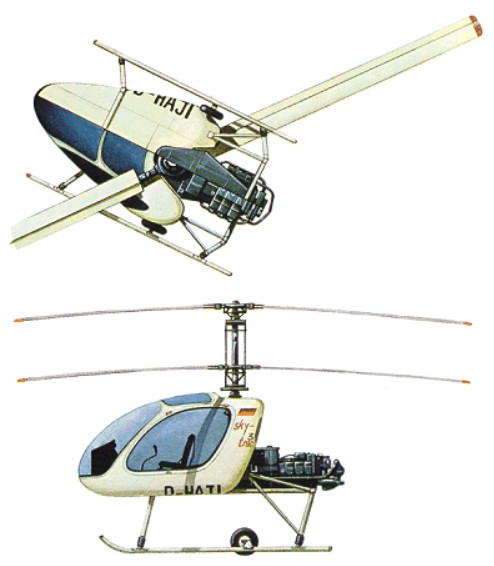
Prototypes of the Sky-Trac 1 (D-HAJE) and Sky-Trac 3 (D-HAJI) were exhibited publicly for the first time at the Hanover Air Show in May 1966.
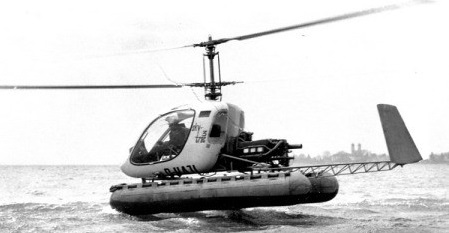
The second machine built (D-HARB) was fitted with a pontoon landing gear and a longer boom with a V-tail. Both are powered by similar 260hp Franklin 6AS-335-B piston-engines, the Sky-Trac 1 being a single-seater with a ‘goldfish bowl’ moulded canopy, open at the rear.
The three-seat Sky-Trac 3 (D-HAJI c/n 11), also flown in 1965, had a more complete cabin structure, faired-in at the back and underneath, and was fitted with spray bars and under-slung tanks for agricultural chemicals. The Sky-Trac 3 can lift loads at least equivalent to its own weight, an under-fuselage hook permitting slung loads of over 700kg to be transported. Alternatively, the heart-shaped cabin can accommodate a stretcher and medical attendant in addition to the pilot, or for agricultural use can be fitted with spray bars and an under-slung tank holding 650 litres of liquid chemicals.
The HTM FJ-Skytrac received both German and FAA certification in 1969.
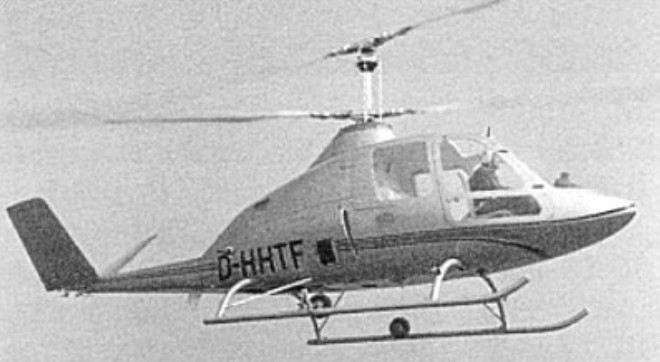
The company developed a kit to convert the Skytrac into a four-seat light helicopter known as the HTM Skyrider. On 21 February 1974 Helicopter Technik München flew the prototype (D-HHTF) of the HTM Skyrider four-seater powered by a 260-hp (194-kW) Avco Lycoming engine.
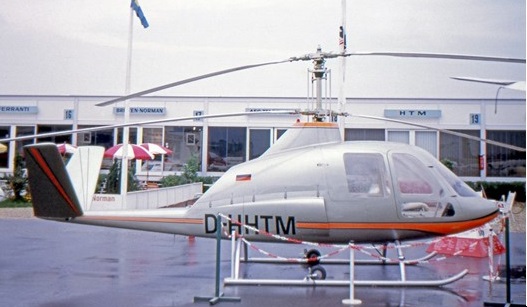
After extensive development work had been carried out, the Wagner designs were passed to a new company, Helikopter Technik Munchen (HTM) in 1971. HTM abandoned the Aerocar, but built a new prototype of the FJ-Sky-Trac (D-HHTM) in tandem two-seat configuration, as a utility helicopter with a 260hp Lycoming IO-540 engine. This still had the coaxial rotor system but was extensively redesigned to accommodate the new engine and cockpit layout.
In 1971, the newly formed Helikopter Technik München (HTM) took over the manufacture and marketing of the Skytrac, announcing in mid-1972 that a production line was being established at Jesenwang with the intention of producing 35 machines by the end of 1973, all of which had found buyers. After this initial batch, HTM planned to sell licences to produce the design in batches of 30 machines each. None of this was to come to pass, however, as HTM was unable to finance the production of the first batch of aircraft.
HTM then went on to build two examples of the HTM Skyrider (D-HTMS and D-HHTF) which reverted to the configuration of the Sky-Trac with a four-seat cabin and a fully enclosed streamlined structure. Mockups of this configuration were displayed at the Hanover and Cannes airshows in 1972 and a prototype was exhibited at the June 1973 Paris Air Show. The Skyrider had a skid undercarriage and V-tail, which commenced flight testing on 21 February 1974. It was possible to convert the basic Skytrac into a Skyrider in a matter of only a few hours’ work.
The Sky-Trac 1 and Sky-Trac 3 were used by HTM to demonstrate the concept, and a new prototype of the Sky-Trac (D-HHTM) was built in tandem two-seat configuration, as a utility helicopter with a 260 h.p. Lycoming 10-540 engine. This still had the coaxial rotor system but was extensively redesigned to accommodate the new engine and cockpit layout.
Since 1992 all the rights for production and design of the Skytrac and Skyrider helicopters are owned by Mr. P. Chrobak.
Construction Numbers:
D-HAJE Wagner Helicopter Technik FJ-V6, Skytrac 1, cn 10
D-HAJI Wagner Helicopter Technik FJ-V7, Skytrac 3, cn 11
D-HARB Wagner Helicopter Technik FJ-V8, Skytrac 1, cn 12
D-HAGO Wagner Helicopter Technik FJ-V2 Skytrac cn 6
D-HAGU Aerocar Wagner Helicopter Technik FJ-V3 Skytrac cn 7
D-HAGY Wagner Helicopter Technik FJ-V4 Skytrac cn 8
D-HAHI Skyrider Wagner Helicopter Technik FJ-V5 Skytrac cn 9
I worked in the Montege des Skytrack and Skyrider from 1972 to 1974 as a group leader and was one of the few co-riders who was allowed to get into a Skyrider. Unfortunately, the company HTM then went into insolvency and I still have a title from the insolvency administrator about 5000 DM that was never enforced. The helicopter was moved in Moosbach / Lohrbach airfield in the Odenwald.
Franz Wenninger
Specifications:
Skytrac
Engine: 1 × Franklin 6AS-335-B, 195 kW (260 hp)
Length: 4.00 m (13 ft 2 in)
Main rotor diameter: 10.40 m (34 ft 1 in)
Height: 3.80 m (12 ft 6 in)
Main rotor area: 84.9 m2 (914 ft2)
Empty weight: 850 kg (1,870 lb)
Gross weight: 1,500 kg (3,300 lb)
Maximum speed: 160 km/h (100 mph)
Range: 400 km (250 miles)
Service ceiling: 3,500 m (11,000 ft)
Rate of climb: 2.0 m/s (400 ft/min)
Crew: One pilot
Capacity: 2 passengers
HTM Skyrider
Engine: Lycoming IO-540, 260hp
Rotor diameter: 10.40m
Fuselage length: 7.43m
Weight empty: 1015kg
Gross weight: 1530kg
Max speed: 185km/h
Service ceiling: 3860m
Range: 620km
Wagner Sky-Trac 3
Engine: 1 x Franklin 6AS-335-B, 195kW / 260 hp
Rotor diameter: 10.0m
Fuselage length: 4.0m
Height: 3.80m
Max take-off weight: 1500kg
Max speed: 166km/h
Service ceiling: 2200m
Max range: 200km
Helicop-Air L.50 Girhel / L.51 Girhel
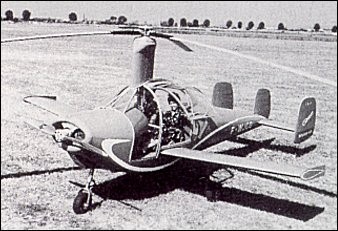
In France, Helicop-Air, produced the prototype of a two-seat light autogyro-type aircraft known as the Girhel.
The Girhel is a side-by-side two-seat light aircraft to which an autogyro rotor has been fitted. It was designed with the assistance of Ing. Georges Lepere.
For take-off the rotor can be set turning by engaging a clutch in a drive-shaft from the engine. In flight the rotor autorotates and the engine drives a tractor airscrew in the conventional manner. Most of the “lift” is contributed by the fixed wings in cruising flight, so that the rotor is heavily loaded only during take-off and landing. The three-blade rotor is of wood construction, with variable pitch. Starting is by a clutch and drive-shaft from engine. The wings are mid-wing cantilever monoplane with a single metal spar, wood covering, large ailerons, and end-plates at the tips.

The all-metal fuselage structure has a cantilever monoplane type tail unit, with conventional elevators, two fins and central rudder. All-wood structure. The landing gear is a non-retractable tricycle type. The nose-wheel is steerable and brakes are on the main wheels.
The two seats are side-by-side in the enclosed cabin. Dual controls are optional. Space for baggage is aft of the seats. There is provision for carrying a litter or agricultural spray-gear.
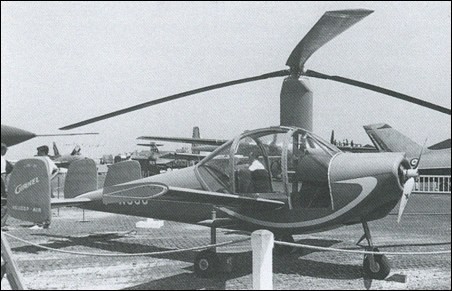
This was exhibited for the first time at the 1959 Paris Salon de l’Aeronautique.
It is not clear whether the prototype actually flew.
Two versions of the Girhel were offered:
Girhel L.50. 90hp Continental C90 engine with Ratier two-blade fixed-pitch airscrew.
Girhel L.51. With 150hp Lycoming O-320 engine with a variable-pitch airscrew.
Helicop-Air L.50 Girhel
Engine: Continental C.90, 65kW
Prop: Ratier two-blade fixed-pitch
Rotor diameter: 10.0m
Wngspan: 6.0m
Length: 6.10m
Height: 2.70m
Helicop-Air L51 Girhel
Engine: Lycoming O-320, 150hp
Prop: variable-pitch
Rotor diameter: 10.0m
Wngspan: 6.0m
Length: 6.10m
Height: 2.70m
Weight empty: 416kg
Weight loaded: 750kg
Max speed (est.): 215km/h
Cruising speed (est.): 180km/h
Min flying speed (est.): 22km/h
Range with pilot and 234kg payload (est.): 100km
Range with two persons and baggage (est.): 1000km
Helicom H-1 Commuter Junior
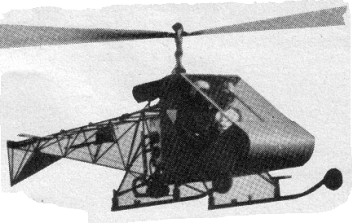
Harold E. Emigh founded the Helicopter Research Corporation in 1954 to develop and market a single-seat personal helicopter. Known as the Helicom Commuter Jr Model H-1 A, the prototype first flew in 1960, and was sold both in ready-to-fly form and as a kit for assembly by amateur constructors. A ground trainer version was developed also, mounted via a gimbal to a castoring base which was too heavy for the helicopter to lift from the ground.
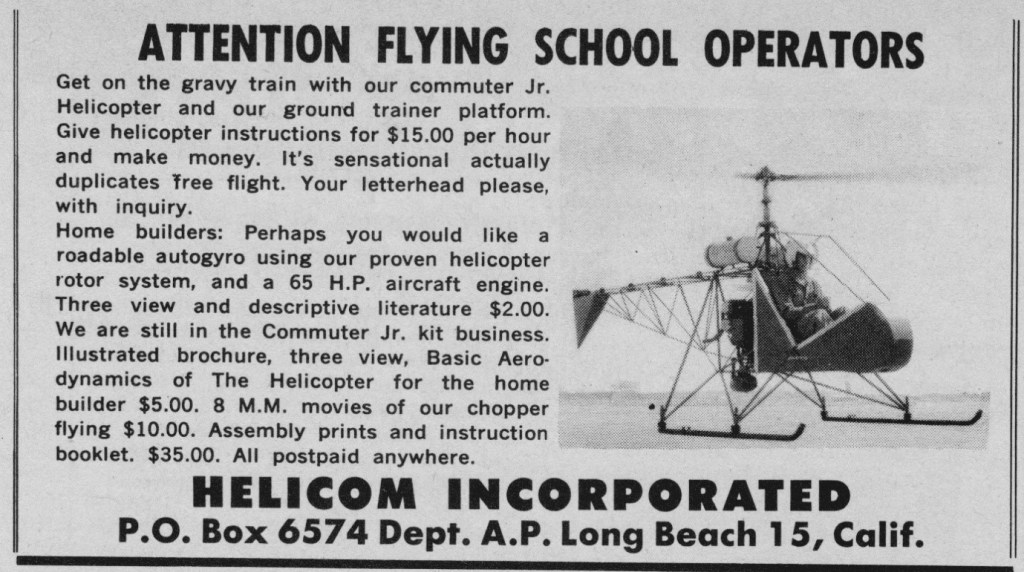
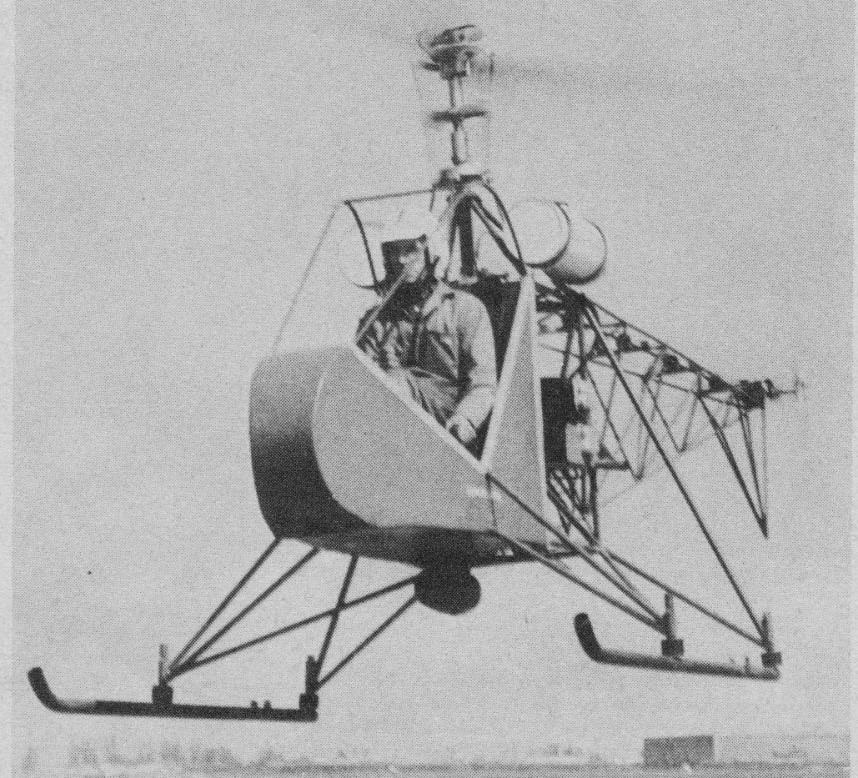
The commercial rights were sold to Southern Pacific Aircraft Co and then to International Helicopter Inc of Mayville, New York, with the machine being refined along the way as the Commuter II.
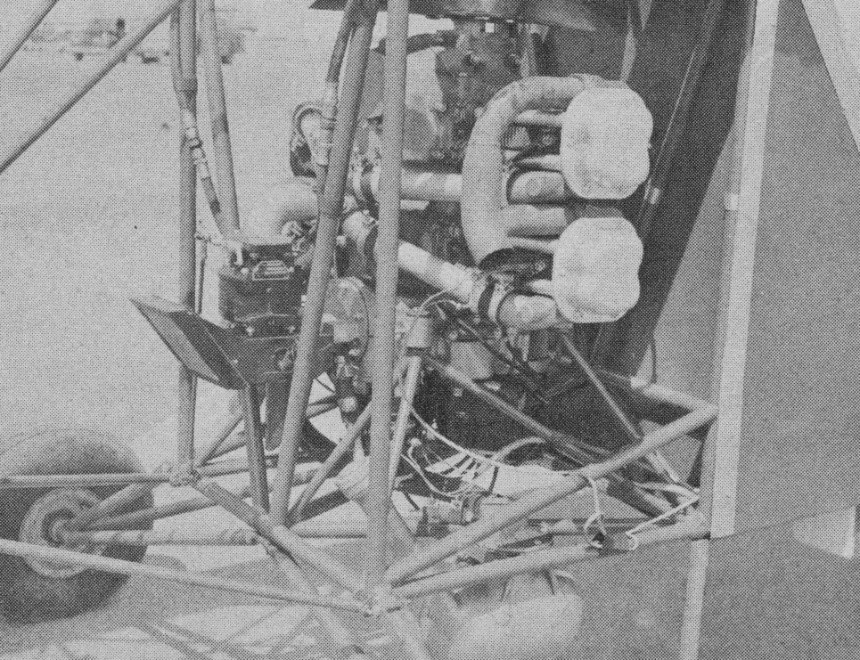
Engine: Continental, 90 hp.
Gross weight: 950 lb
Fuel capacity: 2 x 6 USG
Cruise: 90 mph
Heldeberg Marathon / Blue Heron Marathon
The Heldeberg Marathon, also called the Blue Heron Marathon, was an American powered parachute, that was designed and produced by Heldeberg Designs of Altamont, New York.
The Marathon was designed to comply with the US FAR 103 Ultralight Vehicles two-seat trainer rules and was marketed as a light-sport aircraft. The aircraft takes its name from its design goal of an aircraft with long range and endurance and features a range of 115 mi (185 km). It features a parachute-style high-wing, two-seats-in-tandem accommodation, tricycle landing gear and originally a single 50 hp (37 kW) Rotax 503 engine in pusher configuration. The 64 hp (48 kW) Rotax 582 was the standard engine used on later models.
The aircraft is built from a combination of bolted dural aluminium and stainless steel tubing. It features a double ring propeller guard that has been roll-over tested. The 10 U.S. gallons (38 L; 8.3 imp gal) fuel tank is made from aluminium. In flight steering is accomplished via foot pedals, or optionally a control stick, that actuate the canopy brakes, creating roll and yaw. On the ground the aircraft has lever-controlled nosewheel steering. The main landing gear incorporates gas strut suspension. The aircraft is factory supplied in the form of an assembly kit that requires 30–50 hours to complete.
Originally marketed by the factory under their own name, the aircraft was later marketed under the brand name Blue Heron, although the manufacturer remained the same. The selling price was US$21,995 in 2012, though production is now completed.
Blue Heron Marathon
Powerplant: 1 × Rotax 582, 64 hp (48 kW)
Length: 9 ft 8 in (2.95 m)
Wingspan: 39 ft 6 in (12.04 m)
Height: 6 ft 6 in (1.98 m)
Wing area: 500 sq ft (46 m2)
Empty weight: 308 lb (140 kg)
Gross weight: 850 lb (386 kg)
Fuel capacity: 10 U.S. gallons (38 L; 8.3 imp gal)
Cruise speed: 32 mph (51 km/h; 28 kn)
Range: 115 mi (100 nmi; 185 km)
Rate of climb: 900 ft/min (4.6 m/s)
Wing loading: 1.7 lb/sq ft (8.3 kg/sq.m)
Crew: one
Capacity: one passenger
Heldeberg Spirit 103 / Blue Heron Spirit 103
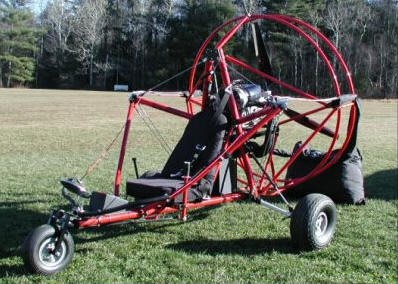
The Heldeberg Spirit 103, also called the Blue Heron Spirit 103, is an American powered parachute, designed and produced by Heldeberg Designs of Altamont, New York.
The Spirit 103 was designed to comply with the US FAR 103 Ultralight Vehicles rules, including the category’s maximum empty weight of 254 lb (115 kg). The aircraft has a standard empty weight of 205 lb (93 kg). It features a parachute-style high-wing, single-place accommodation, tricycle landing gear and originally a single 45 hp (34 kW) 2si 460 engine in pusher configuration. The 40 hp (30 kW) Rotax 447 and 50 hp (37 kW) Rotax 503 engines are used on current models.
Early models used a large sized 500 sq ft (46 m2) parachute, whereas current models use a smaller and faster 400 sq ft (37 sq.m) wing.
The aircraft is built from a combination of bolted 6061 T-6 aluminium and stainless steel tubing. It features a double ring propeller guard that has been roll-over tested. The 5 U.S. gallons (19 L; 4.2 imp gal) fuel tank is made from aluminium. In flight steering is accomplished via foot pedals, or optionally a control stick, that actuate the canopy brakes, creating roll and yaw. On the ground the aircraft has lever-controlled nosewheel steering. The main landing gear incorporates gas strut suspension. The aircraft was factory supplied in the form of an assembly kit that requires 30–50 hours to complete for US$12795 in 2012.
Originally marketed by the factory under their own name, the aircraft was later marketed under the brand name Blue Heron, although the manufacturer remained the same.
Blue Heron Spirit 103
Engine: 1 × Rotax 503, 50 hp (37 kW)
Wingspan: 39 ft 6 in (12.04 m)
Wing area: 400 sq ft (37 sq.m)
Length: 8 ft 6 in (2.59 m)
Height: 6 ft 0 in (1.83 m)
Empty weight: 235 lb (107 kg)
Gross weight: 580 lb (263 kg)
Fuel capacity: 5 U.S. gallons (19 L; 4.2 imp gal)
Wing loading: 1.45 lb/sq ft (7.1 kg/sq.m)
Power Loading: 11.3 lbs. per hp
Cruise speed: 32 mph (51 km/h; 28 kn)
Rate of climb: 450 ft/min
Take Off Distance: 150 ft
Landing Distance: 150 ft
Seats: one
Heitmann Type III
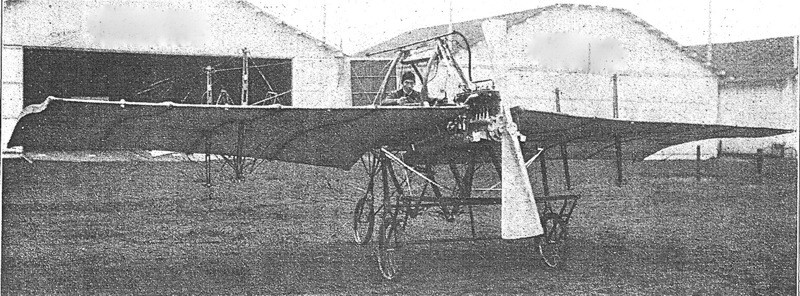
An Argus-engined tractor monoplane, tested at Johannisthal, Germany, in late 1909. Characteristic features: shaped wing profile, big radiator on top of the rear fuselage, double top-and-bottom cabanes encircling the cockpit and anhedral tail surfaces.
Heitmann Typ IV Eindecker
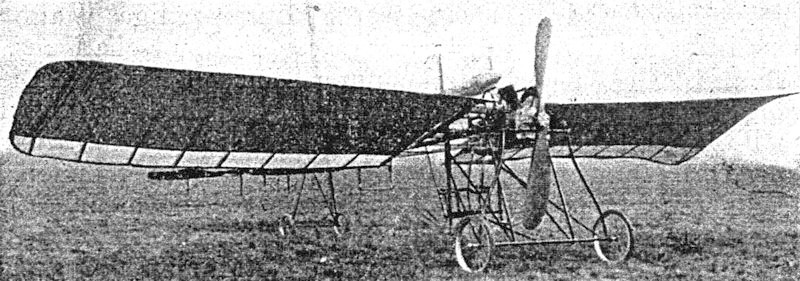
Heinrich Heitmanns company built his fourth monoplane as a Grade-like with a Delfosse engine. According to “Motorwagen” 1911, it flew successfully on the Wandsbecker Exerzierplatz.

