In 1918 the New Britain Machine Co built an 18-cylinder air-cooled radial aero engine designed by G O Hodge. With two banks of 9 cyls each, it produced 320hp@2000rpm from 904.68ci. The dry weight was 480 lb.
Engines – Power
Hodge
New Britain Machine Co,
G O Hodge
New Britain CT
USA
Built a 320 hp aero engine in 1918.
Hodek HK-101
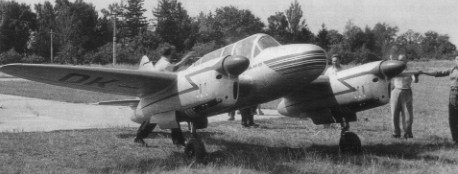
One of three new Czechoslovak prototypes unveiled at an international airshow held at Prague-Ruzyne airport on September 7, 1947, was the civil HK-101 light twin.
Engines: 2 x Walter Minor 4-III.
Hockaday CV-139 Comet
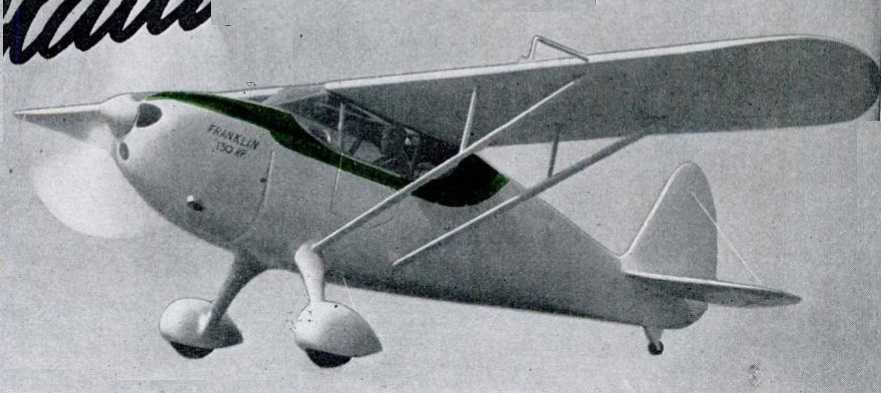
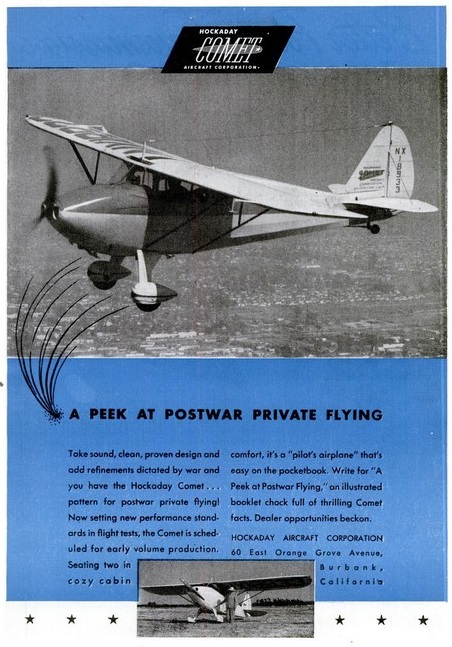
Design work on the CV-139 Comet two-seat high-wing cabin monoplane, but was suspended in 1940 to make way for military contract work for other aircraft companies. The project was resumed in 1944, when the sole prototype was test flown.
Hobson Mozzi
The Mozzi microlight is a New Zealand design with a high-lift wing of 30 feet span, strut braced for easy removal. Built by J.L. Hobson, it features a tricycle undercarriage, pod and windscreen of a B20. Power comes from a Rotax 447 and top speed so far is 65 mph, with an economical cruise speed in the low 40s. Most of the fittings are of the builder’s own design.
Hiway Hang Gliders Skytrike
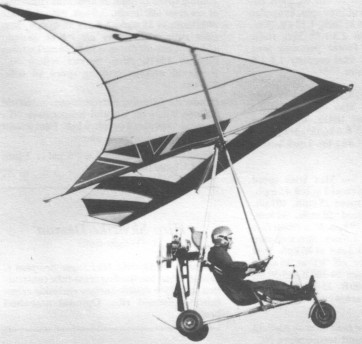
The Skytrike was the first British produced trike unit; allied to Hiway’s simple but effective Super Scorpion wing, (usually in the larger ‘C’ size). Designed by Frank Tarjanyi, the Skytrike/Super Scorpion C was introduced in 1979, the combination of a single surface wing and 10 hp did not exactly make for high performance and its pilot weight range was distinctly limited, but the basic formula was obviously right.
The power shortage was solved by the introduction of Robin engines, in which form the trike unit was dubbed Skytrike Mk II, with the Valmet engined version being known retrospectively as the Mk I. Two versions of the Mk II were offered, a single cylinder 250 cc version which usually retained the Super Scorpion wing, and a twin cylinder 330 cc version which typically is flown with the Hiway Demon wing.
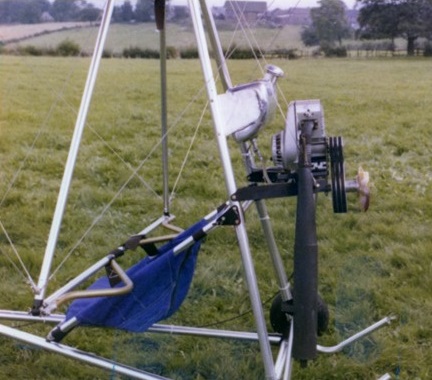
Hiway’s next move was an attempt to retain the performance of the 330 cc version but save some weight, by using the small but powerful liquid cooled Hiro Delta MkI engine to produce the Hiro Skytrike trike unit. The result was an aircraft with an impressive performance for its engine size, due partly to the elimination of drive belts in favour of integral reduction gearing. Moreover, the liquid cooling allowed the inclusion of an effective carburettor anti icing system. Other than the engine, the only significant change to the trike unit was the replacement of the front wire by a strut.
Despite these qualities, the Hiro Skytrike found few buyers in a market which was becoming enamoured with the smoothness and reliability of the 330 cc Robin. It was not helped by the Skytrike’s growing reputation for poor detail engineering. Having made the initial great leap to power, it seemed that the company’s heart had returned to soaring; the marketing and detail development of the Skytrike were neglected and the company’s resources concentrated instead on a radical new hang glider called the Explorer. When this was received less than rapturously by the hang gliding world, it spelt the end of the company. In 1983 Hiway Hang Gliders Ltd was in liquidation.
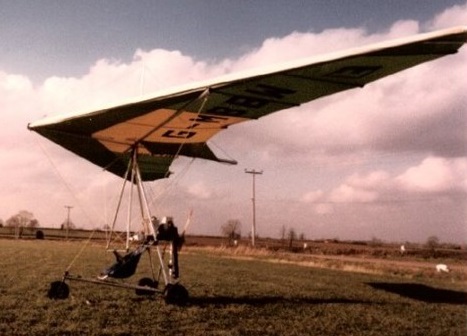
The Mk.II 330/Demon wing has floating cross tube construc¬tion with 75% double surface enclosing cross¬tube; pre formed ribs, and optional nosewheel brake.
Mk.I
Engine: Valmet, 10 hp at 5000 rpm.
Propeller diameter and pitch 54 x 30 ft, 1.37 x 0.76 m.
V belt re¬duction, ratio 2.8/1.
Max static thrust 75 lb, 34 kg.
Power per unit area 0.05 hp/sq.ft, 0.5 hp/sq.m.
Fuel capacity 2.1 US gal, 1.8 Imp gal, 7.9 litre.
Wing span 33.5 ft, 10.21 m.
Mean chord at 5.9 ft, 1.80 m.
Total wing area 198 sq.ft, 18.4 sq.m.
Wing aspect ratio 5.7/1.
Empty weight 1251b, 57kg.
Max take off weight 286 lb, 130kg.
Payload 161 lb, 73kg.
Max wing loading 1.44 lb/sq.ft, 7.1 kg/sq.m
Max power loading 28.6 lb/hp, 13.0 kg/hp.
Max level speed 26 mph, 42 kph.
Never exceed speed 40 mph, 64kph.
Max cruising speed 22mph, 35kph.
Economic cruising speed 22mph, 35kph.
Stalling speed 17 mph, 27 kph.
Max climb rate at sea level 100 ft/min, 0.5 m/s.
Min sink rate 190 ft/min at 21 mph, 1.0 m/s at 34 kph.
Best glide ratio with power off 8/1 at 22 mph, 35 kph.
Take off distance 150 ft, 45 m
Land¬ing distance 70 ft, 20 m
Range at average cruising speed 51 mile, 83 km.
Mk.II 250/Super Scorpion C
Engine: Robin EC25PS, 18 hp at 7000 rpm.
Propeller diameter and pitch 52 x 31 inch, 1.32 x 0.79 m.
V belt reduction, ratio 2.3/1. (Early aircraft used a 54×24 inch propeller with reduction ratio 2/1.)
Max static thrust 1301b, 59kg.
Power per unit area 0.09hp/sq.ft, 1.0hp/sq.m.
Fuel capacity 2.4 US gal, 2.0 Imp gal, 9.1 litre. (Early aircraft used a 1.6 US gal (1.3 Imp gal, 6.1 litre) fuel tank.)
Wing span 33.5 ft, 10.21 m.
Mean chord at 5.9 ft, 1.80 m.
Total wing area 198 sq.ft, 18.4 sq.m.
Wing aspect ratio 5.7/1.
Empty weight 1651b, 75kg.
Max take off weight 3491b, 158kg.
Payload 1841b, 83kg.
Max wing loading 1.76 lb/sq.ft, 8.6kg/sq.m.
Max pow¬er loading 19.41b/hp, 8.8kg/hp.
Max level speed 30 mph, 48 kph.
Never exceed speed 45 mph, 72kph.
Max cruising speed 25mph, 40kph.
Economic cruising speed 25 mph, 40 kph.
Stalling speed 18 mph, 29 kph.
Max climb rate at sea level 300 ft/min, 1.5 m/s.
Min sink rate 250 ft/min at 25 mph, 1.3 m/s at 40 kph.
Best glide ratio with power off 9/1 at 25 mph, 40kph.
Take off distance 90 100ft, 25 30 m.
Landing distance 90 100ft, 25 30m.
Range at average cruising speed 50 mile, 80 km.
Mk.II 330/Demon
Engine: Robin EC34PM, 32 hp at 6500 rpm.
Propeller diameter and pitch 52 x 30 inch, 1.32 x 0.76 m.
V belt reduction, ratio 2/1.
Max static thrust 180 lb, 82 kg.
Power per unit area 0.18 hp/sq.ft, 2.0 hp/sq.m.
Fuel capacity 2.4 US gal, 2.0 Imp gal, 9.1 litre. (Early aircraft used a 1.6 US gal (1.3 Imp gal, 6.1 litre) fuel tank.).
Length overall 11.0ft, 3.35m.
Wing span 32.0ft, 9.75m.
Chord at root 8.2ft, 2.50m.
Chord at tip 3.5 ft, 1.07 m.
Dihedral 0 degs
Nose angle 120 degs.
Total wing area 175 sq.ft, 16.3 sq.m.
Wing aspect ratio 5.9/1.
Empty weight 195 lb, 88kg.
Max take off weight 470 lb, 213 kg.
Payload 275 lb, 125 kg.
Max wing loading 2.69 lb/sq.ft, 13.1 kg/sq.m.
Max power loading 14.7 lb/hp, 6.7kg/hp.
Max level speed 40 mph, 64 kph.
Never exceed speed 45 mph, 72 kph.
Max cruising speed 35 mph, 56 kph.
Economic cruising speed 30mph, 48kph.
Stalling speed 22 mph, 35 kph.
Max climb rate at sea level 600 ft/min, 3.0 m/s.
Min sink rate 300 ft/min at 28 mph, 1.5 m/s at 45 kph.
Best glide ratio with power off 7/1 at 28 mph, 45 kph.
Take off distance 80 ft, 25 m.
Landing distance 100 ft, 30 m.
Range at average cruising speed 65 mile, 105 km.
Hitachi Kokuki Kabushiki Kaisha
Founded in 1939, this company produced the Hitachi T-2 two-seat sesquiplane trainer of wood and metal construction.
Historical Aircraft Corp PZL P.11
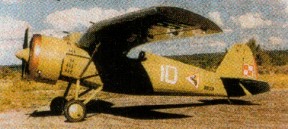
Historical Aircraft Corp offers kits to build a range of 60 percent scale single-seat fighter representations, including P-51D, Corsair, PZL P.11 c and, P-40 Tomahawk, plus an 85 percent scale representation of Ryan STA.
First flown in 1990, the kit included engine, prop and instruments, with a 1997 price of US$25,500.
Historical Aircraft Corp P.11c
Top speed: 105 mph
Cruise: 90 mph
Stall: 55 mph
Range: 300 sm
Rate of climb: 900 fpm
Takeoff dist: 900 ft
Landing dist: 900 ft
Service ceiling: 12,500 ft
Engine: 100 hp
Fuel capacity: 11 USG
Empty weight: 850 lb
Gross weight: 1100 lb
Height: 7.5 ft
Length: 18.3 ft
Wing span: 27.8 ft
Wing area: 97.3 sq.ft
Seats: 1
Landing gear: tailwheel
Hispano-Suiza 14AA
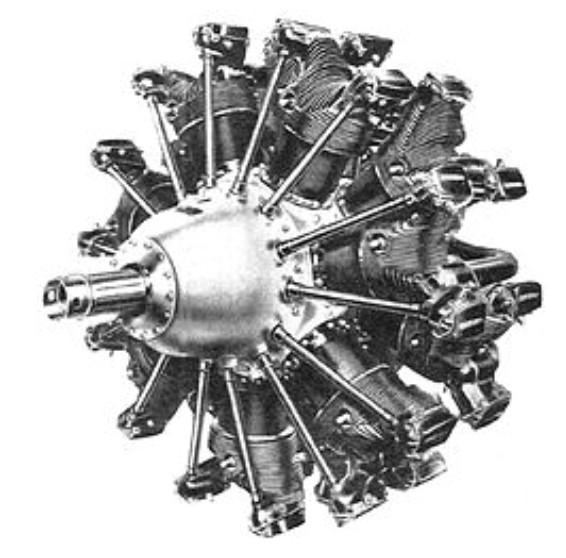
The Hispano-Suiza 14AA was a fourteen-cylinder aircraft radial engine used in France during the late 1930s. As Hispano-Suiza lacked recent experience in developing radial engines, it was derived from the licensed Wright R-2600 engine. Due to reliability problems, the engine was largely supplanted by the similar Gnome-Rhône 14N.
Not to be confused with the smaller Hispano-Suiza 14AB, which was derived from the smaller Wright Whirlwind series.
Applications:
Amiot 341
LeO 45
Farman F.223
Latécoère 530
Latécoère 570
Koolhoven F.K.58
Specifications:
14AA-04
Type: Fourteen-cylinder two-row supercharged air-cooled radial engine
Bore: 156 mm (6.13 in)
Stroke: 170 mm (6.69 in)
Displacement: 45.25 l (2,761 in³)
Length: 1,650 mm (64.96 in)
Diameter: 1,260 mm (49.61 in)
Dry weight: 640 kg (1,411 lb)
Valvetrain: Overhead valves
Supercharger: Single-speed centrifugal type supercharger, 10.0:1 reduction
Fuel system: Carburetor
Fuel type: 85-87 octane rating gasoline
Cooling system: Air-cooled
Reduction gear: 1.58:1
Power output: 793 kW (1,063 hp) at 2,125 rpm for takeoff
Specific power: 17.52 kW/l (0.39 hp/in³)
Compression ratio: 6.2:1
Specific fuel consumption: 369 g/(kW•h) (0.61 lb/(hp•h))
Oil consumption: 12 g/(kW•h) (0.32 oz/(hp•h))
Power-to-weight ratio: 1.24 kW/kg (0.75 hp/lb)
Hispano-Suiza 12Z / SNECMA Hispano 12Z
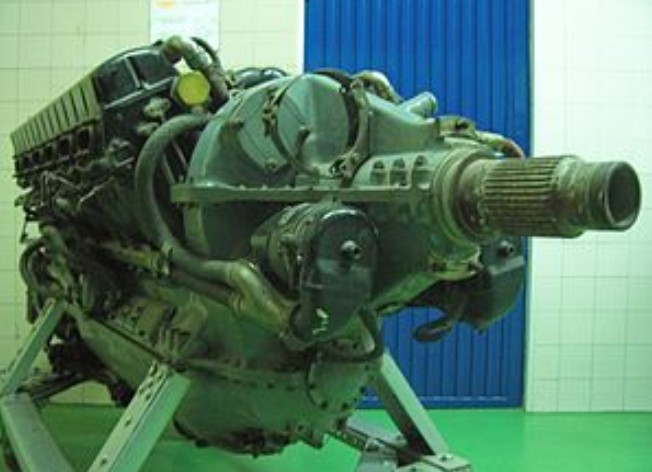
The 12Z was the final evolution of the series of Hispano-Suiza V-12 aircraft engines, which had just entered production when France fell to the Germans during World War II. A small number were produced during the war but the German occupation government would not allow full-scale production to start. After the war small numbers were built to equip new designs, but the rapid introduction of the jet engine ended further development.
The 12Z differed from the earlier 12Y primarily in the use of four valves per cylinder operated by dual overhead cams. This gave the cylinders considerably better volumetric efficiency and faster operation, raising the RPM from 2,400 to 2,700. The engine was also designed to run only on 100 octane fuel (instead of 87, which was common at that point) which allowed the compression ratio to rise from the 12Y’s 5.8:1 to the 12Z’s 6.75:1. These changes raised the power from 1,000 to 1,300 hp (750 to 970 kW) at sea level.
Unfortunately the engine continued to use a single-stage, single-speed supercharger and therefore lacked the all-altitude performance of German and British designs. But tuning the supercharger for a different critical altitude improved high-altitude performance considerably, delivering 1,500 hp (1,120 kW) at 21,000 ft (6,400 m) as opposed to 930 hp (690 kW) at 2,950 ft (900 m) for the 12Y.
Small prototype runs started in 1939, and were fitted to the French Armée de l’Air’s front-line fighter aircraft, the M.S.410 and D.520, creating the M.S.450 and D.524 respectively. Production of the main model, the 12Z-17, was just starting at the time of the armistice. Production was undertaken in Hispano-Suiza’s Spanish factories, but these engines had many problems and were never used in any numbers.
After the war a new version tuned to operate with 92 octane fuel, as opposed to the -17’s 100/130, was built in limited numbers as the 12Z-89. Compression ratio was raised slightly to 7:1, but with the lower grade fuel the power dropped slightly to 1,280 hp (950 kW) at 2,600 rpm (1,479 hp (1,100 kW) maximum take-off). These engines apparently had the same sorts of reliability issues as the earlier -17’s made in Spain, and the type never entered production.
Variants:
Hispano-Suiza 12Z-1
The initial version of the engine used for development
Hispano-Suiza 12Z-17
development peak at time of the Fall of France in May 1940
Hispano-Suiza 12Z-89
post-war development,not successful.
Applications:
Ikarus S-49C
Hispano Aviación HA-1112
Breguet 482
Specifications:
12Z-1
Type: V-12 60° liquid-cooled, geareed drive supercharged four stroke piston engine
Bore: 150mm (5.9in)
Stroke: 170mm (6.69in)
Displacement: 36.05 litres (2,199.9 cu.in)
Length: 2,384mm (93.8in)
Width: 744mm (29.3in)
Height: 1,074mm (42.3in)
Dry weight: 620kg (1,367lb)
Hollow propeller shaft to accommodate a cannon barrel
Valvetrain: Two intake and two sodium-cooled exhaust valves per cylinder actuated by dual overhead camshafts
Supercharger: Gear-driven single-stage two-speed centrifugal type supercharger with automatic boost control – ratios 6.36:1 and 9.38:1
Fuel system: Direct fuel injection @ 40kg/sq.cm (570psi) 2x Lavalette P511-AS2 6-plunger injection pumps with 1x Lavalette KFD injector per cylinder
Fuel type: 100/130-octane rating gasoline
Oil system: Dry sump, pressure feed @ 5kg/sq.cm (70psi), 20.5 centistokes (100S.U. secs) viscosity oil
Cooling system: Ethylene Glycol/water mix
Reduction gear: Spur reduction gear ratio 0.6:1
Air Equipment 1525 compressed gas starting system
Power output:
Take-off – 1,342kW (1,800hp) @ 1,150mm (45.3in)Hg boost @ 2,800rpm
Military, low – 1,193kW (1,600hp) @ 2,500m (8,200ft) @ 2,800rpm
Military, high – 984kW (1,320hp) @ 8,000m (26,200ft) @ 2,800rpm
Cruising, low – 1,193kW (900hp) @ 3,000m (9,800ft) @ 2,100rpm
Cruising, high – 1,193kW (900hp) @ 5,600m (18,400ft) @ 2,100rpm
Specific power: @ take-off power – 37.22kW/l (0.818hp/in³)
Compression ratio: 7.0:1
Specific fuel consumption: 0.29kg/kW/hr (0.48lb/hp/hr)
Oil consumption: 0.006 kg/kW/hr (0.018lb/hp/hr)
Power-to-weight ratio: @take-off power – 2.16kW/kg (1.32hp/lb)
B.M.E.P. (Brake mean effective pressure) 16.3 kg/sq.cm (232psi)

