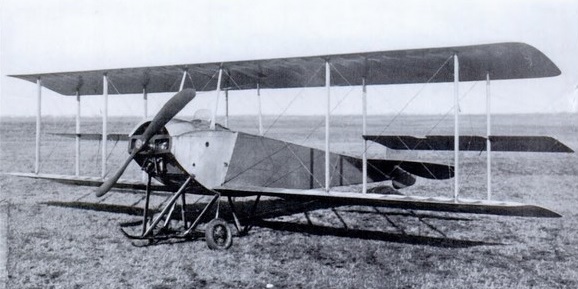
The Huntington Tractor Scout, two-place trainer, was built for an unsuccessful military evaluation in 1915. Powered by a 90 hp Gyro engine, it was built at the Hempstead Plains Airfield in Garden City.
The Huntington Tractor Scout, two-place trainer, was built for an unsuccessful military evaluation in 1915. Powered by a 90 hp Gyro engine, it was built at the Hempstead Plains Airfield in Garden City.
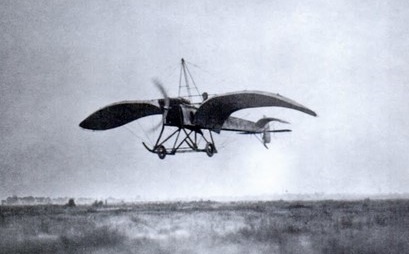
A more traditional design, the 1914 Huntington Clam was flown several times at the Hempstead Plains Airfield.
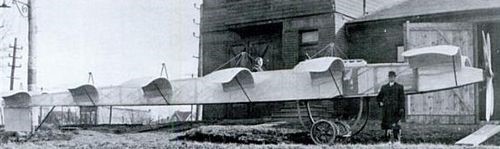
A multi-wing aeroplane designed and built by Howard Huntington sometime during 1912/1913. The photo shows Huntington in front of his house in Hollis, Queens, on January 22, 1914.
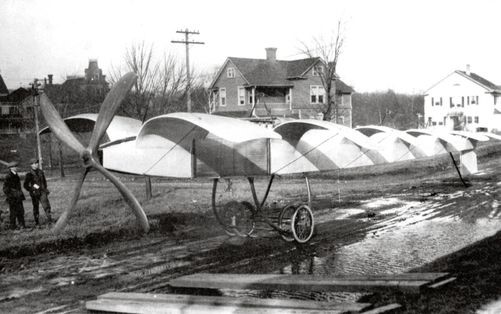
In June of 1914 Huntington constructed a single wing variant of his multiplane – the Huntington “Clam”.
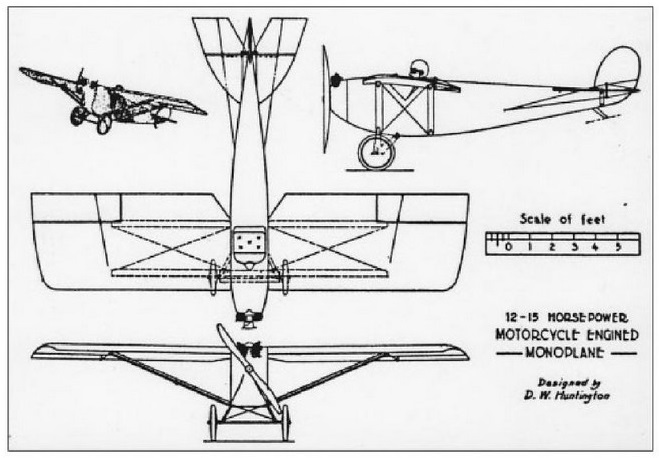
The 1920 Huntington H-12 monoplane was a successful design powered with a motorcycle engine. Designed and built by Dwight Huntington of Hempstead, this was the first kit, or plan-built, lightplane professionally engineered in the United States.
With a wingspan of 20 ft, the wings were attached to the upper longerons, but downward vision was increased by windows in the sides of the cockpit. It was powered by a 15 hp Harley Davidson motorcycle engine.
Able to cruise a 60 mph, plans of the H-12 were sold through aviation magazines into the late 1920s.
The cost of construction, without motor, was well under $80.
A four/six-seat amphibian with a Pratt & Whitney Wasp engine.
A two-seat landplane, powered by a Wright-built Gipsy.
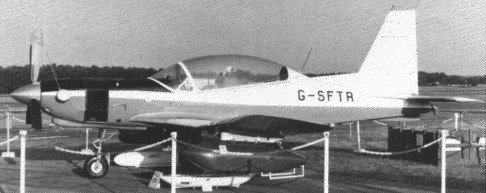
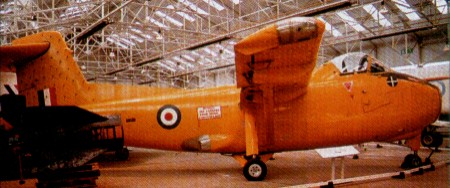
The Hunting H.126 was a one-off single-seat research aircraft with fixed tricycle landing gear designed to test the effects of directing the jet exhaust air across the flaps and control surfaces to increase lift, or as they were known in Britain, “jet flaps”. The exhaust efflux of a turbojet engine is ducted to the trailing edge of an aircraft’s wings and ejected through a narrow slit along the trailing edge. As well as being used to provide propulsion, the efflux can be deflected downward to form a “jet-flap” of high velocity gas which makes possible the achievement of lift coefficients of 10 or more. The shoulder-level wing featured a set of struts, not for support but in order to provide piping for the compressed air used in the blown flaps. A maxi¬mum of 60% of the jet exhaust can be directed to the wings and a further 10% to reaction jets in the tail and wingtips.

The H.126 first flew on 26 March 1963, being flown in a series of one-hundred test flights at the Royal Aircraft Establishment’s Aerodynamics Flight at RAE Bedford by mid-1965 with the program ending in 1967. After two years storage it was sent to the United States in 1969 for wind tunnel testing by NASA returning in May 1970. Stored for another two years it was struck off charge in September 1972 and eventually made its way to the RAF Museum at RAF Cosford.
A notice inside the cockpit reads “The airspeed must not fall below 28 knots”.

Powerplant: one Bristol Siddeley Orpheus turbojet.
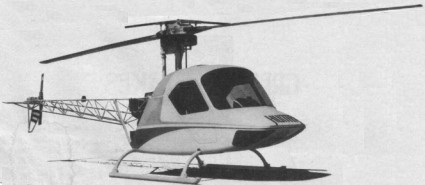
A two place, light utility helicopter, featuring a composite cabin, welded tubular fuselage and multiple V belt main rotor drive.
Engine: Lycoming IVO 360 AlA, 180 hp.
Cruise: 80 mph.
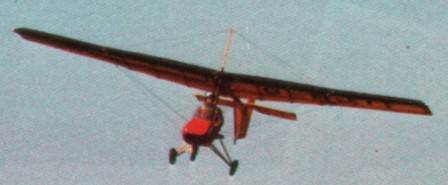
Single seat single engined high wing monoplane with conventional three axis control. Wing has unswept leading edge, swept forward trailing edge and tapering chord cruciform tail. Pitch control by elevator on tail; yaw control by fully flying rudder with additional fin; roll control by half span ailerons; control inputs through stick for pitch/roll and pedals for yaw. Wing braced from above by kingpost and cables, from below by cables; wing profile, modified 23012; 100% double surface. Undercarriage has three wheels in tricycle formation with additional tailwheel; no suspension on nosewheel and steel spring suspension on main wheels. Push right go right nosewheel steering connected to yaw control. No brakes. Aluminium tube framework, with optional pod. Engine mounted below wing driving pusher propeller. Aluminium tubing to British HT3OTF specification. Polyester sailcloth.
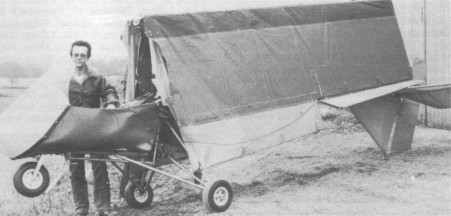
The Pathfinder II is similar in concept to the Pathfinder I and is a logical development of the previous design. Visually the most obvious difference is the large diameter single upright, which replaces the two uprights originally used, but there are many other changes too. A fully double surface wing is used, with curved underside, lower camber (3%), 12% aerofoil, shorter span and slightly lower area, changes which make the aircraft less affected by turbulence and, as a bonus, faster.
To improve handling, rigid ailerons are used, constructed similarly to the tail surfaces of the Pathfinder I The rudder has been made smaller and the fin area larger. Although the 330 engine is unchanged internally, the mounting system has been changed to reduce vibration and the fan-cooling dispensed with, saving weight and increasing power. Other improvements are the inclusion of a carburettor heat facility and a more durable design of drive shaft.
The combined effect of these changes is an aircraft which is faster, lighter and more compact than its predecessor. Although the pod remains optional, it is a standard fitment.
Steve Hunt designed the wings of the Pathfinder II to fold in four minutes, allowing the aircraft to be stored in a small space without being totally dismantled.
Engine: Robin EC34, 35 hp at 6500 rpm.
Propeller diameter 54 inch, 1.37 m.
V-belt reduction, ratio 2.4/1.
Max static thrust 210 lb, 95 kg.
Power per unit area 0.24 hp/sq.ft, 2.6 hp/sq.m.
Fuel capacity 5.4 US gal, 4.5 Imp gal, 20.4 litre.
Length overall 21.0 ft, 6.40 m.
Height overall 8.5ft, 2.59m.
Wing span 29.0ft, 8.84m.
Chord at root 5.3ft, 16.3m.
Chord at tip 4.5ft, 1.37m.
Dihedral 1 deg
Sweepback 0 deg
Total wing area 146 sq.ft, 13.6 sq.m
Wing aspect ratio 5.8/1.
Wheel track 4.4ft, 1.34m.
Nose¬wheel diameter overall 13 inch, 33 cm.
Main wheels diameter overall 13 inch, 33 cm.
Optional floats, dimensions: 12 ft, 3.66 m long.
Optional skis, dimensions 3.8 ft, 1.16 m long.
Empty weight 260 lb, 118kg.
Max take off weight 540 lb, 245kg.
Payload 280 lb, 127 kg.
Max wing loading 3.70 lb/sq.ft, 18.0 kg/sq.m.
Max power loading 15.41b/hp, 7.0kg/hp.
Load factors: +6.0, 4.0 ultimate.
Max level speed 80 mph, 129 kph.
Never exceed speed 90 mph, 145 kph.
Max cruising speed 75 mph, 121 kph.
Economic cruising speed 60 mph, 97 kph.
Stalling speed 26 mph, 42 kph.
Max climb rate at sea level 500 ft/min, 2.5 m/s.
Take off distance 300 ft, 90 m.
Landing distance 300 ft, 90 m.
Service ceiling 12,000 ft, 3660 m.
Range at average cruising speed 180 mile, 290 km.

