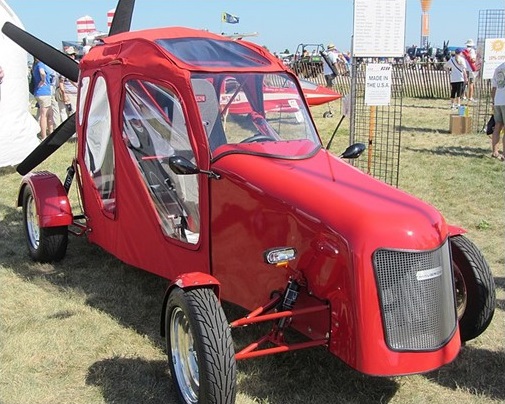
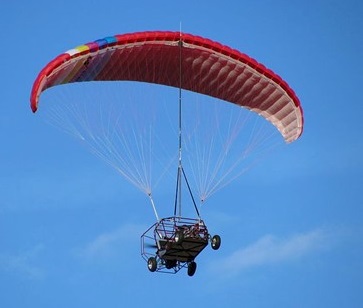
The I-TEC Maverick is a powered parachute aircraft with a roadable fuselage. Equipped with the largest powered parachute certified by the FAA, the Maverick received experimental aircraft airworthiness certification on April 14, 2008, with N-Number 356MV.
prototype flight
Capable of interstate speeds on pavement, the Maverick’s dune buggy-like frame of chromoly tubing gives it the ability to be used off-road. Additionally, the vehicle can deploy a parafoil and fly as a powered parachute, it weighs about 1100 pounds and has a useful carrying capacity equivalent to a Cessna 172 (fuel and 550 pounds cargo). With a 22-foot mast, the Maverick can take off and land in weather conditions that other powered parachutes would not be able to safely operate in. Steve Saint has said he envisions the Maverick being useful to the Huaorani and other Indian groups, farmers and ranchers, pipeline inspection crews and anyone else with a requirement to traverse rough, roadless ground. Popular Mechanics gave it their Breakthrough Award in 2009. In 2012, the Maverick was accepted by the United States FAA to operate as an Experimental homebuilt, S-LSA, or E-LSA.
Variants:
Maverick URVATV (Ultimate Roadable, All-Terrain, Aerial Vehicle) Initial model
Maverick HPAV (High Performance Aerial Vehicle) Transaxle removed, fan drive only
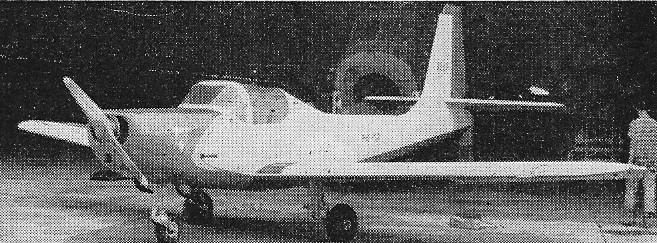
Dott Ing Stelio Frati designed the F.20 Pegaso light twin; two prototypes built (first flown 1971) and an agreement was reached for production aircraft to be manufactured by Italair.
The XL-17 ” Musang” (Wildcat) is the fourth aircraft in the series designed and constructed by the Institute of Science and Technology of Manila in the Philippine Republic, and is part of a programme to test the application of local materials, such as home-grown woods, to aircraft structure. During their experiments the Institute developed a material which it called “Wobex”. “Wobex” consists of diagonally woven strips of thin bamboo glued together, made air tight and leakproof, and finished on the surface with a layer of fine sawdust and glue. Its main use is as a stressed skin covering.
In the mid-1950s the Philippine Institute of Science and Technology (I.S.T.) designed the single engine, tricycle undercarriage, low wing monoplane L-17 was one of them.
Designed by Antonio J. de Leon, its wing was a single-piece wooden structure with 5° of dihedral and a straight-tapered plan. It was plywood-covered and had split flaps inboard of the ailerons. The cantilever tail unit was similarly constructed with the straight-tapered horizontal surfaces on top of the extreme aft fuselage; the single-piece elevator carried an offset trim tab. The vertical tail was tall and straight-edged; the bottom of the horn balanced rudder was above the elevator and just aft of its hinge, with a small cut-out to allow for elevator deflection.
Fuselage is a one-piece semi-monocoque structure with wooden bulkheads and stringers covered by a “Wobex ” skin, which in turn is covered with fabric for final finishing and polishing. Fuel tanks are fitted aft of the seats and the rest of the fuselage space can be used as either a radio compartment or as baggage space. The engine mount is the standard truss-type with attachments at four points to the firewall bulkhead, which is reinforced for the attachment of the nose landing gear. The cantilever wing is trapezoid in form and of one-piece construction that tapers in chord and length. It is made up of one main and one auxiliary spar of box-type construction and reinforced diagonal spar. The leading edge is covered with a thick plywood covering to take torsional and chordwise shear loads. Overall wing covering is fabric. Slotted type ailerons are fitted and simple split flaps are located under the wings between the ailerons and the fuselage. The wing root upper section upper covering is reinforced to serve as a step and walkway to the cockpit. A tricycle undercarriage is fitted, the main gear to the main wing spars and the nose gear to the firewall bulkhead.
Cockpit seating two side by side under a single piece canopy. A 108 hp (80 kW) Lycoming O-235-C1 flat-four engine drove a two-blade propeller. The fixed tricycle undercarriage had rearward-sloping oleo legs mounted to the wings, giving a track of 2.40 m (7 ft 10 in).
The first flight of the L-17 was scheduled for May 1956.
Engine: 1 × Lycoming O-235-C1, 81 kW (108 hp) Propeller: 2-bladed , fixed pitch, wooden Wingspan: 9.60 m (31 ft 6 in) Wing area: 13.40 m2 (144.2 sq ft) Airfoil: US 35B at root, NACA 23012 tip Length: 7.20 m (23 ft 7 in) Height: 3.20 m (10 ft 6 in) Empty weight: 510 kg (1,124 lb) Gross weight: 735 kg (1,620 lb) Fuel capacity: 68 L (15 Imp gal, 18 US gal) Maximum speed: 210 km/h (130 mph, 110 kn) Cruise speed: 175 km/h (109 mph, 94 kn) Stall: 80 kph Rate of climb: 3.8 m/s (750 ft/min) Crew: 2
In the early 1950s in the Philippines, the Institute of Science and Technology (I.S.T., previously known as the Bureau of Science) designed at least three different prototypes, both to investigate the scope for local aircraft design and production and to examine the use of indigenous materials in their construction. One such material of interest was Wobex (Woven bamboo experimental), a reinforced woven bamboo.
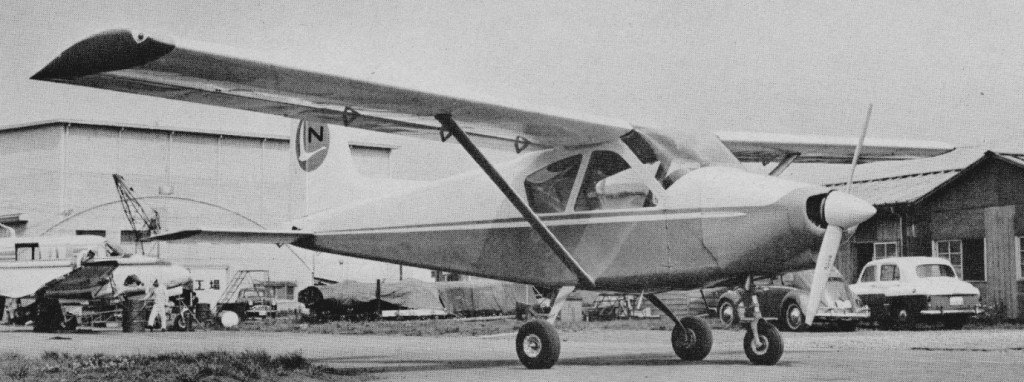
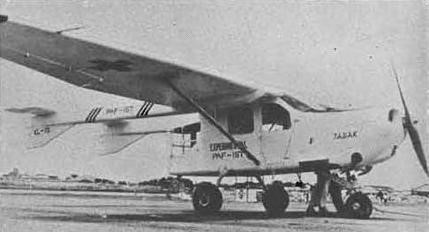
The XL-15 Tagak was the second of these prototypes, developed in collaboration with the Philippine Air Force, it was designed by Antonio J. de Leon as a utility, liaison or ambulance aircraft and as a test bed for the use of local materials in aviation. It was a single-engine, high-wing monoplane with a twin-boom layout and tricycle undercarriage to enable easy access to the fuselage pod via rear doors. The inner wing sections, fitted with slotted flaps on the trailing edges had constant chord but further out the wings tapered, with slotted ailerons. There was a single lift strut on each side between wing and lower fuselage, with an airfoil profile to add to the lift from the wings.
The fuselage of the Tagak was a wood and plywood framed semi-monocoque skinned with Wobex and ply. Its cabin, behind the 185 hp Lycoming flat six engine, was 3.26 m (10 ft 6 in) long to the rear of the pod. There were two front seats under the wing leading edge, two more behind and room for one or two (stacked) stretcher cases. The cabin had two windows on each side and the rear part of the pod, which projected behind the wing trailing edge, was also extensively glazed. The two tail booms, of all ply construction, were integral with the wing centre section. The fins, with long chord underside fillets, were integral with the booms. The tailplane was rectangular and extended beyond the fins, carrying a horn balanced elevator. The fixed surfaces were of wood and ply construction, with Wobex covering; control surfaces were fabric covered.
Flight testing of the Tagak began in October 1954. By 1956 some small modifications had been made: rudder area was increased and a shimmy-damper added to the nosewheel leg.
Only one was built.
Engine: 1 × Lycoming O-425A, 138 kW (185 hp) Propeller: 2-bladed fixed pitch Wingspan: 12.0 m (39 ft 4 in) Wing area: 20.30 m2 (218.5 sq ft) Airfoil: NACA 23012 (inner section), USA 35B outer section Length: 9.15 m (30 ft 0 in) Height: 2.80 m (9 ft 2 in) Empty weight: 780 kg (1,720 lb) Gross weight: 1,250 kg (2,756 lb) Fuel capacity: 174 L (38 Imp gal, 46 US gal) Maximum speed: 200 km/h (120 mph, 110 kn) Cruise speed: 158 km/h (98 mph, 85 kn) Range: 675 km (419 mi, 364 nmi) Service ceiling: 4,000 m (13,000 ft) Rate of climb: 3.0 m/s (590 ft/min) Seats: 4
The XL-10B Balang (Grasshopper) was a powered glider joint project of Institute of Science and Technology (IST) and Philippine Air Force (PAF) Air Research and Development Authority (ARDA).
It first flew in 1953.
Engine: 20 hp Wingspan: 12 m Length: 5.20 m Height: 1.5 m Aspect ratio: 8.1 Wing area: 17.8 sq,m Empty weight: 185 kg Loaded weight: 280 kg Max speed: 125 kph Cruise speed: 72-80 kph Stall: 49 kph Glide speed: 75 mph
In the early 1950s in the Republic of the Philippines, the Institute of Science and Technology (I.S.T., previously known as the Bureau of Science) designed at least three different prototypes, both to investigate the scope for local aircraft design and production and to examine the use of indigenous materials in their construction. One such material of interest was Wobex (Woven bamboo experimental), a reinforced woven bamboo.
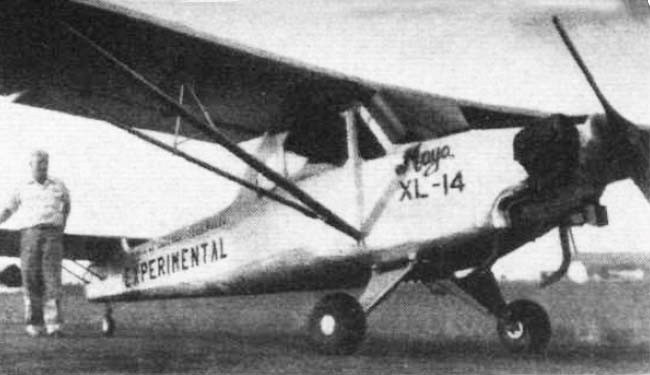
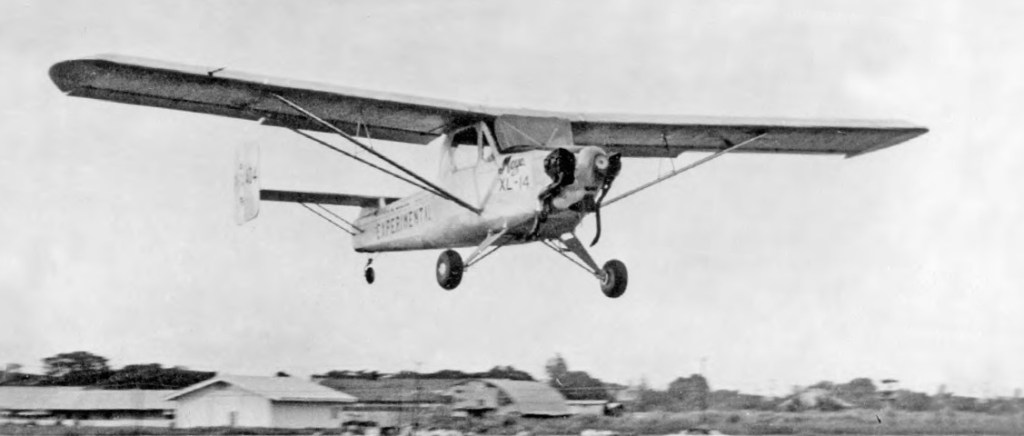
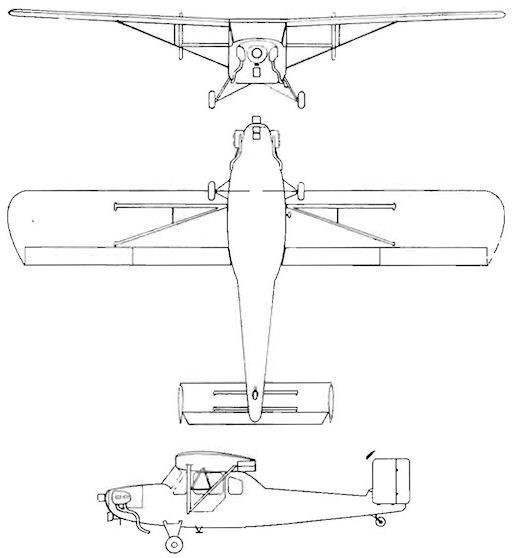
Designed by Antonio J. de Leon, the XL-14 Maya (until 1995 the Maya was the national bird of the Philippines) was the first of this series of prototypes. It was a single-engine, high-wing monoplane of standard layout except for its twin tail. The wing had constant chord and was built around two parallel, solid spars and wooden ribs. The leading edges were covered and reinforced with Wobex and the rest of the wing was fabric covered. The centre section was integral with the cabin top and the outer wings were braced on each side with V struts from the wing spars to the lower fuselage. Ailerons and slotted flaps were fitted. It had a strut braced tailplane, set slightly above the fuselage top on a short pylon. The tailplane carried almost rectangular endplate fins and rudders. The tail structure was wooden with fabric covering.
The Maya, bearing its experimental category registration PI-X-104 on its fins, had a semi-monocoque fuselage with wooden stringers and Wobex mat covering. The cabin stood above the rear fuselage line, enclosing side-by-side seats with a third, occasional seat, or luggage space, behind. In front a 75 kW (100 hp) Lycoming flat four engine, with cylinder-heads exposed, drove a two-blade propeller. It had a conventional undercarriage, with each mainwheel mounted on V-struts and half axles hinged to the fuselage central underside via rubber shock absorbers. The fixed tailwheel was steerable.
The date of the Maya’s first flight is not known, though the aircraft was complete by May 1955 and a later design, the XL-15 Tagak was being flight tested by October 1954. Only one Maya was built, for although it was described as being suitable for agricultural use and for utility and observation work, its function was always as a constructional material experimental aircraft.
Engine: 1 × Lycoming O-235-2, 75 kW (100 hp) Propeller: 2-bladed wooden, fixed pitch Wingspan: 10.24 m (33 ft 7 in) Wing area: 16.0 sq,m (172 sq ft) Length: 6.30 m (20 ft 8 in) Height: 2.40 m (7 ft 10 in) tail up Empty weight: 510 kg (1,124 lb) Gross weight: 780 kg (1,720 lb) Fuel capacity: 68 L (15 Imp gal, 18 US gal) Maximum speed: 184 km/h (114 mph, 99 kn) Cruise speed: 150 km/h (93 mph, 81 kn) Range: 480 km (300 mi, 260 nmi) Service ceiling: 3,820 m (12,530 ft) Rate of climb: 3.6 m/s (710 ft/min) initial Capacity: 2/3 (3rd passenger under 50kg (110 lb))
The Isotta Fraschini V.5 of 1916 was an Italian eight-cylinder, water-cooled, in-line piston aero engine first run in 1915. The “V” denoted “Volo” or “flight” rather than piston arrangement.
The V.5’s construction was fairly typical of aircraft engines of the period with cast-iron cylinders mounted in pairs with common heads and water jackets. It had much in common with the six-cylinder Isotta Fraschini V.4 and was built at a similar time. Though powerful, it was very heavy and thus, like some other Isotta Fraschini engines, better suited to airships than aircraft.
Applications: Forlanini airship
Specifications: Type: 8-cylinder inline Bore: 130 mm (5.12 in) Stroke: 180 mm (7.09 in) Displacement: 19 L (1,165 cu in) Length: 1,990 mm (78.3 in) Width: 600 mm (23.6 in) Height: 1,010 mm (39.8 in) Dry weight: 351 kg (774 lb) Valvetrain: Overhead camshaft Fuel system: Twin carburettors, twin eight spark magnetos Oil system: Forced feed Cooling system: water; cast iron cylinders in pairs, each pair in a steel water jacket Reduction gear: direct Power output: 183 kW (245 hp) at 1,400 rpm
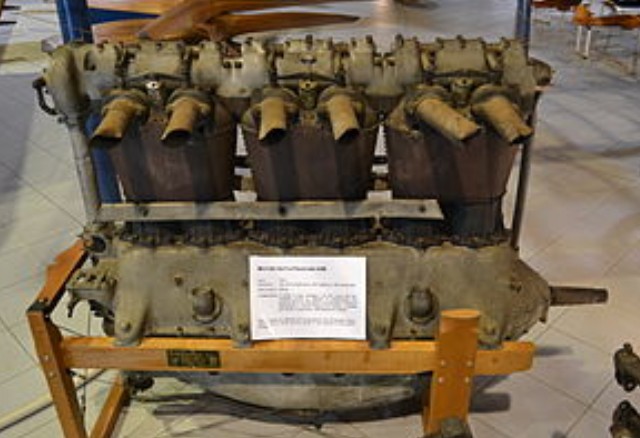
The Isotta Fraschini V.4 of 1916 was an Italian six-cylinder, water-cooled, in-line piston aero engine of World War I (the “V” denoted “Volo” or “flight”). Its construction was fairly typical of aircraft engines of the period with six cast-iron cylinders mounted in pairs with common heads. This engine was also produced by Alfa Romeo.
V.4b Type: Six-cylinder, water-cooled, in-line piston engine Bore: 130 mm (5.12 in) Stroke: 180 mm (7.09 in) Displacement: 14.3 L (874 cu in) Length: 1,470 mm (58 in) Width: 460 mm (18.11 in) Height: 1,020 mm (40.15 in) Dry weight: 264 kg (584 lb) Valvetrain: Overhead camshaft Fuel system: Twin carburettors, two six spark magnetos Oil system: Forced feed Cooling system: Water; cylinders in pairs, each pair in a steel water jacket Power output: 142 kW (190 hp) at 1,450 rpm Compression ratio: 4.8