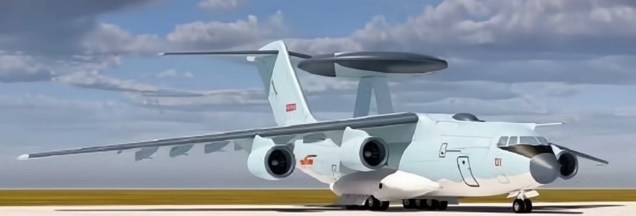
China has not officially confirmed the first flight of the KJ-3000 aircraft, which will significantly enhance its early warning capabilities. The KJ-3000 is based on the People’s Liberation Army Air Force (PLAAF) Y-20 transport aircraft and is the latest addition to China’s “eye in the sky” arsenal of early warning aircraft.
The rotodome is a discus-shaped rotating radome that allows the detection and tracking of targets by providing 360-degree coverage. Some experts speculate that the bulge on the tail may be related to the integration of some advanced communication systems.
The aircraft is powered by the domestically-produced WS-20 high-bypass turbofan engine, like the Y-20B transport aircraft that it is based on. It is anticipated to generate approximately 31,000 pounds of thrust. As per some unconfirmed claims, the aircraft would have a detection range exceeding 360-500 km.
The KJ-3000 can carry more payload—up to 66 tons— 16 tons more than the KJ-2000. Moreover, the WS-20 engines provide more thrust and fuel efficiency, enabling longer flight operations.
The aircraft could operate as a complete command center since it integrates C4ISR (Command, Control, Communications, Computers, Intelligence, Surveillance, and Reconnaissance) technologies, allowing for better coordination between the land, sea, and air domains.
Two major Chinese aviation companies, Shaanxi Aircraft Corporation and Xi’an Aircraft Corporation, expressed interest to develop the Y-20 aircraft, but Xi’an was announced as the manufacturer of Y-20 in 2007.
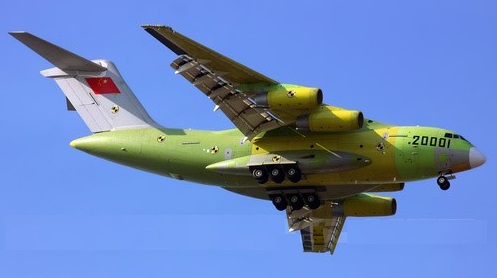
Developed by Xi’an Aircraft Industrial Corporation and was officially launched in 2006 the Xi’an Y-20 (Chinese: 运-20; pinyin: Yùn-20; literally: “transport-20”) is a large military transport aircraft. The official codename of the aircraft is Kunpeng (Chinese: 鲲鹏), after the mythical bird that can fly for thousands of miles described in the ancient Chinese Taoist classic Zhuangzi. However, within the Chinese aviation industry itself, the aircraft is more commonly known by its nickname Chubby Girl (Chinese: 胖妞), because its wide fuselage in comparison to other Chinese aircraft previously developed in China.
The aircraft was primarily designed and developed in China by Xi’an Aircraft Industrial Corporation under Tang Changhong. Certain parts of the wing such as the triple-slotted trailing-edge flaps were developed by the Ukrainian Antonov Design Bureau. The Y-20 uses components made of composite materials. The composites are produced in China, whereas in the past they had to be imported. The Y-20’s cabin incorporates flame-retardant composites developed by the 703 Institute of the China Aerospace Science and Technology Corporation (CASC). The 703 Institute was created in March 2009 with development taking three years. The performance of the composites is reportedly comparable to those that fulfill FAR Part 25.835. The 703 Institute achieved another milestone by establishing a comprehensive Chinese evaluation and certification system for aircraft composite materials based on international standards.
The Y-20 is the first cargo aircraft to use 3D printing technology to speed up its development and to lower its manufacturing cost. Model-based definition (MBD) is also used, and it’s the third aircraft to utilize MBD technology in the world, after Airbus A380 (2000) and Boeing 787 (2005). A project team to implement MBD for Y-20 program was formally formed in October 2009, and after the initial success in application on the main landing gear, MBD application was expanded to the entire aircraft and became mandatory for all contractors and sub contractors of the Y-20 program. The implementation of MBD was initially met with strong resistance, with only a third of suppliers agreeing to implement MBD. However, the general designer of Y-20 declared that those who refused to implement MBD will be banned from participating in the Y-20 program, thus forcing everyone to comply, resulting in increases in productivity. The implementation of MBD greatly shortened the time required, for example, without MBD, installation of wings takes a month or two, but with MBD adopted, the time is drastically shortened to just a few hours, and in general, the design work reduced by 40%, preparation for production reduced by 75%, and manufacturing cycle reduced by 30%. In addition to 3D printing, Y-20 is also the first aircraft in China adopting associative design technology (ADT) in its development. Headed by the deputy general designer of structural design, Mr. Feng Jun (冯军), the initial attempt to implement ADT actually failed after two months spent on application on the nose section. It was only after the second attempt that took another three months on the application on wings did ADT became successful. The adaptation of ADT greatly shortened the development time by at least eight months, and modification of wing design that previously took a week is shortened to half a day.
The Y-20 airlifter has a glass cockpit, which accommodates three crew members. Cargo is loaded through a large aft ramp that accommodates rolling stock. The Y-20 incorporates a shoulder wing, T-tail, rear cargo-loading assembly and heavy-duty retractable landing gear, consists of three rows, with a pair of wheels for each row, totalling six wheels for each side. The structural test was completed in 194 days as opposed to the 300 days originally planned, thanks to the successful development and application of an automated structural strength analysis system. According to the deputy general designer, the shortest take-off distance of Y-20 is 600 to 700 meters. Y-20 incorporates a total of four LCD EFIS, and the development of EFIS for Y-20 utilizes virtual reality via helmet mounted display. Eight types of different relays used on Y-20 are developed by Guilin Aerospace Co., Ltd. a wholly own subsidiary of China Tri-River Aerospace Group Co., Ltd.(中国三江航天集团), which is also known as the 9th Academy of China Aerospace Science and Industry Corporation (CASIC).
It was reported that the Y-20 started ground testing from December 2012, including runway taxi tests. The aircraft made its maiden flight lasting one hour on January 26, 2013 at Shaanxi Yanliang Aviation Base. During landing in first flight, it was reported that the Y-20 prototype bounced once before finally settling on runway due to high landing speed. In December 2013, a new Y-20 prototype took to the sky.
The Y-20 is powered by four 12-ton thrust Soloviev D-30KP-2 engines, and all early production units are likely to be similarly powered. The Chinese intend to replace the D-30 with the 14-ton thrust WS-20, which is required for the Y-20 to achieve its maximum cargo capacity of 66 tons. The Shenyang WS-20 is derived from the core of the Shenyang WS-10A, an indigenous Chinese turbofan engine for fighter aircraft.
In 2013, Shenyang Engine Design and Research Institute was reportedly developing the SF-A, a 28700-pound thrust engine, for the Y-20 and the Comac C919. The SF-A is derived from the core of the WS-15. Compared to the WS-20, the SF-A is a conservative design that does not seek to match the technology of more modern engines.
In late 2017, it is revealed that domestic Chinese turbofan WS-18 has begun flight test on Y-20. Compared with Russian Soloviev D-30, WS-18 is 300 kg lighter, weighing at 2000 kg; with thrust increased from 12.5 ton of D-30 to 13.2 ton; and fuel consumption of WS-18 is also reduced in comparison to D-30, and the mean time between overhaul of WS-18 is 3000 hours. However, because the increase in thrust is not significant in comparison to D-30, WS-18 is like to be a stopgap measure before WS-20 is ready. The production aircraft are equipped with WS-20 engines.
The aircraft is equipped with a retractable landing gear comprising two main landing gear units and a nose unit. Each of the two main units on either side of under-fuselage features six wheels, which are arranged in a two-two-two layout from front-to back. The steerable nose gear includes a standard twin-wheel leg unit. The landing gear allows take-offs and landings on rough airfields or unpaved runways.
In 2014 the PLA National Defence University’s Center for Economic Research recommended the purchase of up to 400 Y-20s, comparing the PLAAF’s needs with the existing airlifter fleets of the United States and Russia. In June 2016 Jane’s reported that up to 1,000 Y-20s are being requested by the Chinese military.
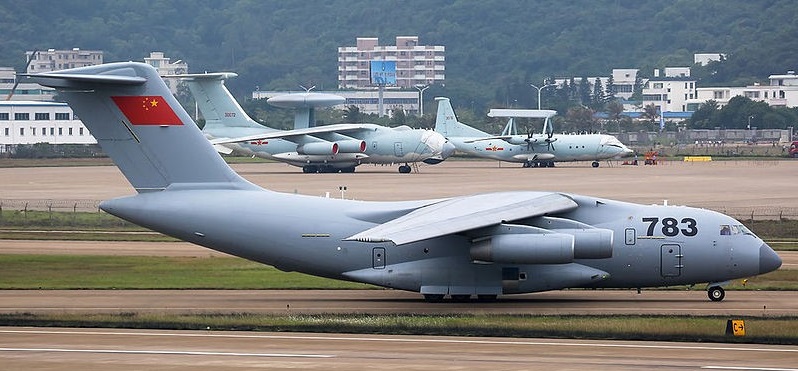
On 6 February 2016 the Y-20 was flown for the first time and pictures of the fifth prototype (serial number 788) in flight appeared on Chinese military webpages. Other known prototypes carry identification numbers 781, 783 and 785. On 27 January 2016, former Chinese test pilot Xu Yongling had reported in a Xinhua article that Chinese aviation industry officials had stated that the Y-20 “completed development” at the end of 2015. In June 2016, the first two Xian Y-20 aircraft were delivered to the People’s Liberation Army Air Force (PLAAF).
On 6 July 2016 the first serial Y-20 (serial number 11051) was handed over to the PLAAF in a ceremony. The second aircraft serialed 11052 followed soon after – it is assigned to the 12th Regiment of the 4th Transport Division at Qionglai, Chengdu. On 8 May 2018, it was announced by PLAAF’s spokeperson Shen Jinke that Y-20 had “recently conducted its first joint airdrop training with the country’s airborne troops”.
At least two aircraft stationed at Qionglai Air Base since July 2016. Commercial satellite imagery captured on 9 December 2017 suggests that at least three more Xian Aircraft Corporation Y-20 Kunpeng transport aircraft have entered service with China’s People’s Liberation Army Air Force (PLAAF). In these images there are a total of 5 Xi’an Y-20’s lined up at Qionglai Airbase near Chengdu in China’s southwestern Sichuan Province.
The YY-20A tanker, bearing the serial number 20646, was spotted in February 2025.
YY-20A
Derived from the Xi’an Y-20 strategic transport, the YY-20A tanker variant can haul up to 90 tons of fuel, tripling the capacity of the aging H-6U tankers it’s replacing.
2023 analysis pointed to the YY-20B’s “hot and high” takeoff capability—enabled by the WS-20 engines—as a game-changer, allowing operations from rugged, high-altitude bases that could support a Taiwan contingency.
The base Y-20A transport, powered initially by Russian D-30KP-2 engines, boasts a 66-ton payload and a range of up to 7,800 kilometers when fully loaded, capable of carrying everything from ZTZ-99 tanks to medical supplies.
The YY-20A tanker variant, introduced in 2022, swaps cargo for fuel pallets, featuring two underwing refueling pods and a centerline drogue for large aircraft like the H-6N bomber or KJ-500A AEW&C platform, monitored by IIR/TV cameras for precision.
The Y-20B, rolled out by 2023, upgrades to four Shenyang WS-20 high-bypass turbofans, boosting thrust to 31,000 pounds per engine and enhancing the range and short-field performance. A YY-20B tanker sub-variant, spotted in late 2023, likely builds on this, though some speculate the Y-20B’s modular design allows any unit to double as a tanker with minimal reconfiguration.
Advanced avionics, a glass cockpit with heads-up displays, and composite materials round out a platform that’s as modern as it is massive, with a 50-meter wingspan and 47-meter length.
Analysts see a niche for the Y-20E export variant, powered by WS-20s.
In 2025 production capacity was ramping up and a civilian Y-20F-100 variant pitched for commercial use.
Specifications (estimated) Engines: 4 × Soloviev D-30KP-2 turbofans Wingspan: 45 m (147 ft ~ 164 ft) Wing area: 330 m² (3550 ft²) Length: 47 m (154.2 ft) Height: 15 m (49.2 ft) Empty weight: 100,000 kg (220,400 lb) Max takeoff weight: 220,000 kg (485,000 lb) Payload: 66 tonnes (145,505 lb) Max wing loading: 710 kg/m² (145 lb/ft²) Cruise speed: Mach 0.75 Range max payload: 4,500 km Range 40 ton payload: 7,800 km Service ceiling: 13,000 m (42,700 ft) Crew: 3: pilot, copilot & load master
In 1970, Xian Aircraft Factory proposed an upgraded four-engined version of their H-6 Tu-16 copy. The proposal was approved, while the PLAAF issued an extra requirement of capabilities against sea targets two years into development. To test their plans, Xian re-engined an H-6 with four Rolls-Royce Spey turbofans – two in the wing roots and two under the wings. Designated the H-6I, the prototype took flight in 1978. Performance gains were impressive – climb rate increased by 40%, and range increased by a third. Payload was also increased significantly. While Xian’s proposed H-8 was to use revised Spey engines mounted in underwing pylons to reduce maintenance costs, the program fell victim to downsizing efforts in 1980.
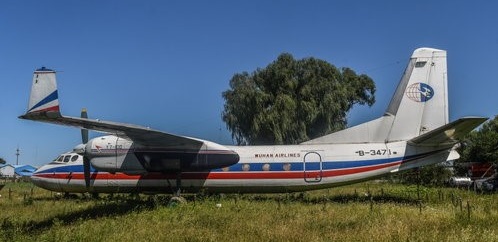
An Antonov An-24 copy. Built in Xian, the Y-7 is an improved version of the Soviet An-24 twin-turboprop transport. The Y-7 received its Chinese certificate of airworthiness in 1980, and has a wider fuselage and larger wing than the An-24, combined with Chinese engines and equipment. Of the first 24 Y-7s built, about ten were delivered for military use.
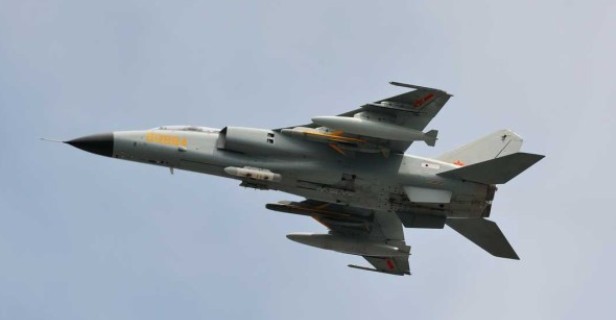
In the early 1970s, China was looking for a fighter-bomber to replace the H-5 (Il-28) and Q-5. Initially, China looked abroad for joint solutions, but when these efforts fell through, a program was started to develop a domestic design. Requirements soon emerged from the PLAAF and PLANAF requesting separate configurations. The PLAAF wanted side-by-side seating, terrain-following radar, and an extensive ECM suite, while the PLANAF requested tandem seating, all-weather performance, and reconnaissance capabilities. The PLAAF variant would be dropped fairly early on and by the end of 1988, Xian had developed a two-seat design with a shoulder mounted wing, powered by two Rolls-Royce Spey engines. While it was equipped with a powerful radar capable of tracking both aircraft and ships, the original design lacked any significant air-to-air capabilities. The aircraft was not without its teething issues. Flight testing was filled with major (often near catastrophic) malfunctions. The first flight ended early when violent vibrations shook off the majority of the cockpit instrumentation, and later tests ended when massive fuel leaks almost caused the aircraft to run out of fuel in flight. When the aircraft began operational evaluations, one aircraft lost its entire rudder in flight, making a successful emergency landing. Despite all of the issues, the PLAAF soon requested its own variant of the JH-7. Designated the JH-7A, the new aircraft was to have a stronger airframe and higher payload than the JH-7 and the capability to deploy various precision-guided weapons.
JH-7
After extensive testing and redesigns, JH-7s began to enter service with the PLANAF and PLAAF in 2004. Over 200 have entered service, providing the Chinese with a fairly capable replacement to their MiG-19-derived Q-5s. JH-7As continue to be upgraded with systems such as a newly developed helmet-mounted sight. Meanwhile, the Chinese are working on a more extensive upgrade to the design, designated the JH-7B. The JH-7B is to feature upgraded avionics, a reduced frontal RCS, aerial refueling capabilities, and upgraded engines producing 15% more thrust. Plans called for the JH-7B to enter production in 2015.
Xian JH-7A
China revealed a 20-year-old fighter/bomber at the Air Show China ‘98, held at Zhuhai. The aircraft, the FBC-1 Flying Leopard, is an export version of the JH-7 twin-seat strike fighter and actually flew in 1989, though its development programme dates back to the 1970s. This was the first time the aircraft has been flown in public. The aircraft was developed by the Xian Aircraft Design and Research Institute (ADRT) and is capable of Mach 1.7, and has a range of 890 nm.
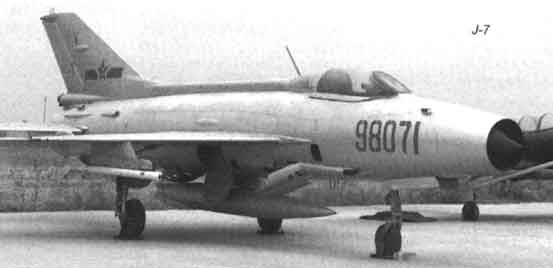
The Xian factory reverse-engineered the MiG-21 and the resulting J-7 made its first flight in December 1964. Two years later, manufacture halted because of unexplained technical problems after only 70 had been built.
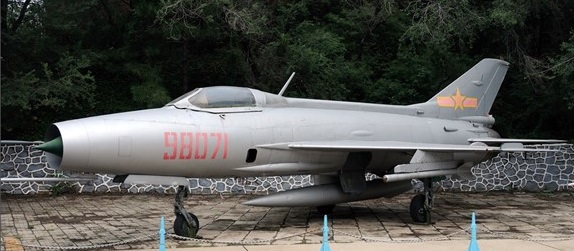
The early model J7I can be seen as the first variant of the type of full production standard. One difference with the MiG-21F-13 is the drag chute housing at the base of the tail.
J7I 98071
Meanwhile, in the common cause of communism, China was allowing Soviet supplies to pass through its territory bound for Vietnam, where the USA was embroiled in conflict. One day, several railway wagons containing dismantled MiG-21s went astray, and subsequently the J-7 re-entered production in modified form at Chengdu. The new J-7 II, a considerably upgraded Chinese development, entered production in the early 1980s, and by 1982 was being exported as the F-7B. China (Giuzhou) also produces the JJ-7 two-seat operational trainer, designated FT-7 for export (first flown in 1981). The JJ-7 dual seat version was originally built by Guizhou Aviation Industry Group (GAIG).
Despite Chinese denials, a number of F-7s have been confirmed in Iranian service, while Iraq has also received the type via assembly (by Chinese technicians) in Egypt.
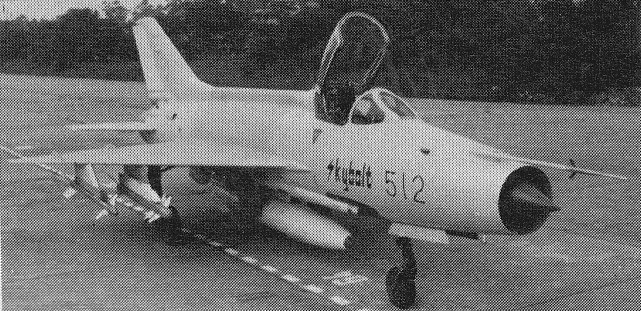
Details of the latest export version of the Chinese-built MiG-21 were released in 1984. Known as the F-7M Airguard and (as offered to Pakistan) F-7P Skybolt, this variant of the earlier F-7B is extensively modernised with Western avionics including ranging radar, a weapons aiming computer, a headup display, multimode radios, and IFF. Two additional wing hardpoints are fitted, and two fuselage cannon are carried, rather than the one carried by earlier models. Other changes include a revised canopy, an updated ejection seat, and a relocated brake-parachute housing.
With development of a successor to the J-7 (MiG-21) that formed the backbone of the PLAAF taking far longer than hoped, Chengdu began efforts to modernize the design. Work began in 1987, resulting in a major design overhaul. The wings were redesigned to have a double-delta planform, and the engine was replaced with a WP-13F engine. The primitive radar of the J-7 was replaced with the British Super Skyranger radar, and fuel capacity was increased. The modifications improved turn performance, and the takeoff roll was reduced from 1km to 600m. Upgrades to the cockpit included HOTAS controls, as well as the later addition of a helmet-mounted sight. Development proceeded quickly, with the first J-7E, as the new model was known, flying in 1990.
By the time the J-7E came about, most J-7 operators had since moved on to more capable designs. However, Pakistan, the largest non-Chinese J-7 operator, ordered significant numbers of the type. A special variant was developed to meet Pakistani requirements, integrating new western radars and the capability to mount AIM-9 AAMs.
Ever eager to develop anti-shipping platforms, the PLANAF also ordered a special J-7 variant with the ability to deploy AShMs (J-7EH). The J-7EH features the ability to carry antiship missiles, but, due to limitations with the radar, must receive targeting data from other aircraft.
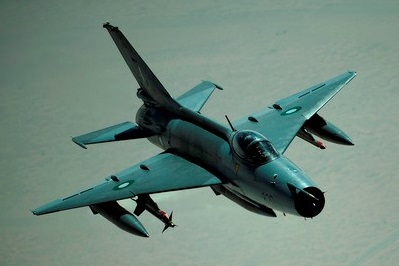
The derivative of the F-7M supplied to Pakistan as the F-7P Skybolt featured 20 PAF specified changes, including for four, rather than two, PL-5B or AKM-9 Sidewinders on pylons outboard of the main undercarriage attachment points. The Skybolt retains the two wing root-mounted Type 30-1 cannon ND MOST OF TE Western systems of the basic F-7M, although some equipment (eg. IFF) is installed in Pakistan.
F-7P Skybolt
The initial Pakistan Air Force order for 20 F-7P was fulfilled in August 1988 when the aircraft were ferried from Chengdu, but the Chengdu Aircraft Corporation was by then responsible for F-7 production.
After the final deliveries to Bangladesh, Chengdu shut down J-7 production in May 2013, marking the end of a 2,400 aircraft production run.
F-7M Airguard Engine: 1 x Wopen-7B (BM) Installed thrust (dry / reheat): 43 / 60 kN Span: 7.2 m Length: 13.9 m Wing area: 23 sq.m Empty wt: 5275 kg MTOW: 7531 kg Warload: 1800 kg Max speed: 2.05 Mach Initial ROC: 9000 m / min Ceiling: 18,700 m TO run: 700-950 m Ldg run: 600-900 m Combat radius lo-lo-lo: 370 km Air refuel: No Armament: 2 x 30 mm, 2 x AAM Hard points: 5
A 1961 split ending Soviet assistance, left the Chinese with the task of getting the Tu-16 into production as the Hongzhaji-6 (bomber aircraft no. 6). The Chinese spent two years in reverse-engineering the Tu-16 and its Mikulin AM-3 turbojets, and started production in 1962 for first deliveries in 1968. Since that time the Air Force of the People’s Liberation Army has received more than 100 H-6s for the strategic free-fall bomber and anti-ship roles, the latter with two missiles carried under the wings. Principal version – H-6 (sole production model in several variants up to at least the H-6D, or H-6 IV, which is believed to be the anti-ship type). Low-rate production of the Tu-16 Badger continues at Xian in 1987, and the H-6 is still the mainstay of China’s strategic nuclear bomber force. Local developments of the design include an anti-shipping version carrying C601 missiles and equipped with an under-nose search radar. A four-engined variant of the H-6 has also been reported. Customer: China 120+
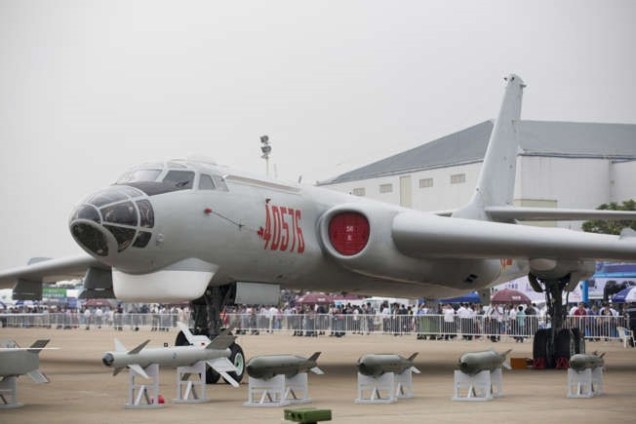
After decades of service, Xian finally performed a major overhaul of their H-6 (Tu-16) around the turn of the century. While previous modifications merely upgraded avionics of the design, the new variant developed, the H-6K, redesigned the airframe to extensively use composites, and replaced the old Chinese engines with Russian-made Saturn D-30KP turbofans. As Chinese bomber doctrine has long since shifted to the use of bombers as cruise-missile carriers, the bomb bay was replaced with larger fuel tanks, and the obsolete tailgun armament was replaced with an extensive ECM suite. Similarly, the glazed navigator position was replaced with a more powerful targeting radar. The H-6K first flew in January 2007, and after two years of testing, the bomber entered service with a combat radius nearly double that of the original H-6.
China International Aviation & Aerospace Exhibition in Zhuhai, China, 2014
About 150 of its bombers have been built, and about 120 were still operational in 2025. The H-6 has been upgraded to carry modern weapons, including hypersonic and nuclear-capable missiles.
China sold H-6s to both Egypt and Iraq, but those countries no longer have their bombers operational. According to the Center for Strategic and International Studies, Iraq’s four H-6s were destroyed while in service.
The H-6 has four crew and is powered by two Soloviev D-30KP-2 turbofan engines, each with 27,000 pounds of thrust. Its top speed is 670 mph, and its cruising speed is 477 mph. Its combat range is 2,200 miles. It can also carry 26,500 pounds of bombs, both guided and unguided (dumb bombs), but no longer carries free-fall nuclear bombs, as the H-6 could not be relied upon to penetrate an enemy’s air space.
Xian H-6 Type: six-seat strategic medium bomber and anti-ship missile carrier Engines: 2 x 20,944-lb (9,500-kg) thrust Xian WP-8 turbojets Maximum speed 616 mph (991 km/h) at 19,685 ft (6,000 m) Initial climb rate 4,100 ft (1,250 m) per minute Service ceiling 40,355 ft (12,300 m) Range 2,983 miles (4,800 km) with an 8,157-lb (3,700-kg) warload Empty weight about 82,010 lb (37,200 kg) Maximum take-off weight 158,733+ lb (72,000+ kg) Wing span 108 ft 1.2 in (32.95 m) Length 114 ft 2.1 in (34.80 m) Height 35 ft 5.2 in (10.80 m) Wing area 1,772.87 sq ft (164.70 sq.m) Armament: four 23-mm cannon in twin-gun dorsal and tail turrets, and up to 19,842 lb (9,000 kg) of bombs
Xiamen Ad Light Aircraft Co produced Nanjing University of Aeronautics and Astronautics FT-300 three-seat derivative, pusher-engined type of composites construction and with rear-mounted wings and canards.
Xiamen Ad Light Aircraft Co produced the AD-100 single/two-seat lightplane, a pusher-engined type of composites construction and with rear-mounted wings and canards.
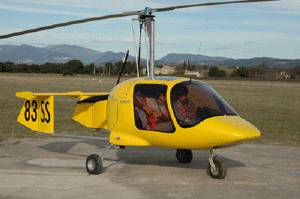
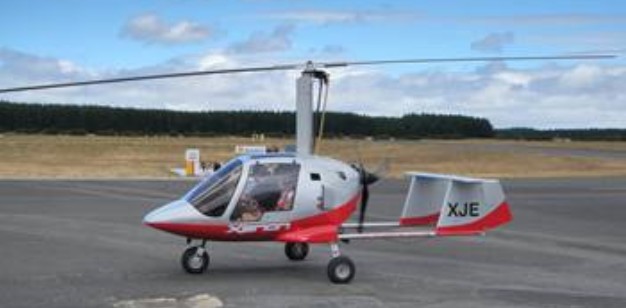
Xenon was designed by French aircraft designer Raphael Celier and was manufactured in Poland to the French Ultralight category standards.
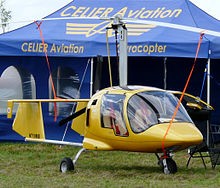
Celier Aviation established its reputation with the two-seat side-by-side configuration Celier Xenon 2 series of autogyros. By 2011 over 100 of these were flying.
A Celier Xenon 2 on display at Sun ‘n Fun in Lakeland, Florida, United States, 2008.
This high performance ultralight autogyro was available as a kit or ready to fly. Registered as an LSA. Delivered fully factory built starting at $61,000 in 2009. The composite structure is the airframe, providing lightness and incorporating a full roll cage to protect the occupants. The cabin is 10″ wider than a Cessna 172 and the two pilots are separated by a 10″ console and arm rest. Behind the seats is a very large luggage compartment. The Aircopter rotor blades are aluminum yet use titanium for strength and tip weighting for higher inertia. The DUC R propeller features a spoon blade with a wider tip and built in feathering. It is carbon forged under high pressure and a carbon fiber spinner is fitted. The box tail section is directly in the propeller slipstream and is on a long lever arm for effectiveness with or without engine power. The 28″ high cabin is soundproofed, with interior carpeting and heated leather bucket seats, and the Xenon meets European noise standards. The Xenon is available with a choice of 3 different engines. The standard model comes with a Rotax 912S Engine that delivers 100 horsepower. The 914 Model features a Rotax turbo that delivers 115 horsepower for up to 5 minutes after which the engine delivers a continuous 100 horsepower. The high altitude or extra climb ability model is the 912 RST version which has a Rotax 912 sporting a custom designed Mitsubishi turbo delivering 122 horsepower for take-off followed by a continuous 110 horsepower with full time turbo boost. The doors are removable for flight, leaving a full wrap around optical windshield with overhead windows and foot well windows, allowing near unobstructed viewing. The instrument panel is shock mounted to be vibration free and includes full instrumentation for flight performance and engine monitoring. Flight instruments include: altimeter, airspeed indicator and vertical speed indicator. Rotor tach and fuel are separate gauges while graphic digital engine monitor uses colored LEDs to keep track of engine tach, CHT and EGT gauges, volt/amp meter, oil pressure and temperature, fuel flow, turbine temperature and manifold pressure. There is a 12 volt power plug for the portable GPS or MP3 player. Options include intercoms, VHF radio and transponder with altitude encoder. The console arm rest puts the throttle and 280 rpm pre-rotator under one hand. Circuit breakers control the panel and landing lights and overhead heat vents are fitted. Options vary depending on the model but your Xenon is available with propeller spinner, special metallic paint, cabin and blade covers, larger rotors, removable joystick, adjustable pedals, heated leather seats or a ballistic parachute.
Engine: Rotax 912S, 100 hp Propeller: 3 Blade DUC Windspoon 68.5 in Max TO weight: 1,155 lbs. Empty Weight: 583 lbs Payload: 462 lbs Rotor blades: Type 8H12 Aircopter Extruded Aluminum Rotor Diameter: 27.55 ft Dics Area: 596.1 sq. ft Total Width: 86.6 in Total Length: 192.9 in Total Height: 110.23 in Cabin Width: 49.2 in Pre-rotator: Mechanical 280 RRPM Wheel Diameter: 400×4 Vne: 108 kt / 124 mph / 200 kph Minimum Speed: 19 mph Cruise 75%: 75 mph Max speed: 105 mph Climb Rate: 600-1200 fpm Glide Ratio: 3:1 Service Ceiling: 15,000 ft Endurance: 4 hr + res Take off Dist: 100-300 ft Landing Dist: 15 ft Fuel Capacity: 22 USG Fuel Burn @ 65% pwr: 4.8 USGPH Endurance: 4 hrs + res
Engine: Rotax 914, 115 hp Empty Weight: 616 lbs Propeller: 3 Blade DUC Windspoon 68.5 in Max TO weight: 1,155 lbs. Rotor blades: Type 8H12 Aircopter Extruded Aluminum Payload: 484 lbs Rotor Diameter: 27.55 ft Dics Area: 596.1 sq. ft Total Width: 86.6 in Total Length: 192.9 in Total Height: 110.23 in Cabin Width: 49.2 in Pre-rotator: Mechanical 280 Wheel Diameter: 400×4 Vne: 108 kt / 124 mph / 200 kph Minimum Speed: 19 mph Cruise 75%: 87 mph Max speed: 115 mph Climb Rate: 600-1200 fpm Glide Ratio: 3:1 Service Ceiling: 15,000 ft Endurance: 4 hr + res Take off Dist: 100-300 ft Landing Dist: 15 ft Fuel Capacity: 22 USG Fuel Burn @ 65% pwr: 4.8 USGPH Endurance: 4 hrs + res
Engine: Rotax 912 RST, 122 hp Empty Weight: 605 lbs Propeller: 3 Blade DUC Windspoon 68.5 in Max TO weight: 1,155 lbs. Rotor blades: Type 8H12 Aircopter Extruded Aluminum Payload: 550 lbs Rotor Diameter: 27.55 ft Dics Area: 596.1 sq. ft Total Width: 86.6 in Total Length: 192.9 in Total Height: 110.23 in Cabin Width: 49.2 in Pre-rotator: Mechanical 280 RRPM Wheel Diameter: 400×4 Vne: 108 kt / 124 mph / 200 kph Minimum Speed: 19 mph Cruise 75%: 99 mph Max speed: 121 mph Climb Rate: 600-1200 fpm Glide Ratio: 3:1 Service Ceiling: 15,000 ft Endurance: 4 hr + res Take off Dist: 100-300 ft Landing Dist: 15 ft Fuel Capacity: 22 USG Fuel Burn @ 65% pwr: 4.8 USGPH Endurance: 4 hrs + res
Xenon Gyrocopter Engine: Rotax 912RST (turbo) Height: 2.8m Fuselage width: 2.2m Length: L4.9m Empty weight: 294kg Max take off weight: 544kgs Payload: 240kgs Fuel capacity: 87 litres VNE: 113 knots Cruise speed: 86 knots Min speed: 16 knots Rate of climb: 800-1200 fpm Take off Distance: 35-100 meters Landing distance: 0-5 metres Range: 4hours plus Seats: 2











 All Aero