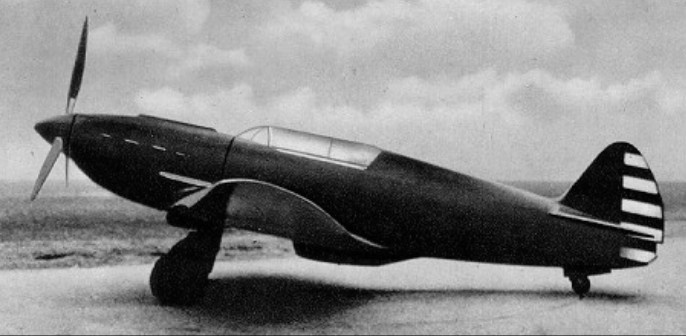
In the early summer of 1940, with the I-26 established in production in the GAZ 115, Aleksandr Yakolev’s OKB initiated the redesign of the fighter for all-metal construction as the I-30 (Ya-30), and the first of two prototypes entered flight test in the spring of 1941 as the Yak-3. Powered by a Klimov M-105P 12-cylinder liquid-cooled Vee-type engine rated at 1,100hp for take-off and fitted with a Ye-100 mechanically-driven supercharger developed by V A Dollezhal, the Yak-3 had a three-piece wing with dihedral on the outer panels only and possessed an exceptionally heavy armament by contemporary standards. The single engine-mounted 20mm ShVAK cannon and twin synchronised 7.62mm ShKAS machine guns of the Yak-1 were augmented by two wing-mounted ShVAK cannon. The initial flight test programme suffered constant difficulties with the supercharger, the engine being replaced three times in seven weeks with the result that the Dollezhal supercharger was discarded from the second prototype Yak-3 (I-30-II) which was flown in the summer of 1941 with a standard M-105P engine. The second prototype differed in having the radiator bath moved farther aft, the oil cooler air intake transferred from beneath the nose of the wing root leading edge and an additional pair of synchronised ShKAS machine guns mounted above the engine. With such exceptionally heavy armament and the increased fuel resulting from the larger-capacity tanks rendered possible by the metal wing, the Yak-3 was underpowered by the M-105P. In addition, the prevailing shortage of dural militated against continued development at that stage in the conflict with Germany, the Yak-3 programme being discontinued in the late autumn of 1941, and the designation subsequently being reassigned to an unrelated design.
I-30 (1st prototype) Max take-off weight: 3130 kg / 6901 lb Empty weight: 2550 kg / 5622 lb Wingspan: 9.74 m / 32 ft 11 in Length: 8.50 m / 28 ft 11 in Height: 3.00 m / 10 ft 10 in Wing area: 17.15 sq.m / 184.60 sq ft Max. speed: 584 km/h / 363 mph Range: 900 km / 559 miles
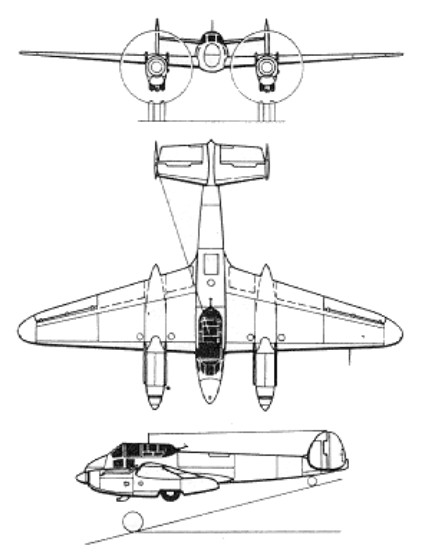
In 1938, the UV-VS (Upravlenie Voenno-vozdushnikh Sil – Administration of the Air Force) formulated a requirement for a two-seat multi-role high-speed combat aircraft. To meet this demand, the OKB (Experimental Construction Bureau) headed by Aleksandr S Yakolev evolved the Ya-22, or Samolet 22. An aerodynamically clean, two-seat low-wing cantilever monoplane of mixed construction and powered by two 960hp M-103A (V Ya Klimov-developed two-speed supercharged derivative of the Hispano-Suiza 12Y) 12-cylinder Vee-type engines, the Ya-22 was proposed in three dedicated versions: long-range escort fighter, short-range bomber and tactical reconnaissance aircraft. Prototypes of all three variants were built simultaneously, the first to fly being the fighter, which, assigned the NKAP (State Commissariat for Aviation Industry) designation I-29, made its maiden flight on 22 February.
Yakolev was then instructed to modify the design to serve as a bomber, the aircraft being redesignated BB-22 (blizhnii bombardirovshchik or short-range bomber). This resulted in major revisions of accommodation, armament and fuel storage, plus the provision of an internal bomb bay. The BB-22 bomber and R-12 reconnaissance prototypes differed from the I-29 primarily in that the fuel tank immediately aft of the cockpit was supplanted by a bay accommodating either eight 50kg bombs in the BB-22 or photo-flashes (for use in conjunction with a single AFA-13 camera) in the R-12. The I-29 had twin 20mm ShVAK cannon in fairings beneath the forward fuselage and a single 7.62mm ShKAS for the aft-positioned observer/navigator, deployment of this gun being permitted by lowering of the aft-fuselage top decking. On 15 March 1939, shortly after commencement of flight testing, Yosif Stalin personally decided to order production of the bomber variant (as the M-105-powered Yak-2) to the exclusion of both fighter and reconnaissance versions.
The first series BB-22 was completed on 31 December 1939 and flown on skis on 20 February 1940. By that time two factories were in production and experimental variants – the R-12 photographic reconnaissance aircraft and I-29 (or BB-22IS) long-range escort fighter – were being prepared for test flights. The BB-22 was redesignated Yak-2 at the end of 1940, and as powered by two 716kW M-103 Vee engines had a maximum speed of 530km/h at sea level service ceiling of 8800m and range of 800km. In 1940 the basic design was further refined to improve the crew positions, field of view and armour protection; the M-105 engine was introduced with better protection for the fuel system, and provisions were made for external bomb racks. Then redesignated Yak-4, the aircraft entered production in the autumn of 1940 and about 600 of both versions were built, the majority of them Yak-4s . They were not particularly successful in service, many of them being lost in the early days of the German invasion.
Ya-22 Max take-off weight: 5023 kg / 11074 lb Empty weight: 3796 kg / 8369 lb Wingspan: 14.00 m / 46 ft 11 in Length: 10.18 m / 33 ft 5 in Height: 3.30 m / 11 ft 10 in Wing area: 29.40 sq.m / 316.46 sq ft Max. speed: 567 km/h / 352 mph Range: 1050 km / 652 miles
Yak-4 Engine: 2 x M-105R, 810kW Max take-off weight: 5245 kg / 11563 lb Wingspan: 14.0 m / 46 ft 11 in Length: 10.2 m / 33 ft 6 in Wing area: 32.0 sq.m / 344.44 sq ft Max. speed: 530 km/h / 329 mph Ceiling: 9500 m / 31150 ft Range w/max.fuel: 1600 km / 994 miles Range w/max.payload: 800 km / 497 miles Armament: 1 x 7.62mm machine-gun Bombload: 400 kg Crew: 2
The type had a wooden wing combined with a fuselage of mixed construction and main landing gear units retracting inwards into the underside of the wing. Flown initially on 13 January 1940, the first prototype was soon lost in a fatal accident, but the development programme was continued without any break by the second prototype which incorporated some improvements.
A pre-production batch of Yak-1s was flying by the end of 1940 and 64 initial series machines had also been completed by then.
In June 1941 the designation was changed to Yak-1 and the type was cleared for production. In the same month Germany invaded and the entire production line was moved 1000 miles eastward to Kamensk-Uralsk. Despite this delay of about six weeks, about 500 Yak-1 were in action by the end of 1941.
Changes were introduced during the course of production and many aircraft of the main variants were completed from early 1942 with all increased span more pointed wing. A new pilot’s canopy and cut-down rear fuselage were introduced on the Yak-1B and reduction of overall weight was achieved with the Yak-1M. The mount of many leading Soviet fighter pilots, Yak-1s equipped a high proportion of fighter squadrons from 1942 onwards, when the type was phased out of production in mid-1943, a total of 8,721 series aircraft of all versions had been completed.
Engine: 1 x VK-105PF, 870kW Max take-off weight: 3000 kg / 6614 lb Empty weight: 2330 kg / 5137 lb Wingspan: 10.0 m / 33 ft 10 in Length: 8.5 m / 28 ft 11 in Height: 1.7 m / 6 ft 7 in Wing area: 17.2 sq.m / 185.14 sq ft Max. speed: 580 km/h / 360 mph Ceiling: 10000 m / 32800 ft Climb to 5000m: 4.5-6.8 min Range: 850 km / 528 miles 360 turn: 17-21 sec Armament: 1 x 20mm machine-guns, 2 x 7.62mm machine-guns, 6 missiles Weight of fire / sec. salvo: 1.856kg-2.000kg Crew: 1
Engine: Klimov M-105PA, 1100 hp Wingspan: 32 ft 9.75 in Max speed:m364 mph at 16,400 ft
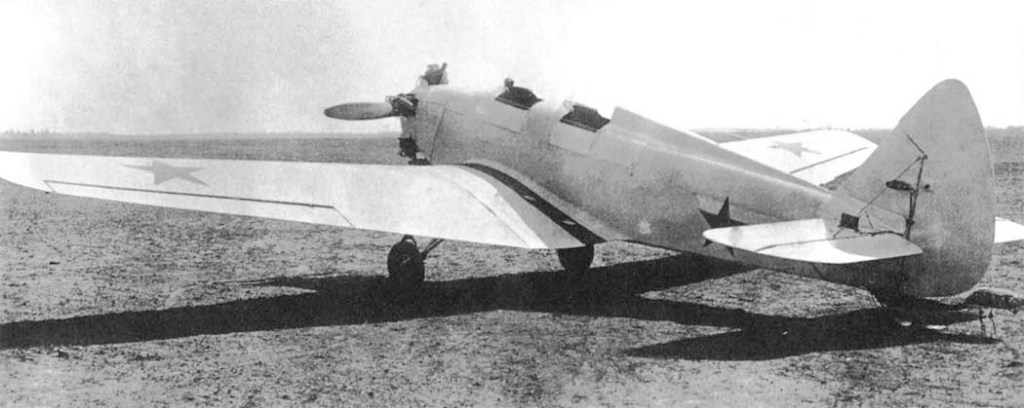
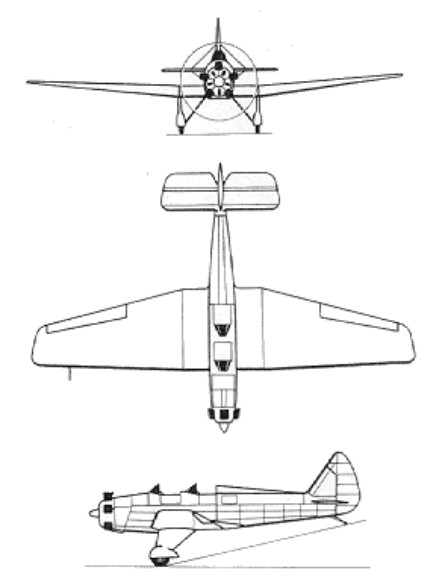
The preceding U-2 (Po-2) biplane was no longer a suitable trainer for the faster modern aircraft entering service, and to fill the role, the UT-2 was designed as a trainer.
The new aircraft was designed by Alexander Sergeevich Yakovlev’s team at OKB-115. Originally designated AIR-10, it was based upon the AIR-9, but it was simpler, with tandem open cockpits, also omitting slats and flaps. It first flew on 11 July 1935. The AIR-10 won the competition in 1935 and, after minor changes, was accepted as the standard Soviet Air Force trainer. With the disgrace of Alexey Ivanovich Rykov under whom Yakolev had been working, the initials AIR were replaced with Ya making what would have been the AIR-20 the Ya-20 (Я-20).
AIR 10
The wood-and-metal mixed construction of the AIR-10 was simplified to use only wood to facilitate production, and the AIR-10s 120 hp Renault inline engine was replaced with the 112 kW (150 hp) Shvetsov M-11E radial on the prototype, and the 82 kW (110 hp) M-11Gs in early production aircraft. Serial production started in September 1937. The Soviet VVS (Air Force) assigned the aircraft the designation UT-2 (uchebno-trenirovochnyi {учебно-тренировочный}, trainer).
The UT-2 (Russian: Яковлев УТ-2; NATO reporting name “Mink”) was not easy to fly and easily entered into spins. The UT-2 model 1940 featured a lengthened forward fuselage, and a change to the 93 kW (125 hp) M-11D radial to attempt to rectify the problem. Despite improvements, the handling and flight characteristics remained challenging.
UT-2
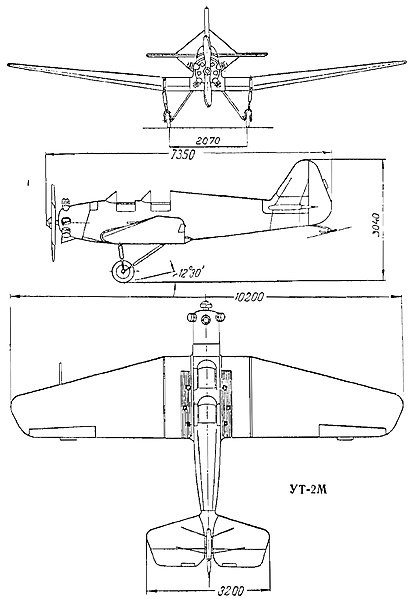
To further improve handling and stability, the new UT-2M (modernized) variant was developed in 1941 and it replaced the original UT-2 in production. The wing planform was redesigned, with a swept leading edge and a straight trailing edge, and the vertical stabilizer was enlarged.
Polish UT-2s post-war.
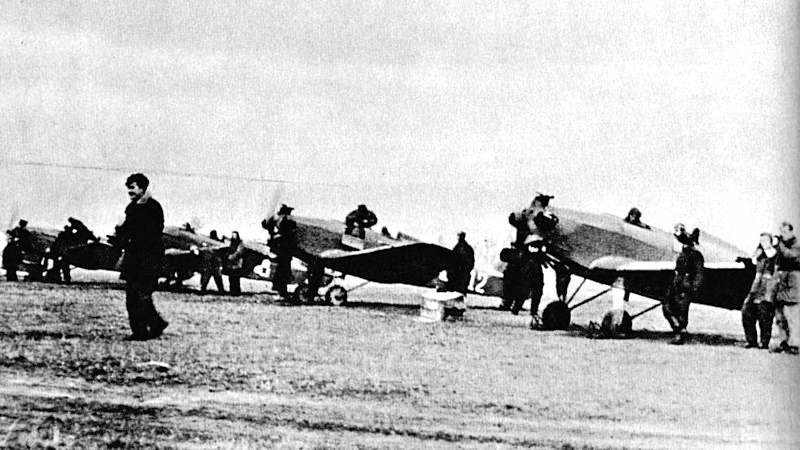
7,243 UT-2 of all types were produced in five factories between 1937 and 1946. In the 1950s, the UT-2 was replaced by the Yak-18 primary trainer and the Yak-11 advanced trainer.
Before and after World War II the UT-2 was used by civilian organizations, and after the war, UT-2s were also operated by the Polish and Hungarian Air Forces.
Operators:
France Normandie-Niemen unit Hungarian Air Force Air Force of the Polish Army Polish Navy Mongolian People’s Air Force Romanian Air Force Soviet Air Force
SFR Yugoslav Air Force 1st Training Aviation Regiment (1945-1948) 104th Training Aviation Regiment (1948-1956) Liaison Squadron of 5th Military district (1952-1956) Liaison Squadron of 3rd Aviation Corps (1950-1956) Letalski center Maribor
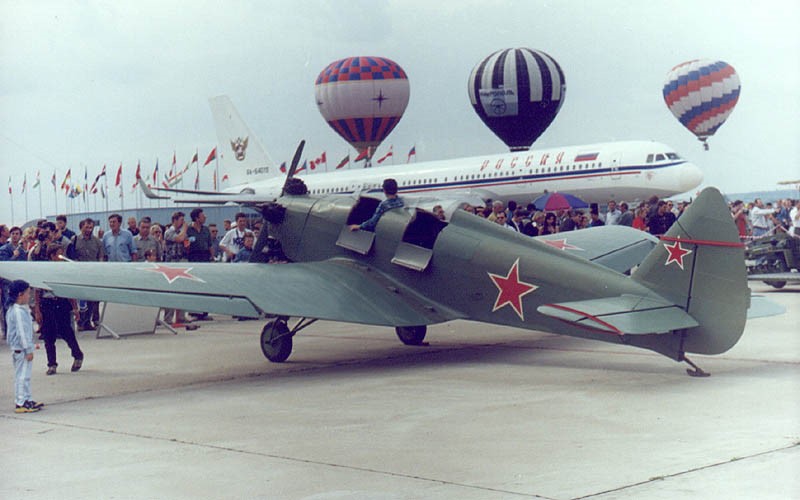
UT-2 survivor at Monino
The Central Air Force Museum at Monino has an example on display, as does the Technical Museum of Vadim Zadorogny near the Arkhangelskoye Palace, and the Nikola Tesla Technical Museum in Zagreb, Croatia.
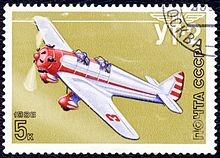
Soviet stamp showing UT-2
Variants:
AIR-10 Precursor Engine: 120hp Renault
Ya-20 Prototype
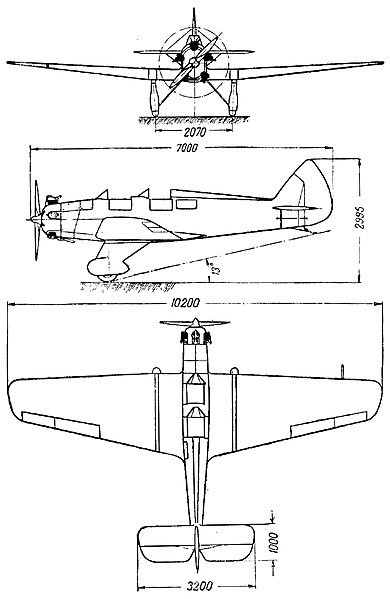
UT-2 initial production variant Engine: 1 x M-11, 74kW Max take-off weight: 856 kg / 1887 lb Empty weight: 616 kg / 1358 lb Wingspan: 10.2 m / 33 ft 6 in Length: 7.0 m / 23 ft 12 in Height: 3.0 m / 10 ft 10 in Wing area: 17.1 sq.m / 184.06 sq ft Max. speed: 200 km/h / 124 mph Cruise speed: 160 km/h / 99 mph Ceiling: 3200 m / 10500 ft Range: 750 km / 466 miles Crew: 1 Passengers: 1
UT-2 (1940 standard) improved spin characteristics. Engine: Shvetsov M-11D, 93.2 kW (125.0 hp) Propeller: 2-bladed fixed-pitch Wingspan: 10.2 m (33 ft 6 in) Wing area: 17.12 m2 (184.3 sq ft) Airfoil: Göttingen 387 Length: 7.15 m (23 ft 5 in) Height: 2.99 m (9 ft 10 in) Empty weight: 628 kg (1,385 lb) Gross weight: 940 kg (2,072 lb) Maximum speed: 210 km/h (130 mph, 110 kn) Cruise speed: 99 km/h (62 mph, 53 kn) Range: 1,130 km (700 mi, 610 nmi) Service ceiling: 5,000 m (16,000 ft) Rate of climb: 3.3 m/s (650 ft/min) Crew: 2
UT-2MV Armament: 8 x RS-82 rockets or 2-4 x 50 kg (110 lb) bombs
UT-2 (1944 standard)
UT-2L UT-2 with MV-4 inline engine for tests.
UT-2L improved 1940 standard with canopy and engine cowling, fuselage similar to early Yak-18 but had fixed undercarriage.
UT-2M production from 1941, new wings and empennage
Compact monoplane aerobatic trainer with open cockpit. When the I-16 fighter came to service, it became obvious than biplane trainers (like U-2) do not provide enough training ground to fly fast and ‘hot’ monoplane fighters. A.S.Yakolev was one of the first designers who started to build monoplane trainers to match I-16 performance. The AIR-14 construction was similar to the AIR-10: wire-braced fuselage of wielded soft steel tubes, with light wooden structure supporting the skin. Wings were single-piece with two spars, converging toward the wingtip (later this construction was used in Yak-1). Tailplane, tailfin and ailerons had aluminium frame. All skinning – fabric. Landing gear – fixed with rubber shocks. To prove its reliability Yu.I.Piontkovsky performed 300 landings during single day, followed by 1000 more (in few days). State Acceptance Trials took place in 1936 with 100hp M-11. After minor modification and installation of 115hp M-11G the aircraft was presented again in 1937 and after successful trials production was launched. Later with 150hp M-11E performance was improved again. In 1939 the engine mount was extended forward, making handling easier. Same modification included a new fuel system, allowing inverted flight. Small series were built with oleo-pneumatic shocks and single machine-gun. In 1937 UT-1 was installed on floats, setting two records in October same year: October 2: Yu.I.Piontkovsky set speed record 218km/h at 100km; October 21: D.N.Fedoseev flew floatplane from Moscow to Ufa, covering 1174km non-stop; Total number of variants was about 10, with different wing section, new propellers, floating ailerons etc. Not all of them were successful. UT-1 was too demanding for primary trainer, and biplanes were still used on early training stages. In 1941 some UT-1s were armed in frontline workshops. Typical armament included two ShKAS machine guns and few RS-82 rockets under the wings. 1241 built 1937-1940. UT-1 established eight international records of speed, ceiling and range. Light trainer remained unsurpassed as aerobatic/sport aircraft until 50’s.
Engine: 1 x M-11E, 118kW Max take-off weight: 590 kg / 1301 lb Empty weight: 430 kg / 948 lb Wingspan: 7.3 m / 24 ft 11 in Length: 5.8 m / 19 ft 0 in Height: 2.0 m / 7 ft 7 in Wing area: 8.3 sq.m / 89.34 sq ft Max. speed: 255 km/h / 158 mph Cruise speed: 190 km/h / 118 mph Ceiling: 7120 m / 23350 ft Range: 670 km / 416 miles Crew: 1
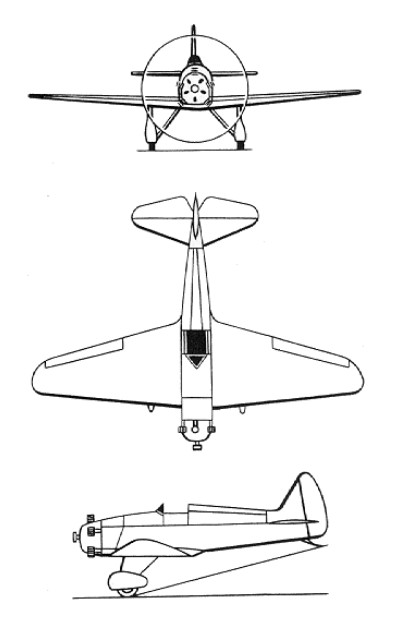
From 1933 Yakovlev and his design team developed a 2-seat low-wing monoplane sport aircraft with open cockpits, wooden wings, welded steel tube fuselage, powered by a Shvetsov M-11 engine. Fitted with landing flaps and automatic leading-edge slats, the AIR-9 design was submitted to a safe aircraft design competition, but was not proceeded with.
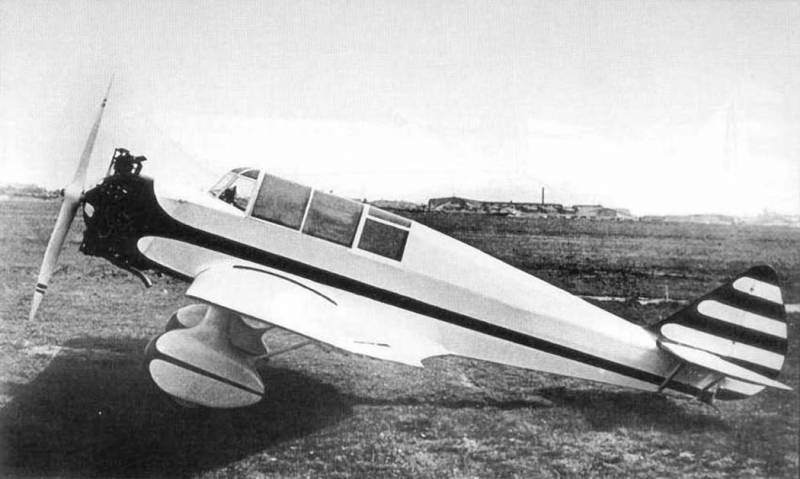
The original AIR-9 design was re-worked in 1934 to include enclosed cockpits, but dispensing with the automatic slats. The tandem cockpits were fitted with sliding canopies; the forward canopy slid rearwards over the fixed centre canopy section and the rear canopy slid forwards under the centre-section.
The structure of the AIR-9 followed Yavovlev’s previous designs with wooden plywood and fabric covered wings, welded steel tube fabric-covered fuselage and Duralumin fabric covered tail surfaces. The fixed spatted main undercarriage was supported by struts, later fitted with trousers as well as spats, with a fixed tail-skid or tailwheel (as exhibited at the 1935 Milan airshow).
The AIR-9bis, in later form, without cowling and with undercarriage strut trousers
The AIR-9 was powered by a single 100 hp (75 kW) Shvetsov M-11 five-cylinder air-cooled radial driving a fixed pitch 2-bladed wooden propeller, variously fitted with individual exhaust stacks, collector ring and Townend ring cowling.
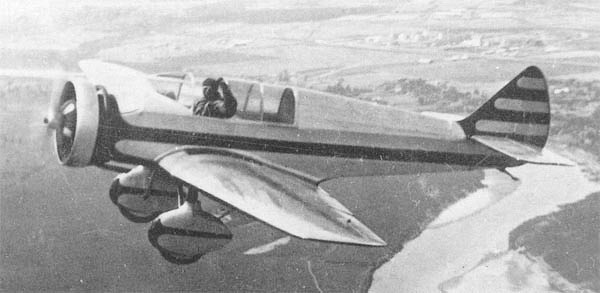
In 1935 the AIR-9 was modified, or a second aircraft built, with a forward sloping windshield and re-designated AIR-9bis. The large number of variations in configuration suggest that there were more than one aircraft, but this cannot be confirmed.
The AIR-9bis in flight, piloted by Piontkovskii
The AIR-9bis was displayed at the 1935 Paris and Milan airshows, and in 1937, was flown by I.N. Vishnevskaya and Ye.M. Mednikova to set a women’s altitude record in the FAI Class C category.
Variants: AIR-9 The original open cockpit 2-seat low-wing monoplane sport aircraft design, with split flaps and automatic leading edge slats; not proceeded with.
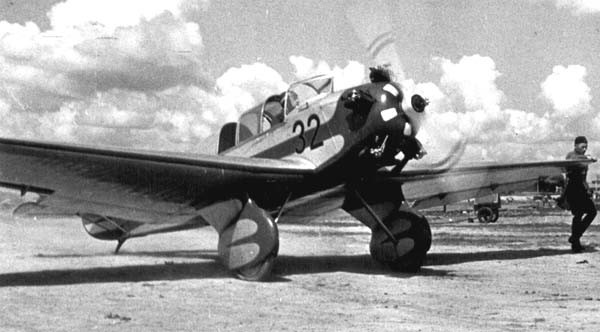
AIR-9 The original design reworked with closed cockpits and other refinements but without automatic slats. At least one built, at some stage seen with racing number 31.
AIR-9bis Further modifications prompted re-designation to AIR-9bis, introducing a forward sloping windshield and undercarriage trousers. One converted from the AIR-9 or possibly several new built aircraft, seen wearing racing number 32.
AIR-9bis Engine: 1 × Shvetsov M-11, 75 kW (100 hp) Propeller: 2-bladed wooden fixed pitch Wingspan: 10.2 m (33 ft 6 in) Wing area: 16.87 m2 (181.6 sq ft) Length: 6.97 m (22 ft 10 in) Empty weight: 495 kg (1,091 lb) Max takeoff weight: 768 kg (1,693 lb) Fuel capacity: 63.5 kg (140 lb) fuel; 17.5 kg (39 lb) oil Maximum speed: 215 km/h (134 mph, 116 kn) Landing speed: 65 km/h (40 mph; 35 kn) Cruise speed: 195 km/h (121 mph, 105 kn) Range: 695 km (432 mi, 375 nmi) Service ceiling: 6,080 m (19,950 ft) Time to 1,000 m / 3,300 ft): 4 minutes 48 seconds Time to 3,000 m / 9,800 ft: 16 minutes 24 seconds Take-off run: 80 m (260 ft) Landing run: 90 m (300 ft) Crew: 2
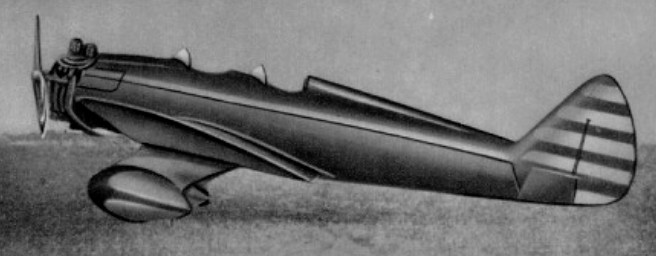
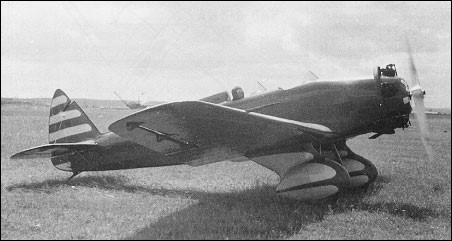
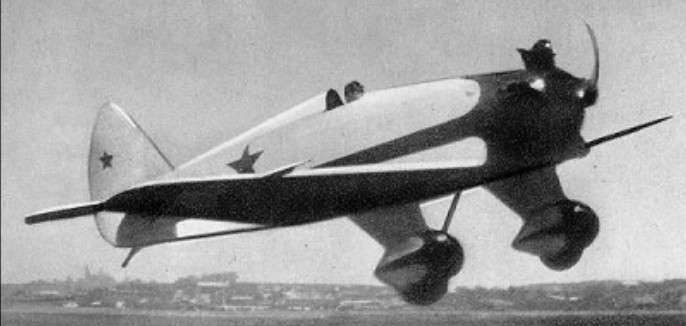
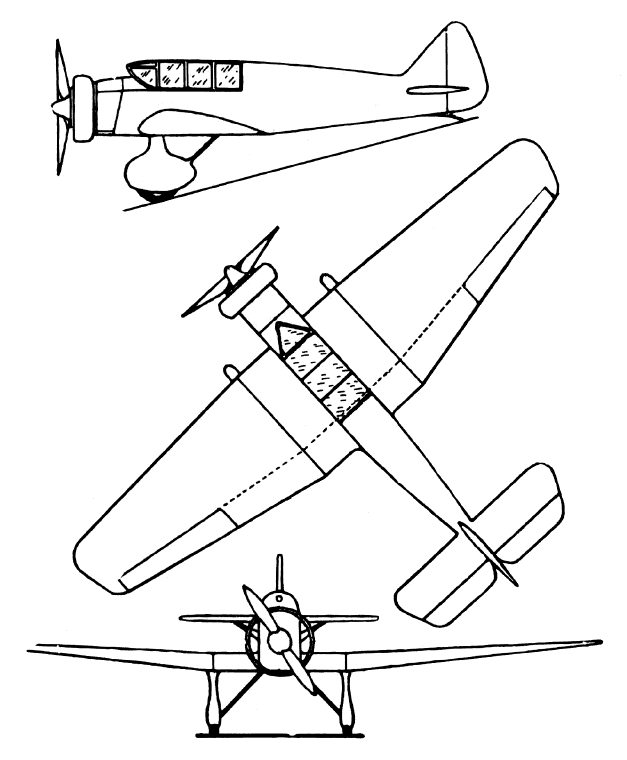
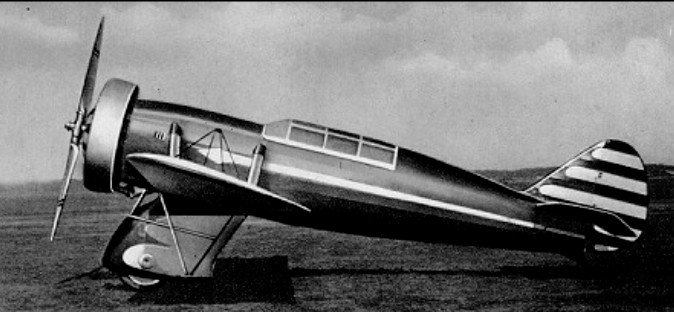
A two seat low-wing monoplane built for record speed. Both cockpits were covered by a long and low transparent canopy. Engine covered by Townsend ring. The aircraft had mixed construction: steel tubes and fabric for fuselage, mostly wood and fabric in thin (8%) wing, duralumin and fabric for ailerons and tail surfaces. Fixed landing gear was enclosed into ‘pants’ fairings. Construction started in April 1932. The aircraft was ready at the end of Summer 1932 and on November 19 325km/h was demonstrated, and in Spring 1933 – 332km/h. Flights continued until 1934, when an aileron broke off in flight due to flutter (then almost unknown and not understood). Test-pilot Yu.I.Piontkovskij managed to land on unprepared terrain. Since AIR-7 fulfilled its goal (to demonstrate high speed), it was not restored.
Engine: 1 x M-22, 355kW Max take-off weight: 1400 kg / 3086 lb Empty weight: 900 kg / 1984 lb Wingspan: 11.0 m / 36 ft 1 in Length: 7.8 m / 26 ft 7 in Wing area: 19.4 sq.m / 208.82 sq ft Max. speed: 325 km/h / 202 mph Range: 1300 km / 808 miles Crew: 2
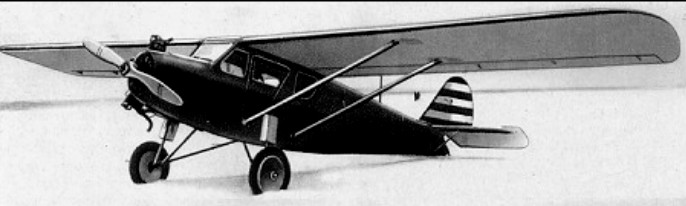
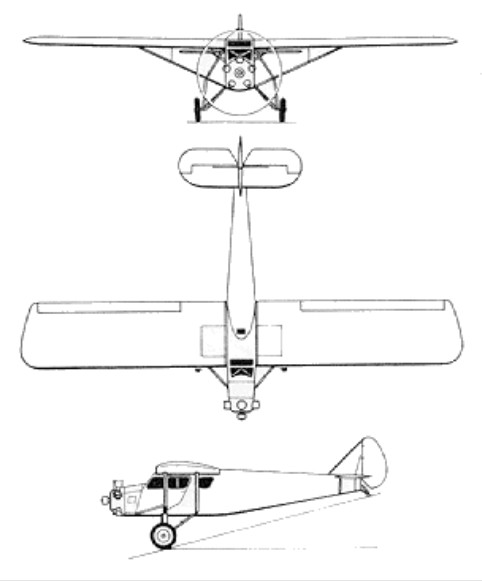
An AIR-5 adaptation for the domestic M-11 engine, designated AIR-6, was ready in May 1932, flew on September 8 and passed all trials easily. Adopted as short range liaison aircraft. In 1934 a group of AIR-6 performed flight Moscow-Irkutsk-Moscow (with refuel landings), covering more than 10,000km. During 1934-36 a total of 486 AIR-6 were built. Twenty of them were modified as air ambulance with room for a stretcher and doctor.
Engine: 1 x M-11, 81kW Max take-off weight: 993 kg / 2189 lb Empty weight: 620 kg / 1367 lb Wingspan: 12.1 m / 40 ft 8 in Length: 8.0 m / 26 ft 3 in Height: 2.3 m / 8 ft 7 in Wing area: 19.8 sq.m / 213.13 sq ft Max. speed: 166 km/h / 103 mph Cruise speed: 140 km/h / 87 mph Ceiling: 4500 m / 14750 ft Range: 650 km / 404 miles Crew: 1 Passengers: 2
With his next design, the “AIR-3” of 1929, Yakovlev chose to go to a monoplane configuration, resulting in a tidy parasol-winged aircraft powered by a five-cylinder radial Czech-made Walter NZ engine; the AIR-3 had additional fuel tanks for long-range operation. A handful of “AIR-4” machines was built, featuring various improvements such as doors to make it easier for the two crew to get in and out.
The AIR-4s were used for various tests and trials, including one in which the aircraft was given translucent skinning as something of a “visual stealth” measure as the Kozlov PS.
Yakovlev also designed a specialized trainer version of the AIR-4, the “AIR-8”, very similar to the AIR-4 but with various tweaks, particularly reinforcement of landing gear and the like to tolerate the blunders of trainee pilots. Only one was built, the VVS (Voyenno Vozdushniye Sily / Red Air Force) evaluating it, then forgetting about it.
Variation: Kozlov PS
AIR-4 Engine: Walter NZ Wingspan: 11.1 m / 36 ft 5 in Wing area: 36.5 m2 / 392.88 sq ft Length: 6.94 m / 23 ft 9 in Empty weight: 395 kg / 871 lb Take-off weight: 630 kg / 1389 lb Max. speed: 150 km/h / 93 mph Ceiling: 4000 m / 13,100 ft Range: 500 km / 311 miles
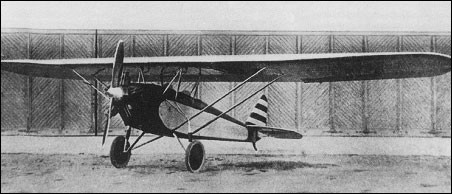
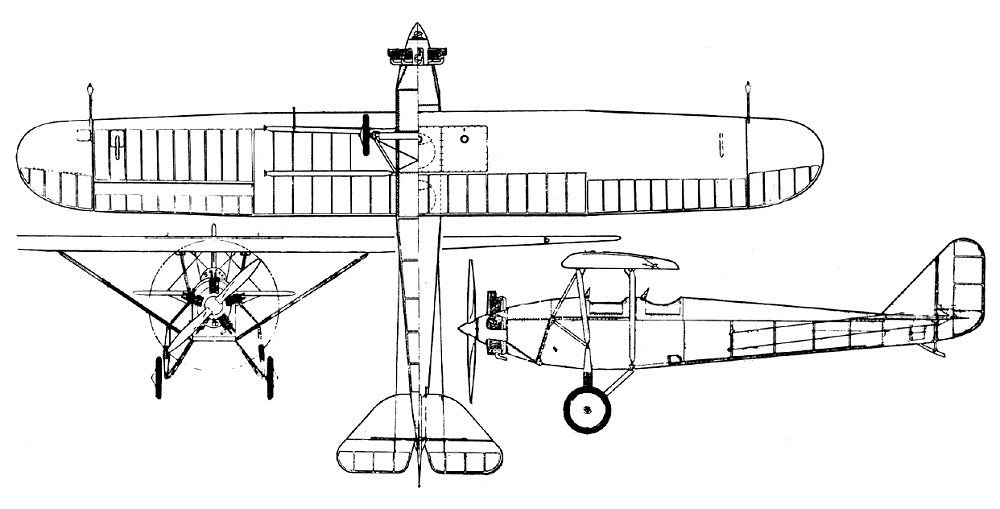
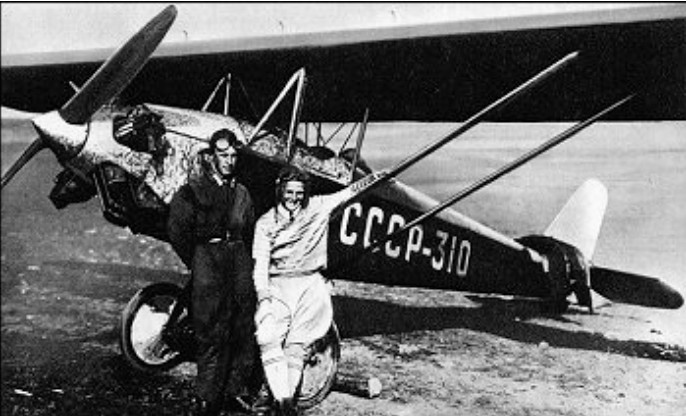
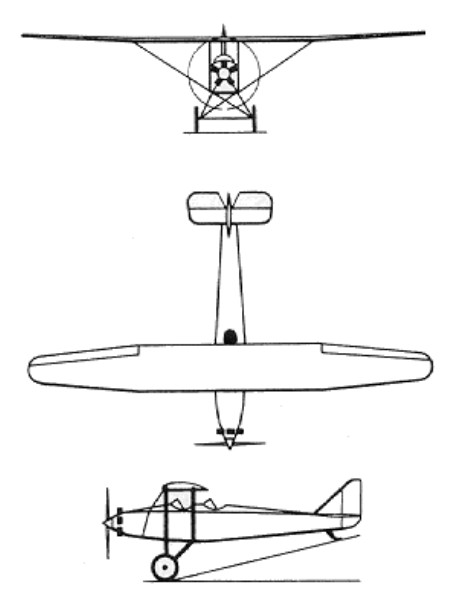
A development of the AIR-2 in parasol monoplane configuration, it used an identical fuselage, powerplant, landing gear and tail. Finance for construction was provided by Osoaviakhim. The aircraft was ready in the Summer of 1929 and on September 6 pilots Filin and Kovalkov (at the time students of the VVA, as well as a designer), flew nonstop from Mineralnye Vody to Moscow covering 1835km with average speed 166.8km/h, setting another International Record for Yakolev’s aircraft.
Engine: 1 x Walter, 44kW Max take-off weight: 762 kg / 1680 lb Empty weight: 392 kg / 864 lb Wingspan: 11.0 m / 36 ft 1 in Length: 7.1 m / 23 ft 4 in Height: 2.4 m / 8 ft 10 in Wing area: 16.5 sq.m / 177.60 sq ft Max. speed: 146 km/h / 91 mph Cruise speed: 125 km/h / 78 mph Ceiling: 4200 m / 13800 ft Crew: 2






 All Aero