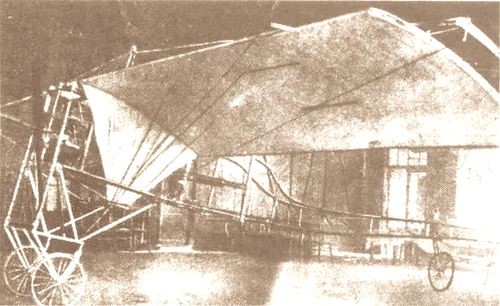
Slovenian aviation pioneer Alphonse Kjuder and Ivan Renčelj were self-taught in the field of aviation. The head and financing of the project was Kjuder, while Renčelj was the main designer and builder. The plane was powered by a five-cylinder Anzani and embodied some unusual solutions – the wing could be moved sideways to achieve lateral control and in case of an accident it could be turned perpendicular to brake the plane. It was exhibited in mid-October 1911 in Ljubljana. It apparently never flew.
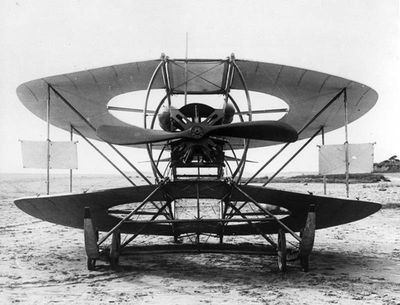
John Kitchen’s annular biplane was built in 1910. It was sold to Cedric Lee, who also had visions of revolutionary annular designs. Together with George Tilghman Richards, he tested the aeroplane at Famine Point near Heysham, Lancashire during 1911 without any success. Finally it was destroyed when it’s hangar was blown down in a gale.
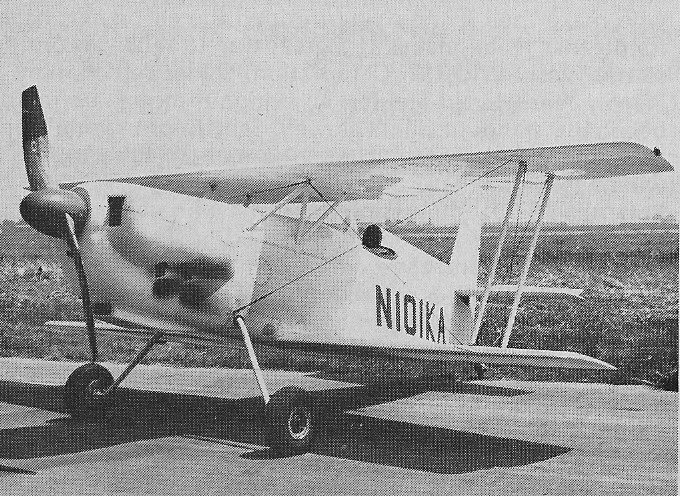
W.B.Kinner, son of the Kinner Fleet designer and a Captain with Saturn Airways, completed a fifteen year homebuilt project designed so it could be built in his garage.
The wings are metal and plywood, and the fuselage is plywood with fibreglass cowl and turtledeck.
Kin Air Engine: Lycoming O-290-G4, 125 hp Wingspan: 16 ft 6 in Length: 14 ft 6 in Height: 5 ft Empty weight: 705 lb
Timm acquired the production rights to the Kinner B-2R and produced four as the Timm 160 (ATC 617), including NC14200. The Timm 160 was a 1937 open cockpit low wing monoplane.
The R-715 can be installed as tractor or pusher. The standard starter mount affords a wide range of starters, as Heywood injection, hand turning gear, electric or combination starters, electric starters etc. The provision of a standard drive for an electric starter affords use of electric type starters, lighting system, radio etc. Provision of a fuel pump drive allows various locations of fuel tanks. The carburettor location allows gravity feed. Standard SAE propeller end of crankshaft provides for use of a minimum weight metal propeller hub.
Type: 5 cylinder 4 stroke air cooled radial Manufacturer’s Rating: 190 hp at 1800 rpm Displacement: 715 cu.in Compression ratio: Bore: 5 5/8 in Stroke: 5 3/4 in Length: 34 13/16 in Diameter: 50 in Weight: 410 lb Lubrication: Circulating oil system, pressure feed to front & rear main bearings, and to plain link pins, through grooved master rod bearings. Ignition: 2 Scintilla magnetos Carburation: Stromberg
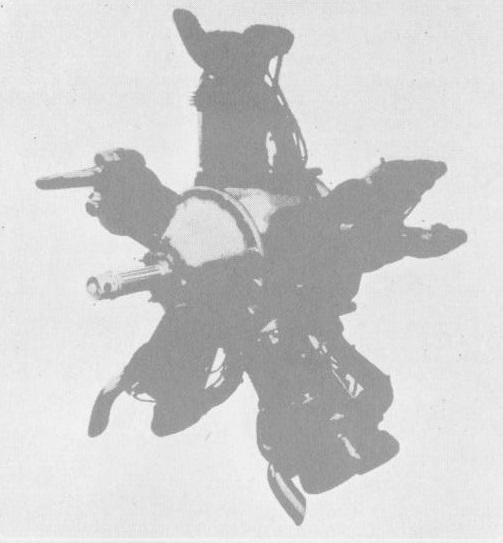
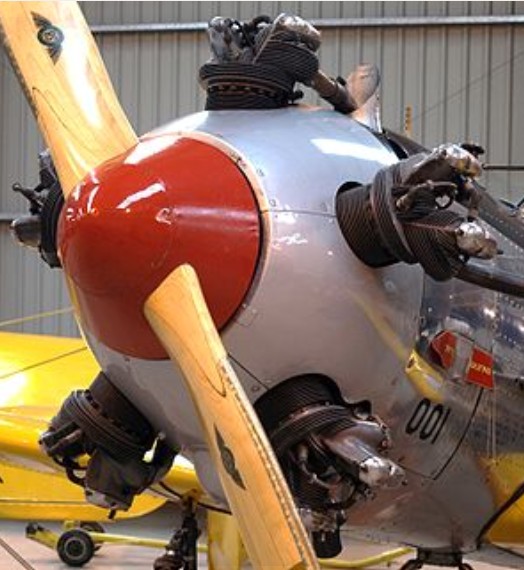
The Kinner R-5 is an American five cylinder radial engine for light general and sport aircraft of the 1930s. The R-5 was a development of the earlier Kinner B-5, with slightly greater power and dimensions. The main change was the increase in cylinder bore from 117 mm (4.625 in) to 127 mm (5 in) and an increase in cylinder stroke from 133.3 mm (5.25 in) to 139.7 mm (5.5 in). This led to a corresponding increase in displacement from 7.2 liters (441 cu in) to 8.8 liters (540 cu in).
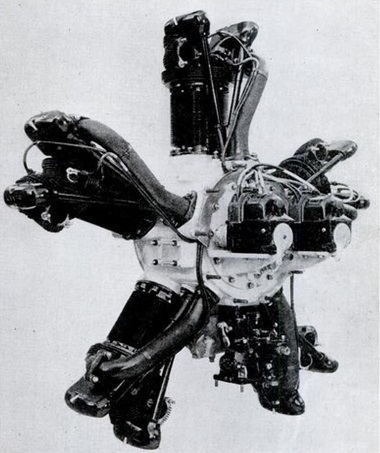
The head of the R-5 Series 2 has approximately three times as much cooling fin area as previously used cylinder heads, having longer fins spaced closer together. A greater angle between inlet and exhaust valves results in a stronger head and provides additional metal between valve seats. Cylinder heads have rear exhaust ports and lugs are provided for support of cowling rings.
Enlarged intake passages and valves increase the efficiency and result in higher brake mean effective pressure. Bearings have been increased in size. The crankshaft has been greatly strengthened by increased sections. The main and master rod bearings are of the copper lead steel-backed type. Master-rod sections have been enlarged and design altered to give a very much stronger rod with little increase in weight. Improved front cover provides additional strength and durability. All oil passages are contained in the engine.
Kinner R-5 Series 2
Rocker arms have a roller supported on needle bearings on valve end which reduces side thrust on valve and increases life of valve guides. High pressure grease lubrication is provided for the main roller bearing of the rocker arm and the rocker arm end of pushrods. Pushrod rocker arm adjusting screws are designed so that with their removal the pushrod can be withdrawn through the opening of the rocker arm for inspection.
The Kinner R-5 Series 2 employs a separate camshaft for each of the five cylinders. Each camshaft includes a simple spur gear driven by pinion gear on rear end of crankshaft at one-half engine speed.
Spur type magneto drive gears are driven by the cam gears. Oil pressure and scavenger pumps are driven by shafts keyed into slots in the ends numbers three and four camshafts, respectively.
Provision for Eclipse compressed air started and Eclipse Y150 direct electric starter, also generator and fuel pump drives are provided. Each accessory has its own mounting pad. Provision is made in oil sump for Cuno oil filter.
This engne may be fitted with battery ignition and two machine gun synchronising drives were available. The R-5 was a rough running but reliable engine and the R-5 and its derivatives were produced in the 1,000s, powering many World War II trainer aircraft, its military designation R-540.
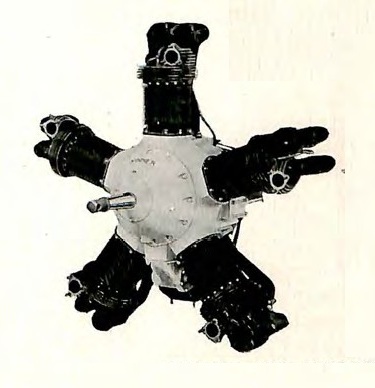
The Kinner C-5 was an American five cylinder radial engine for small general and sport aircraft of the 1930s. The C-5 was a development of the earlier R-5 with greater power and dimensions. The main change was the increase in cylinder bore from 128 mm (5.0 in) to 143 mm (5.625 in) and an increase in cylinder stroke from 140 mm (5.5 in) to 145 mm (5.75 in). This led to a corresponding increase in displacement from 8.85 liters (540 cu in) to 11.71 liters (715 cu in).
The U.S. military designation was R-720.
Applications: Consolidated YPT-11B Kellett K-3 Kinner P Stearman YPT-9C Verville YPT-10D Waco OSO Waco OEC Waco ODC Waco OBF
Specifications: Type: 5-cylinder air cooled radial Bore: 5.625 in (143 mm) Stroke: 5.75 in (145 mm) Displacement: 715 cu in (11.71 liters) Length: 34.8in (884 mm) Diameter: 50 in (1,270 mm) Dry weight: (dry) 420 lb (190 kg) Valvetrain: 1 inlet and 1 exhaust valve per cylinder Fuel system: 1 Stromberg carburetor Fuel type: 73 octane Cooling system: Air Power output: maximum 245 hp at 2,200 rpm , cruise 210 hp at 1,900 rpm Compression ratio: 5.25:1 Specific fuel consumption: 0.6 lb (273 gm) /hp/hr Oil consumption: 0.015 lb (7 gm) /hp/hr