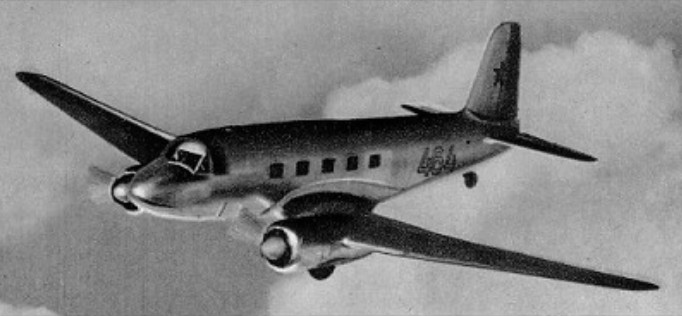
A 1949 ten-passenger transport aircraft powered by two 559kW ASh-21 radial engines.
Engines: 2 x Ash-21, 515kW Max take-off weight: 6400 kg / 14110 lb Empty weight: 5200 kg / 11464 lb Wingspan: 20.0 m / 66 ft 7 in Length: 14.5 m / 48 ft 7 in Max. speed: 370 km/h / 230 mph Cruise speed: 300 km/h / 186 mph Ceiling: 5000 m / 16400 ft Range: 1000 km / 621 miles Crew: 2 Passengers: 10
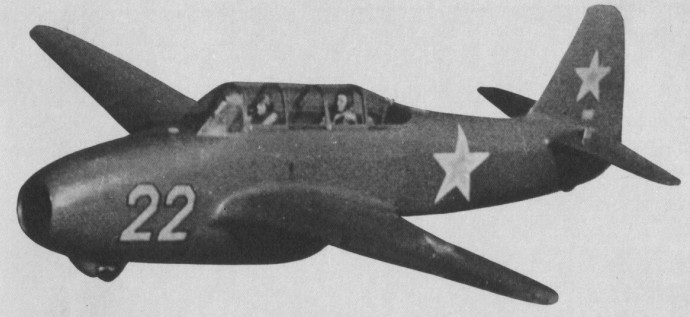
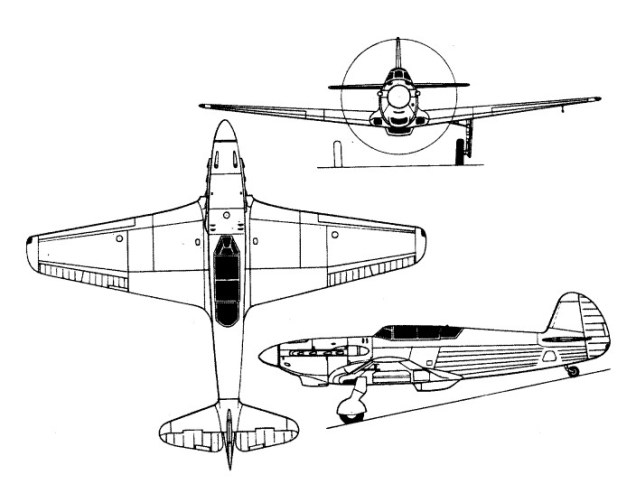
In 1945 the Soviet authorities instructed four bureaux to design fighters Mikoyan/Gurevich and Sukhoi were allocated respon¬sibility for twin engined types, with Lavoch¬kin and Yakolev concentrating on single jet aircraft. The powerplant was to be the Kolesov RD 10, an adaptation of the Junkers Jumo 004B developing 850 kg (1874 lb) of thrust. Primarily the responsibility of Yevgenii Adler and Leon Shekhter, development of the Yak-15 began in May 1945 around the captured German jet engines which were becoming available. The all-metal second-generation Yak-3 airframe was used as a basis and enabling the first of three prototypes to be completed in the following October. Taxying trials and short “hops” were performed, but flight testing was delayed while the possibility of the jet efflux attaching to the fuselage at high incidences was explored in the TsAGI T-101 full-scale wind tunnel. The Yak-15 retained most of the wing, rear fuselage, tail and undercarriage of the Yak-3, a new fuselage nose housing a Junkers Jumo 004B turbojet being introduced, and the main-spar being arched over the jetpipe. Main longerons were strengthened to take the increased load. A stainless steel sheet was attached beneath the rear fuselage to protect it from the hot exhaust gases, and a roller replaced the tail wheel, with protection against the jet blast being given by a shield. The first prototype was ready in October 1945, but the first flight was delayed to 24 April 1946, just three hours after the Mikoyan-Gurevich OKB’s I-300 (MiG-9). The Yak-15 was demonstrated over Tushino during Aviation Day on 18 August 1946, and two days later, on 20 August, the NKAP (People’s Commissariat for the Aircraft Industry) issued a directive that 12 additional aircraft be built to participate in the October Revolution Parade to be held on the following 7 November, 80 days later. Produced by hand, the first of these flew on 5 October and the last in time to participate in the Parade, which, in the event, was cancelled because of inclement weather. State Acceptance testing was completed in May 1947, and, despite being structurally limited to Mach=0.68 below 3200m, 280 were ordered into production at GAZ 153 as an interim type single-¬seat jet conversion trainers. Flutter problems with an airframe which had been designed to accept a piston engine resulted in the Yak 15’s top speed being limited to Mach 0.68, thus preventing full power being used below 3200 m (10500 ft). One of the pre-series Yak-15s had meanwhile been adapted as a tandem two-seat conversion trainer under the designation Yak-21. The initial pro¬duction batch used the tailwheel undercar¬riage, but this proved unsatisfactory and the type was redesigned as the Yak 15U (Usover shenstvovanny, or improved) with a tricycle layout. The nose wheel could not retract fully, since it was mounted beneath the air intake, so it was housed in a bulged fairing when in the up position. The change to a nose wheel layout altered the Yak 15’s balance, so the main undercarriage was mod¬ified to retract between the main spars instead of in front of the forward member. The series Yak-15 carried an armament of two 23mm NS-23 cannon and was powered by a Jumo 004B turbojet which had been adapted by I F Koliesov of the Lyulka bureau for manufacture at Kazan as the RD-10 with a rating of 892kg. Production gave place late in 1947 to the Yak-17 after completion of 280 Yak-15s.
The Yak-15 was to achieve the distinction of being one of only two service jet fighters in aviation’s annals to have been derived from a piston-engined service fighter (the other being the Swedish Saab 21R).
Span, 30 ft 2.25in (9,20m) Length, 28 ft 6.5 in (8,70 m) Height, 7 ft 5.5 in (2,27m) Wing area, 159.85 (14,85sq.m) Max speed, 435 mph (700km/h) at 8,200 ft (2 500 m), 500 mph (805km/h) at 16,405 ft (5 000 m) Time to 16,405 ft (5000 m), 4.8 min Max range, 317mls (510 km) Empty weight, 5,1811b (2350 kg) Loaded weight, 6,0291b (2735kg)
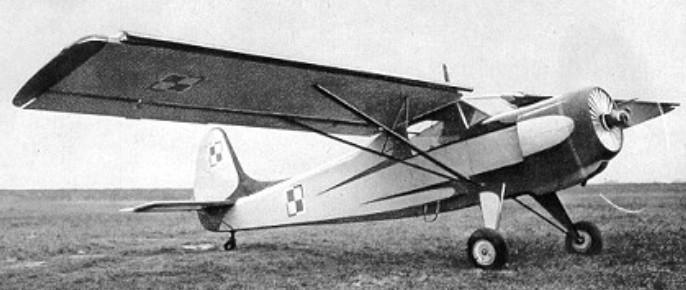
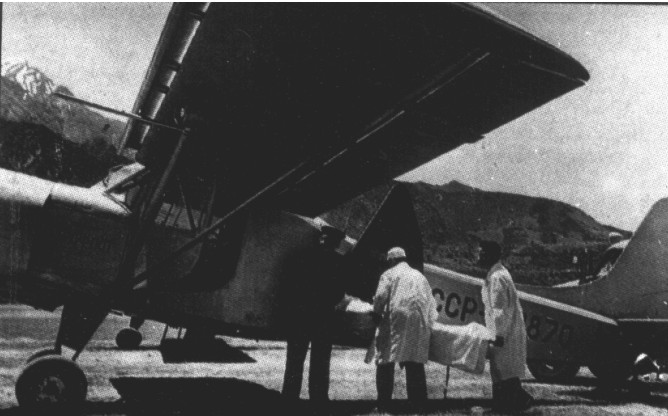
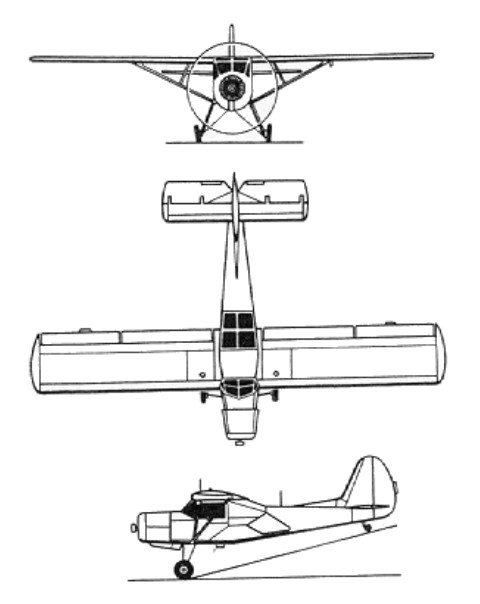
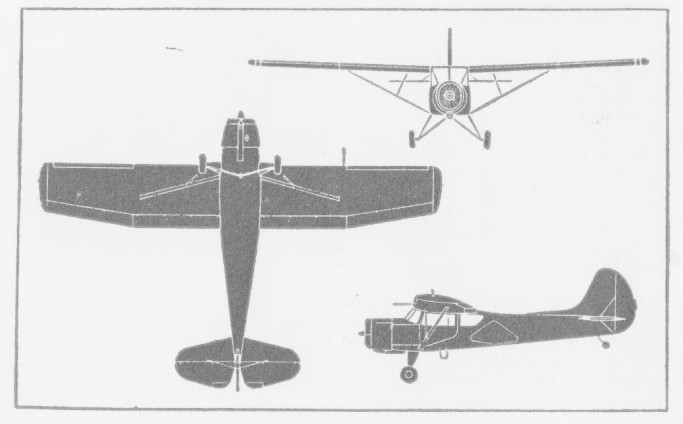
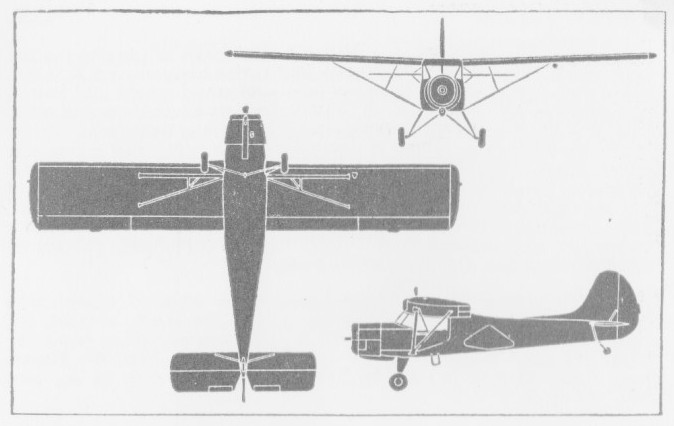
The Yak-12 was a single 179kW AI-14R-engined high-wing light general-purpose aircraft built in several versions from the late 1940s. It was known to NATO as Creek.
The Yak-12A four-seater presented a complete re-design of the basic aircraft, providing greater payload and range. Apart from additional windows, the fuselage remained unchanged, but entirely new wings of reduced area with taper on the trailing edges of the outboard panels was introduced. Single bracing struts replaced the earlier Vee-type struts, along with re-designed tail surfaces. Fuel capacity was substantially increased. Appearing in 1957, Yak-12A manufacturing was sold to Poland, the first Polish production model flying in August 1959 and production continuing until 1961.
In 1952 the Yak-12R (Creek-B) appeared. This retained the mixed construction of the original but introduced the 240 hp Ivchenko AI-14R radial.
The Yak-12R was superseded in production by the Yak-12M (Creek-C) which employed an all metal structure with fabric covering. In 1955 a manufacturing licence for the Yak-12M was acquired by Poland, the type entering production at Okecie in 1955
The Shanghai Dragon Volant – 1 version was built in Shanghai, China.
Shanghai Dragon Volant – 1
Chan Yang 1
The Chinese Chan Yang 1 version of the Yak-12 featured a 220 hp engine.
Yak-12 Engine: 1 x AI-14R, 190kW Max take-off weight: 1435 kg / 3164 lb Empty weight: 1014 kg / 2235 lb Wingspan: 12.6 m / 41 ft 4 in Length: 9.0 m / 30 ft 6 in Height: 3.1 m / 10 ft 2 in Wing area: 2.9 sq.m / 31.22 sq ft Max. speed: 220 km/h / 137 mph Cruise speed: 160 km/h / 99 mph Ceiling: 4600 m / 15100 ft Range w/max.fuel: 760 km / 472 miles Crew: 1 Passengers: 1
Yak-12A Engine: 240 hp Ivchenko AI-14R Wingspan: 31 ft 4 in Length: 29 ft 6 in Height: 10 ft 3 in Wing area: 233.264 sq.ft Empty weight: 2330 lb Loaded weight: 3494 lb Max speed: 133 mph Max cruise: 112 mph Econ cruise: 96 mph ROC: 709 fpm Service ceiling: 15,090 ft Range: 688 mi
Yak-12M Engine: 240 hp Ivchenko AI-14R Wingspan: 41 ft 4 in Length: 29 ft 6 in Height: 10 ft 3 in Wing area: 233.264 sq.ft Empty weight: 2263 lb Loaded weight: 3197 lb Max speed: 112 mph Max cruise: 102 mph Econ cruise: 79 mph ROC: 805 fpm Service ceiling: 13,650 ft Range: 475 mi
Yak-12R Engine: 240 hp Ivchenko AI-14R Wingspan: 41 ft 4 in Length: 29 ft 6 in Height: 10 ft 3 in Wing area: 233.264 sq.ft Empty weight: 2204 lb Loaded weight: 3494 lb Max speed: 114 mph Max cruise: 99 mph Econ cruise: 80 mph Service ceiling: 13,120 ft Range: 310 mi
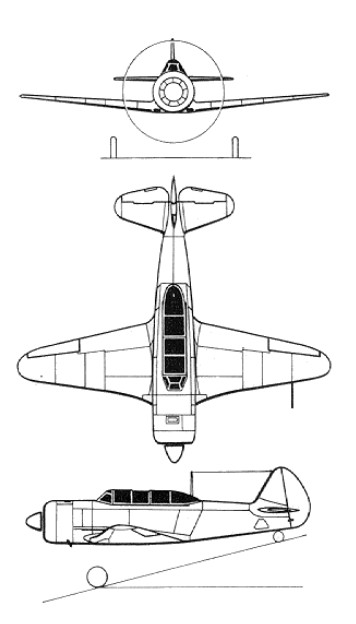
The Yak 11 began life as a radial engine tandem seat advanced fighter trainer variant of the Yak 3. A converted Yak 3 trainer flew in 1945 as the Yak-3UTI and in 1946 there appeared a second prototype with a number of refinements and using less Yak-3 components.
Trials were completed in 1946 and entering Soviet service in 1947. The Yak-11 has all-metal wings and a fuselage covered in plywood and fabric and has a retractable tailwheel landing gear.
NATO code name ‘Moose’. A total of 3859 being built until production ended in 1956 before moving on to a modified version featuring a nosewheel.
Also built under licence in Czechoslovakia as the LET C-11, production totalled 3859 in the USSR and, from 1953, 707 in Czechoslovakia,
In 1958 there appeared the Yak-11U (Czech C-11U) version with retractable tricycle landing gear.
Yak C.11
The Yak-11 was a two-seat intermediate trainer and became a standard type with the Soviet forces and those of a large number of other countries including Afghanistan, Albania, Angola, Bangladesh, Bulgaria, Cambodia, China, Czechoslovakia, East Germany, Hungary, Mongolia, Poland, Romania, Somalia, USSR, Vietnam, and Yemen.
Engine: 1 x Shvetsov ASh-21, 570 hp / 425 kW Wingspan: 9.4 m / 30 ft 10 in Length: 8.5 m / 27 ft 11 in Height: 3.3 m / 10 ft 10 in Wing area: 15.4 sq.m / 165.76 sq ft Empty weight: 1900 kg / 4189 lb Max take-off weight: 2418 kg / 5331 lb Max. speed: 456 km/h / 283 mph at 8200 ft / 2500 m Cruise speed: 400 km/h / 249 mph Service ceiling: 7100 m / 23,295 ft Range w/max.fuel: 1290 km / 802 miles Armament: 1 x 12.7mm or 2 x 7.62 mm machine-guns Bombload: 2 x 110 lb / 50 kg Crew: 2
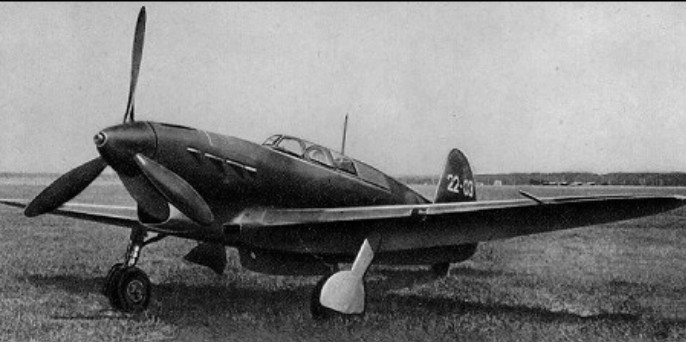
A development of the experimental Yak-7DI fighter, the original Yakolev Yak-9 differed in having a revised rudder and wooden wings incorporating metal spars; the series version, which entered production in the summer of 1942, also introduced a retractable tail-wheel.
Deliveries to V-VS lAPs (fighter regiments) began in October 1942 and the type was soon engaged in the Battle of Stalingrad. By February 1943 production aircraft were being built with reduced-span wings that incorporated duralumin ribs and with the initial powerplant (an M105PF or M-105PF-1) being replaced by the 925kW M-105PF-3. The Yak- 9 operated with a wide variety of armament, including all types of aircraft cannon then in production in the Soviet Union, and during 1943 there appeared variants which developed the full potential of the Yak-9 for use in anti-tank, light bomber and long-range escort roles.
Yak-9D over Crimea 1944 – nearest Col Avdyeyev, 15 victories
The Yak-9D appeared in 1943, primarily intended for bomber escort duties, having a reduced armament and sufficient extra fuel to give a maximum range of 882 miles.
The second generation of Yak-9s began with the Yak-911 prototype of late 1943, which introduced a redesigned airframe, a new wing of increased span and area, and the more powerful VK-107 engine; to overcome resulting centre of gravity problems the wing was moved slightly forward.
The 1943 Yak-9T appeared in 1943 in two versions. The second version was armed with a single 75mm connon for anti-shipping duties.
Later variants, differing primarily in armament and equipment installations, included the Yak-9L and Yak-9M.
The Yak-9U, an improved and cleaner-looking model, was powered by a 1650 hp M-107A engine, had entered production before the war ended and, with the Yak-9P (the final version) equipped Soviet and satellite squadrons for many years afterwards.
Production of the Yak-9 ended in 1946 after a record 16,769 aircraft had been delivered. Main post-war operators, apart from the Soviet Union, were Bulgaria, Poland, French Normandie Squadron and Yugoslavia.
Some Yaks were fitted with either a 37 mm or 75 mm cannon for anti tank use.
2010: FOR SALE: Share in Yak-9V fighters syndicate. Based at Omaka, NZ, syndicate welcomes NZ and internationally based members in ownership consortium. Yak-9V is essentially a Yak-11 with V-12 power, offering full dual controls in a V-12 fighter
Yak 9 Engine: Klimov VK-105PF, 1260 hp Wingspan: 32 ft 9.75 in / 10 m Wing area: 17.1 sq.m / 184.06 sq ft Length: 28 ft 0.5 in / 8.54 m Height: 8 ft / 2.44 m Max take-off weight: 2873-3060 kg / 6334 – 6746 lb Max. speed: 595 km/h / 370 mph Service ceiling: 34,500 ft / 10,500 m ROC: 3795 fpm / 1150 m/min Range w/max.fuel: 1000 km / 621 miles Range w/max.payload: 850 km / 528 miles Armament: 1 x 20mm machine-guns, 1 x 12.7mm machine-guns Crew: 1
Yak 9D Engine One 1,260 h.p Klimov VK-105PF Wing span 32.75 ft. (9.96 m.) Length: 28 ft 0.5 in / 8.54 m Height: 8 ft / 2.44 m Weight empty 6,000 lb. (2,720 kg.) Max speed 360 m.p.h. (580 km.p.h.) Ceiling 36,000 ft. (11,000 m.) fully loaded ROC: 3795 fpm / 1150 m/min Range 880 miles (1,400 km.) Armament 1 x 20 mm. cannon and 1 x 12.7 mm. machine gun Seats: 1
Yak-9DD Range: 1367-2200 mi
Yak-9P Engine: Klimov VK-107A, 1650 hp Wingspan: 32 ft 9.75 in / 10 m Length: 28 ft 6.5 in / 8.70 m Height: 8 ft / 2.44 m Max speed: 416 mph / 670 kph ROC: 4920 fpm / 1500 m/min Service ceiling: 34,500 ft / 10,500 m Range: 520-550 mi Seats: 1
Yak-9T Length: 28 ft Span: 32 ft 9.75 in Max speed: 382 mph Armament: 1 x 30mm AT cannon, 1 x 12.7mm mg
Yak-9T Engine: Klimov M-105PF, 1260 hp Wingspan: 32 ft 9.75 in / 10 m Length: 28 ft 0.5 in / 8.54 m Height: 8 ft / 2.44 m Empty weight: 6063 lb / 2750 kg MTOW: 7055 lb / 3200 kg Max speed: 363 mph at 16,400 ft ROC: 3795 fpm / 1150 m/min Service ceiling: 34,500 ft / 10,500 m Range: 520-550 mi Armament: 1 x 30mm Nudelman cannon, 1 x 12.7mm Beresin mg Seats: 1
Yak-9U Engine: Klimov VK-107A, 1650 hp Wingspan: 32 ft 9.75 in / 10 m Length: 28 ft 6.5 in / 8.70 m Height: 8 ft / 2.44 m Empty weight: 5100 lb / 2313 kg MTOW: 6988 lb / 3170 kg Max speed: 435 mph / 700 kph ROC: 4920 fpm / 1500 m/min Service ceiling: 34,500 ft / 10,500 m Range: 520-550 mi Seats: 1
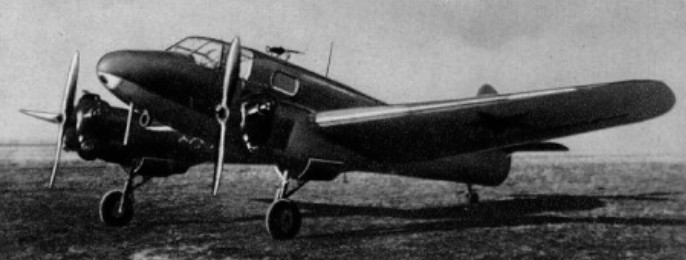
The Yak-6M was an improved version which finally led to the somewhat larger Yak-8, the prototype of which was first flown at the beginning of 1944. This was to have been a dedicated transport, essentially for military use, with accommodation for up to six passengers, but in the absence of anticipated higher-power engines its performance was disappointing and no series production ever took place.
In parallel with the I-26 (or Ya-26), the Yakolev design bureau developed a two-seat version under the designation Yakolev Ya-27. One pre-production I-26 was completed to this configuration. It was intended to serve not only as a dual-control fighter trainer, but also as a liaison and unit support aircraft. Compared with the I-26, the Ya-27 was simplified and of reduced weight, the tandem cockpits being enclosed by an extended glazed canopy. The resulting Yak-7 aircraft entered production in May 1941 and was soon found to have better flying qualities than those displayed by series Yak-1s. This performance, combined with the urgent need for more fighters, led to production of a single-seat version of which the first was flown in June 1941; in the following month the fighter was officially designated Yak-7A and the two-seater Yak-7V.
By the end of 1941 a new single-seater, the Yak-7B, had replaced the Yak-7A. In late 1941 the rear fuselage was lowred to produced the Yak-7B which in early 1942 supplanted the Yak-1 in production.
Total delivery of all versions of the Yak-7 was 6,399 aircraft, production terminating in early 1943; of this number, some 1,500 were Yakolev Yak-7Vs.
Yak-7A
Engine: 1 x VK-105PF, 870kW Max take-off weight: 3050 kg / 6724 lb Empty weight: 2330 kg / 5137 lb Wingspan: 10.0 m / 33 ft 10 in Length: 8.5 m / 28 ft 11 in Height: 1.7 m / 6 ft 7 in Wing area: 17.2 sq.m / 185.14 sq ft Max. speed: 520 km/h / 323 mph Ceiling: 10000 m / 32800 ft Range: 600 km / 373 miles Armament: 1 x 20mm machine-guns, 2 x 12.7mm machine-guns Crew: 1
Conceived as a light utility transport, the twin-engined low-wing Yakolev Yak-6 was largely of wooden construction and flown for the first time in June 1942; it had retractable tailwheel landing gear and accommodated two crew and four passengers. An NBB (or short-range night bomber) version had external racks for five 100kg bombs under the fuselage and provision for a single 7.7mm ShKAS machine-gun, but the Yak-6 could also be equipped to carry stores or freight (including a 500kg external load) or for use as an ambulance aircraft, glider tug or close-support aircraft carrying 10 RS-82 rockets. Often flown with the main landing gear units locked down, the Yak-6 was also used to supply partisans, and by 1944 most operational units had one of these aircraft to ferry personnel between bases. Production totalled about 1,000. The Yak-6M was an improved version which finally led to the somewhat larger Yak-8, the prototype of which was first flown at the beginning of 1944. This was to have been a dedicated transport, essentially for military use, with accommodation for up to six passengers, but in the absence of anticipated higher-power engines its performance was disappointing and no series production ever took place.
Engines: 2 x M-11F, 103kW Max take-off weight: 2350 kg / 5181 lb Wingspan: 14.0 m / 46 ft 11 in Length: 10.4 m / 34 ft 1 in Wing area: 29.6 sq.m / 318.61 sq ft Max. speed: 180 km/h / 112 mph Cruise speed: 150 km/h / 93 mph Range: 880 km / 547 miles Armament: 1 machine-guns Bombload: 500kg Crew: 2 Passengers: 6
Originally proposed in parallel with the Ya-26 (I-26), the Ya-28 (I-28) was a dedicated high-altitude interceptor fighter developed in competition with the Mikoyan-Gurevich OKB’s Kh (I-200). Flown in the late spring of 1941 – shortly after the I-30 alias Yak-3 – the high-altitude fighter had meanwhile been redesignated Yak-5 and its test programme had been delayed by development problems with its mechanically-driven two-stage Dollezhal supercharger. Possessing a fundamentally similar mixed structure to that of the Yak-1, but featuring a modified wing structure with automatic outboard leading-edge slats, the Yak-5 was powered by a Klimov M-105PD – the M-105P with the Dollezhal supercharger – rated at 1,220hp for take-off and 1,150hp at 2700m. Armament was similar to that of the Yak-1. To improve all-round vision for the pilot, the cockpit canopy was extended aft. Two further prototypes of the Yak-5 were built, but the two-stage supercharger proved troublesome, and this problem, coupled with the higher priority assigned to the “frontal” Yak-1, led to rejection of the Yak-5 as a production type. Nonetheless, flight testing continued and it was alleged that a speed of 650km/h was attained at 8500m, and that, during June 1942, an altitude of 12890m was reached by one of the Yak-5 prototypes.
Empty weight: 2990 kg / 6592 lb Ceiling: 12000 m / 39350 ft Range: 460 km / 286 miles
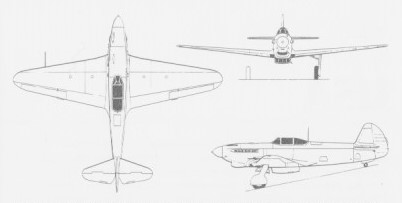
Design began at the end of 1941 of a single-seat fighter using the new VK-107 engine, requiring the least-possible drag, smallest dimensions and weight consistent with a manoeuvrable and tough machine. Due to delays with the new engine and pressure to build the maximum number of aircraft already on the production lines, this new Yak-3 programme was shelved.
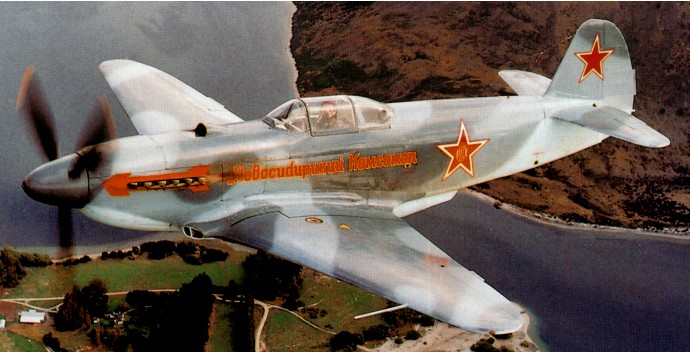
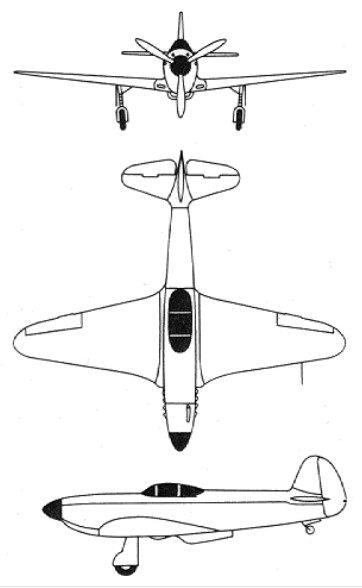
A new small wing was developed and tested along with other changes on a Yak-1M in late 1942, and the first Yak-3 prototype was flown in late 1943. Although evaluation aircraft flew in combat, the first series Yak-3s did not enter operation with the 91st IAP until July 1944. The wings have metal spar, wood ribs with plywood cover and fabric overcoat. The fuselage is welded steek tubing with wood shell cover and fabric over.
The first all metal steel spar wings with light alloy stressed skinned wings and fuselage the production Yak 3U rolled out in late autumn 1944 and deliveries were just being made to front line squadrons when the war ended. The fastest of all Yakolev production piston engined fighters, the Yak 3U was comparable with the Spitfire XIV and XVIII.
Initial non-availability of the VK-107 engine forced reliance to be placed on the VK-105PF-2 that had powered earlier Yaks. The Russian fighter achieved a maximum speed of 447 mph at 19,685 feet when fitted with the VK 107A of 1700 hp as from August 1944, easily outpacing the latest marks of Bf 109 and FW 190. Built to a total of 4,848, the Yak-3 achieved fame and a very high score rate against German aircraft in 1944-45. The Yak-3 equipped the famous Free French ‘Normandie-Niemen’ unit, and achieved its peak of perfection when the VK-107A engine of 1268kW became available in limited numbers from August 1944, the type’s maximum speed then improving to 720km/h at 6000m.
Armed with an engine mounted 20 mm ShVAK cannon and two synchronised 12.7 (0,5 inch) UBS machine guns mounted in the upper decking of the forward fuselage.
Designed specifically for low altitude combat and army co operation the Yak 3 fighter usually operated at altitudes below 8-10,000 ft. where it was markedly superior to the German Bf 109G and Fw 190A and was extensively used for ground strafing.
A Yak-3 airframe was modified to produce the Yak-15 jet fighter in 1945, developed subsequently as the Yak-17.
After discussions with interested American groups in 1991, the Yakolev Design Bureau used the original drawings and some of the original jigs to recommence production for the international warbird market. This resulted in the Yak-3M. The 1993 brand new Yak 3 differs only from the original Red Air Force examples in the engine department, a World War 2 Allison V 1710 99 providing more reliability than the now ex¬tremely rare Klimov VIKA05PF and modern avionics. Modifications to accept the Allison were made by the Yakolev engineers, an in house re engining. The Yakolev factory personnel simply opened the bottom drawer, took out the 1944 plans, blew off the dust, and went to work on a new production batch. The production line was simply restarted. A number of the original jigs were in existence to facilitate the work.
Yak-3UPW
Five Yak-3UPW were built in Romania in 1994. They were powered by Pratt & Whitney R-1834 Twin Wasp with a new Hamilton Standard three blade prop.
Yak-3 Engine: VK-107, 1310 hp Wingspan: 30.18 ft Length: 27.88 ft Speed: 342 mph at 16,400 ft Gross weight: 4848 lb Armament: 1 x 20mm cannon, 2 x 12.7mm mg
Yak-3U Engine: 1 x Klimov VK-105PF, 870kW / 1,200 hp Max take-off weight: 2650 kg / 5842 lb Wingspan: 9.2 m / 30 ft 2 in Length: 8.5 m / 28 ft 11 in Height: 2.4 m / 8 ft 10 in Wing area: 14.8 sq.m / 159.31 sq ft Max. speed: 660 km/h / 410 mph Cruise speed: 560 km/h / 348 mph Ceiling: 10700 m / 35100 ft Range: 900 km / 559 miles Armament: 1 x 20mm machine-guns, 2 x 12.7mm machine-guns, Crew: 1















 All Aero