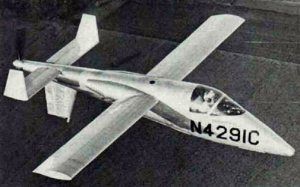
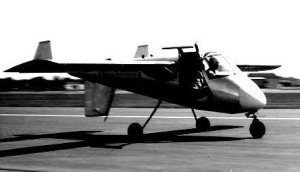
The Lesher Teal, registered N4291C, was explicitly designed to break records in the Fédération Aéronautique Internationale Class C1a, for propeller-driven aircraft of less than 500-kg (1102-lb.) gross weight.
The Teal retained the Nomad’s Continental O-200A power and all-aluminum pusher configuration, this time in a single-seat layout. Its wingspan is a diminutive 23 ft. 10 in. (by contrast, a Piper J3’s span is 35 ft. 3 in.).
At one point of the Teal’s design, Ed, who weighed well over 200 lb., considered using a jockey pilot. Instead, not wanting to miss the fun, he decided this was a good incentive to lose some weight.
The Teal first flew in April 1965.
In August 1965, Lesher piloted it to the EAA Fly-In in Rockford, Illinois, where he was honored for his achievements. Then he began attacking the FAI records.
In 1967, Lesher and his Teal set a Class C1a speed record for a 500-km closed course at 181.55 mph. Later that year, he flew the Teal at 169.20 mph for a new 1000-km closed-course record. Before the year ended, Lesher and the Teal averaged 141.84 mph for a new closed-course record of 2000 km.
In 1968, a loss of power brought the Teal to an emergency landing, and considerable damage, in a Michigan field. After a rebuild, Lesher and his Teal set another FAI record in 1970, this one for a closed-circuit distance of 1554.29 miles. In 1973, he and the Teal set a 3-km speed record of 173.101 mph as well as a 15-25-km record of 169.134 mph. Finally, the pair set an FAI C1a record for straight-line distance, officially 1835.459 miles, by traveling from Florida to Arizona.
For these record-breaking achievements, Lesher earned the FAI’s Louis Blériot Medal four times, in 1967, 1970, 1973 and 1975. He was inducted into the Michigan Aviation Hall of Fame in 1988.
The Lesher Teal has resided in the EAA Adventure Museum since 2002.
The 1946 Stinson 106 Skycoach, one of Stinson’s products during Lesher’s time with this Wayne, Michigan, company. The Skycoach’s pusher propulsion, though, intrigued Lesher and he incorporated this feature into his home-built aircraft.
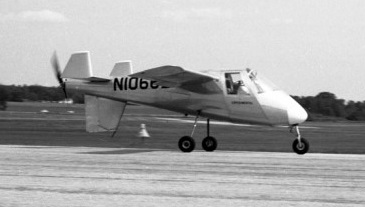
The Nomad was an all-aluminum side-by-side two-place pusher. Powered by a 100-hp Continental O-200A air-cooled flat-four placed immediately behind the cockpit, fed with air intakes at the wing roots, the Nomad made innovative use of a Dodge Flexidyne Coupling to dampen torsional vibration.
The wing was built as a single assembly with a very simple profile and no dihedral. The vee-tailed empennage and vertical fin in low position was meant to impair the Hartzell propeller’s efficiency as little as possible, while the vertical fin placed below helped to keep the propeller clear from the ground.
Construction began in 1959 and the Nomad, registered N1066Z, flew in October 1961 after 5000 hours of construction. Lesher and the plane took Grand Prize at the 1964 AC Spark Plug Rally.
The Nomad was followed by the better-known Lesher Teal, which also remained a prototype.
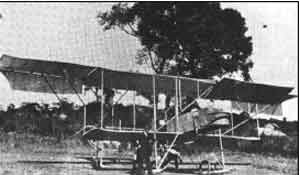
In April 1912 Fernand Lescarts, with the financial help of King Albert, travelled from Belgium to the Congo bringing with him a Farman biplane. The Farman was destroyed during the journey whereupon Lescarts designed and built a new biplane, and named it N’Deke Mwaope (White Bird), which flew pretty well until a violent windstorm wrote an end to the story.
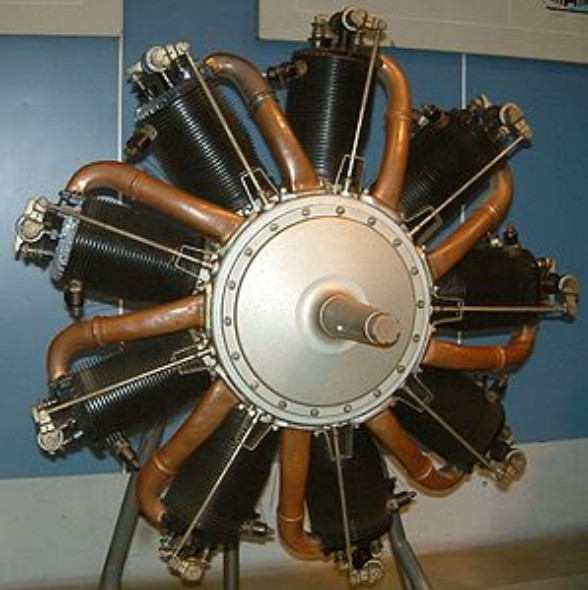
Le Rhône was the name given to a series of popular rotary aircraft engines produced in France by Société des Moteurs Le Rhône and the successor company of Gnome et Rhône. They powered a number of military aircraft types of the First World War. Le Rhône engines were also produced under license worldwide. Although not powerful (the largest wartime version produced 130 horsepower (97 kW)), they were dependable rotary engines. The Le Rhône 9 was a development of the Le Rhône 7, a seven-cylinder design.
The copper induction tubes had their crankcase ends located in different places on the 80 and 110 horsepower (60 and 82 kW) versions – the 80 hp versions had them entering the crankcase in a location forward of the vertical centerline of each cylinder, while the 110 hp version had them located behind the cylinder’s centerline. This resulted in the 80 hp version’s intake plumbing being “fully visible” from the front, while the 110 hp version had the lower ends of its intake tubes seemingly “hidden” behind the cylinders.
A complicated slipper bearing system was used in the Le Rhône engine. The master rod was of a split-type, which permitted assembly of the connecting rods. It also employed three concentric grooves, designed to accept slipper bearings from the other cylinders. The other connecting rods used inner-end bronze shoes, which were shaped to fit in the grooves. The master rod was numbered as number one and the shoes of numbers. two, five and eight rode in the outer groove, the shoes of three, six and nine in the middle groove and four and seven in the inner groove. Although this system was complex, the Le Rhône engines worked very well.
The Le Rhône engines used an unconventional valve actuation system, with a single centrally-pivoting rocker arm moving the exhaust valve and the intake valve. When the arm moved down it opened the intake valve and when it moved up it opened the exhaust value. To make this system work a two-way push-pull rod was fitted, instead of the more conventional one-way pushrod. This feature required the cam followers to incorporate a positive action, a function designed in by using a combination of links and levers. This design functioned but it did prevent the incorporation of valve overlap which limits power output. Due to the structural and cooling limitations of the overall engine design the Le Rhône engines produced as much power as they were capable of, regardless.
As well as production by Société des Moteurs Gnome et Rhône, which had bought out Société des Moteurs Le Rhône in 1914, the Le Rhône was produced in Germany (by Motorenfabrik Oberursel), Austria, the United Kingdom (by Daimler), Russian Empire and Sweden.
Le Rhône 80 hp (60 kW) engines were made under license in the United States by Union Switch and Signal of Pennsylvania, and the 110 hp (82 kW) Oberursel UR.II rotary engine used by Germany in World War I, in such famous fighters such as the Fokker Dr.I triplane, was a close copy of the 110 hp 9J version.
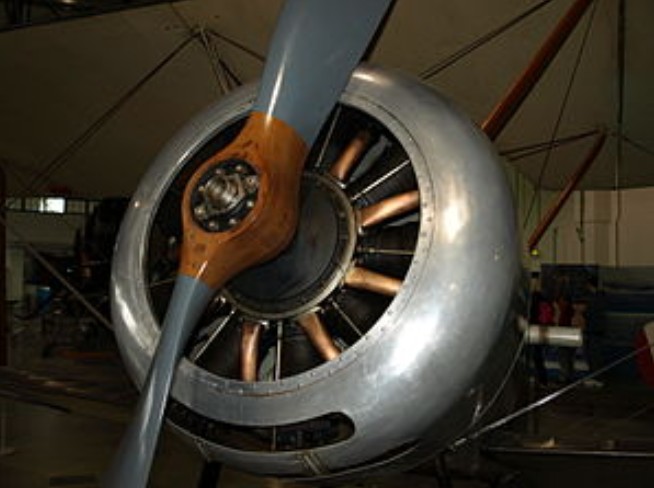
Le Rhône 9C in a Sopwith Pup
First run in 1916, the Le Rhône 9C is a nine-cylinder rotary aircraft engine produced in France by Gnome et Rhône. Also known as the Le Rhône 80 hp in a reference to its nominal power rating, the engine was fitted to a number of military aircraft types of the First World War. Le Rhône 9C engines were also produced under license in Great Britain by several companies, and in the United States. British production amounted to 1,088 examples.
In common with other Le Rhône series engines, the 9C featured highly visible telescopic copper induction pipes and used a single push-pull rod to operate its two overhead valves.
Oberursel produced the 110 hp model, supposedly without authorization in Germany. The Oberursel Ur.II was a straight copy of the Le Rhône, but the Le Rhône was preferred over the Oberursel due to the materials used in the French product. However, by July 1918 there was a shortage in Germany of castor oil, a plant-derived lubricant that the rotaries required as it could not be easily dissolved into the fuel, and because it possessed lubrication qualities superior to mineral oils of the day. A new Voltol-based lubricant, derived from mineral oil, was substituted and was blamed for engine failures on rotary-engined German fighters such as the Fokker E.V which used the Oberursel Ur.II. It has been suggested that without proper lubricants, the Le Rhône rotary would have been equally failure-prone.
A few examples of the 9C engine remain airworthy both in Europe and North America, one powering a vintage Sopwith Pup biplane in England, and a small number of others having powered reproduction WW I-era aircraft at Old Rhinebeck Aerodrome.
Variants:
Le Rhône Type 9C (1916) 80 hp (60 kW), nine-cylinder rotary engine.
Le Rhône Type 9J (1913) 110 hp (82 kW), nine-cylinder rotary engine.
Le Rhône Type 9Ja (1915) 110 hp (82 kW), nine-cylinder rotary engine.
Le Rhône Type 9Jb (1916) 120 hp (89.5 kW), nine-cylinder rotary engine.
Le Rhône Type 9Jby (1916) 130 hp (97 kW), nine-cylinder rotary engine.
Le Rhône Type 9R (1916) 170 hp (127 kW), nine-cylinder rotary engine.
Le Rhône 9Z (1920) A 9-cylinder rotary.
Le Rhône K (1916) A 9-cylinder rotary prototype engine.
Le Rhône L (1916) A 9-cylinder rotary prototype engine.
Le Rhône M (1917) A 9-cylinder rotary prototype engine.
Le Rhône P (1917) A 9-cylinder rotary prototype engine.
Le Rhône R (1917) A 9-cylinder rotary prototype engine.
Applications: Bristol M.1 Bristol Scout Caudron G.III Caudron G.IV Henry Farman F.20 Grahame White G.W.15 Grahame White G.W.E.6 Bantam Morane-Saulnier G Morane-Saulnier H Morane-Saulnier L Morane-Saulnier N Morane-Saulnier P Nieuport 10 Nieuport 11 Nieuport 21 Pemberton Billing P.B.23 Ponnier M.1 Royal Aircraft Factory F.E.8 Royal Aircraft Factory S.E.4 Sopwith Camel Sopwith Dove Sopwith Pup Thomas-Morse S-4 Vickers F.B.12
Le Rhône 9C Type: Nine-cylinder, single-row rotary engine Bore: 105 mm (4.13 in) Stroke: 140 mm (5.51 in) Displacement: 10.89 lt (664.47 cu in) Diameter: 94.5 cm (37.2 in) Dry weight: 121.5 kg (268 lb) Valvetrain: Cam-operated single rocker for both inlet and exhaust valves Oil system: Castor oil, total loss Cooling system: Air-cooled Power output: 92 hp (68.6 kW) at 1,300 rpm (maximum) Compression ratio: 4.5:1
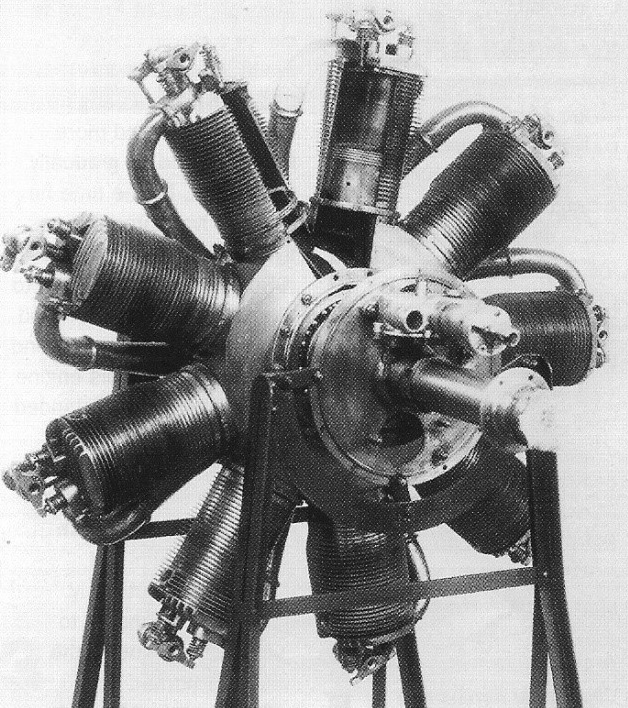
Le Rhône was the name given to a series of popular rotary aircraft engines produced in France by Société des Moteurs Le Rhône and the successor company of Gnome et Rhône. First run in 1910, they powered a number of military aircraft types of the First World War. Le Rhône engines were also produced under license worldwide. Although not powerful (the largest wartime version produced 130 horsepower (97 kW)), they were dependable rotary engines. The Le Rhône 9 was a development of the Le Rhône 7, a seven-cylinder design.
The copper induction tubes had their crankcase ends located in different places on the 80 and 110 horsepower (60 and 82 kW) versions – the 80 hp versions had them entering the crankcase in a location forward of the vertical centerline of each cylinder, while the 110 hp version had them located behind the cylinder’s centerline. This resulted in the 80 hp version’s intake plumbing being “fully visible” from the front, while the 110 hp version had the lower ends of its intake tubes seemingly “hidden” behind the cylinders.
A complicated slipper bearing system was used in the Le Rhône engine. The master rod was of a split-type, which permitted assembly of the connecting rods. It also employed three concentric grooves, designed to accept slipper bearings from the other cylinders. The other connecting rods used inner-end bronze shoes, which were shaped to fit in the grooves. The master rod was numbered as number one and the shoes of numbers. two, five and eight rode in the outer groove, the shoes of three, six and nine in the middle groove and four and seven in the inner groove. Although this system was complex, the Le Rhône engines worked very well.
The Le Rhône engines used an unconventional valve actuation system, with a single centrally-pivoting rocker arm moving the exhaust valve and the intake valve. When the arm moved down it opened the intake valve and when it moved up it opened the exhaust value. To make this system work a two-way push-pull rod was fitted, instead of the more conventional one-way pushrod. This feature required the cam followers to incorporate a positive action, a function designed in by using a combination of links and levers. This design functioned but it did prevent the incorporation of valve overlap which limits power output. Due to the structural and cooling limitations of the overall engine design the Le Rhône engines produced as much power as they were capable of, regardless.
As well as production by Société des Moteurs Gnome et Rhône, which had bought out Société des Moteurs Le Rhône in 1914, the Le Rhône was produced in Germany (by Motorenfabrik Oberursel), Austria, the United Kingdom (by Daimler), Russian Empire and Sweden.
Le Rhône 80 hp (60 kW) engines were made under license in the United States by Union Switch and Signal of Pennsylvania.
Variants:
Le Rhône Type 7A (1910) 50 hp (37 kW), seven-cylinder rotary engine – twenty built for use on Borel Monoplanes and Sommer Biplanes.
Le Rhône Type 7B (1911) 50 hp (37 kW), seven-cylinder rotary engine – Thirty-five prototype engines built.
Le Rhône Type 7B2 (1912) 60 hp (44.7 kW), seven-cylinder rotary engine – 350 built at Societe Moteurs le Rhône.