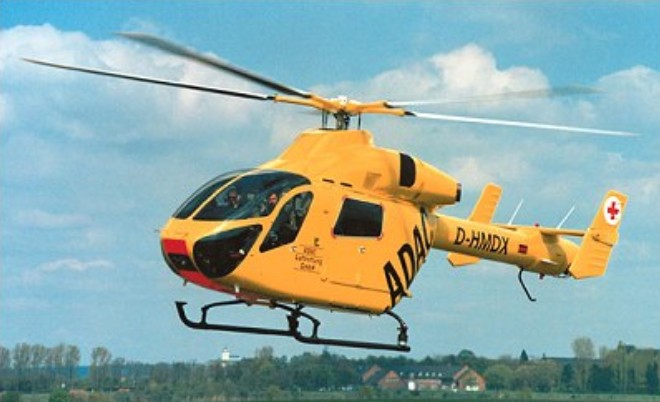
The genesis of the Explorer dates to 1986, when company engineers hit upon the idea of using the latest technology, such as an all-composite main rotor and MDHS’ own no-tail-rotor (NOTAR) anti-torque system, as a basis for a new eight-seater design which would give excellent performance at affordable cost. The MD Explorer is the first commercial helicopter totally designed using computer-aided design techniques and only after a detailed market survey of over 177 operators asking them what they wanted from a new utility helicopter in terms of flight performance and general layout in a 1800 to 3600kg helicopter.
McDonnell-Douglas MD-900 / MD-902 Explorer Article
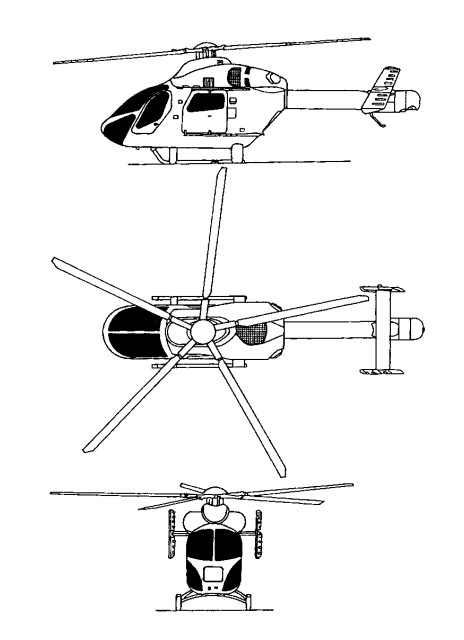
MDHS decided to go ahead with design work in January 1989 with a senior advisory council formed from risk-sharing partners in the $200 million programme. The Explorer is created using computer-aided design (CAD) techniques. The Explorer is the first helicopter to have a major portion of its primary structure constructed from composites. This is most evident in the fuselage, which is manufactured by Hawker de Havilland in Australia. Skins, floors, mb/keel beam and aft-fuselage assemblies are made from a pre-impregnated carbon-fibre composite with a toughened epoxy resin system produced by Hexel. Hawker de Havilland refined manufacturing techniques after the first three fuselage units and standardised on a final design which is around 10% lighter than the development fuselages, weighing in at just 260kg. Metallic parts consist of the titanium roof which provides protection from fire in the engine area, the main frames, fittings and forward-cockpit structure. Two aluminium plough beams form the primary structural support for the nose and provide enhanced crash-protection. In the event of a forward impact with the ground, the beams are designed to keep the nose of the helicopter from tipping down. In the passenger configuration, the Explorer’s 1.44m-wide cabin provides enough space for two rows of three 480mm seats , with a seventh passenger seated in the co-pilots position. Without seats, the helicopter has a completely flat floor which is accessible via a rear-access door and large sliding doors on either side of the cabin. The tailboom and empennage are all-composite primary structures made by MDHS using the same carbon composite and toughened resin as the fuselage. Like the fuselage, the early tailboom design was altered slightly for the final-production configuration to give a 25% weight saving. As the tailboom is hollow to accommodate the NOTAR system, it has aerodynamic surfaces on the inside, as well as the outside. Slots run the length of the right-hand side of the boom to allow air to escape and create the Coanda effect at the heart of the NOTAR principle.
Initially known as MDX, then MD 900 (proposed MD 901 with Turbomeca engines was not pursued. Hawker de Havilland of Australia designed and manufactures airframe; Canadian Marconi tested initial version of integrated instrumentation display system (IIDS) early 1992; Kawasaki completed 50 hour test of transmission early 1992. Other partners include Aim Aviation (interior), IAI (cowling and seats) and Lucas Aerospace (actuators).
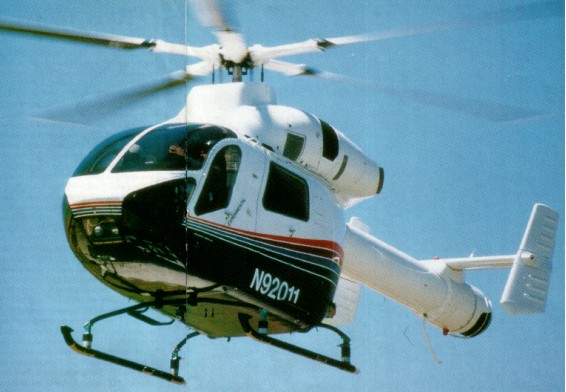
Ten prototypes and trials aircraft, of which seven (Nos. 1, 3-7 and 9) for static tests, were built. The first flight (No.2/N900MD) was on 18 December 1992 at Mesa, Arizona, followed by No.8/N900MH 17 September 1993 and No.10/N9208V 16 December 1993; first production/demonstrator Explorer (No.11/N92011) flown 3 August 1994.
FAA certification 2 December 1994; first delivery 16 December 1994; JAA certification July 1996; FAA certification for single-pilot IFR operation achieved January 1997. Type certificate transferred to MDHI on 18 February 1999.
This new technology helicopter received type certification on 21 December 1994 from the FAA which was only 23 months after first flight. This was one of the shortest certification periods ever recorded for a new helicopter and was also the first new design passenger and utility rotorcraft certified by the FAA in more than ten years.
FAA certification of uprated PW207E engine achieved in July 2000, providing 11% more power for take-off and 610m increase in hovering capability OEI in hot-and-high conditions; first delivery of PW207E-engined Explorer to Police Aviation Services, UK, 27 September 2000. “100th production” Explorer (actually 89th overall, including prototypes) delivered 1 March 2002 to Tomen Aerospace Corporation of Japan for ENG operations by Aero Asahi of Hiroshima. Total fleet time stood at more than 120,000 hours by December 2002.
MDHS begun delivery of the Explorer with a target direct-operating cost of $389/h and a base price of $3.16 million at 1995 exchange rates.
The Explorer has been built largely from composite materials and is powered by twin Pratt & Whitney Canada PW 206A turboshafts and has a maximum gross weight of 2950kg. It can lift 1150kg internally, or 1350kg externally and weighs only 1350kg empty. The helicopter incorporates a range of new technologies to improve safety and performance and reduce operating costs. These include the NOTAR yaw control system, composite, bearingless main rotor with five blades. Digital avionics including FADEC, diagnostics and an Integrated Instrument Display System. The liquid crystal Integrated Instrument Display System (IIDS) replaces traditional cockpit instruments by presenting aircraft operating information in a digital format and icon symbology on two six-inch screens. The system also records operating data for on-board health and usage monitoring, providing technicians with accurate information for performing maintenance functions.
The NOTAR anti-torque system features all-composites five-blade rotor of tapered thickness with parabolic swept outer tip with bearingless flexbeam retention and pitch case; tuned fixed rotor mast and mounting truss for vibration reduction; replaceable rotor tips; maximum rotor speed 392 rpm; modified A-frame construction from rotor mounting to landing skids protects passenger cabin; energy-absorbing seats absorb 20 g vertically and 16 g fore and aft; onboard health monitoring, exceedance recording and blade track/balance.
Mechanical engine control from collective pitch lever is back-up for electronic FADEC. Automatic stabilisation and autopilot available for IFR operation. The transmission overhaul life 5,000 hours; glass fibre blades have titanium leading-edge abrasion strip and are attached to bearingless hub by carbon fibre encased glass fibre flexbeams; rotor blades and hub on condition.
The baseline MD 900 is powered by two Pratt & Whitney Canada PW206E turboshafts with FADEC, each rated at 463kW for 5 minutes for T-O, 489kW for 2.5 minutes OEI and 410kW maximum continuous. Transmission rating 820kW for T-O, 746kW maximum continuous, 507kW for 2.5 minutes OEI and 462kW maximum continuous OEI.
Fuel contained in single tank under passenger cabin, capacity 564 litres, of which 553 litres are usable. Single-point refuelling; self-sealing fuel lines.
Accomodation is for two pilots or pilot/passenger in front on energy-absorbing adjustable crew seats with five-point shoulder harnesses/seat belts; six passengers in club-type energy-absorbing seating with three-point restraints; rear baggage compartment accessible through rear door; cabin can accept long loads reaching from flight deck to rear door; hinged, jettisonable door to cockpit on each side; sliding door to cabin on each side.
Hydraulic system, operating pressure 34.475 bar.
With 14 feet of flat floor space in the rear cabin, the Explorer is expected to undertake a multitude of civil missions from general utility to offshore transportation, corporate flight, tourist flights and air medical services. In the EMS configuration the Explorer can accommodate two patients, two attendants and life support equipment in addition to the flight crew.
The 100th Explorer registered in 2002 (to become seventh for Netherlands police); total of 108 manufactured by December 2002; first delivery 16 December 1994 to Petroleum Helicopters Inc (PHI) which ordered five; second delivery (N901CF) December 1994 to Rocky Mountain Helicopters for EMS duties with affiliate Care Flight unit of Regional Emergency Medical Services Authority (REMSA) in Reno, Nevada. Total of two delivered in 1994, 12 in 1995, 15 in 1996, one in 1997, four in 1998, 11 in 1999, 16 in 2000, 20 in 2001 and four in 2002; initial (MD 900) series comprised 40 aircraft including three flying prototypes; FW207E engine from 64th production (67th overall) aircraft.
MD Enhanced Explorer: Improved version, announced September 1996; originally MD 902, but now known as “902 Configuration”. Main features include Pratt & Whitney Canada PW206E engines with increased OEI ratings; transmission approved for dry running for 30 minutes at 50% power; improved engine air inlets, NOTAR inlet design and engine fire suppression system, and more powerful stabiliser control system, resulting in 7% increase in range. 4% increase in endurance and 113kg increase in payload over Explorer. First flight (N9224U; c/n 900-0051, 41st Explorer) 5 September 1997, FAA certification to Category A performance standards (including continued take-off with one failed engine) and single-pilot IFR operation achieved 11 February 1998; JAA certification for Category A performance achieved July 1998. Retrofit kits to convert Explorers to Category A standard. First Enhanced Explorer delivery in May 1998 to Tomen Aerospace of Japan. PW206E replaced by PW207E from late 2000, beginning at c/n 900-0077, allowing further MTOW increase to 2,948kg.
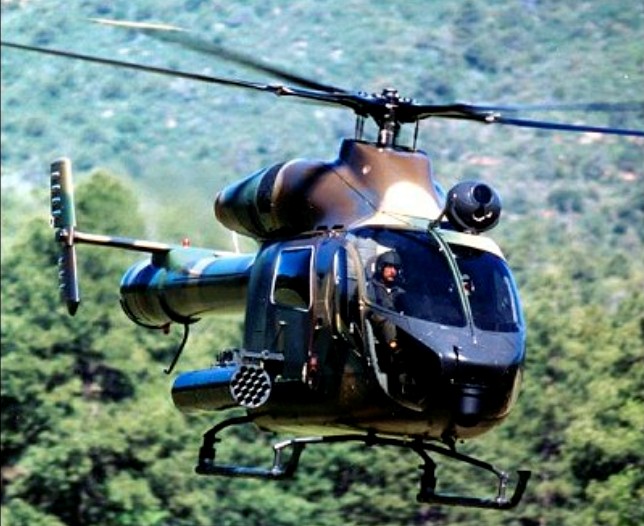
MH-90 Enforcer: Beginning March 1999, under a programme code-named Operation New Frontier, the US Coast Guard used two leased MD 900 Explorers for shipboard anti-drug smuggling operations. Armed with a pintle-mounted M240 7.62mm minigun at the door station. In September 1999 the MD900s were exchanged for two leased MD 902 Enhanced Explorers. These subsequently replaced by Agusta A 109s. Six delivered to Mexican Navy at Acapulco (two each respectively in May and December 1999 and April 2000) for anti-drug operations, equipped with 12.7mm General Dynamics GAU-19/A Gatling guns, and 70mm rocket pods; further four in process of delivery. Weapons qualification trials were completed at Fort Bliss, Texas in November 2000.
Combat Explorer: Displayed at Paris Air Show, June 1995; demonstrator N9015P (No.15), an MD 900 variant. Can be configured for utility, medevac or combat missions; armament and mission equipment may include seven- or 19-tube 70mm rocket pods, 12.7mm machine gun pods, chin-mounted FLIR night pilotage system and roof-mounted NightHawk surveillance and targeting systems. Combat weight 3,130kg; two P&WC PW206A engines. No customers announced by January 2000, but N9015P became one of initial two MH-90s (with third prototype, N9208V).
February 19, 1999: Boeing sold MD commercial line to RDM The dutch company bought the ex Mc Donnell Douglas models MD 500E and MD 530F single-engine helicopters with conventional tail rotors, the MD 520N and MD 600N single-engine NOTAR helicopters and the MD Explorer series of twin-engine, eight-place helicopters.
Costs: US$2.285 million (2002); direct operating cost US$408.11 (2002) per hour.
McDonnell Douglas MD 902 Explorer
Engine: 2 x Pratt & Whitney Canada PW206E, 630 shp
Length: 32.316 ft / 9.85 m
Height: 12.008 ft / 3.66 m
Rotor diameter: 33.825 ft / 10.31 m
Wing area: 3939.624 sqft / 366.0 sq.m
Max take off weight: 6504.8 lb / 2950.0 kg
Weight empty: 3214.9 lb / 1458.0 kg
Max. speed: 160 kts / 296 km/h
Cruising speed: 140 kts / 259 km/h
Initial climb rate: 2795.28 ft/min / 14.2 m/s
Service ceiling: 18497 ft / / 5638 m
Wing load: 1.64 lb/sq.ft / 8.0 kg/sq.m
Range: 313 nm / 580 km
Crew: 2
Payload: 8pax
MD Explorer
Engine: 2 x Turbomeca Arrius 2C
Instant pwr (Turbomeca engine): 480 kW.
Rotor dia: 10.3 m
MTOW: 2700 kg
Useful load: 1165 kg
Max cruise: 150 kts
Max range: 600 km
Seats: 8
MD Explorer
Engine: 2 x P&WC PW206A
Gross wt: 2,722kg
Empty operating wt: 1,481kg
Useful load: 1,163kg
Fuel capacity wt (600litres): 438/472kg
Main rotor dia: 10.34m
Length: 9.86m
Height: 3.66m
Skid width: 2.23m
Passengers: 7.
Crew: 1
Max cruise speed @ ISA 38oC: 135kt (@sea level ISA: 139kt)
Max range: 530km
Max endurance: 3.5hr
Hover Out of ground effect @ ISA: 3,353m (@lSA+20o: 2,073m)
Hover in ground effect @ ISA 3901m (@lSA+20o: 2,621m)
Climb rate: 14.2m/s
Ceiling: 20,000ft
MD 900 Explorer
Engines: 2 x Pratt & Whitney PW 206B turboshaft, 469kW
Rotor diameter: 10.31m
Length with rotors turning: 11.83m
Fuselage length: 9.85m
Height: 3.66m
Fuselage width: 1.63m
Max take-off weight: 3057kg
Empty weight: 1481kg
Max speed: 278km/h
Cruising speed: 250km/h
Rate of climb: 14.2m/s
Hovering ceiling: 3840m
Service ceiling: 6100m
Range: 530-600km
Payload: 1360kg
Crew: 1-2
Passengers: 6