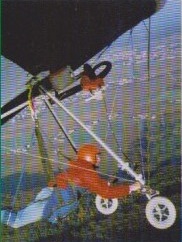
The Mini Fly Set is a power unit which can be quickly attached to the keel of a hang glider.
Empty weight: 16 kg
Engine: Sach 166
Certification: vz
Reduction: 1:3
Prop diameter: 112
Fuel capacity: 10 lt
Price (1998): DM6840
The Mini Fly Set is a power unit which can be quickly attached to the keel of a hang glider.
Empty weight: 16 kg
Engine: Sach 166
Certification: vz
Reduction: 1:3
Prop diameter: 112
Fuel capacity: 10 lt
Price (1998): DM6840
1998:
Kümmerle H./Gewerbestr. II
D-74912 Kirchardt
Germany
Power pack builder

This Edward Mines curiosity was entered in the Doncaster (UK) Flying Meet, and made its debut there on the fifth day of the event (Wednesday, October 20, 1909). It attracted some media attention, unfortunately most of it negative. Promptly nicknamed the “coffee-stall”, its planes had a span of only fourteen feet and a chord of six feet. There was no tail, and the ruddering was by means of square ‘flaps’ fitted between the wings. This machine had an elevator in front of the top plane, and the bottom plane’s extremities were adjustable. Needless to say, it never flew. A photo exists of the Mines biplane in an earlier version, without the flaps between the wings.
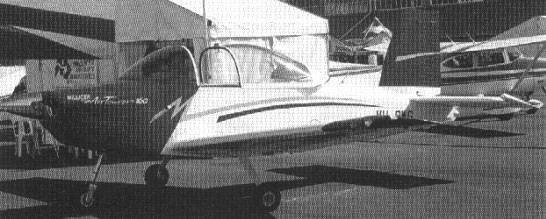
A redevelopment of the original Victa Airtourer. The prototype features a wet wing, inverted fuel system, electric flap and redesigned undercarriage.

Originally introduced in the 1990s, Jim Millett’s Hornet returned in 2004 with a new team.
One of the features is a large rubber donut shock-absorber that is centrally located in the fuselage to bear the load from the main gear.
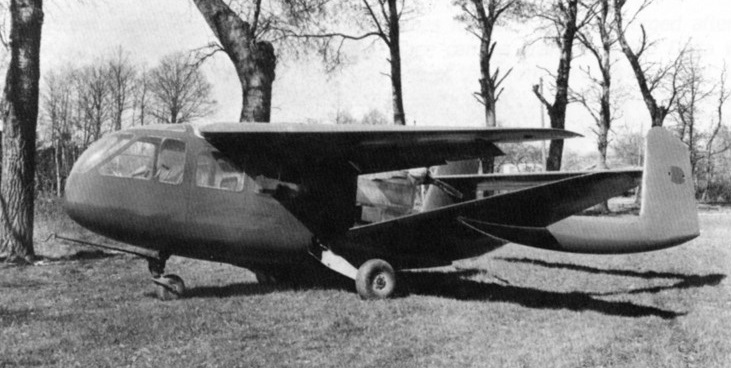
A twin-boom, heavily-staggered biplane four-seater, powered by 180 hp Regnier engine and first flown 1949.
The “Lil’ Rascal” by Merle B. Miller began flight testing in early 1978. This biplane makes use of a steel-tube fuselage and tail section covered with Stits Poly-Fibre Dacron. The wings are constructed of spruce and plywood and are covered with same fabric. The landing gear is the nonretractable tailwheel type, and seating is for two persons in a side-by-side open cockpit. The standard 85-hp engine turns a fixed-pitch prop.
Gross Wt. 1100 lb
Empty Wt. 600 lb
Fuel capacity 12 USG
Wingspan 20 ft 8 in
Length 15 ft 3 in
Engine 85-hp Continental
Top speed est: 110 mph
Cruise est: 90 mph
Stall est: 58 mph
Aeroneering Inc., Box 22064, Savannah, GA 31403, USA.
Built the 1978 Miller Lil’ Rascal
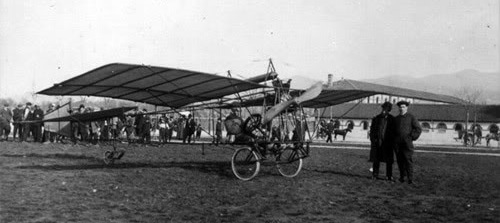
The third and final aeroplane designed and constructed by Franz Miller of Turin, Italy.
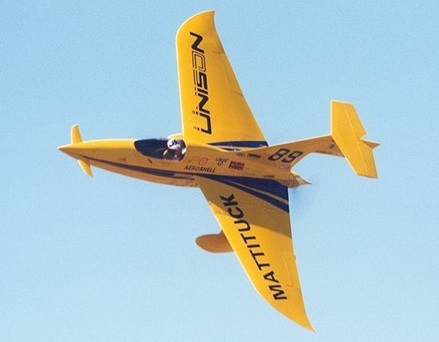
The Miller-Bohannon JM-2 Special, named Pushy Galore, is a one-of-a-kind American homebuilt Formula One racing and record-setting aircraft, based on Jim W Miller’s Miller JM-2 design, but highly modified by Bruce Bohannon.
Bohannon began construction of Pushy Galore in 1988 and first flew it in the early part of 1989, first entering it in a race in June 1989.
The aircraft features a cantilever mid-wing, a single-seat enclosed cockpit under a bubble canopy, fixed main tricycle landing gear with a retractable nose wheel, a t-tail, nose mounted canard and a single engine in pusher configuration.
The aircraft is made from welded steel tubing covered in molded carbon fiber. As required by the Formula One rules, its engine is a 100 hp (75 kW) Continental O-200A.
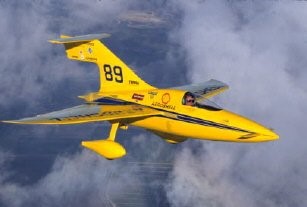
Only one example was ever built, N189BB.
Bohannan entered the aircraft in the Reno Air Races in 1994, qualifying in third place in the Formula One class, with a speed of 236.153 mph (380.051 km/h).
In 1995 Bohannan flew the aircraft to second place in the Formula One Gold championship race at Reno, Nevada.
Bohannan also used the aircraft to set world time-to-climb records in the Fédération Aéronautique Internationale (FAI) C-1.A class. At AirVenture 1994 Bohannan set a new world time-to-climb record, climbing to 6,000 m (19,685 ft) in 12 minutes and 50 seconds. In January 1996, Bohannan climbed the aircraft to 9,000 m (29,528 ft) in 41 minutes and 35 seconds, setting class world time-to-climb, absolute altitude and altitude in horizontal flight records. In July 1996 at AirVenture in Oshkosh, Bohannan set a third FAI class time-to-climb record of 3,000 m (9,843 ft) in three minutes and eight seconds.
After the climb records were set in 1996 Bohannan retired the aircraft and in 1998 donated it to the AirVenture Museum.
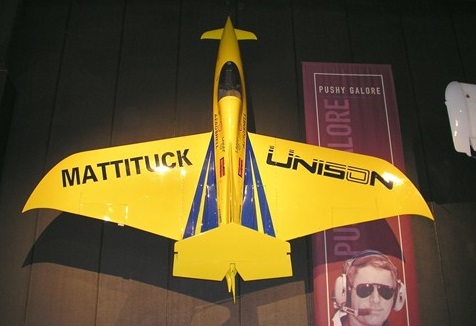
JM-2 Special Pushy Galore
Engine: 1 × Continental O-200A, 100 hp (75 kW)
Wingspan: 18 ft 5 in (5.61 m)
Length: 17 ft 2 in (5.23 m)
Height: 6 ft 3 in (1.91 m)
Maximum speed: 250 mph (402 km/h; 217 kn)
Crew: one

