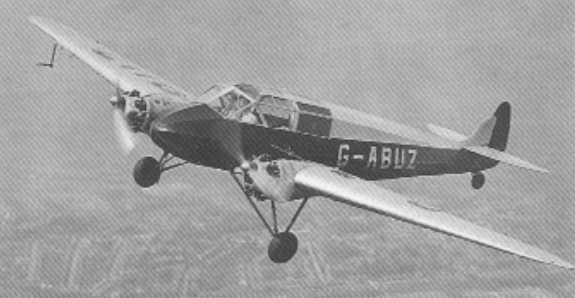
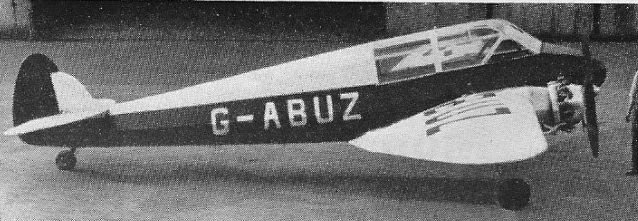
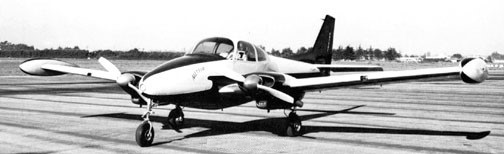
The prototype General Aircraft Monospar ST 4 was G ABUZ.
ST.4/1 prototype
The ST 4 went into series production by the newly formed General Aircraft Ltd at Croydon. This four seat aircraft was powered by two 85hp Pobjoy radials and introduced the characteristic ‘Monospar’ look. Seven ST 4 Mk Is and 22 improved Mk IIs were built. A version with retractable undercarriage, the ST 6, attracted little interest, including a single conversion from an ST 4 Mk II.
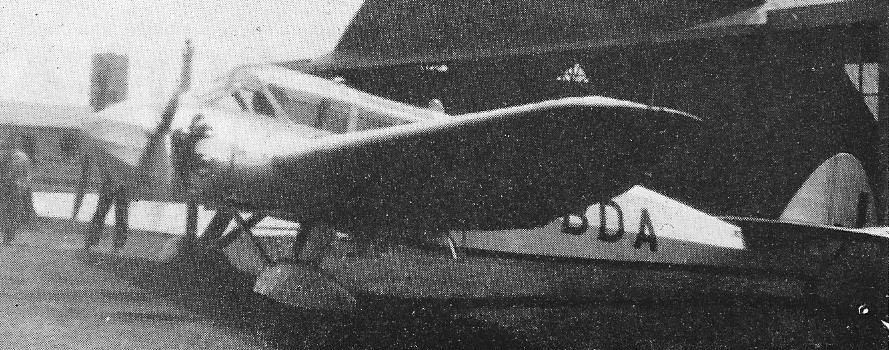
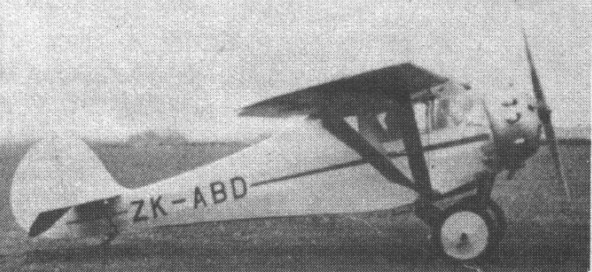
S.T.4 Mk.II J-BBDA
Ten S.T.4 Mk.II were sold abroad. On was sold in Japan to the Asahi Press Association in 1933, and delivered in the winter of 1933/34. Registered J-BBDA, the agent for the sale was the Aviation Department of Nosawa & Co,
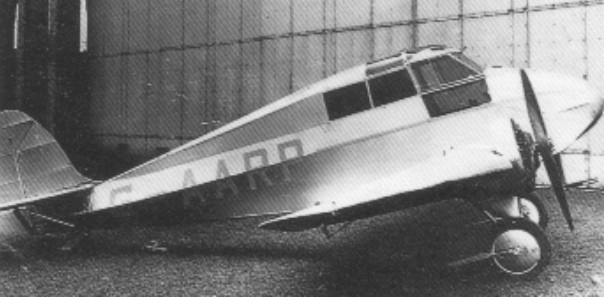
A complete aircraft, three-seat enclosed cabin monoplane ST 3 G AARP utilising a single spar wing was built by Gloster at Brockworth for Stieger and made its first flight in 1931. With two Salmson radials developing 100hp between them the ST 3 had unusually high performance for its power and could be dived at 178 mph.
Sonex, Ltd. is a kit manufacturer in Oshkosh, Wisconsin. Their original design, the all-metal, two-seat Sonex single engine monoplane morphed into the V-tailed Waiex. Add a 45′ wingspan to that airplane, and a motorglider, the Xenos, is born. The company boasts the talents of John Monnett, creator of the Monerai sailplane and the Moni motorglider.
Designed by John Monnett as a simple airframe and power plant to create a fun VFR machine. A basic and economical all metal, two place monoplane with a hp range of 80-120. With all the metal except the main spar, pop-riveted, options include nose or tail wheel.
Designed to meet the needs of the European and Domestic sport aircraft markets, it can incorporate various light weight engines of 80 to 120 hp (engine package weight of less than 200 lbs.), and is perfectly suited to the new US Sport Pilot/LSA regulations. The three recommended powerplants include the 2180cc Volkswagon, 2200 Jabiru, and 3300 Jabiru.
Performance is achieved through its clean aerodynamic shape and simple, light weight construction. The Sonex plans contain many options, including a tailwheel or tricycle landing gear along with a center or dual stick. Motor mount drawings are supplied for all three recommended powerplants.
The Sonex features easily removable wings for transport and storage.
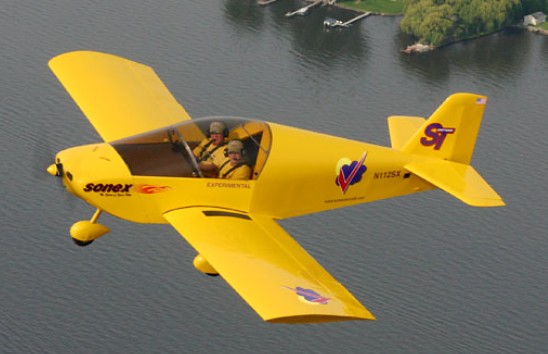
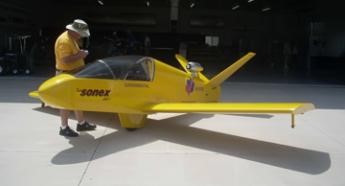
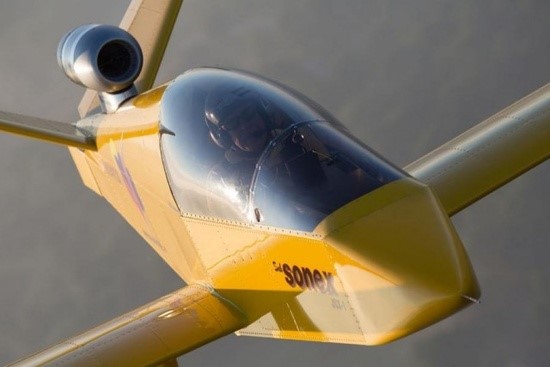
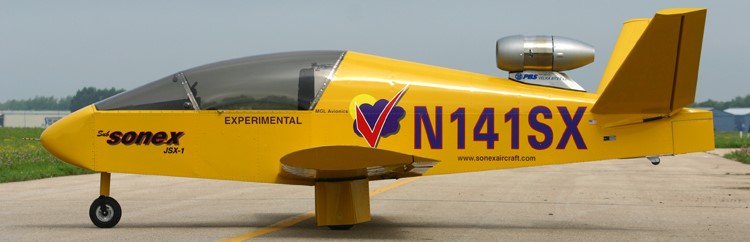
The SubSonex jet aircraft prototype, JSX-1, made its first flight on August 10, 2011 at Wittman Airport in Oshkosh, Wisconsin. Piloted by Bob Carlton, the flight lasted approximately 14 minutes and focused on low-end speed, including stalls and low approaches in the landing configuration. The engine selected for the SubSonex is the Czech-built PBS TJ-100 turbojet.
Through the course of a series of high-speed taxi tests, Sonex design team has identified some issues with controllability of the aircraft in the transition phase approaching takeoff speeds, and has decided to enter a thorough design review process aimed at making the aircraft easier to handle for the average recreational pilot.
The Subsonex originally sported a tandem landing gear with outrigger gear on each wing tip. Due to the increased power offered by the new PBS TJ-100 engine selected for the SubSonex, it was determined that a tricycle gear configuration would be needed to increase yaw stability on the ground in the transition phase approaching takeoff speeds.
SubSonex personal Jet aircraft
During Air Venture 2010, it was presented with the new fixed tricycle landing gear and the PBS TJ-100 turboJet engine.
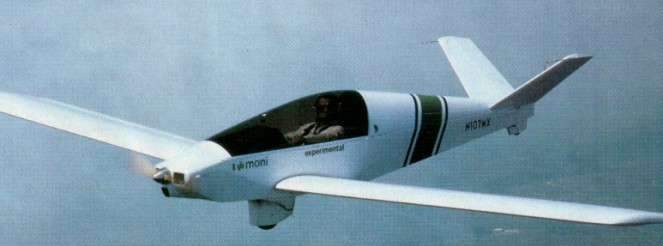
Single seat single engined low wing mono¬plane with conventional three axis control. Wing has unswept leading and trailing edges, and constant chord; V tail. Pitch/yaw control by elevon; roll control by full span ailerons; control inputs through stick for pitch/roll and pedals for yaw. Cantilever wing; wing profile; double surface. Undercarriage has two wheels in tandem with wing tip wheels; no suspension on either wheel. No ground steer¬ing. Aluminium tube/glass fibre fuselage totally enclosed. Engine mounted at wing height driving tractor propeller.
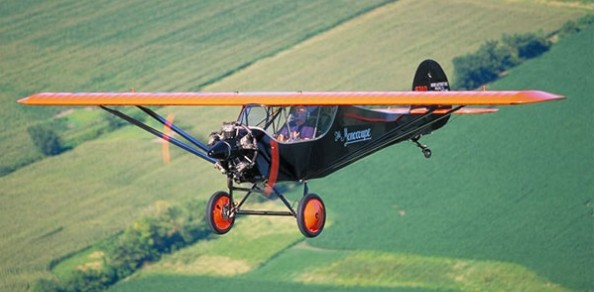
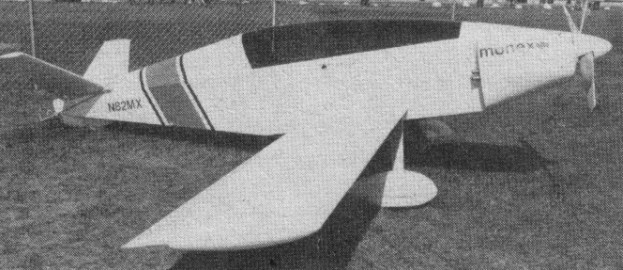
Shown for the first time at the 1981 homebuilders’ convention at Oshkosh, the Moni is defined by its creator as an aerial leisure vehicle, ARV standing for Air Recreational Vehicle. A maximum speed of 120mph (193kph), together with a remarkably well thought out set of aerodynamics classify it as a very light aircraft rather than as a single seater ultra¬light for home building. Following from the single seat Sonerai of 1970 and the two seater Sonerai II of 1973, the Moni benefits from this experience and particularly from that of the 1980 Monex, from which it takes its aerodyna¬mic configuration (basically rectangular wing, V tail set at 110O and a canopy which does not deviate from the fuselage line) and its construction method and with 200mph (322 kph) straight and level on 65 hp, there is clearly not much wrong with the Monex’s configuration.
Whereas the Monex uses a two stroke twin cylinder Zenoah engine of 440 cc, the Moni has KFM 107. It delivers 22 hp at 6000 rpm which, with direct drive to a 38 inch (96 cm) diameter twin blade propeller, gives a tip speed of some 300 m/s. The wing has an I-shaped extruded alumi¬nium spar together with a false spar on which is hinged the full span ailerons which also serve as flaps, hinging upwards as much as 8 degrees to reduce the drag in cruise by altering the camber. The skinning is made from a single¬sheet rolled around the leading edge, bonded to the ribs and riveted to the false spar. Each wing weighs only 50 lb (23 kg) and is de¬mountable for ease of garaging and trailer transport.
In 1983 this aircraft was only sold as a kit, for $6000, and no assembly time was quoted.
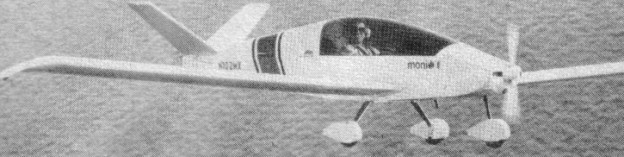
Moni Tri-Gear
The Moni Tri-Gear is designed for the low-time pilot. Nosewheel is direct steering. A belly flap provides glidepath control. Wings are removable for trailering.
Moni Engine: KFM 107, 22 hp at 6300 rpm Propeller diameter 37 inch, 0.96m No reduction Power per unit area 0.29hp/sq.ft, 3.2 hp/sq.m Fuel capacity 4.0 US gal, 3.3 Imp gal, 15.1 litre Length overall 15.0 ft, 4.57 m Height overall 3.3ft, 0.99m Wing span 27.6ft, 8.38m Constant chord 2.9 ft, 0.88 m Sweepback 0 deg Total wing area 75 sq.ft, 7.0 sq.m Wing aspect ratio 10/1 Empty weight 260 lb, 118kg Max take off weight 500 lb, 227kg Payload 240 lb, 109kg Max wing loading 6.66 lb/sq.ft, 32.4kg/sq.m Max power loading 22.7 lb/hp, 10.3kg/hp Load factors +6.0, 4.0 design Max level speed 120 mph, 193 kph Max cruising speed 110mph, 177kph Economic cruising speed 80mph, 129kph Stalling speed 38mph. 61 kph Max climb rate at sea level 500 ft/min. 2.5 m/s Best glide ratio with power off 20/1 at 50 mph, 80 kph Take off distance 400 ft. 122 m Range at average cruising speed 320 mile, 515km
Moni Tri-Gear Engine KFM 107, 2 cylinder, 22 hp electric start. Wingspan: 27’6” Length: 15’ Gross Wt: 560lbs Empty wt: 280 lbs Fuel cap: 4 US Gal
The Monex made its maiden flight on September 30, 1980. It is a high-performance, single-place, conventionally geared aircraft, and was used primarily as a research and development airplane for the Moni. The construction technique used in Monex is reflected in the Moni series of aircraft available in kit form.